




- How much does web development cost?
- Average web development cost by website type
- What factors actually affect web development cost
- Web development cost vs. web design cost: why they get confused
- A realistic web development cost breakdown
- Want an actual number instead of a range?
- Freelancer vs agency vs in-house: how pricing actually differs
- Web development cost by technology and platform
- How AI is changing web development cost
- Ongoing maintenance and hidden costs after launch
- Web development cost considerations specific to hiring in the US
- How to estimate your web development budget
- Red flags to watch for when comparing quotes
- How to reduce web development costs without sacrificing quality
- Frequently Asked Questions
- How much does web development cost on average?
- How much does it cost to build a website for a small business?
- What is the difference between website development cost and web development services cost?
- Is it cheaper to hire a freelancer or a web development agency?
- What is included in a typical web development cost quote?
- How much does custom web development cost compared to using a template?
- Do web development costs include ongoing maintenance?
- How can a business reduce web development costs?
- How long does web development take, and does a faster timeline cost more?
- Does web development cost include hosting and a domain name?
- The bottom line
- Ready to see what your project would actually cost?
“How much does web development cost?” is one of those questions that sounds simple and almost never has a simple answer. Ask three agencies and you might get three numbers that are nowhere near each other, not because someone is padding the invoice, but because “a website” can mean a five-page brochure site or a custom platform handling thousands of daily transactions. Both are technically web development. Their price tags do not belong on the same page.
This guide breaks down actual web development cost by project type, by technology, and by who builds it, so you walk away with a real number range instead of a vague estimate. We will cover website development cost for small businesses, ecommerce stores, SaaS products, and enterprise platforms, what drives custom web development cost up or down, how freelancer, agency, and in-house pricing actually compares, and where the hidden ongoing costs tend to hide. By the end, you should be able to build a realistic budget before you ever request a quote from a web development services provider.
Quick Answer
Web development cost typically ranges from around $3,000 for a simple small business website up to $200,000 or more for a custom enterprise platform, with most professional business websites landing between $10,000 and $50,000. Freelancers generally charge $25 to $150 or more per hour, while agencies price bespoke projects from roughly $5,000 to $100,000 and beyond, according to WebFX’s published web development pricing data. Building a comparable team in-house costs even more once salary is factored in: the median annual wage for web developers and digital designers in the United States was $95,380 in 2024, according to the U.S. Bureau of Labor Statistics. The right number for your project depends far more on features, integrations, and ongoing support needs than on page count alone.
How much does web development cost?
At the broadest level, web development cost breaks into three tiers based on who is building the site and how it gets built. None of them is automatically the “right” answer. Each fits a different budget, timeline, and level of complexity.
- DIY website builders: Roughly $0 to $500 a year using tools like Wix or Squarespace. Fine for a basic online presence, limiting the moment you need custom functionality or a distinct brand experience
- Freelancers: Typically $25 to $150 or more per hour, or $1,000 to $50,000 or more per project depending on scope and the freelancer’s experience level and location
- Web development agencies: Generally $5,000 to $100,000 or more for a custom build, with ongoing retainer options for maintenance, security, and iterative improvements after launch
A DIY builder makes sense when the site is genuinely simple and nobody on the team needs it to do anything unusual. The moment a business needs custom integrations, a design that does not look like a template, or a site built to scale with traffic and features over several years, that route stops being cheaper and starts being a rebuild waiting to happen. That is generally where custom web development earns its higher price tag: it is priced for the work of building something specific to your business rather than assembling a template.
Average web development cost by website type
Website development cost varies enormously by category, and this is where most quick answers fall apart. A small business brochure site and a custom SaaS platform get lumped into the same search term, but they are not comparable projects.
| Website type | Typical cost range | Typical timeline |
|---|---|---|
| Small business website | $3,000 to $10,000 | 2 to 6 weeks |
| Ecommerce website | $15,000 to $50,000, up to $75,000+ for complex catalogs | 6 to 12 weeks |
| SaaS or web application | $50,000 to $150,000+ | 3 to 6 months |
| Enterprise platform | $150,000 to $500,000+ | 6 to 12+ months |
A small business website usually needs a handful of pages, a contact form, basic SEO structure, and a design that reflects the brand. Nothing exotic, which is exactly why it sits at the lower end of the range.
Ecommerce websites cost more because a storefront is never just a website. Product catalogs, payment gateway integration, inventory syncing, shipping logic, and tax calculation all add engineering time that a static site never touches. Businesses evaluating this route often start by understanding the cost to hire an ecommerce website developer before scoping a full catalog migration, since the developer cost and the platform licensing cost are two separate budget lines that get confused constantly.
Catalog size matters more here than most first-time buyers expect. A store with fifty products and a boutique with fifteen thousand SKUs across dozens of variants are not the same engineering problem, even if both call themselves “an online store.” Product data migration, search and filtering performance, and how cleanly the site handles out-of-stock and back-order states all scale with catalog size, and each one quietly adds to the final number well before design is even discussed.
SaaS and web application costs jump again because the “logic-to-design ratio” flips. A marketing website is mostly about presentation. A SaaS product is mostly about what happens after someone logs in: user authentication, role-based permissions, a database architecture that will not fall over at scale, and an API layer other tools can plug into. Companies scoping this kind of build should look closely at SaaS development cost specifically, since it behaves nothing like a typical website quote and depends heavily on how many user roles, integrations, and data models the product needs from day one.
Enterprise platforms sit at the top of the range because they usually involve legacy system integration, strict security and compliance requirements, and a scale of traffic and data that smaller builds never have to plan for. At this tier, the web development cost is really a systems integration cost wearing a website’s clothes.
What factors actually affect web development cost
The type of site sets the general ballpark. Within that ballpark, a handful of specific factors are what actually move a quote up or down.
- Number and complexity of pages: A ten-page marketing site costs far less than a two-hundred-page resource hub with custom templates for every content type
- Design complexity: A template-adapted design costs less than a fully custom visual identity built from scratch, and animation-heavy or highly interactive design adds real development time
- Custom features and integrations: Payment gateways, CRM connections, booking systems, and third-party APIs each add scoping, development, and testing time
- Content management system: A standard CMS setup is inexpensive to configure. A headless CMS or a fully custom content architecture costs more but pays off for teams that need flexibility across multiple channels
- Database complexity: Sites that store, relate, and query large amounts of user or transaction data need more architecture work than a site that mostly displays static content
- Content creation: Copywriting, photography, and video production are usually priced separately from development, but they belong in the same budget conversation from the start
- Team location and structure: Rates vary meaningfully between in-house hires, US-based agencies, and offshore development partners, which is often the single biggest lever on total cost
- Timeline pressure: Compressing a twelve-week build into six weeks usually means paying for parallel work streams and more senior staff, which raises cost even though scope has not changed
Of these, integrations and custom features are the ones that most often blow past an initial estimate. A client will ask for “a simple contact form” in the kickoff call and, three weeks later, want that form routing leads into a CRM, triggering an automated email sequence, and flagging high-value leads to a Slack channel. None of that is unreasonable to want. It is simply not “a simple contact form” anymore, and the budget should reflect that honestly rather than getting squeezed in after the fact.
Web development cost vs. web design cost: why they get confused
A lot of budget confusion traces back to a single mixed-up assumption: that “design” and “development” are the same line item. They are not, and quotes that blur the two make comparison shopping nearly impossible.
Web design cost covers the visual and experiential side, layout, typography, color, user flow, and the overall look and feel a visitor sees. Web development cost covers everything that makes the design actually function, the code, the database, the integrations, the parts a visitor never sees but absolutely depends on. A stunning design that nobody built the back end for is a set of static images. Solid back-end architecture wrapped in a generic template undersells a business that deserves better visual credibility. Both halves need real budget, and a quote that only itemizes one of them is not a complete quote.
This distinction matters most when comparing proposals from different providers. A design-focused studio and a development-focused shop can both hand you a number for “your website,” and those numbers can look wildly different because they are quietly scoping different halves of the same project. Asking every vendor to break out design and development separately is the fastest way to compare apples to apples instead of guessing why one quote is triple another.
A realistic web development cost breakdown
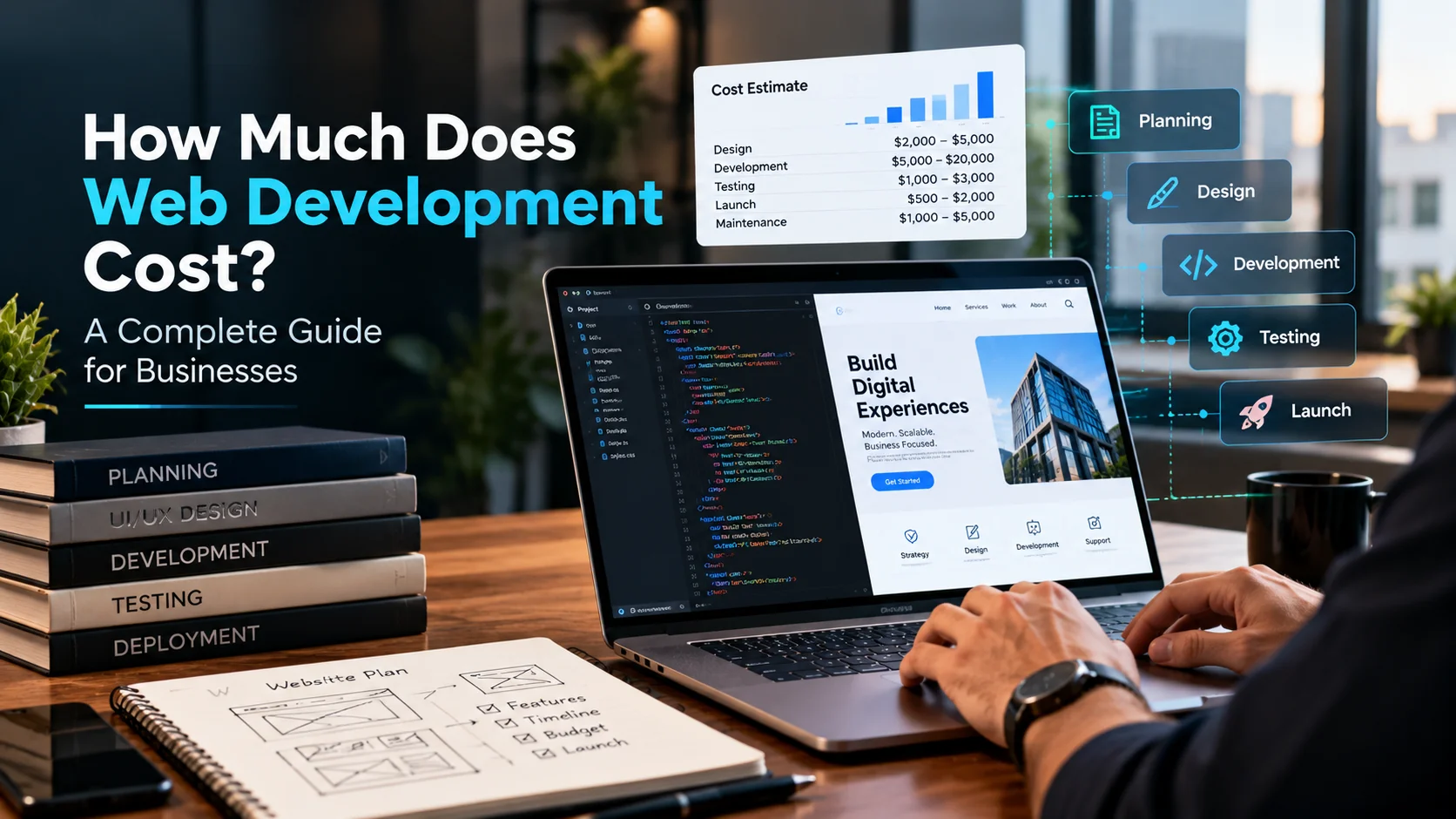
Most quotes arrive as a single number, which makes it hard to know what you are actually paying for. Here is a rough breakdown for a mid-sized custom business website project, priced around $30,000, to show where the money typically goes.
- Discovery and strategy (about 8 percent): Requirements gathering, competitor review, information architecture, and technical planning before any design work begins
- UX and UI design (about 22 percent): Wireframes, visual design, and a design system covering every page type and reusable component
- Front-end development (about 25 percent): Turning approved designs into responsive, accessible, performance-tested code across devices
- Back-end development (about 25 percent): CMS configuration, database setup, integrations, and any custom application logic the site needs
- Quality assurance and testing (about 10 percent): Cross-browser testing, performance checks, accessibility review, and bug fixing before launch
- Project management (about 10 percent): Coordinating the team, managing the timeline, and keeping the client informed throughout the build
These percentages shift depending on the project. A design-led rebrand skews more toward UI work. A data-heavy internal tool skews hard toward back-end development and testing. But this general shape holds for most professional projects, and it is a useful gut check when comparing quotes: if a proposal has no line item for testing or project management, ask why, because that work still has to happen even if nobody priced it separately. Getting the design and front-end phases right the first time also matters more than it might seem, since custom web design done well up front tends to reduce rework costs during the development phase that follows it.
Want an actual number instead of a range?
Elsner can review your requirements and give you a real, scoped estimate based on your specific features, integrations, and timeline, not a generic bracket.
Freelancer vs agency vs in-house: how pricing actually differs
Who builds the site changes the price as much as what gets built. Each model carries real tradeoffs beyond the headline rate.
| Model | Typical rate | Best for | Main tradeoff |
|---|---|---|---|
| Freelancer | $25 to $150+ per hour | Small, well-defined projects with a tight budget | Limited bandwidth and range of disciplines covered |
| Agency | $5,000 to $100,000+ per project | Custom builds, redesigns, ongoing iteration | Higher project cost than a single freelancer |
| In-house team | $95,380 median salary per developer, plus benefits and tooling | Companies with constant, ongoing development needs | Fixed cost regardless of workload, plus hiring time |
A freelancer is a reasonable choice for a single, well-scoped deliverable, a landing page, a small fix, a plugin configuration. Where freelancers struggle is range: one person rarely covers strategy, design, front-end code, back-end code, and testing equally well, so a bigger project often means either compromising on one of those disciplines or hiring multiple freelancers and managing the coordination yourself.
An agency costs more upfront because you are paying for a full team and an established process, not a single person’s hours. That premium buys coordination you do not have to manage yourself, and it buys pattern recognition from having solved similar problems for other clients already.
In-house hiring makes sense once development is not a project but a permanent function of the business, constant feature work, ongoing maintenance, a roadmap that never really ends. Below that threshold, a salaried hire is an expensive way to buy occasional work, since the cost stays fixed whether that person is fully booked or waiting on the next request. Businesses weighing this decision benefit from a flexible engagement model that can scale from a single project up to an embedded team without forcing a hiring decision before the workload actually justifies one.
Web development cost by technology and platform
The platform behind a site changes the cost equation too, mostly through licensing, plugin ecosystems, and how much custom code a given build actually needs.
WordPress remains one of the more cost-efficient starting points for content-driven sites, since a large plugin ecosystem covers a lot of common functionality without custom code. Cost climbs as soon as a business needs custom post types, a bespoke theme, or performance optimization beyond what off-the-shelf plugins handle well. Businesses estimating this route in detail should look at WordPress website development cost specifically, since pricing swings widely between a theme-based build and a fully custom WordPress site.
Platforms built specifically for ecommerce, rather than a general CMS with a store plugin bolted on, trade some flexibility for speed of setup. A hosted platform handles hosting, security patching, and PCI compliance for payments as part of the subscription, which lowers the technical burden but adds a recurring platform fee on top of whatever custom development the store still needs. That tradeoff is worth naming explicitly, since it is easy to compare a platform’s monthly fee against a fully custom build’s zero monthly fee and miss that the custom option still needs someone paid to maintain security and compliance manually.
No-code and low-code website builders sit in an interesting middle tier that most cost guides skip entirely. Tools in this category let a non-technical team assemble reasonably sophisticated sites, membership areas, simple booking flows, basic internal dashboards, without writing code from scratch, usually for a monthly subscription plus a modest setup fee rather than a large upfront project cost. The tradeoff shows up later: as requirements grow more specific, no-code platforms hit walls that custom development never runs into, and migrating off one once a business has outgrown it is its own project with its own cost. It is a reasonable starting point for validating an idea. It is rarely the right foundation for a product a company expects to still be running in five years.
Ecommerce platforms like Magento carry their own cost profile, generally higher than a content site because of catalog management, checkout logic, and third-party integrations for shipping, tax, and payments. Magento specifically tends to cost more upfront than lighter platforms but scales well for larger catalogs, which is why understanding Magento development cost matters most for merchants already anticipating serious growth rather than a first small store.
Custom-coded stacks, built with frameworks like React, Node.js, Laravel, or PHP directly rather than a pre-built CMS, cost the most upfront because nothing is pre-assembled. What that investment buys is complete control over performance, architecture, and future scalability, which matters for products expected to grow well beyond what a CMS plugin ecosystem was designed to support.
How AI is changing web development cost
AI has genuinely changed parts of the web development workflow, though it has not collapsed cost the way some pitches suggest. Code generation tools speed up repetitive front-end work, boilerplate setup, and first-pass content drafting, which can shorten the discovery and build phases somewhat. What AI has not replaced is the judgment work: deciding what the site actually needs to do, how it should be architected to scale, and how it should be tested before real users touch it. That thinking time is still the bulk of a professional quote, and it is not something a generative tool does reliably on its own.
Where AI does add real cost is on the feature side, not the build-process side. Adding AI-driven functionality into a website itself, a smart search bar, a recommendation engine, a chatbot connected to a live knowledge base, brings genuine new engineering work: model selection, prompt or fine-tuning setup, and ongoing API usage costs that scale with traffic. Businesses budgeting for this kind of feature should treat it as its own line item rather than assuming it comes bundled into a standard development quote, since the ongoing usage-based costs alone can meaningfully change a project’s total cost of ownership over its first year.
Ongoing maintenance and hidden costs after launch
The initial build is rarely the last check a business writes. A website that launches and then gets ignored degrades fast, technically and competitively, and the ongoing costs that follow launch catch a lot of first-time buyers off guard.
- Hosting: Roughly $2 to $1,000 or more per month depending on traffic, server resources, and whether the site needs dedicated infrastructure
- Domain registration: Around $1 to $12 per year, small but easy to forget until it lapses unexpectedly
- Maintenance and updates: Roughly $5 to $5,000 or more per month, scaling with site complexity and how frequently content and features change
- Security and SSL: From free basic certificates up to around $1,500 per year for advanced coverage on higher-risk sites
- Third-party software licenses: Premium plugins, analytics tools, and integration platforms often carry their own recurring subscription cost
- Content updates: New pages, blog posts, and campaign landing pages usually need ongoing design and copywriting support
A useful rule of thumb, though it varies by industry and platform, is budgeting roughly 15 to 20 percent of the original build cost annually for maintenance, security, and incremental improvements. On a $30,000 website, that is somewhere between $4,500 and $6,000 a year, a number that rarely shows up in the initial pitch but shows up on every renewal invoice afterward. Sites running on WordPress specifically should look closely at WordPress maintenance cost, since plugin updates and security patching on that platform are frequent enough to genuinely need a standing plan rather than reactive fixes.
Web development cost considerations specific to hiring in the US
Location changes the math substantially, and it is worth being direct about why. A US-based in-house web developer commands a median salary of $95,380 a year according to BLS data cited earlier, and that figure sits before payroll taxes, benefits, equipment, and software licenses are added on top. Fully loaded, a single in-house developer often costs a company closer to $120,000 to $140,000 annually once those extras are counted.
That is precisely why so many US businesses lean on agencies or blended teams rather than hiring every role locally. An agency or outsourced development partner spreads specialized talent, design, front-end, back-end, QA, project management, across a project cost rather than requiring five separate full-time salaries for work that might only need a few months of focused effort. This is not an argument against ever hiring in-house. It is a reason to be deliberate about when a full-time US hire actually pencils out against a project-based engagement, especially for a first website or a defined redesign rather than an ongoing product.
How to estimate your web development budget
Rather than starting with a number and working backward, a more reliable approach starts with scope and works forward to a realistic range.
1. Define what the site actually needs to do
List core functions before thinking about design at all: lead capture, product sales, user accounts, content publishing. This list determines which cost tier you are realistically in before a single quote comes back.
2. List every integration you already know you need
CRM, email marketing platform, payment processor, analytics, help desk software. Each one adds scoping and testing time, and naming them upfront prevents the scope creep that turns a $15,000 quote into a $28,000 invoice.
3. Decide who is providing content
Clarify early whether copywriting, photography, and video are part of the development budget or a separate line item. This single ambiguity is one of the most common sources of scope disagreements between clients and development partners.
4. Set aside a contingency, not just a headline number
A 15 to 20 percent buffer on top of the quoted price covers the inevitable mid-project addition without derailing the whole budget. Projects that skip this step tend to either cut scope late or run over budget with no plan for it.
5. Budget for year one after launch, not just launch itself
Add hosting, maintenance, and a realistic estimate of ongoing content or feature work into the same planning conversation, so the true first-year cost is visible before the project is approved, not discovered afterward.
Startups and early-stage companies working through this exercise often benefit from thinking about software development cost planning for startups as a single connected process rather than pricing the website in isolation from the product roadmap it needs to eventually support.
A mistake worth avoiding
Picking the lowest quote without checking what it actually excludes is one of the most expensive mistakes in web development. A rock-bottom price often means no testing phase, no post-launch support window, or content and images priced as an add-on you will only discover once the invoice arrives. Compare quotes line by line, not just by their bottom number, and ask directly what is not included before signing anything.
Red flags to watch for when comparing quotes
Beyond the mistake of chasing the lowest number, a few specific warning signs in a proposal are worth catching before you sign anything.
- A single lump-sum number with no breakdown. If a provider cannot tell you roughly what portion covers design versus development versus testing, they likely have not scoped the project carefully either
- No mention of revision rounds. Unlimited revisions sound generous but often signal a vague process. A defined number of revision rounds per phase is usually a sign of a team that scopes work properly the first time
- Vague ownership of the finished code and content. Confirm in writing that you own the final site, its code, and its content once paid in full, rather than being locked into the original vendor for every future change
- No post-launch support window mentioned at all. Every project surfaces small bugs in the first few weeks of real usage. A proposal with zero post-launch support built in is quietly pushing that cost onto you later
- A quote dramatically below every other bid you received. This usually means something is missing, testing, content, a support window, rather than that one provider is simply more efficient than everyone else
How to reduce web development costs without sacrificing quality
Cutting cost and cutting quality are not the same decision, whatever a rushed vendor might imply. A few approaches reliably lower spend without gutting the result.
- Launch a focused first version. Ship the core experience first and add secondary features after real usage data tells you which ones actually matter, rather than building every idea into version one
- Use a proven CMS instead of building everything custom. A well-configured off-the-shelf CMS handles most content needs at a fraction of the cost of a fully bespoke content system
- Lock scope before development starts. Every mid-project addition costs more than the same feature scoped in from day one, since it usually means reworking something already built
- Choose a design system over one-off page designs. Reusable components cost more to design once and far less to design a second, third, and tenth time
- Match the engagement model to the actual workload. A short, defined project rarely justifies a full-time hire, and constant ongoing work rarely stays cheap on a per-project agency rate forever
The “launch a focused first version” approach deserves particular attention, since it is the single most effective lever most businesses underuse. Building a lean, functional core and expanding based on real feedback consistently produces a better return than trying to guess every feature a user will eventually want. This is the same logic behind starting with an MVP development approach, and it applies just as well to a marketing website as it does to a full product build.
Key takeaways
- Web development cost ranges from roughly $3,000 for a small business site to $500,000 or more for a full enterprise platform, with most professional business websites falling between $10,000 and $50,000.
- The median US in-house web developer salary is $95,380 a year according to BLS data, which is often higher than a scoped agency project for a first website or a defined redesign.
- Features and integrations, not page count, are what actually move a quote significantly higher, especially CRM connections, payment processing, and custom database work.
- A realistic cost breakdown includes discovery, design, front-end and back-end development, QA, and project management, not just “design and build” as a single line item.
- Ongoing costs after launch, hosting, maintenance, security, and content updates, typically run 15 to 20 percent of the original build cost annually.
- Launching a focused first version and locking scope before development starts are the two most effective ways to reduce cost without cutting corners on quality.
Frequently Asked Questions
How much does web development cost on average?
Most professional business websites cost between $10,000 and $50,000, though the full range spans from around $3,000 for a simple small business site to $200,000 or more for a custom enterprise platform. The final number depends primarily on features, integrations, and design complexity rather than page count alone.
How much does it cost to build a website for a small business?
A professional small business website typically costs between $3,000 and $10,000, covering a handful of custom-designed pages, a contact form, basic SEO structure, and mobile responsiveness. Costs rise if the business needs custom features like online booking, a member portal, or advanced integrations beyond a standard content site.
What is the difference between website development cost and web development services cost?
Website development cost usually refers to the price of a specific project, the design and build of one site. Web development services cost can also include ongoing engagements, ongoing feature development, maintenance retainers, or a dedicated team supporting a product over months or years rather than a single fixed deliverable.
Is it cheaper to hire a freelancer or a web development agency?
A freelancer is usually cheaper for a small, clearly defined project, since you are paying one person’s hourly rate rather than a full team. An agency costs more upfront but covers a broader range of disciplines, design, development, QA, and project management, together, which matters more as project complexity grows.
What is included in a typical web development cost quote?
A complete quote should cover discovery and planning, UX and UI design, front-end and back-end development, quality assurance testing, and project management. It should also state clearly whether content creation, ongoing hosting, and post-launch maintenance are included or billed separately, since these are commonly excluded from the headline number.
How much does custom web development cost compared to using a template?
Custom web development typically costs two to five times more than a template-based build, since every element is designed and coded specifically for the business rather than adapted from an existing structure. The tradeoff is a site that is not constrained by a template’s built-in limitations as the business grows or needs custom functionality.
Do web development costs include ongoing maintenance?
Not usually. The initial project cost typically covers design, development, and launch, while hosting, security updates, content changes, and technical maintenance are billed separately, often as a monthly retainer. A common budgeting rule of thumb is setting aside 15 to 20 percent of the original build cost annually for ongoing maintenance and improvements.
How can a business reduce web development costs?
The most effective approaches are launching a focused first version instead of every feature at once, locking project scope before development begins, using a proven CMS rather than building custom content management from scratch, and matching the engagement model, freelancer, agency, or in-house, to the actual amount of ongoing work rather than defaulting to one option out of habit.
How long does web development take, and does a faster timeline cost more?
A small business website typically takes two to six weeks, an ecommerce build six to twelve weeks, and a SaaS or enterprise platform three months to a year or more. Compressing any of these timelines usually raises cost, since it requires more senior staff or parallel work streams to hit the same scope in less time.
Does web development cost include hosting and a domain name?
Rarely as a default. Hosting, typically $2 to $1,000 or more per month depending on traffic and resources, and domain registration, usually $1 to $12 per year, are almost always billed separately from the development project itself. Confirm this explicitly before signing, since assuming it is bundled in is a common source of post-launch surprise.
The bottom line
Web development cost is not one number, and any guide that hands you a single figure without asking about your features, integrations, and timeline is guessing. What actually determines your budget is the type of site you need, the complexity of what it has to do, and who builds it, freelancer, agency, or in-house team. Get those three factors clear before requesting quotes, budget honestly for the year after launch and not just the build itself, and you will end up with a number that holds up rather than one that quietly grows every time a new requirement surfaces mid-project.
Ready to see what your project would actually cost?
Elsner scopes web development projects around your actual features and goals, not a generic package. Tell us what you are building, and we will give you a real number to plan around.