


































Nina’s Jewelry
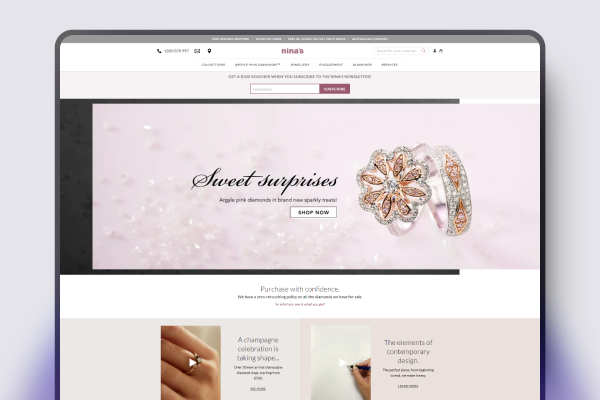
Elsner developed dedicated platforms for Nina’s Jewellery’s B2B and B2C customers, ensuring each audience received a tailored shopping experience. By integrating an Advanced Retail Management System (ARMS), we streamlined….
Legacy systems create real problems. They struggle with integration. Performance slows down. Security vulnerabilities appear constantly. Modern technology stacks solve these issues effectively.
At Elsner, product modernization brings in contemporary frameworks. We use cloud-native architectures. The technologies we choose align with current industry standards. This matters because businesses need platforms that work well today and tomorrow.
Some projects move from monolithic structures to microservices. Others update outdated technologies with frameworks like React, Node.js, or Python. Modern APIs need to connect smoothly. Third-party services must integrate without friction. Emerging tools should work seamlessly with your platform.
Product modernization doesn’t mean starting from scratch. You don’t need massive budgets to see real improvements. At Elsner, we find the areas where updates create the most business value. We skip unnecessary expenses.
Some businesses do better with phased modernization. Costs spread over time. Operations continue normally. Other businesses need targeted technology upgrades. We focus on performance bottlenecks. Security gaps get priority. Specific features that affect revenue or user experience come first.
Our product modernization services maximize your investment. We prioritize changes that actually matter. Trendy features that waste money get eliminated. Instead, we invest in improvements that cut operational costs. Downtime becomes minimal. Your product lasts longer.
Modern businesses need products that use cloud infrastructure properly. Scalability matters. Reliability counts. Global availability makes a difference. At Elsner, product modernization incorporates cloud-native principles. These principles change how applications handle traffic, data, and user demands.
Projects often move legacy on-premise systems to cloud platforms like AWS, Azure, or Google Cloud, optimizing architecture along the way. Others focus on containerization, serverless models, and infrastructure-as-code to simplify deployment and resource management.
Traffic spikes, outages, and multi-region demands require platforms that scale automatically and recover quickly through cloud-native modernization.
Product evolution stops when developers fight with outdated codebases. Complex deployment processes slow everything down. Poor documentation frustrates teams. At Elsner, product modernization improves how developers work. Development cycles speed up. Maintenance becomes more efficient.
Some projects need modern CI/CD pipelines. Automated testing and deployment save significant time. Other projects require code refactoring. Documentation needs updating. Development environments must improve. Teams shouldn’t spend hours on basic changes. Fear of making updates because the system might break is a real problem.
We modernize with developer-friendly architecture, clean code standards, and automation that ensures smoother workflows and confident deployments.
Some businesses need outdated systems updated because current technology no longer supports business requirements or security standards. A legacy software modernization company typically begins this work with a detailed assessment, followed by architecture and technology planning to ensure long-term stability and compliance.
Platform migrations are executed when products need to move to modern infrastructure or technology stacks. The focus here stays on stability and business continuity rather than disruptive changes.
Many projects involve existing products built on outdated frameworks or languages. Instead of rebuilding everything, upgrades are made where technology gaps actually exist.
This part deals with moving products from legacy infrastructure to cloud environments. Migrations are planned so business operations continue smoothly throughout the transition process.
API work handles connectivity, data exchange, and system integration, becoming essential once products need to interact with modern services or third-party platforms. Guided by AI Strategy Consulting, these integrations are planned to support intelligent workflows without adding unnecessary complexity.
Some products benefit from breaking monolithic structures into manageable services. In those cases, systems are re-architected so components can evolve independently without affecting the entire product.
Database updates address performance issues, scalability limitations, and data management challenges. The aim is to keep data systems efficient even as volume and complexity increase.
Performance and security issues are usually caused by multiple outdated components. These are addressed systematically rather than applying temporary fixes.
After modernization, ongoing improvements are inevitable. Continuous enhancement helps keep products competitive and aligned with evolving business goals over time.
Choosing product modernization companies is about expertise, reliability, and long term partnership rather than quick fixes alone. Businesses choose Elsner for product modernization services that focus on stable, maintainable software products built for real business operations, sustainable growth, and consistent performance after transformation.
Hire our experts
Every business operates differently, and product modernization requirements vary based on how products, users, and operations interact with digital platforms. At Elsner, projects are planned around business structure rather than fixed approaches. We work with B2B, B2C, and D2C models, designing product modernization services that support operational efficiency, system reliability, user experience, and future scalability.
B2B platforms often involve complex workflows, multiple stakeholders, and integration dependencies.
Product modernization for B2B businesses focuses on system stability, secure data handling, and reliability under enterprise-level usage. Projects usually include architecture updates, integration improvements, and performance optimization aligned with business operations.
Industries commonly supported include:
Read More
Our sectors include:
Elsner developed dedicated platforms for Nina’s Jewellery’s B2B and B2C customers, ensuring each audience received a tailored shopping experience. By integrating an Advanced Retail Management System (ARMS), we streamlined….
Kushals is an online platform that offers a convenient and exciting way to purchase Fashion and Silver Jewellery and Accessories. Built on the Shopify platform, it provides a smooth and user-friendly interface for buying a vast range of jewellery.
Furnmall, a top furniture seller, moved online after their old website struggled. The Elsner team advised using Shopify, adding fancy features and Zoho tools for a seamless experience. Their goal was a user-friendly and appealing online shop. They also sought a centralized system to track customers, products, and finances. Objective The primary objective was to…
We understand product limitations and define a clear modernization strategy before starting.
Modernization roadmaps are designed to keep business continuity, risk management, and incremental progress in focus.
Core systems are modernized with clean architecture and stable functionality.
Performance, security, and functionality are validated to ensure consistent behavior across environments.
The modernized product is launched carefully after thorough testing and preparation.
Ongoing support is provided to handle updates, optimizations, and future enhancements.
Hear it from our loyal customers around the globe
Every project starts with understanding how the product actually works and where limitations exist. Before making any changes, current architecture, business requirements, and transformation goals are assessed. This helps avoid unnecessary risks and ensures the modernized product supports real operations, not just technology trends.
Our product modernization services are used by startups, growing companies, and established enterprises. Some need straightforward technology updates for continued support, while others require comprehensive architectural transformation. The approach changes based on product complexity and business needs, not company size.
Yes. Many clients come with products built on outdated technology stacks that need modernization rather than complete replacement. As a product modernization company, we often work on legacy system updates, technology migrations, performance improvements, or architectural changes while keeping business operations intact.
Scalability is planned during modernization, not added later. This includes modern architecture patterns, efficient data handling, and technology choices that allow future growth. As one of the leading product modernization companies, the focus stays on building systems that remain manageable as user demands and business requirements expand.
Yes. Product modernization does not end at deployment. Support is provided for updates, optimizations, and future enhancements. Many businesses rely on ongoing support to keep their modernized products competitive while adapting to new technologies and market demands.
The engagement model depends on modernization scope and project complexity. Fixed pricing works well for defined transformation requirements, while hourly or dedicated teams suit evolving needs. The goal is to choose a model that offers flexibility without compromising transformation quality.