



- Shopify vs Etsy: Core Differences Explained
- What is Shopify?
- What is Etsy?
- Key Difference Summary
- The Role of AI in Ecommerce in 2026
- How AI is Changing Online Selling
- AI Capabilities in Shopify
- AI Capabilities in Etsy
- Shopify vs Etsy: Feature by Feature Comparison
- 1. Ease of Setup
- 2. Pricing and Fees
- 3. Traffic and Customer Acquisition
- 4. Branding and Customization
- 5. Scalability and Growth
- 6. AI and Automation Capabilities
- Pros and Cons of Shopify and Etsy
- Shopify: Pros and Cons
- Etsy: Pros and Cons
- Which Platform is Best for Different Use Cases?
- Best for Beginners
- Best for Building a Brand
- Best for Handmade or Niche Products
- Best for Scaling and Automation
- Shopify vs Etsy: Can You Use Both Together?
- Final Verdict: Which Platform Wins in 2026?
- Frequently Asked Questions
- Ready to Build Your Ecommerce Business the Right Way?
Ecommerce in the US is not just growing, it is completely reshaping how people start businesses, earn money, and reach buyers from their living rooms.
By 2026, US ecommerce revenue is expected to cross the $1.3 trillion mark. That single number tells you everything. Selling online is no longer an option for most entrepreneurs. It is the plan.
What sets 2026 apart from earlier years is the rise of AI in ecommerce. From personalized product suggestions to round the clock automated support, artificial intelligence is now woven into how online stores run, not as a future trend, but as today’s standard.
Now, when you decide to sell online, two names come up almost immediately: Shopify and Etsy. Both are powerful. Both serve real sellers. Yet they work in entirely different directions.
This comparison will walk you through both: their costs, AI muscle, growth potential, and which type of seller each is truly built for. That way, you can step forward with clarity instead of second guessing yourself.
Shopify vs Etsy: Core Differences Explained
What is Shopify?
Shopify is a hosted ecommerce platform that lets you build your own independent online store with reliable Shopify Development Services. You get your own domain, your own storefront, and full control over how your brand looks and functions.
Shopify is built for sellers who want to own their customer relationships outright. You are not sharing page space with competitors. Your store is yours alone: your pricing, your design, your checkout, your customer data.
It works well for businesses at every stage, from solo sellers just starting out to large scale DTC brands processing thousands of orders every single day. That range is exactly what makes Shopify a top pick for long term brand building.
What is Etsy?
Etsy is an online marketplace built around handmade goods, vintage finds, and niche products. Rather than owning a standalone store, you create a shop listing inside the Etsy ecosystem.
The biggest draw here is built in traffic. Etsy already has over 90 million active buyers. When you list a product, those buyers can find you through Etsy’s search, without spending a rupee on ads. That is a powerful head start for new sellers.
The tradeoff is control. You follow Etsy’s rules, work within its pricing structures, and live inside its page layouts. Your shop will always look somewhat like thousands of others. Building a truly distinct brand identity within Etsy’s walls takes real effort.
Key Difference Summary
| Factor | Shopify | Etsy |
|---|---|---|
| Store Type | Standalone online store | Marketplace listing |
| Traffic | You drive your own traffic | Built in buyer traffic |
| Branding | Full brand control | Limited customization |
| Setup Time | Slightly longer | Very fast |
| Best For | Brand building & scaling | Quick start & niche products |
| Ownership | Full ownership of data | Etsy owns the platform |
The Role of AI in Ecommerce in 2026
How AI is Changing Online Selling
AI in ecommerce now covers a wide range of tools that most sellers rely on daily. Personalized product suggestions, smart inventory alerts, chatbots that handle support questions at 3 AM. These are standard expectations now, not luxury add ons.
AI driven search has completely changed how buyers find products. Instead of browsing categories, customers now get curated results shaped by their past behavior and browsing habits. Sellers who understand this shift, and work with it, carry a real advantage.
Predictive analytics is another area worth your attention. AI tools can now forecast demand, flag slow moving inventory, and even suggest the right window to run a promotion. Therefore, you waste less money and make sharper restocking calls.
AI Capabilities in Shopify
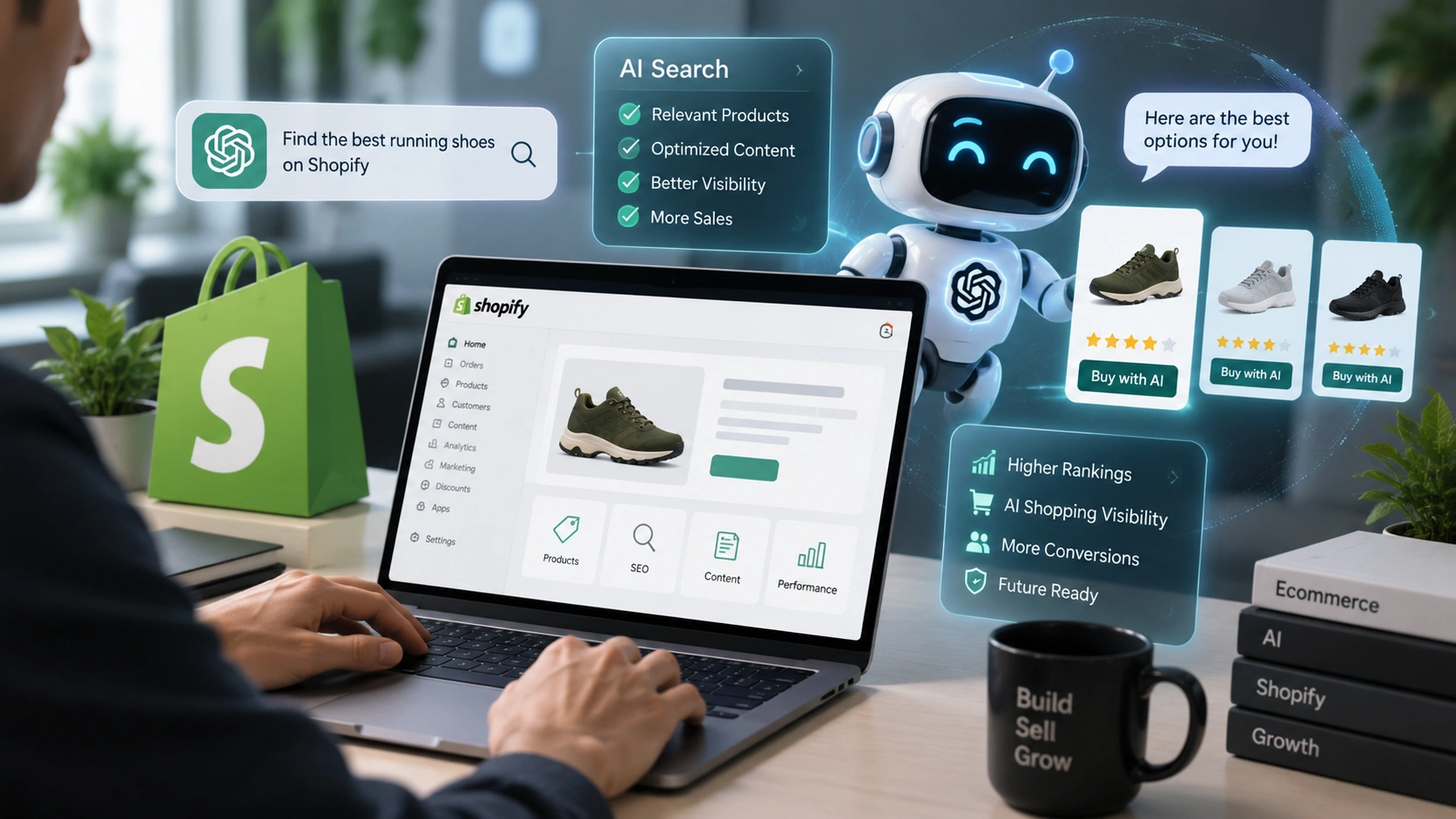
Shopify’s AI offerings in 2026 are genuinely strong. The platform gives you Shopify Magic, a built in suite of AI tools sitting right inside your dashboard. You get AI generated product descriptions, automated email drafts, and smart chatbot connections.
Not only that, but Shopify’s app marketplace opens access to hundreds of third party AI tools. From predictive upselling to abandoned cart recovery powered by machine learning, the options are wide. Sellers on Shopify can also build custom AI workflows through tools like Klaviyo, Gorgias, and various headless commerce setups.
This way, your store can run smart automation without requiring a full tech team behind it.
AI Capabilities in Etsy
Etsy does use AI, but the key difference is who controls it. Etsy’s AI powers its internal search algorithm, which decides how your listings rank and who gets to see them. As a seller, you have no hand in shaping that algorithm.
Etsy also uses AI to recommend listing tweaks, like better tags or title edits. These nudges are helpful for newer sellers still finding their footing. That said, the level of control available is far more limited compared to Shopify Automation Guide standards.
For sellers who want to build ecommerce automation tools and custom AI experiences, Etsy simply falls short. Its closed nature means you work within its system, not alongside it.
Shopify vs Etsy: Feature by Feature Comparison
1. Ease of Setup
Etsy wins on speed. You can create a shop, add listings, and be selling within a few hours. There is no domain to configure, no theme to design. Likewise, payment setup through Etsy Payments is quick and guided.
Shopify takes a bit more time to set up properly. You need to pick a theme, connect a domain, set up payment gateways, and configure shipping rules. However, Shopify’s onboarding is well structured. At Elsner, we have helped dozens of clients launch Shopify stores smoothly. Most go live within a week with the right support in place.
2. Pricing and Fees
Understanding Shopify vs Etsy fees is something you genuinely need to get right before committing to either platform.
| Fee Type | Etsy | Shopify |
|---|---|---|
| Monthly Subscription | None (optional Plus at $10/mo) | From $39/mo (Basic) |
| Listing Fee | $0.20 per listing | None |
| Transaction Fee | 6.5% per sale | 0% (on Shopify Payments) |
| Payment Processing | 3% + $0.25 | 2.9% + $0.30 (Basic) |
| App and Add on Costs | Minimal | Varies (can add up) |
At low sales volumes, Etsy feels cheaper. No monthly subscription makes it easy to start. However, that 6.5% transaction fee adds up fast as your revenue climbs.
Shopify’s monthly cost looks higher upfront, but the lower transaction fees mean you hold onto more per sale at scale. If you sell $10,000 a month on Etsy, you are handing over $650 in transaction fees alone. On Shopify Basic with Shopify Payments, that number drops noticeably.
3. Traffic and Customer Acquisition
Etsy’s built in marketplace traffic is its single biggest strength. Buyers already on Etsy are in shopping mode, actively searching for products like yours. This means new sellers can get early sales without any paid advertising or Professional SEO groundwork.
Shopify gives you zero organic traffic by default. You are fully responsible for customer acquisition through SEO, paid ads, social media, email campaigns, or influencer tie ups. That requires more effort and more upfront budget.
This is not a flaw in Shopify. It is simply the reality of owning an independent store. The upside is that every customer you bring in belongs to you. On Etsy, those buyers belong to Etsy first.
4. Branding and Customization
If branding matters to you, and it should for any long term business plan, then Shopify takes this one decisively.
Shopify gives you complete design freedom. You can build a store that looks nothing like any other Shopify store. Custom fonts, layouts, product page structures, animations. All of it is in your hands. Likewise, your own domain means buyers remember your brand name, not a marketplace URL.
Etsy stores all follow a similar frame. Your shop gets a banner and a bio, but the surrounding structure stays Etsy. Buyers are always aware they are shopping on Etsy, not on your brand. That limits how deep your brand identity can actually go.
5. Scalability and Growth
Shopify is purpose built for scaling. As your order volume grows, the platform grows with you. You can add staff accounts, upgrade your plan, connect with warehouses, and link sales channels like Amazon, Instagram, and TikTok Shop, all from one place.
Etsy has real limits on how big you can grow within its walls. High volume sellers regularly run into challenges with listing management, fee accumulation, and the inability to create loyalty programs or retain customer data for future outreach.
Businesses that take multichannel selling seriously will eventually find Shopify more fitting. That is simply where the platform is designed to go.
6. AI and Automation Capabilities
Shopify’s lead in ecommerce automation tools is clear. From Shopify Flow for workflow automation to AI driven upsell apps and smart email campaigns, sellers can build highly automated businesses without constant manual effort.
Etsy offers limited automation options. Tools like Marmalead for listing optimization or eRank for SEO research exist, but deep workflow automation or AI personalized marketing is simply not part of the Etsy ecosystem.
This gap matters more each year. As AI becomes a standard part of how successful online businesses run, platforms that fully support it will carry a structural advantage going forward.
Pros and Cons of Shopify and Etsy
Shopify: Pros and Cons
| Shopify Pros | Shopify Cons |
|---|---|
| Full brand ownership and control | Monthly subscription cost required |
| Advanced AI and automation tools | Requires effort to drive traffic |
| Scales well with business growth | App costs can add up |
| Own your customer data | Steeper learning curve initially |
| Multichannel selling support | No built in buyer audience |
Etsy: Pros and Cons
| Etsy Pros | Etsy Cons |
|---|---|
| Built in buyer traffic immediately | 6.5% transaction fee on every sale |
| Fast and simple setup | Limited branding and customization |
| Low barrier to entry | Etsy controls your visibility |
| Great for niche and handmade products | Hard to build a distinct brand |
| No monthly subscription needed | Customer data belongs to Etsy |
Which Platform is Best for Different Use Cases?
Best for Beginners
Etsy is the stronger starting point for most beginners, especially those selling handmade, vintage, or niche products. The built in audience removes the pressure of mastering SEO and paid advertising from day one. You can test products, validate demand, and read your market without a significant upfront spend.
For those who are complete newcomers to online selling, Etsy’s guided setup is genuinely reassuring. There are fewer moving parts to manage early on, which lets you stay focused on your product and the experience you give your first customers.
Best for Building a Brand
Shopify is the only real option if brand building is your core goal. Your own domain, your own visual identity, your own email list. These are the building blocks of a brand that lasts through market shifts and algorithm changes. Etsy simply cannot give you these in any meaningful way.
At Elsner, we work with businesses that are serious about building DTC brands. The ones who invest in a proper Shopify setup early tend to grow faster, retain customers more effectively, and carry far more control over their own business trajectory.
Best for Handmade or Niche Products
Etsy’s audience is uniquely suited for handmade goods, craft supplies, digital downloads, vintage items, and personalized products. The buyers who come to Etsy are specifically searching for these kinds of items. Therefore, if your product fits this category, Etsy puts you in front of the right people faster than almost anything else.
That said, even niche product sellers benefit from eventually building a Shopify store as a secondary channel. The goal is not to stay on Etsy forever. It is to use Etsy as a launchpad for something bigger.
Best for Scaling and Automation
Shopify wins this category outright. The difference in Shopify vs Etsy AI commerce capabilities shows the gap clearly. Shopify supports custom AI workflows, predictive analytics, automated fulfillment, and multi warehouse inventory tracking. None of which are available on Etsy.
Businesses processing more than 200 to 300 orders a month will feel Etsy’s friction quickly. Shopify scales alongside you rather than creating bottlenecks as you grow.
Shopify vs Etsy: Can You Use Both Together?
Yes, and many of the most successful sellers do exactly this. Running both platforms at once is called a multichannel selling strategy, and it makes a great deal of sense during the early to mid growth phase of a business.
Here is how it plays out in practice. You start on Etsy to get exposure and validate your product. Etsy’s traffic brings you sales and reviews without requiring ad spend. This way, you build proof that your product actually works in the market.
At the same time, you build your Shopify store to establish your brand. You guide your happiest Etsy buyers toward your Shopify store through packaging inserts or follow up messaging. Over time, you shift more of your effort toward your own store, where you keep more revenue and own the customer relationship entirely.
Not only that, but you can connect Etsy and Shopify through third party tools that sync inventory across both platforms. That prevents overselling and cuts down on manual work considerably.
The hybrid approach is a smart move for sellers who are not yet ready to leave Etsy’s traffic behind but want to start building something more sustainable alongside it.
Final Verdict: Which Platform Wins in 2026?
There is no single right answer to the Shopify vs Etsy debate. The better platform depends entirely on where you stand in your business journey and what you are actually trying to build.
If you are just starting out, have a handmade or niche product, and want to test the market with minimal cost and effort, start with Etsy. It gets you selling faster than almost anything else out there.
If you are serious about building a brand, want full control over your customer relationships, and plan to hire Shopify developer experts for AI and automation at scale, Shopify is where that long term growth lives.
The smart play for many sellers in 2026 is to start on Etsy for validation, then build on Shopify for lasting brand ownership. Use the platforms together rather than treating them as rivals.
At Elsner, we help businesses at every stage, whether you are migrating from Etsy to Shopify, launching a brand new Shopify store, or building a multichannel setup that covers both. Our team brings 20+ years of ecommerce development experience and 9,500+ projects delivered globally. Reach out when you are ready to take your next step.
Frequently Asked Questions
Q1. Is Shopify better than Etsy for beginners in 2026?
For absolute beginners, Etsy is often the easier entry point. No monthly subscription and built in traffic make it low risk to start. However, beginners who are committed to building a brand from day one will find the structure that Shopify for small business offers genuinely worth the initial effort.
Q2. What are the main fee differences between Shopify and Etsy?
Etsy charges $0.20 per listing and a 6.5% transaction fee on every sale. Shopify charges a monthly subscription starting at $39 but has 0% transaction fees when you use Shopify Payments. At higher sales volumes, Shopify typically costs less overall.
Q3. Can I use Shopify and Etsy together?
Absolutely. Many sellers run both at the same time, using Etsy for marketplace traffic and discovery while using Shopify to build their brand and retain customers. Third party tools can sync inventory across both platforms to reduce manual work.
Q4. Which platform is better for AI driven ecommerce?
Shopify is the stronger choice for AI driven ecommerce. Shopify Magic, third party AI apps, and custom automation workflows give sellers far more room to operate. Etsy uses AI internally for search ranking but does not pass those tools to sellers.
Q5. Is Etsy still profitable in 2026?
Yes, Etsy remains a profitable platform for sellers in the right product categories. Handmade goods, personalized products, vintage items, and digital downloads continue to sell well there. The key is keeping a close eye on your fee structure and treating Etsy as one channel within a broader strategy, not your entire business.
Q6. When should I move from Etsy to Shopify?
Consider making the move when your monthly sales consistently sit above $3,000 to $5,000, when you want to build a recognizable brand, or when Etsy’s fees start eating deeply into your margins. Likewise, if you want to run real email marketing campaigns or loyalty programs, Shopify is where that capability lives.
Ready to Build Your Ecommerce Business the Right Way?
Whether you are evaluating platforms for the first time or planning a migration from Etsy to Shopify, Elsner can help you make the right call for your business.
Our team specializes in Shopify development, Shopify SEO, ecommerce consulting, and platform migration. We have worked with businesses across the US and globally, from solo sellers to growing DTC brands, and we know what moves the needle.
Talk to our ecommerce experts today. We will look at your current setup, understand your goals, and map out a path forward that fits both your budget and your growth timeline. Your next step starts with a conversation.