 Zoho
Solutions
 Ecommerce
Development
 Web
Development
 AI
Solutions




- What Is Enterprise Data Security?
- Data Security vs Cybersecurity vs Data Privacy
- Which Data Needs Protection?
- Why Enterprise Data Security Matters for Modern Businesses
- Major Enterprise Data Security Threats and Risks
- Ransomware and Data Extortion
- Phishing and Credential Theft
- Insider Threats
- Cloud Misconfigurations and Data Exposure
- API Security Vulnerabilities
- Third-Party and Supply Chain Risks
- AI-Related Data Security Risks
- Legacy Systems and Unpatched Vulnerabilities
- Essential Enterprise Data Security Strategies and Best Practices
- 1. Discover and Classify Enterprise Data
- 2. Implement Strong Identity and Access Management
- 3. Encrypt Sensitive Data at Rest and in Transit
- 4. Deploy Data Loss Prevention (DLP)
- 5. Strengthen Cloud and Application Data Security
- 6. Adopt Zero Trust Security Principles
- 7. Strengthen Monitoring, Threat Detection, and Security Visibility
- 8. Secure Enterprise Backups and Disaster Recovery
- 9. Manage Third-Party and Vendor Data Security
- 10. Establish Data Governance, Retention, and Secure Disposal
- Protecting Data Across Its Lifecycle
- Enterprise Data Security Control Matrix
- Frameworks and Compliance Requirements Enterprises Should Know
- How to Build an Enterprise Data Security Strategy: A Practical Roadmap
- How to Measure Enterprise Data Security Performance
- Common Enterprise Data Security Mistakes Businesses Should Avoid
- Quick Assessment Checklist for CTOs and IT Managers
- How to Choose the Right Enterprise Data Security Technology or Implementation Partner
- Frequently Asked Questions About Enterprise Data Security
- Conclusion
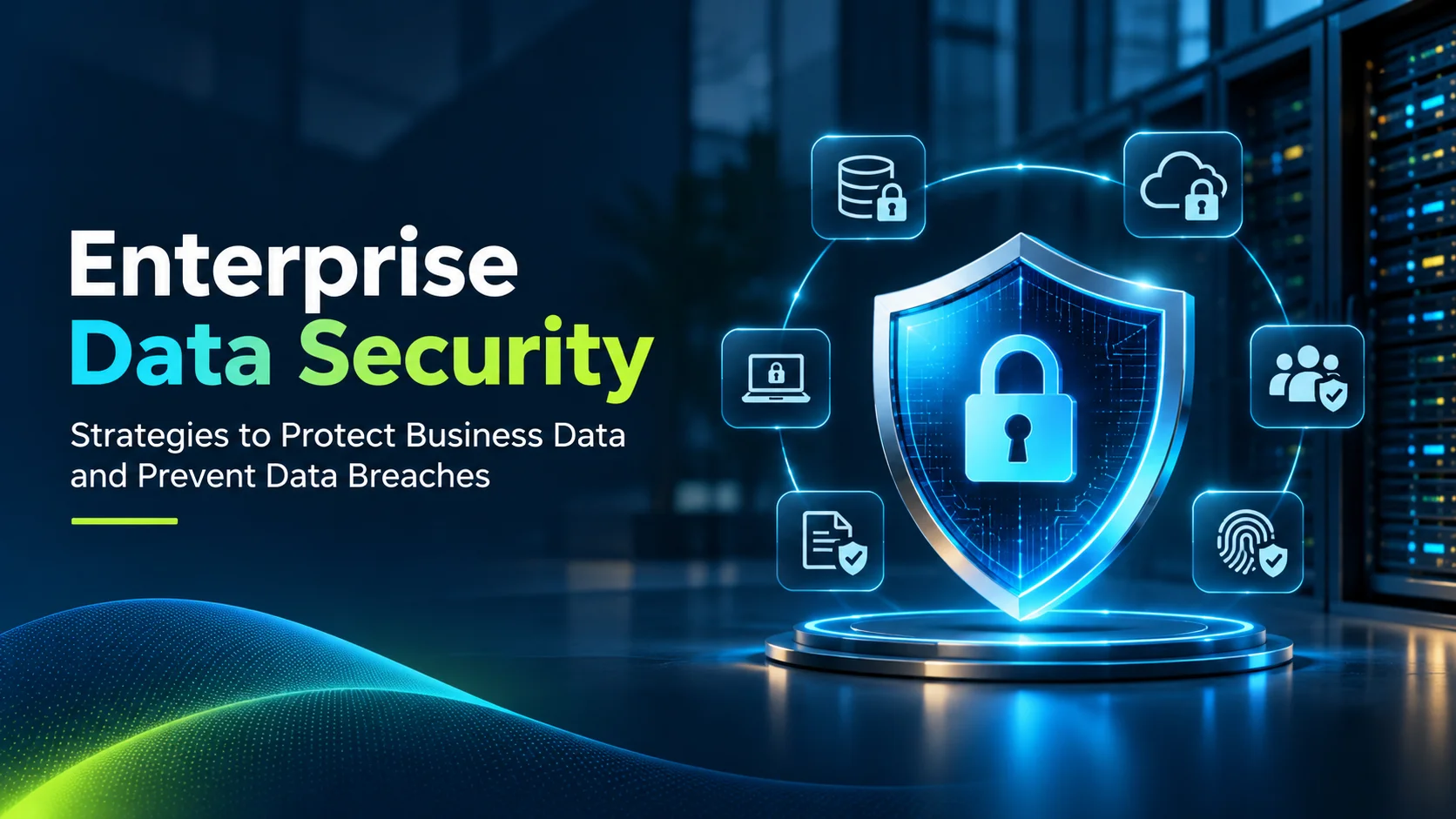
One over-permissioned account can undo years of security spending. It happens quietly. A contractor keeps access after the project ends, a cloud bucket gets opened for a quick test, an employee pastes customer records into a public AI tool. No alarm sounds. The data just leaves.
That’s the problem enterprise data security exists to solve. IBM’s 2026 Cost of a Data Breach Report puts the global average cost of a breach at a record $4.99 million, and organizations took an average of 247 days to identify and contain one. Perimeter firewalls and an annual audit can’t cover that exposure, because sensitive data now sits in SaaS platforms, multiple clouds, APIs, laptops and AI tools at once.
This guide covers what enterprise data security includes, the threats that matter most, the controls worth funding first, how federal and state rules fit in, and a roadmap your team can execute. If your organization builds or runs business applications, our work in custom software development usually starts with these same questions.
$4.99M
global average cost of a data breach in 2026 (IBM)
247 days
average time to identify and contain a breach (IBM, 2026)
48%
of breaches involved a third party (Verizon DBIR 2026, global data)
Quick Answer
Enterprise data security is the set of policies, controls and practices that protect an organization’s sensitive data from unauthorized access, loss, alteration or exposure across its whole lifecycle, wherever the data lives. It combines discovery and classification, access control, encryption, monitoring, backup, governance and incident response, and works best when built on a recognized framework such as NIST CSF 2.0.
What Is Enterprise Data Security?
Enterprise data security protects the information itself, not just the systems around it. The focus is where data lives, who can touch it, how it moves and when it should be destroyed. At enterprise scale, that means records scattered across databases, SaaS tools, warehouses, backups and employee devices.
Every control traces back to the CIA triad. Confidentiality keeps data from people who shouldn’t see it. Integrity stops unauthorized changes, which matters as much for a financial ledger as for source code. Availability keeps data reachable for authorized users, and ransomware attacks exactly that.
Data Security vs Cybersecurity vs Data Privacy
| Concept | Main focus | Question it answers | Example controls |
|---|---|---|---|
| Data security | Protecting data wherever it lives | Is this data protected at rest, in transit and in use? | Encryption, access control, DLP |
| Cybersecurity | Protecting systems, networks and users | Can attackers get in or disrupt operations? | Firewalls, EDR, patching |
| Data privacy | Lawful, fair handling of personal data | Do we have the right to use this data, and for what? | Consent, retention limits, subject rights |
They overlap, but one doesn’t replace another. You can encrypt everything and still break privacy law by keeping data nobody agreed to give you.
Which Data Needs Protection?
- Customer information and payment data
- Financial records and business contracts
- Employee records
- Intellectual property, including proprietary source code
- Healthcare information, where applicable
- Internal communications
Enterprise-level protection differs from basic IT security in one way above all. Basic security assumes a perimeter and a handful of systems. Enterprises have thousands of identities, hundreds of applications, vendors with standing access and data copied into places nobody mapped. Buying tools isn’t the hard part. Knowing what you hold is.
Why Enterprise Data Security Matters for Modern Businesses
Money is the loudest consequence. IBM’s 2026 findings show the global average breach at $4.99 million, up 12% year over year, with healthcare the costliest sector at about $6.64 million for the thirteenth year running. IBM’s country-level breakdown shows its costliest market averaging $11.5 million, more than twice the global figure. These are averages, so extreme incidents pull them up. Your own exposure depends on data volume, industry and detection speed.
AI is changing the math. IBM reports that AI-enabled breaches averaged around $6 million, roughly $1 million above the overall average.
Verizon’s 2026 Data Breach Investigations Report, drawn from more than 22,000 confirmed breaches in 145 countries, found something new. Vulnerability exploitation (31%) overtook credential abuse (13%) as the top initial access vector for the first time in the report’s history. Third parties appeared in 48% of breaches, up from 30%. Both are global figures, not a single market.
- Financial loss: response costs, downtime, legal fees and lost sales.
- Regulatory and contractual consequences: fines, audit findings and customer contract penalties.
- Reputation and trust: customers rarely return quickly after a mishandled breach.
- Operational disruption: systems offline while teams investigate.
- Intellectual property theft: a competitor gains years of product work.
- Continuity risk: no tested recovery path means no business.
Major Enterprise Data Security Threats and Risks
Eight risks account for most of the exposure enterprises ask us about.
Ransomware and Data Extortion
Attackers now steal data before encrypting it, then threaten to publish it. That’s double extortion, so a clean restore doesn’t end the incident. Recovery drags on when backups share the same network and get encrypted too. CISA’s StopRansomware Guide treats prevention and response as one program, which is the right framing.
Phishing and Credential Theft
Credential abuse made up 13% of initial access in the 2026 DBIR, behind exploitation, but it threads through almost every other attack. A convincing email gets a password, business email compromise gets a wire transfer, and a hijacked session opens a mailbox full of contracts. MFA helps, though attackers now target the approval prompt itself.
Insider Threats
Not every insider is malicious. Most incidents begin with an honest mistake: a misdirected export, a shared link left open. The harder problem is permission creep. People change roles, keep old access and collect rights nobody reviews. A compromised employee account looks identical to a trusted one.
Cloud Misconfigurations and Data Exposure
Public storage buckets, databases without authentication and API keys committed to code repositories keep appearing in breach reports. Providers secure the infrastructure. Configuration, identity and data remain yours. In multi-cloud setups each platform has its own permission model, and gaps open between them.
API Security Vulnerabilities
The OWASP API Security Top 10 ranks broken object level authorization first: a user changes an ID in a request and receives someone else’s record. Weak authentication, excessive data in responses and forgotten old API versions add to it. APIs often return more fields than the screen shows, and attackers read all of them.
Third-Party and Supply Chain Risks
A vendor with standing access to your CRM or warehouse is effectively part of your attack surface. Their compromise becomes your incident, and customers will still blame you. With third parties involved in 48% of breaches in Verizon’s data, vendor access deserves the same scrutiny as employee access.
AI-Related Data Security Risks
Staff paste contracts and customer data into public chatbots, a habit called shadow AI. Internal assistants bring subtler problems. A retrieval-augmented generation (RAG) index can surface documents without checking the asker’s permissions in the source system. Over-permissioned AI agents can read and act across systems, and prompt injection can trick them into exposing data they should never share. Training data and vector databases need the same classification and access rules as any other data store.
Legacy Systems and Unpatched Vulnerabilities
Missed patches are an open door, and the 2026 DBIR shows attackers using it more than any other route. Old applications often lack modern authentication, encrypt nothing and can’t be patched without breaking a business process. Sometimes isolation and compensating controls are enough. Often the answer is planned modernization, and this legacy software modernization guide helps teams decide what to isolate, rebuild or retire.
Essential Enterprise Data Security Strategies and Best Practices
Ten strategies carry most of the weight. Each one pairs a technical action with the business reason behind it.
1. Discover and Classify Enterprise Data
You can’t protect data you haven’t found. Run automated discovery across databases, file stores, SaaS platforms and cloud storage, then build an inventory recording what each dataset is, where it sits and who owns it. Apply classification levels such as public, internal, confidential and restricted, and map data flows between systems. Data security posture management (DSPM) tools can automate much of this, but have business owners review the results. Repeat quarterly.
Business value: classification shows where spending belongs and shrinks the scope of every audit.
2. Implement Strong Identity and Access Management
Give every person and service the minimum access its job requires. Role-based access control (RBAC) handles most cases, while attribute-based access control (ABAC) adds context such as device, location or data sensitivity. Enforce multi-factor authentication everywhere, wrap privileged access management (PAM) around admin and service accounts, automate joiner, mover and leaver changes, and review access at least quarterly for sensitive systems.
Business value: fewer standing permissions means a stolen account reaches less.
3. Encrypt Sensitive Data at Rest and in Transit
Encrypt databases, storage and backups at rest, and use current TLS versions in transit. Where full encryption isn’t practical, tokenization swaps sensitive values such as card numbers for meaningless stand-ins, and data masking hides fields in test or analytics environments.
Watch the Keys
Encryption is only as strong as key management. Store keys in a managed key service or hardware security module, rotate them on a schedule, keep them apart from the data they protect and log every use. A key left in a code repository cancels the encryption.
Business value: stolen data that’s properly encrypted is often a much smaller incident, though notification rules vary, so confirm with counsel.
4. Deploy Data Loss Prevention (DLP)
DLP inspects data against policy as it moves. Endpoint DLP watches USB copies and uploads, network DLP inspects traffic, cloud DLP covers SaaS and storage, and email controls catch attachments. Picture a finance analyst emailing a spreadsheet of customer account numbers to a personal address. A good policy blocks it or demands justification. Start in monitor mode, tune out false positives, then enforce.
Business value: it catches accidental leaks that never needed an attacker.
5. Strengthen Cloud and Application Data Security
Apply least privilege to cloud roles, scan configurations continuously and enforce guardrails through infrastructure as code. In multi-cloud environments, normalize policy so each provider isn’t its own exception. Inside applications, lock down database access, authorize every API call at the object level, manage dependencies and test code before release using threat modeling and code review.
Business value: security built into the delivery pipeline usually costs less than fixing exposure in production.
6. Adopt Zero Trust Security Principles
NIST SP 800-207 describes zero trust as moving defenses from network perimeters to users, assets and resources. No request earns trust from its location. Verify identity and device health on each access, authorize per resource, segment networks so one compromised host can’t roam and re-evaluate continuously. It’s an architecture approach, not a product you buy.
Business value: any single compromise has a smaller blast radius.
7. Strengthen Monitoring, Threat Detection, and Security Visibility
Feed logs from identity systems, databases, endpoints and cloud platforms into a SIEM. SOAR playbooks automate routine responses, EDR and XDR watch endpoints and cross-domain signals, and user behavior analytics flags oddities such as a sales account downloading an entire customer table at 2 a.m. Alert on data access and transfers, not only malware.
Business value: IBM’s 247-day figure shows what slow detection costs.
8. Secure Enterprise Backups and Disaster Recovery
Keep offline or immutable copies ransomware can’t alter, encrypt backups, restrict who can delete them and test restores. Set a recovery point objective (RPO) and recovery time objective (RTO) per system, then rehearse disaster recovery against them. Cloud sync isn’t a backup. If encryption or deletion syncs to the replica, you’ve copied the damage. CISA’s guidance stresses offline, tested backups for this reason.
Business value: a tested restore turns an existential event into an expensive week.
9. Manage Third-Party and Vendor Data Security
Tier vendors by the data they touch, match security questionnaires to that risk, require contractual security terms and data processing agreements, and give vendors scoped, time-limited access that’s revoked when contracts end. Monitor continuously instead of yearly. A vendor’s audit report is evidence, not a guarantee.
Business value: third parties sit in 48% of breaches, so this is core security, not paperwork.
10. Establish Data Governance, Retention, and Secure Disposal
Assign owners to datasets, write retention schedules, collect only what you need and securely delete what you don’t, with audit trails to prove it. Data you no longer hold can’t be stolen.
Business value: every unnecessary record adds to breach scope and notification volume.
Protecting Data Across Its Lifecycle
Controls shift as data moves from creation to destruction. Most programs over-invest in storage and neglect the stages on either side.
| Stage | Main risks | Key controls |
|---|---|---|
| Collection | Over-collection, unvalidated input | Collect only what’s needed, record consent, validate input, classify on arrival |
| Storage | Unencrypted stores, open buckets | Encryption at rest, access control, posture scanning, protected backups |
| Processing | Exposure in pipelines and test data | Masking, tokenization, secured pipelines, no production data in development |
| Sharing | Oversharing, vendor exposure | DLP, secure transfer, data processing agreements, scoped vendor access |
| Usage | Excess permissions, shadow AI | Least privilege, activity monitoring, AI usage policy |
| Archiving | Forgotten stores with weak access | Retention rules, encrypted archives, periodic access review |
| Disposal | Residual copies in backups and logs | Secure deletion, backup purge, destruction records, audit trail |
Enterprise Data Security Control Matrix
| Security risk | Recommended control | How it helps | Business benefit |
|---|---|---|---|
| Ransomware | Immutable offline backups, tested restores | Preserves clean recovery copies | Shorter downtime |
| Stolen credentials | MFA and PAM | Blocks reuse of leaked passwords | Fewer account takeovers |
| Insider misuse | Least privilege, access reviews | Cuts the data any account can reach | Smaller breach scope |
| Cloud misconfiguration | Posture scanning, IaC guardrails | Finds exposure early | Fewer public leaks |
| API data exposure | Object-level authorization, API inventory | Stops record-level snooping | Protected customer data |
| Vendor compromise | Tiered risk reviews, scoped access | Limits third-party reach | Lower supply chain risk |
| Shadow AI | Usage policy, DLP on AI tools | Blocks sensitive pastes | Protected IP and compliance |
| Unpatched systems | Patch deadlines, isolation | Closes known holes | Fewer exploit-driven breaches |
Building or Integrating Systems That Hold Sensitive Data?
Tell us what you run today and where the data lives. Elsner’s team can help you plan secure application architecture, integrations and data workflows.
Frameworks and Compliance Requirements Enterprises Should Know
Some of these are laws, some are contractual standards and some are voluntary frameworks. Treat each differently, and don’t present a framework as a mandate.
| Requirement | Type | May apply to | Verify before claiming compliance |
|---|---|---|---|
| NIST CSF 2.0 | Voluntary framework | Any organization | Six functions: Govern, Identify, Protect, Detect, Respond, Recover. No certification exists, so document your own profile. |
| NIST SP 800-207 | Voluntary guidance | Organizations adopting zero trust | How your architecture maps to its principles. |
| HIPAA Security Rule | Federal law | Covered entities and business associates handling electronic protected health information | A current, documented risk analysis under the rule now in force. |
| FTC Safeguards Rule (GLBA) | Federal rule | Financial institutions under FTC jurisdiction | Written security program, designated qualified individual, notification duties. |
| PCI DSS | Industry standard, enforced by contract | Entities that store, process or transmit payment card data | Current version (4.0.1), scope, and validation level agreed with your acquirer. |
| CCPA/CPRA and other state laws | State laws | Businesses meeting each state’s thresholds | Applicability, data categories and requirements differ by state. |
| SEC cybersecurity disclosure rules | Federal rules | Public companies | A process for judging materiality and disclosing incidents, plus risk governance disclosures. |
Two status notes matter. HHS proposed Security Rule changes in January 2025, including mandatory encryption and MFA, but they’re still proposed. The federal regulatory agenda now projects final action in July 2027, and that date could move, so the existing rule governs today. Breach notification deadlines also vary by law, data type, industry and jurisdiction, and some run on short clocks. Confirm with counsel.
Adopting NIST doesn’t make a company compliant with every regulation. This section is general information, not legal advice.
How to Build an Enterprise Data Security Strategy: A Practical Roadmap
Phase 1
Assess current risk
Inventory data, map who can access what, review cloud and application environments and document the gaps.
Phase 2
Design the architecture
Set classification, access models, encryption standards, governance policy and monitoring requirements.
Phase 3
Implement core controls
Enable MFA, apply least privilege, configure DLP, secure APIs, tighten cloud permissions and harden backups.
Phase 4
Monitor, test, improve
Run security testing, review access, test recovery, update policy and fix new vulnerabilities.
| Window | Focus | Example outputs |
|---|---|---|
| Days 1 to 30 | Discover and decide | Inventory of top systems, MFA gap list, named data owners, risk register |
| Days 31 to 60 | Close the biggest gaps | MFA on remote and admin access, privileged account cleanup, immutable backups, vendor tiering |
| Days 61 to 90 | Detect and prove | DLP in monitor mode, logs flowing to a SIEM, a restore test, an incident response tabletop |
That’s an illustrative sequence, not a compliance deadline. Large enterprises usually need longer for full coverage.
Illustrative Scenario (Hypothetical, Not a Client Case Study)
Picture a 1,200-employee distributor. Customer data sits in a CRM, two cloud databases and a shared drive. Sales exports contact lists to spreadsheets, a logistics vendor holds a permanent API key and an AI assistant reads the document library through an admin-level service account. There’s no data inventory, admin credentials are shared and nobody has tested a restore. The sensible build: classify data first, add single sign-on with MFA, put PAM around admins, scope and rotate vendor keys, apply DLP to exports, make AI retrieval respect source permissions, add immutable backups and centralize logging. MFA and key rotation come first. The payoff is fewer standing privileges, faster detection, a restore time the business has actually tested and audit answers in hours.
How to Measure Enterprise Data Security Performance
| Metric | What it measures | Why it matters |
|---|---|---|
| Classification coverage | Share of sensitive data stores classified | Unknown data is unprotected data |
| MFA coverage | Accounts protected by MFA | Credential theft still feeds many attacks |
| Privileged access review completion | Admin accounts reviewed on schedule | Stale admin rights are prime targets |
| Encryption coverage | Sensitive stores encrypted at rest and in transit | Reduces the impact of theft |
| Critical vulnerability remediation time | Days from discovery to fix | Exploitation is now the top entry route |
| Mean time to detect (MTTD) | Time from intrusion to discovery | Dwell time drives cost |
| Mean time to respond (MTTR) | Time from detection to containment | Shows response strength |
| Backup restoration success rate | Restore tests that succeed | Proves recoverability |
| Incident response test frequency | Exercises run per year | Untested plans decay |
| Third-party assessment coverage | Critical vendors assessed | Reveals vendor risk |
| Unauthorized data access incidents | Confirmed policy-violating access | Direct outcome measure |
Set targets from your own risk appetite and baseline. Any numbers you choose are internal goals, not industry benchmarks.
Common Enterprise Data Security Mistakes Businesses Should Avoid
- Treating security as IT’s job alone: business owners must decide who needs access and for how long.
- Skipping discovery and classification: you can’t rank risk on data you haven’t found.
- Granting excessive access: convenience grants pile up into breach scope.
- Relying on passwords: add MFA, and phishing-resistant methods for admins.
- Assuming the cloud provider handles it all: shared responsibility still leaves data and identity with you.
- Ignoring third-party integrations: every connected app is a path to your data.
- Neglecting legacy applications: isolate, patch or retire them.
- Keeping data forever: retention without purpose is liability.
- Never testing backups: restore drills reveal the surprises.
- Having no tested incident response plan: run tabletops with legal and communications in the room.
- Ignoring AI exposure: write usage rules and control what assistants can retrieve.
- Treating compliance as security: an audit passes at one moment, while attackers don’t wait.
Quick Assessment Checklist for CTOs and IT Managers
How to Choose the Right Enterprise Data Security Technology or Implementation Partner
Start by separating two kinds of provider. Specialist cybersecurity firms run security operations: penetration testing, managed detection, incident response and certifications. Software engineering partners build and integrate the systems that hold your data. Most enterprises need both, and blurring them creates scope gaps.
When evaluating a technology partner, look for:
- Relevant experience with enterprise systems such as CRM and ERP
- Secure application architecture skills
- Cloud and infrastructure expertise
- Data integration capability
- A documented security implementation method
- Clear documentation and governance habits
- Ongoing maintenance and support
- A written scope of responsibility: who patches, who monitors, who responds
A development partner can build secure applications, integrate systems with proper authorization, design data workflows and support secure enterprise architecture. Elsner Technologies works in that space as a software and AI development company. For penetration testing, round-the-clock monitoring or incident response, ask a specialist security provider, and write down exactly where each team’s responsibility ends.
Frequently Asked Questions About Enterprise Data Security
What is enterprise data security?
It’s the combination of policies, controls and practices that protect an organization’s sensitive data across its lifecycle, from collection to disposal, wherever it’s stored or shared.
What are the most common enterprise data security threats?
Ransomware, phishing and credential theft, insider mistakes, cloud misconfigurations, vulnerable APIs, third-party compromise, shadow AI and unpatched legacy systems.
How can businesses prevent data breaches?
Classify data, enforce MFA and least privilege, encrypt sensitive data, patch quickly, monitor data access, vet vendors and test backups. No single control is enough on its own.
What are the best practices for protecting sensitive enterprise data?
Know where it lives, limit who can reach it, encrypt it, watch how it moves, keep recoverable backups and delete what you no longer need.
What is the difference between data security and data privacy?
Data security protects data from unauthorized access or loss. Data privacy governs lawful, fair use of personal data. Strong security doesn’t guarantee privacy compliance.
How does zero trust improve enterprise data security?
It verifies every access request instead of trusting network location, so a stolen credential or compromised device reaches far less data.
Which compliance requirements should businesses consider?
It depends on industry and data. Common ones are HIPAA, the FTC Safeguards Rule, PCI DSS, state privacy laws and SEC disclosure rules. Confirm applicability with counsel.
How often should an enterprise review its data security strategy?
Review it at least annually, and after major changes such as new cloud platforms, acquisitions, vendor shifts, AI rollouts or incidents. Review access quarterly.
Conclusion
Enterprise data security isn’t a product or a project with an end date. It’s a habit of knowing your data, limiting access, watching for misuse and rehearsing recovery. Data needs protection across its whole lifecycle, and that takes people, process, technology and governance working together. Assess honestly, fix the biggest gaps first and keep measuring.
Organizations planning secure enterprise applications, data pipelines or system integrations can explore Elsner’s data engineering and MLOps services as one starting point for the build side of that work.
Ready to Strengthen How Your Applications Handle Data?
If you’re planning secure enterprise software, integrations or data workflows, our team can review your architecture and talk through practical next steps.
About This Guide
Written by the Elsner Technologies content team as general information, not legal, regulatory or compliance advice. Breach statistics come from the 2026 IBM and Verizon reports, both of which use global datasets. Regulations and their status change, so confirm requirements with qualified counsel and have a security practitioner review your program.