




- What “agency” and “in-house” actually mean for a SaaS website
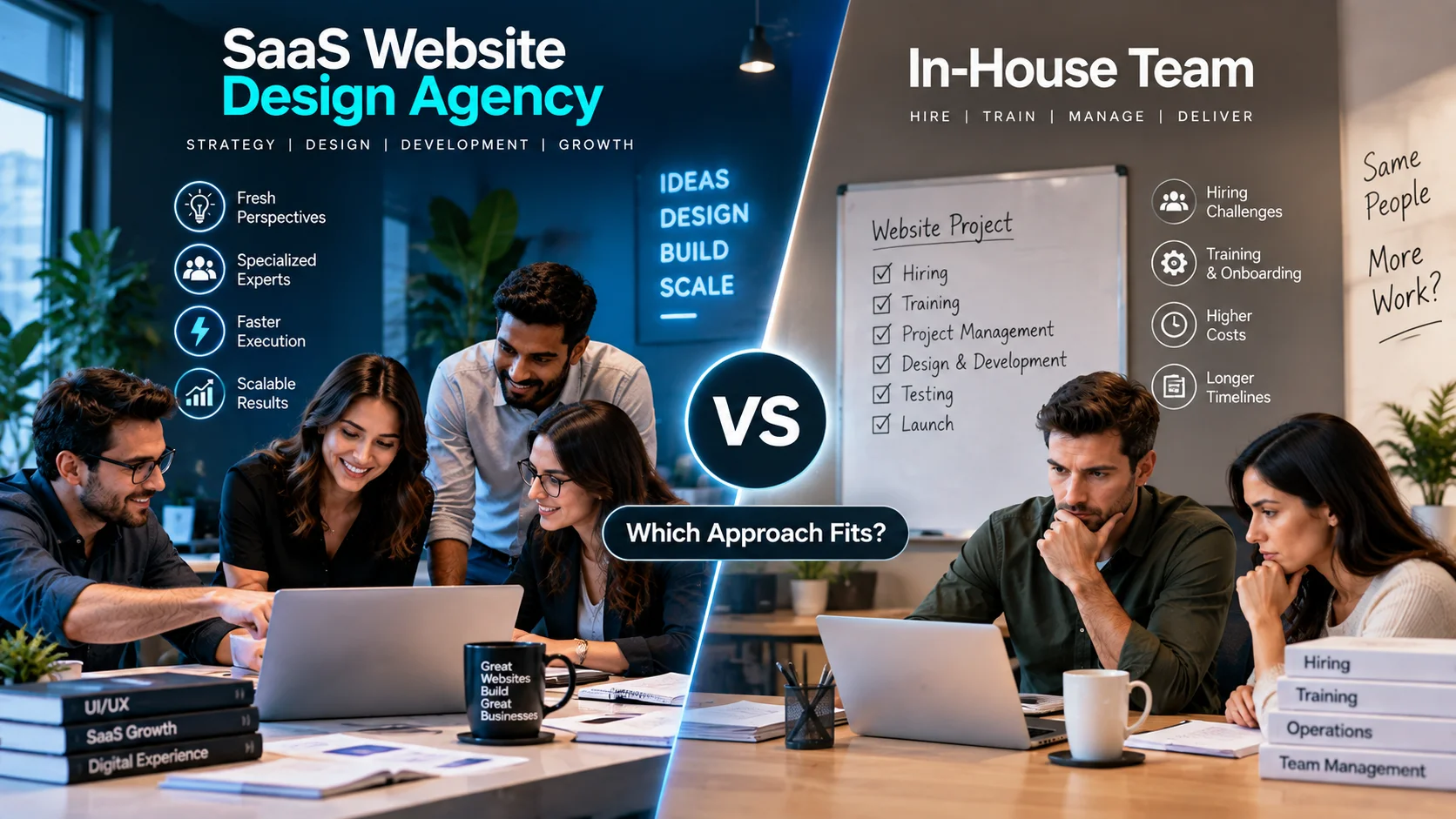
- Agency vs in-house vs hybrid: a direct comparison
- What each option actually costs, beyond the headline number
- Not sure which model fits your current stage?
- When an in-house team is genuinely the better call
- When a specialized agency is genuinely the better call
- The hybrid model most growth-stage SaaS companies actually land on
- Other decisions that quietly go wrong
- A simple framework for making the call
- Frequently Asked Questions
- Is it cheaper to hire an in-house designer or use a SaaS website design agency?
- How long does it take to launch a SaaS website with an agency versus in-house?
- What should a SaaS company look for in a website design agency?
- Can a small SaaS startup manage with just a freelancer instead of either option?
- What is the hybrid model for SaaS website design?
- When should a SaaS company move from an agency to an in-house team?
- Does the website really matter that much for a SaaS company’s sales?
- The bottom line
- Ready to figure out the right setup for your SaaS website?
Somewhere around the Series A mark, almost every SaaS company has the same argument in a leadership meeting. The marketing lead wants a website that actually converts trial signups. The CEO wants it fast. Finance wants to know why a “simple website” needs a five-figure budget either way. And somebody, usually the one who has done this before, asks the question that actually matters: should we build this with our own hires, or bring in a specialized SaaS website design agency?
There is no universally correct answer, whatever a sales page trying to win your business might claim. The right choice depends on your stage, your budget shape, how often your site actually needs to change, and whether design is something your product genuinely depends on or just something it needs to have. This guide breaks down what each model actually costs, where each one wins, and how most SaaS companies actually end up structuring the decision once they have been through it once.
Quick Answer
A specialized SaaS website design agency generally makes sense for companies that need a high-converting site launched fast without carrying a full-time design payroll, while an in-house team makes sense once a company has enough ongoing design, content, and conversion work to keep two or more specialists genuinely busy year-round. Most SaaS companies do not pick one model forever. They start with an agency or freelance mix pre-product-market fit, then build a lean in-house team once the site becomes a constant work item rather than a one-time project. The median time to fill a single specialized role is now 39 calendar days for nonexecutive positions, according to SHRM’s 2026 recruiting benchmark, which is often longer than an agency needs to deliver the entire first version of a site.
What “agency” and “in-house” actually mean for a SaaS website
Before comparing costs and timelines, it helps to be precise about what each model actually involves, since both terms get used loosely.
A SaaS website design agency is an external team, usually a mix of designers, front-end developers, a strategist, and sometimes a copywriter, that you engage for a defined project or an ongoing retainer. Elsner works with SaaS companies this way through custom web design that is scoped around conversion goals rather than a fixed page count. A good SaaS-specialized agency has already solved the specific problems your site faces, pricing page psychology, trial signup friction, technical documentation that does not read like a manual, because they have built dozens of these before.
An in-house team means direct hires on your payroll, typically a product designer or UI/UX designer, sometimes paired with a front-end developer or a marketing-focused generalist. They sit in your standups, know your product roadmap without being briefed on it every time, and can react to a pricing change or a competitor launch the same afternoon it happens. What they trade for that proximity is breadth. One or two in-house designers have seen your product deeply, but they have not necessarily seen fifty other SaaS pricing pages convert or fail.
That second stat is easy to skim past, but it is really the whole argument for taking this decision seriously in the first place. If most of a buyer’s evaluation happens without a rep in the room, the website is not a marketing asset sitting off to the side. For a large share of SaaS deals, it is doing the job a salesperson used to do. That changes the calculation. This is not a decision about who codes a page fastest. It is a decision about who can build and keep improving the one asset a large share of your buyers will judge you on before anyone from your team ever talks to them.
Agency vs in-house vs hybrid: a direct comparison
Most comparisons stop at cost, which misses the point. Cost matters, but so does how fast you can launch, how much strategic thinking comes with the work, and what happens six months after launch when the site inevitably needs updating.
| Factor | SaaS design agency | In-house team | Hybrid model |
|---|---|---|---|
| Speed to launch | Fast, typically weeks, since the team and process already exist | Slow, hiring alone often takes over a month before work even starts | Fast for the initial build, then steady for ongoing work |
| Upfront cost | Project-based, scoped and predictable, no long-term commitment | High, salary plus benefits and tooling regardless of workload | Moderate, agency for the build, lean internal hire for upkeep |
| Breadth of expertise | High, has seen patterns across many SaaS products and pricing models | Deep on your product, narrower on cross-industry benchmarks | Combines outside pattern recognition with internal product context |
| Responsiveness | Depends on retainer terms, same-day changes are not guaranteed | Immediate, sits in the same meetings as product and sales | Fast for urgent tweaks, agency handles larger periodic work |
| Best fit | Pre-Series B companies, redesigns, or teams without design leadership | Companies with enough constant design and content work to fill a role | Growth-stage SaaS companies scaling content and landing pages fast |
What each option actually costs, beyond the headline number
The in-house cost conversation usually starts and stops at a salary figure, which understates the real number by a wide margin. A single mid-level product designer earning close to the national median wage still needs a laptop, a design tool subscription, healthcare and payroll taxes, onboarding time, and management attention. None of that shows up in the offer letter, but all of it shows up on the P&L.
Then there is the utilization problem nobody likes to say out loud. A single in-house designer is genuinely busy during a redesign sprint and genuinely underused for long stretches between major initiatives, unless the company is large enough to keep feeding them landing pages, campaign assets, and product UI work at a steady pace. Paying full-time compensation for a role that is at 60 percent utilization most months is a quiet, recurring cost that rarely gets its own line item.
An agency engagement flips that math. You are paying for output on a defined scope, not for a seat that needs to be filled regardless of workload. The tradeoff is that an agency’s hourly or project rate looks higher on paper than an internal salary divided by 2,080 working hours a year, and if a company ends up needing constant, unscoped changes, that per-project pricing can add up faster than a salaried hire would have. Neither model is cheaper in every scenario. The honest comparison depends on how much design work actually needs doing in a normal month, not in launch month.
Not sure which model fits your current stage?
Elsner can walk through your current site, your team’s actual bandwidth, and give you a straight answer on whether an agency, a hire, or a mix of both makes sense right now.
When an in-house team is genuinely the better call
There are real situations where building internally wins outright, not as a compromise.
- Your website changes constantly. If landing pages, case studies, and pricing experiments ship weekly rather than quarterly, an in-house designer working alongside marketing and product every day will outpace an external retainer that has to be briefed each time
- Design and product are tightly coupled. Companies where the marketing site shares components, a design system, or actual code with the in-product experience benefit from someone who lives in both worlds daily
- You have the volume to justify it. Once a company has enough recurring work to keep two or more specialists fully occupied, the per-hour economics of an in-house team start beating an agency retainer
- Institutional knowledge compounds. A designer who has been through three pricing changes and two rebrands with your company carries context that takes an outside team real time to rebuild each engagement
When a specialized agency is genuinely the better call
The reverse cases are just as common, particularly earlier in a company’s life or during a specific project.
- You need a launch, not a department. A full redesign or a first real website is a defined project with a clear end point, which is exactly what agency engagements are structured around
- You do not have design leadership yet. Without someone senior enough to direct a junior in-house hire, a first design hire often ends up unsupervised and inconsistent. A team that has already shipped SaaS sites brings that judgment built in
- Speed matters more than customization of process. An agency with an established workflow can move from kickoff to launch faster than most companies can source, interview, and onboard a single qualified hire
- You need outside pattern recognition. A team that has built pricing pages, trial flows, and documentation sites for other SaaS companies has already seen what tends to convert and what tends to quietly leak signups, something a first internal hire has to learn on your dime
This is the stage where Elsner’s SaaS development work most often gets engaged, companies past the point of a template theme but not yet ready to carry a full internal design function.
The hybrid model most growth-stage SaaS companies actually land on
In practice, the cleanest version of this decision, agency or in-house, is somewhat rare past a certain company size. What tends to actually happen is a blend: an agency handles the initial build or a major redesign, then a lean internal hire, sometimes a generalist rather than a specialist, takes over day-to-day maintenance, small content updates, and campaign landing pages, while the agency stays on for periodic bigger projects.
This works well because it matches spend to actual need. The heavy lift, information architecture, conversion strategy, the design system, gets built by people who have solved that problem repeatedly. The ongoing churn, a new integration page here, an updated case study there, gets handled by someone close enough to the business to make small calls without a full briefing cycle every time. Companies scaling their content output specifically benefit from this split, since it lets an internal hire focus on volume while the agency protects the underlying design system from drifting inconsistent over time.
A mistake worth avoiding
Hiring a single in-house designer and expecting them to also handle strategy, copywriting, front-end implementation, and conversion analysis is a common way this decision goes wrong. One person, however talented, cannot realistically own all four disciplines well at once. Companies that make this mistake often end up quietly paying an agency anyway a year later to fix a site that was never given the range of skills it needed the first time.
Other decisions that quietly go wrong
Choosing based on the cheapest quote, not the right specialization. A general web design agency that has never built a SaaS pricing page or a self-serve trial flow will need to learn those patterns on your budget, the same problem as hiring an unsupervised junior in-house.
Treating the website as a one-time project either way. A site that launches and then goes untouched for two years loses relevance fast in a market where competitors are testing pricing pages monthly. Whichever model you choose, budget for ongoing iteration, not just the initial build.
Ignoring the handoff between design and engineering. A beautifully designed site that takes engineering weeks to implement, or that an in-house designer cannot code themselves and has no developer support to build, stalls at exactly the point it should be shipping. This is where pairing design decisions with actual web development capacity, whichever model you choose, prevents a finished design from sitting in a queue for months.
A simple framework for making the call
Rather than debating in the abstract, four questions tend to settle this decision faster than any pros-and-cons list.
- How much design and content work actually needs doing in a typical month, not in launch month
- Does someone on the team have the seniority to direct and evaluate design work, or would a hire be operating unsupervised
- How fast does this need to launch, and can the company afford the 39-day median hiring runway before work even begins
- Is the website mostly a marketing asset, or is it structurally tied to the product experience through shared components or a design system
A company answering “not much,” “no,” “fast,” and “mostly marketing” is looking at a strong case for an agency. One answering “constant,” “yes,” “we have time,” and “tightly coupled” is looking at a strong case for in-house. Most companies land somewhere in between, which is exactly why the hybrid model shows up as often as it does. Teams working through this alongside a broader product development strategy tend to make this call more confidently, since the website decision stops being isolated from the roadmap it needs to support.
Key takeaways
- A SaaS website design agency fits companies that need a fast, expert-built launch without carrying full-time design payroll, while in-house fits companies with enough constant work to keep a role genuinely busy.
- In-house cost is more than the salary line. Benefits, tooling, management time, and utilization gaps between major projects all add real cost that rarely gets its own budget line.
- With B2B buyers spending only 17 percent of their purchase time with a supplier directly, the website is doing far more of the sales job than it gets credit for, which raises the stakes on whoever builds it.
- The median 39-day time-to-fill for a single hire, per SHRM’s 2026 benchmark, is often longer than an agency needs to deliver a full first version of a site.
- Most growth-stage SaaS companies end up on a hybrid model: an agency for the build and major redesigns, a lean internal hire for day-to-day updates and content velocity.
- Whichever model is chosen, the recurring mistake is treating the website as a one-time project instead of budgeting for ongoing iteration.
Frequently Asked Questions
Is it cheaper to hire an in-house designer or use a SaaS website design agency?
It depends on how much design work needs doing every month. An agency is usually cheaper for a defined project or infrequent updates, since you pay for scoped output rather than a full-time salary. An in-house hire becomes more cost-efficient once there is enough recurring work, redesigns, new landing pages, ongoing content, to keep that person consistently busy rather than idle between projects.
How long does it take to launch a SaaS website with an agency versus in-house?
A specialized agency with an established process can typically move from kickoff to launch in a matter of weeks. Building in-house first requires hiring, which carries a median time-to-fill of around 39 calendar days for a single role according to SHRM’s 2026 data, before any design work even starts, then additional time for a new hire to get up to speed on the product.
What should a SaaS company look for in a website design agency?
Look for direct experience with SaaS-specific pages, pricing tables, trial and demo flows, feature comparison pages, and technical documentation, rather than general small-business web design experience. Ask to see conversion outcomes from past work, not just visual portfolios, and clarify upfront whether front-end development and copywriting are included or handled separately.
Can a small SaaS startup manage with just a freelancer instead of either option?
For a very early-stage company with a simple site and a tight budget, a skilled freelancer can be a reasonable middle ground. The tradeoff is availability and range: a single freelancer may not cover strategy, copywriting, and development together, and their capacity is limited if the company suddenly needs faster turnaround during a launch or fundraising push.
What is the hybrid model for SaaS website design?
A hybrid model uses an outside agency for the initial build or major redesigns, since that work benefits from specialized, cross-industry expertise, while a lean in-house hire handles day-to-day updates, new landing pages, and content changes. This is the most common setup among growth-stage SaaS companies, since it matches spend to how the actual workload is distributed over time.
When should a SaaS company move from an agency to an in-house team?
The signal is usually workload, not company size. Once landing pages, campaigns, and site updates are shipping weekly rather than quarterly, and there is enough of that work to keep one or more specialists fully occupied, an in-house hire typically starts winning on cost and responsiveness compared to an ongoing agency retainer.
Does the website really matter that much for a SaaS company’s sales?
Yes, more than most teams assume. Gartner research on B2B buying found that buyers spend only 17 percent of their total purchase time meeting directly with a supplier, with the majority of the decision shaped by independent research, much of it on the vendor’s own website. For self-serve or product-led SaaS in particular, the website is often doing a meaningful part of the job a sales conversation used to do.
The bottom line
Neither model is inherently better. An agency wins on speed, breadth of pattern recognition, and predictable project cost. An in-house team wins on proximity, product context, and cost efficiency once there is enough steady work to justify it. The mistake worth avoiding is picking a model out of habit, defaulting to a hire because that is what companies “are supposed to do,” or defaulting to an agency because it feels lower-commitment, without actually working through how much design work your company generates in a normal month. Answer that question honestly, and the right structure usually becomes obvious well before the debate needs to happen in a leadership meeting again.
Ready to figure out the right setup for your SaaS website?
Elsner works with SaaS companies at every stage, from a first real website to a full redesign backed by a dedicated team, without locking you into a structure that stops fitting once you grow past it.