



- What Is Custom MVP Development?
- MVP vs. Prototype vs. Proof of Concept
- Why Choose Custom MVP Development Over Templates and No-Code?
- Types of MVPs
- When Are You Ready to Start Custom MVP Development?
- Benefits of Custom MVP Development
- The Custom MVP Development Process
- How to Scope Your MVP
- MVP Testing and Validation
- How Much Does Custom MVP Development Cost?
- Custom MVP Development by Industry
- Common MVP Mistakes to Avoid
- How to Choose the Right MVP Development Company
- What Happens After Your MVP Validates
- Real MVP Examples Worth Knowing
- MVP Development Checklist
- Frequently Asked Questions
Product Development
Quick Answer
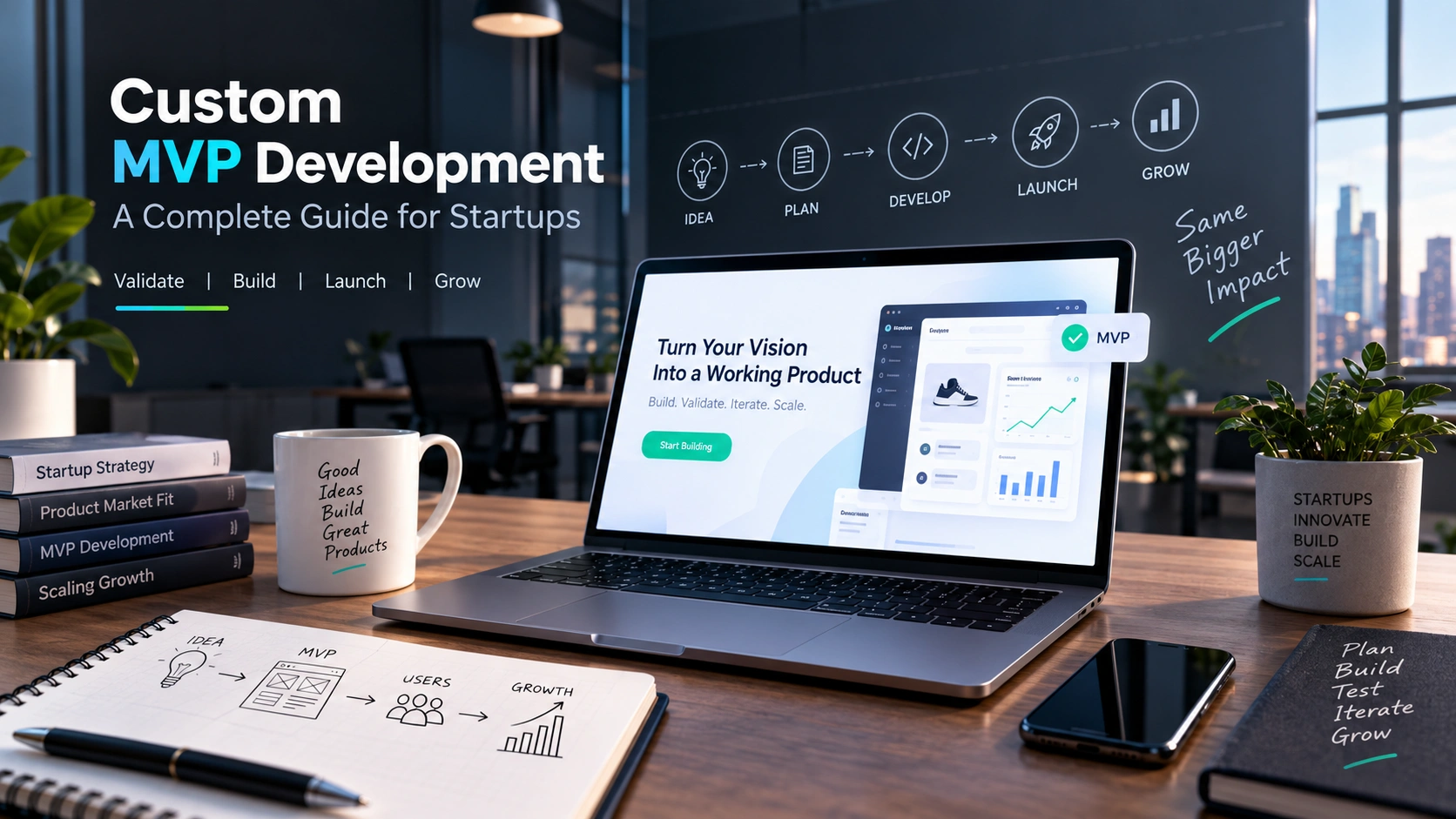
Custom MVP development is the process of building a minimum viable product designed around your specific users, business model, and technical constraints, rather than assembling one from a generic template or no-code kit. The goal is to test your riskiest assumption with real users using the smallest build that can do it, then use what you learn to decide what to build next.
On this page
- What Is Custom MVP Development?
- Why Choose Custom MVP Development Over Templates and No-Code?
- Types of MVPs
- When Are You Ready to Start Custom MVP Development?
- Benefits of Custom MVP Development
- The Custom MVP Development Process
- How to Scope Your MVP
- MVP Testing and Validation
- How Much Does Custom MVP Development Cost?
- Custom MVP Development by Industry
- Common MVP Mistakes to Avoid
- How to Choose the Right MVP Development Company
- What Happens After Your MVP Validates
- Real MVP Examples Worth Knowing
- MVP Development Checklist
- FAQs
Most founders don’t fail because they built the wrong code. They fail because they spent months building the right code for the wrong product. CB Insights’ analysis of startup post-mortems found that “no market need” was the most frequently cited reason startups shut down, ahead of running out of cash or losing to a competitor. In other words, the product worked. Nobody wanted it.
An MVP exists to catch that mistake early, before it’s expensive. But not every MVP catches it. A generic template or a rushed no-code build tests whether people click a button, not whether they’d actually use and pay for what you’re proposing. This guide covers what custom MVP development actually involves, how the process works, what it costs, and how to avoid the mistakes that turn an MVP into a wasted first version instead of a genuine test.
#1
Ranked cause of startup failure across founder post-mortems studied by CB Insights: building a product the market didn’t need. Source: CB Insights
What Is Custom MVP Development?
A minimum viable product is the smallest version of a product that lets you test a core assumption with real users and get honest feedback, rather than opinions. The concept, popularized by Eric Ries in The Lean Startup, centers on a build-measure-learn loop: build the smallest thing that tests your riskiest assumption, measure how real users actually behave, and use that to decide what to build next.
“Custom” is the part that gets skipped when teams are in a hurry. A generic MVP template or a no-code kit can get something live quickly, but it’s built around assumptions that may not match your users, your business model, or your competitive position. Custom MVP development means the scope, the tech stack, and the specific feature you’re testing are chosen for your situation, not pulled from a template built for a different product.
That doesn’t mean over-engineering. A well-scoped custom MVP is still lean. It just means the one feature you build is the right one to build, and the architecture underneath it won’t box you in the moment the product starts to work.
MVP vs. Prototype vs. Proof of Concept
These terms get used interchangeably, but they answer different questions. A proof of concept tests technical feasibility, whether something can be built at all, usually for internal eyes only and never touched by a real customer. A prototype tests usability and design direction, often a clickable mockup with no real functionality behind it, used to gather feedback on flow and interface before development starts. An MVP is the only one of the three that’s a real, working product real users can actually use, and it’s the only one that produces genuine behavioral data rather than opinions about a mockup. Confusing the three is a common early mistake: teams sometimes build a polished prototype, treat the positive reactions to it as market validation, then discover the reactions don’t hold once money or real usage is involved.
Why Choose Custom MVP Development Over Templates and No-Code?
No-code tools and templates have a real place in early validation. A landing page built in an afternoon can tell you whether anyone cares about your idea before you write a line of code. The limitations show up once you need to test something more specific than “does anyone click this.”
Templates assume a generic user and a generic workflow. If your product’s value depends on a particular sequence, a particular integration, or handling an edge case that matters to your specific market, a template usually can’t represent that accurately enough to produce a meaningful test. The feedback you get ends up telling you something about the template, not about your product.
No-code platforms also tend to hit a wall exactly when an MVP starts succeeding. The moment real usage grows, or you need functionality the platform wasn’t built for, teams often end up rebuilding from scratch, which erases the time advantage the no-code approach was supposed to provide. Custom development from the start, scoped tightly around the one thing you’re testing, avoids that rebuild while still moving at MVP speed. It’s a similar tradeoff to the one teams weigh in broader custom software development decisions: a tailored build costs more upfront than a template, but it doesn’t create a second migration project six months later.
Types of MVPs
Not every MVP needs to be a working product. Depending on what you’re trying to learn, a lighter format can validate your assumption faster and cheaper.
| MVP Type | What It Tests | Best For |
|---|---|---|
| Landing Page MVP | Whether people are interested enough to sign up or click “buy” | Very early demand validation, before any build |
| Concierge MVP | Whether the service itself has value, delivered manually behind the scenes | Service-based or workflow-heavy products |
| Wizard of Oz MVP | Whether users respond to an automated-looking experience that’s actually run manually | Products where the automation is the expensive part to build |
| Single-Feature MVP | Whether one core feature delivers enough value on its own | Products with one clear central use case |
| Piecemeal MVP | Whether stitching together existing tools can approximate your product | Testing a workflow before committing to custom development |
Most custom MVP development engagements start with a single-feature or concierge approach, then move to a fuller build once the core assumption is validated. Choosing the wrong type for what you’re actually trying to learn is one of the most common early missteps, more on that later.
When Are You Ready to Start Custom MVP Development?
Jumping into a custom build before you’re ready wastes the exact time and money an MVP is supposed to protect. A few signals suggest you’re actually ready. You can state the riskiest assumption in one sentence, not a paragraph of hedged possibilities. You know roughly who the first users will be and how you’ll reach them, since an MVP with no path to real users can’t produce real data. You’ve already done the cheapest validation available, conversations, a landing page, a concierge test, and the signal was promising enough to justify a build. And you have a rough sense of what “validated” would actually look like before you start, so the result isn’t reinterpreted after the fact to match whatever happened.
If any of those aren’t true yet, that’s not a reason to abandon the idea. It’s a reason to spend a bit more time on the cheaper validation steps before committing to development, custom or otherwise.
Benefits of Custom MVP Development
Real validation instead of assumptions.
You learn what users actually do, not what they say they’d do in an interview.
Lower financial risk. Capital goes toward testing the riskiest assumption first, instead of building a full feature set before knowing if anyone wants it.
Faster time to market. A tightly scoped MVP can launch in weeks rather than months, so you’re gathering real feedback while competitors are still planning.
Architecture that scales. Unlike a no-code prototype, a custom build can grow into the full product without a rebuild once the MVP proves out.
Stronger investor and stakeholder conversations. A working product with real usage data is a fundamentally different pitch than a deck full of projections.
Better product decisions. Every subsequent feature decision is grounded in how real users behaved with the MVP, not in internal debate.
The Custom MVP Development Process
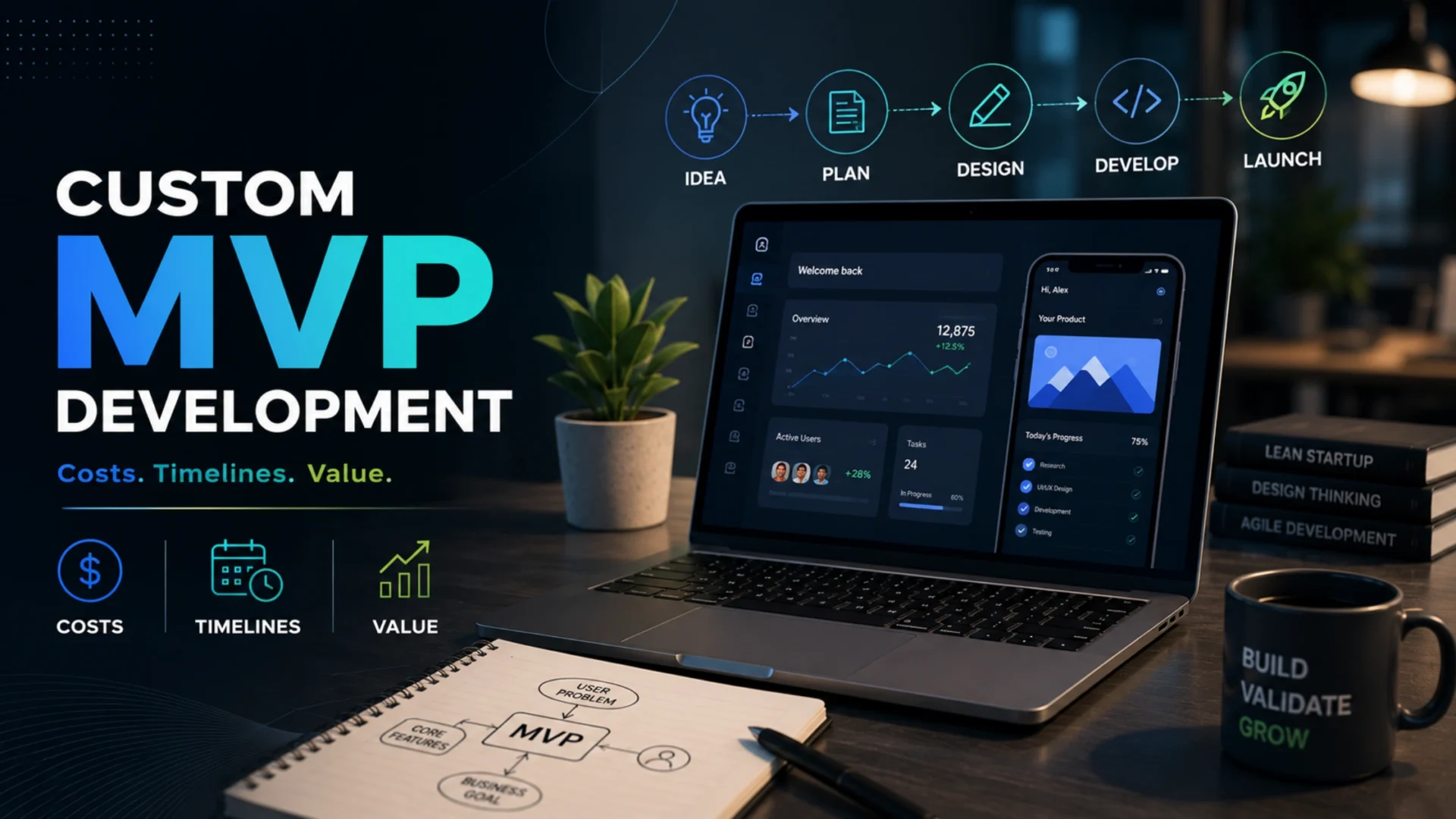
Step 1: Define the riskiest assumption.
Before any design or code, identify the one assumption that, if wrong, kills the business. That’s what the MVP needs to test, not a list of nice-to-have features.
Step 2: Research and scope. Map the target user, the core workflow, and the smallest feature set that can actually test the assumption. This is where scope discipline matters most, and where most MVPs quietly expand past “minimum.”
Step 3: Choose the MVP type and tech stack. Decide whether a concierge, single-feature, or fuller build fits what you’re testing, then pick a stack that supports the MVP now and won’t need to be replaced if it works.
Step 4: Design the core user flow. Wireframes and clickable prototypes for the essential path only. Polish on secondary screens can wait.
Step 5: Build in short, working increments. Development happens in sprints that produce something testable, rather than one long build phase with nothing to show until the end.
Step 6: Launch to a defined group. Release to a closed set of real users rather than the general public. A smaller, well-chosen group produces cleaner signal than a broad, unfocused launch.
Step 7: Measure, learn, and decide. Track how users actually behave against the assumption you set out to test. The output of this step is a decision: keep building, pivot the approach, or stop.
How to Scope Your MVP
Scope creep is the most common way an MVP stops being minimum. A practical way to hold the line is to run every proposed feature through a simple prioritization framework before it’s approved.
MoSCoW sorts features into Must-have, Should-have, Could-have, and Won’t-have for this version. Only “must-have” features that directly test the core assumption belong in the MVP; everything else is deferred, not discarded.
RICE scores each feature by Reach, Impact, Confidence, and Effort, giving a rough numeric way to compare features that otherwise feel equally important in a room full of stakeholders.
Either framework works. What matters is having a documented, revisitable answer to “why is this feature in the MVP” for every item on the list, so scope decisions don’t quietly drift as the build progresses.
MVP Testing and Validation
Testing an MVP is different from testing a finished product. The goal isn’t finding every bug. It’s finding out whether the core assumption holds.
Before launch, functional QA should confirm the core flow works reliably, since a broken primary path will contaminate your results with technical friction instead of genuine product feedback. After launch, the focus shifts to behavioral signals: activation rate, task completion, retention over the first few sessions, and whether users take the specific action tied to your core assumption.
Qualitative feedback matters alongside the numbers. A short user interview after someone completes the core flow often explains the “why” behind a metric that the data alone can’t answer. Treat the first testing round as a checkpoint, not a verdict: a weak result usually points to a scope or targeting problem worth fixing before concluding the whole idea doesn’t work.
Have a product idea but not sure what the MVP scope should be?
Elsner’s team helps startups define, scope, and build MVPs that test the right assumption from day one.
How Much Does Custom MVP Development Cost?
There’s no single honest number here, and any guide that gives you one fixed figure is guessing. What actually drives custom MVP development cost is a combination of factors worth understanding before you request a quote.
Scope and complexity. A single-feature MVP with a simple user flow costs a fraction of an MVP that needs real-time data processing, complex permissions, or multiple user roles.
Platform. A web-only MVP is generally cheaper to build and iterate on than a native mobile app, since mobile adds app store review cycles and platform-specific development.
Integrations. Connecting to payment processors, third-party APIs, or existing enterprise systems adds development and testing time beyond the core feature itself.
Compliance requirements. Healthtech, fintech, and other regulated industries require additional security, data handling, and documentation work that a generic consumer app doesn’t need.
Design depth. A clickable prototype with minimal polish costs less than a fully designed interface, and for a true MVP, minimal polish is usually the right call.
Team structure. A dedicated team with a project manager, developers, and QA costs more per week than a smaller pod, but often moves faster and with fewer handoff errors.
Rather than anchoring on a number pulled from a blog post, the more useful exercise is scoping the MVP first using the frameworks above, then getting quotes against that specific scope. Two MVPs both labeled “custom MVP development” can differ in cost by a wide margin depending on what’s actually inside them.
It helps to think in relative tiers rather than fixed prices. A lean validation build, a single core flow, minimal design, no third-party integrations, sits at the lower end and is often the right starting point when you’re still unsure the assumption holds. A standard custom MVP adds a real design pass, one or two integrations such as payments or authentication, and a small set of supporting features, and represents where most funded startups land. A complex or regulated MVP, multiple user roles, compliance requirements, or integration with existing enterprise systems, costs meaningfully more and takes longer, largely because of the security and documentation work rather than the core feature itself. Knowing which tier your idea actually falls into before requesting quotes makes it much easier to tell whether a proposal is reasonable.
Custom MVP Development by Industry
The core process stays the same across industries, but what counts as “minimum” shifts depending on the constraints of the space.
Healthtech. A healthtech startup MVP development effort usually can’t skip data security and compliance considerations, even at the earliest stage, since handling any patient-adjacent data changes what “minimum” is allowed to mean. Validation often has to happen with a narrower pilot group under tighter data handling than a typical consumer product.
Fintech. Payment handling, KYC requirements, and financial data security push certain “non-core” features into the must-have column earlier than in other industries, even for a concierge-style MVP.
Ecommerce and marketplaces. The core assumption is often two-sided, whether buyers and sellers both show up, which sometimes calls for a concierge MVP where the matching happens manually before any marketplace logic gets built.
B2B SaaS. Validation usually depends less on volume and more on depth: a handful of design partners using the product for real work weekly is a stronger signal than a broad but shallow user base.
Common MVP Mistakes to Avoid
Where MVPs go wrong
Most failed MVPs aren’t failures of execution. They’re failures of scope. Teams add “just one more feature,” test with the wrong audience, or launch broadly before the core flow is reliable, and the result is a build that took months and still didn’t produce a clear answer.
Building for imagined future users instead of the ones you can reach now.
An MVP validated with the wrong audience tells you nothing useful, no matter how clean the data looks.
Treating the MVP as a smaller version of the full product. An MVP isn’t a stripped-down final product. It’s a test built to answer one specific question.
Skipping the “why” behind each feature. Without a documented reason tied to the core assumption, features get added because they feel obviously useful, and scope quietly grows.
Polishing before validating. Time spent on visual design before the core assumption is confirmed is often time spent polishing something you’re about to change.
Launching too broadly, too soon. A wide, unfocused launch produces noisy data. A smaller, well-targeted group produces a clearer signal.
Ignoring qualitative feedback. Usage numbers tell you what happened. A short conversation with real users often tells you why, and why is what shapes the next build.
How to Choose the Right MVP Development Company
Whether you’re evaluating a boutique MVP development agency or a larger mvp development company, a few questions separate a genuine product partner from a team that just writes code to spec.
Do they push back on scope? A partner who accepts every requested feature without question isn’t protecting your runway. The right partner should be asking “does this test the core assumption” as often as you are.
Can they show relevant build experience? Bespoke MVP development for a two-sided marketplace looks different from a bespoke MVP development company build for an internal B2B tool. Ask for examples close to your situation, not just a general portfolio.
What happens after launch? An MVP that validates should turn into a real product. Ask how the team handles the transition from MVP to scaled build, and whether the architecture they’re proposing now will support that.
How do they handle communication? Weekly demos of working software are a better signal of a healthy engagement than status reports describing progress you can’t see.
Do they understand your industry’s constraints? A healthtech or fintech MVP needs a partner who already knows the compliance landmines, not one learning them on your project. Teams with broader AI and machine learning development experience are also worth a look if your MVP’s core value depends on a model or automated recommendation, since that changes both the scoping and the testing approach.
What Happens After Your MVP Validates
Validation isn’t the finish line, it’s the point where the real build decisions start. A common mistake is treating the MVP codebase as the permanent foundation without revisiting it once usage data shows what the product actually needs to become.
If the assumption held: prioritize the next layer of features based on the specific behavior and feedback you gathered, not the original feature wishlist that got deferred during scoping. Revisit the architecture now, before scaling, to confirm it can support real growth rather than just the pilot group.
If the results were mixed: look at whether the issue was the product, the audience, or the scope before concluding the idea failed. A weak signal from the wrong test group is a targeting problem, not proof the concept doesn’t work.
If the assumption didn’t hold: a clear negative result is still a success in the sense that mattered, you found out with a small build instead of a large one. The same process, define the assumption, scope the smallest test, measure honestly, applies to whatever you try next.
Real MVP Examples Worth Knowing
A few widely documented MVPs illustrate how different the “minimum” in minimum viable product can look depending on what’s being tested.
Dropbox famously tested demand with a simple explainer video showing how the product would work, before the underlying file-sync technology was fully built. The response to that video was the validation, not a finished app.
Airbnb’s founders tested their core assumption, that strangers would pay to stay in someone’s home, by renting out air mattresses in their own apartment. No platform, no booking system, just a direct test of the idea.
Zappos began by photographing shoes at local stores and manually fulfilling orders placed on a simple website, testing whether people would actually buy shoes online before any inventory or logistics system existed.
Buffer validated interest with a landing page describing the product and its pricing tiers, months before the scheduling tool itself was built, using sign-up numbers as the signal to move forward.
None of these started as the polished products they eventually became. Each one was scoped around a single question, and the answer to that question shaped everything that came next.
MVP Development Checklist
- Riskiest assumption clearly defined and written down
- Target user and core workflow identified
- MVP type chosen (landing page, concierge, Wizard of Oz, single-feature, or piecemeal)
- Feature list scored against MoSCoW or RICE
- Tech stack chosen with post-MVP scaling in mind
- Core user flow designed and clickable
- Compliance or industry-specific requirements identified early
- Launch group defined and narrow enough for clean signal
- Success metrics tied directly to the core assumption
- Plan in place for qualitative feedback, not just usage data
- Decision criteria set in advance for keep, pivot, or stop
Frequently Asked Questions
What is custom MVP development?
Custom MVP development is building a minimum viable product scoped and engineered around your specific users, business model, and technical needs, rather than assembling one from a generic template or no-code kit.
How is a custom MVP different from a no-code MVP?
A no-code MVP is faster to launch but limited to what the platform supports, and often needs a rebuild once real usage grows. A custom MVP takes longer to build but the architecture can scale into the full product without starting over.
How long does custom MVP development take?
It depends heavily on scope. A tightly scoped, single-feature MVP can launch in a matter of weeks, while an MVP with integrations, compliance requirements, or multiple user roles takes longer. Scoping the MVP properly before estimating timeline avoids surprises later.
How much does MVP development cost?
Cost depends on scope, platform, integrations, compliance needs, and team structure rather than a fixed price. Scoping the MVP first, then requesting quotes against that specific scope, gives a far more reliable estimate than any generic number.
Do I need a working product, or can an MVP be simpler than that?
Not always. A landing page, a concierge service run manually, or a Wizard of Oz test can validate an assumption without any working software, and are often the right first step before committing to a custom build.
How do I choose an MVP development company?
Look for a partner who pushes back on scope, has relevant build experience close to your product type, communicates through working demos rather than status reports, and can explain how the MVP architecture will support your product after launch.
Key Takeaways
- An MVP exists to test your riskiest assumption, not to ship a smaller version of the full product.
- Custom development avoids the rebuild that generic templates and no-code tools often force once real usage grows.
- Scope discipline, using a framework like MoSCoW or RICE, is what keeps an MVP minimum.
- Cost and timeline depend on scope, platform, integrations, and compliance needs, not a fixed number.
- The strongest MVPs are validated with a narrow, well-chosen group and backed by both usage data and direct user feedback.
A custom MVP is not a smaller product. It’s a sharper question, built just well enough to get a real answer from real users. Start by naming the one assumption that would sink the business if it’s wrong, scope the smallest build that tests it, and resist every feature that doesn’t serve that test directly. Get that part right, and the decision about what to build next stops being a debate and starts being obvious.
Ready to turn your idea into a testable MVP?
Elsner works with startups across web, mobile, and AI-driven products to scope, build, and launch custom MVPs that give you a real answer, fast.