




- What a SaaS product development roadmap actually covers
- Why the same roadmap doesn’t work for both audiences
- The roadmap at a glance
- Phase 1: Validation before a single line of code
- Phase 2: MVP scope and architecture, where the tracks split
- What SaaS product development actually costs in 2026
- Not sure which roadmap track fits your product?
- Realistic timelines for both tracks
- What AI actually changes on the roadmap, honestly
- Security and compliance, where the roadmap risk shifts most
- Roadmap mistakes that hit each track differently
- Choosing a development partner for either track
- How Elsner builds SaaS roadmaps for both audiences
- The bottom line
- Ready to map your SaaS roadmap the right way?
- Frequently Asked Questions
- What is a SaaS product development roadmap?
- How does a startup roadmap differ from an enterprise SaaS roadmap?
- How much does SaaS product development cost in 2026?
- How long does it take to build a SaaS product?
- Does AI actually speed up SaaS product development?
- When should compliance work like SOC 2 or HIPAA start on the roadmap?
- What is the biggest reason SaaS roadmaps fail?
- Should a SaaS product start with a monolith or microservices?
A startup roadmap and an enterprise roadmap for the same SaaS idea can look almost nothing alike, and that’s the part most guides skip. A five-person team validating a new billing tool doesn’t need the same sequence, budget, or compliance posture as a 500-person company adding a new module to an existing platform. Yet most SaaS product development advice online hands both audiences the identical eleven-step checklist.
This guide breaks the roadmap into what actually changes based on where you’re starting from, with real 2026 cost ranges, honest timelines, and a clear look at what AI genuinely speeds up versus what it doesn’t touch. If you’re deciding whether to build lean and validate first, or whether your organization needs multi-tenant architecture and SOC 2 readiness from day one, the answer depends heavily on which track you’re on.
Quick Answer
A SaaS product development roadmap is the phased plan that takes a cloud-hosted, subscription-based software product from validated idea through MVP, launch, and ongoing iteration. For startups, the roadmap centers on validating demand fast and building the smallest architecture that proves the hypothesis, typically 3 to 6 months to a working MVP. For enterprises, the roadmap centers on integration with existing systems, compliance from day one, and multi-tenant scale, typically 6 to 12 months before a broad rollout. Both tracks share the same core phases, but the sequencing, budget, and risk tolerance at each phase differ significantly.
What a SaaS product development roadmap actually covers
A SaaS product development roadmap is the sequenced plan for building, launching, and scaling a cloud-hosted software product that customers access on a subscription basis. It covers everything from problem validation and MVP scoping through architecture decisions, security posture, testing, launch strategy, and the ongoing iteration that never really stops once real users are on the platform.
SaaS development differs from a one-time software build in three structural ways. The product is multi-tenant by design, meaning multiple customers share infrastructure while their data stays isolated. The team ships continuously rather than in versioned releases. And churn is instant, since a dissatisfied customer can cancel with a click rather than waiting out a contract term. That last point reshapes the entire roadmap: retention isn’t a marketing metric bolted onto the product, it’s the product’s actual job.
Where most roadmap templates fall short is treating every SaaS build as the same animal. A pre-seed startup validating a brand-new category and a Fortune 1000 company launching an internal tool to 40,000 employees are both “building SaaS,” but they’re solving completely different problems at completely different speeds. The roadmap below splits where it genuinely needs to split, and stays unified where the fundamentals don’t change.
The one question every phase should answer
What will we know after this phase that we don’t know now, and how will that change what we build next. If a phase can’t answer that, it’s busywork dressed up as progress.
Why the same roadmap doesn’t work for both audiences
The global SaaS market is projected to grow from $375.57 billion in 2026 to $1,482.44 billion by 2034, a CAGR of 18.7 percent, according to Fortune Business Insights. That growth isn’t evenly distributed. Large enterprises already account for roughly 62.3 percent of total SaaS market share, per Market Data Forecast, which means most of the dollars in this market are flowing through procurement processes, security reviews, and integration requirements that a scrappy MVP roadmap never has to touch.
Startups and enterprises aren’t just different in size. They’re solving for different kinds of risk at every phase.
A startup’s biggest roadmap risk is building something nobody wants. An enterprise’s biggest roadmap risk is different: it’s building something that works but never clears procurement, security review, or integration with the fifteen other systems it needs to talk to. Neither risk is bigger than the other. They just need entirely different sequencing to manage, which is why the roadmap below splits into two tracks starting at Phase 2.
The roadmap at a glance
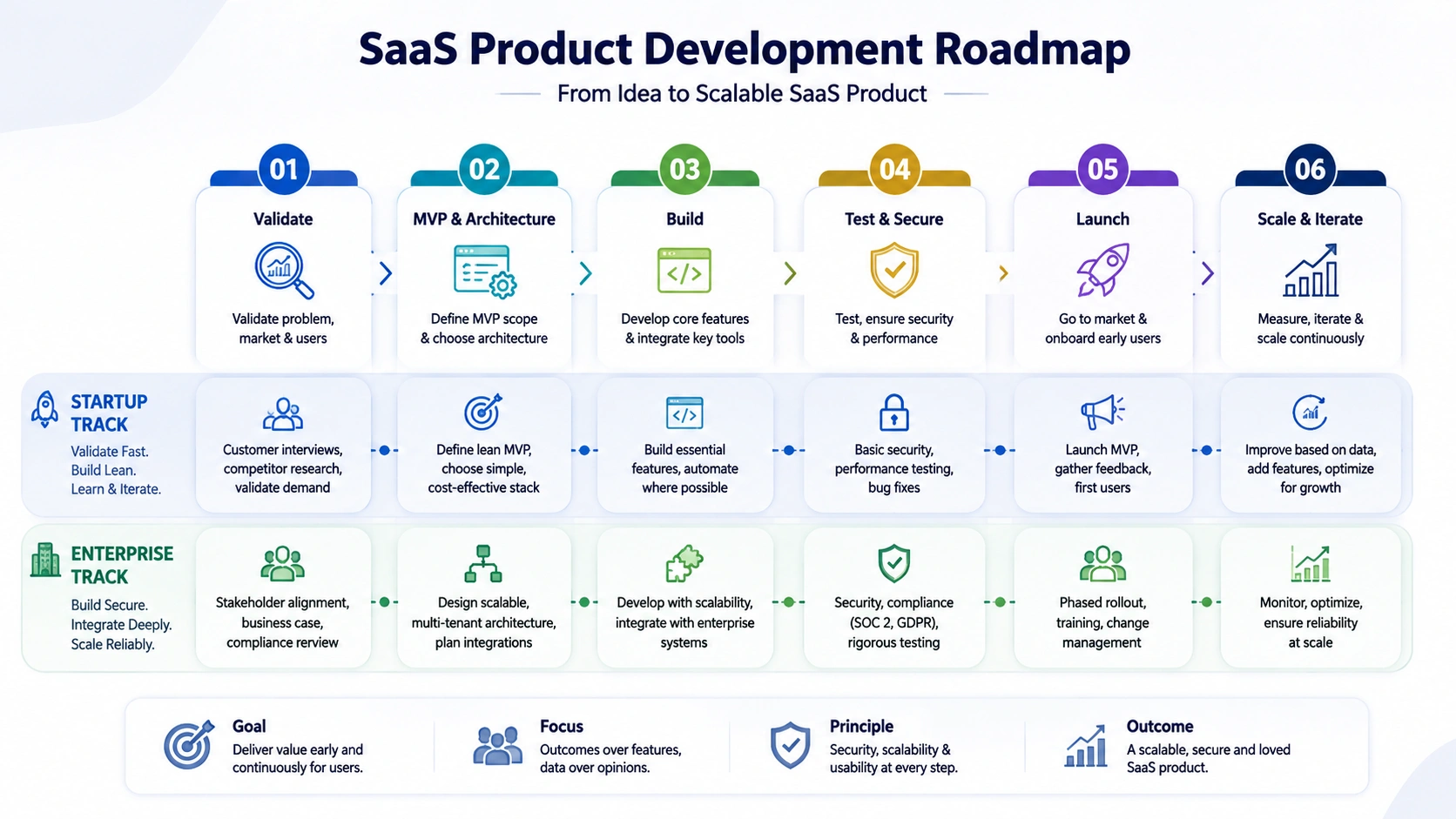
Both tracks share the same six phases. What changes is the depth, the order of priorities within each phase, and how much gets built before real users touch the product.
| Phase | Startup priority | Enterprise priority |
|---|---|---|
| 1. Validation | Prove anyone wants this | Prove internal or market demand exceeds build cost |
| 2. Scope and architecture | Smallest thing that tests the hypothesis | Fit within existing systems, security posture |
| 3. Build | Speed over polish | Reliability and integration over speed |
| 4. Security and compliance | Baseline hygiene, add certifications on demand | SOC 2, GDPR, HIPAA before first pilot |
| 5. Launch | Public or self-serve, fast feedback loop | Phased rollout, pilot group, change management |
| 6. Iterate and scale | Chase activation and retention signals | Chase adoption across departments and business units |
Phase 1: Validation before a single line of code
For a startup, validation means interviews with 15 to 20 people who actually experience the problem, not people who have opinions about it. Ask what they currently do, what they’ve already tried, and whether they’d pay to make the problem go away. A landing page with a real demo video and an email capture, run before any code exists, tells you more about demand than a month of internal debate ever will.
Startup track in practice
Buffer’s earliest version wasn’t scheduling software at all. It was a two-page site: one page explaining the idea, a second asking for an email if someone wanted in. The founder built the actual product only after enough people signed up to justify the engineering time. That’s the validation phase working exactly as it should, proof collected before a single feature gets coded.
For an enterprise, validation looks different because the “customer” is often internal. The equivalent work is confirming that the department requesting the tool has budget authority, that the problem is painful enough to survive a reprioritization six months from now, and that no existing vendor already solves 80 percent of it cheaper than a custom build would. Enterprise validation failures rarely look like “nobody wanted it.” They look like “everyone wanted it, but three other initiatives got funded first,” which is a scoping and stakeholder problem more than a demand problem.
Enterprise track in practice
Slack didn’t start as a product pitched to outside buyers. It began as an internal messaging tool built for one company’s own team, tested against real daily use before anyone outside that organization ever saw it. That’s the enterprise-style validation pattern: prove the tool earns its place inside one team’s actual workflow before scaling the ambition beyond it.
A useful benchmark either way is Sean Ellis’ product-market fit test: ask early users how they’d feel if they could no longer use the product. If fewer than 40 percent say “very disappointed,” the roadmap isn’t ready to move into heavier build phases yet, regardless of company size. Getting this phase wrong compounds through everything downstream, which is one reason we treat product strategy consulting as a distinct engagement rather than a rushed kickoff call.
Phase 2: MVP scope and architecture, where the tracks split
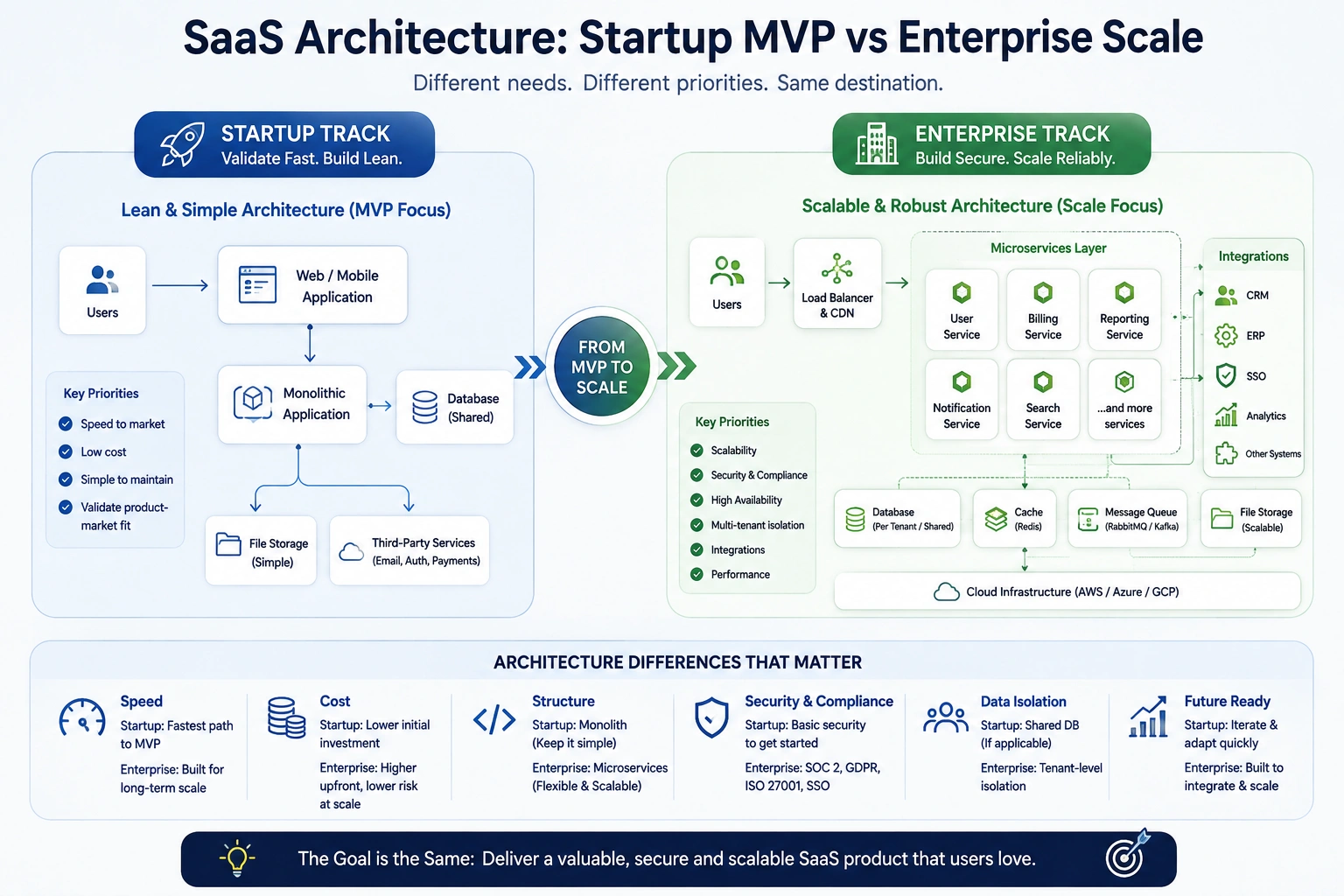
This is the phase where a startup and enterprise roadmap genuinely diverge, and treating them the same here is where most generic advice breaks down.
Startup track. Pick one to three activation metrics before writing any specification. An activation metric is the moment a user gets enough value to come back, and if you can’t name it, the scope isn’t an MVP yet, it’s a wishlist. A clean monolithic backend on a managed cloud platform almost always beats a distributed microservices setup at this stage. Splitting services before you have paying users adds operational overhead that slows down the exact iteration speed an early-stage roadmap depends on.
Enterprise track. Architecture decisions need to account for existing systems from day one, since a tool that can’t integrate with the company’s identity provider, data warehouse, or approval workflows becomes shadow IT the moment it launches. Multi-tenancy strategy matters here in a way it doesn’t for a lean startup MVP. AWS outlines three common tenant isolation models: a silo model with a separate database per tenant for maximum isolation, a bridge model with shared infrastructure but separate schemas, and a pool model with fully shared infrastructure and row-level security. Enterprise SaaS rollouts often need the silo or bridge model for their most security-sensitive customers, even if the broader platform runs pooled infrastructure for everyone else.
A scoping test that works for either track
If a feature doesn’t move the activation metric or block a required integration, it doesn’t belong in this phase. Everything else goes on a list for after real usage data comes in.
What SaaS product development actually costs in 2026
Cost ranges get vaguer the further you move from a specific scope, so here’s the honest breakdown by realistic build tier rather than a single number that hides more than it reveals.
| Build tier | Cost range | Typical scope |
|---|---|---|
| Startup MVP | $25,000 to $70,000 | Single-tenant-simple architecture, core workflow, basic auth |
| Growth-stage v1 | $70,000 to $150,000 | Multi-tenant SaaS, billing integration, role-based access |
| Enterprise-ready platform | $150,000 to $400,000+ | SOC 2 posture, SSO, enterprise integrations, high availability |
A few line items move the number more than founders expect. Compliance work, SOC 2 Type 2, HIPAA, or GDPR readiness, typically adds 30 to 50 percent to a build, since it touches data architecture, logging, and access controls rather than sitting off to the side as a feature. Generative AI capabilities like chat interfaces or retrieval pipelines usually add 15 to 30 percent, mostly from data preparation and evaluation work. And maintenance, which almost nobody budgets properly, runs 15 to 25 percent of the original build cost annually.
The number that predicts success better than any of the above: how much budget goes to validation before development starts. Teams that spend at least 20 percent of total budget on discovery and scoping before writing code are reported to be roughly three times more likely to ship something that actually works, based on data compiled by Startups.com. Skipping that phase to save a few thousand dollars is one of the more expensive shortcuts in this entire process.
Not sure which roadmap track fits your product?
Elsner can review your product hypothesis and give you an honest read on scope, cost, and which phase to prioritize first.
Realistic timelines for both tracks
Anyone promising an enterprise-ready SaaS platform in six weeks is overselling scope. Here’s what the timeline honestly looks like once discovery, build, security, and testing all get their real share of time.
Startup track
Weeks 1 to 4
Validation interviews, smoke-test landing page, activation metric defined, architecture kept deliberately simple.
Weeks 5 to 14
Core MVP build, weekly demoable increments, beta group of 50 to 100 real users by the end of this window.
Weeks 15 to 20
Public or self-serve launch, activation metrics tracked from day one, first iteration cycle starts immediately.
Enterprise track
A focused startup MVP typically lands in 8 to 16 weeks. A full enterprise-ready v1, security posture included, usually runs 9 to 12 months. Timelines that stretch well past those windows almost always signal that the scope crept somewhere along the way, not that the team lacks talent.
What AI actually changes on the roadmap, honestly

Every SaaS development blog right now claims AI has rewritten the entire timeline. That’s true in a narrower way than most of those posts admit, and the difference matters for how you plan phases.
McKinsey ran a controlled study across more than 40 developers, breaking productivity gains down by task type instead of treating “AI helps coding” as one blanket claim:
| Task type | Time saved with AI assistance |
|---|---|
| Code documentation | 45% to 50% faster |
| New code generation | 35% to 45% faster |
| Code refactoring | 20% to 30% faster |
| High-complexity architecture work | Under 10% faster |
That last row matters most for roadmap planning. Multi-tenant data isolation, security architecture, and integration logic, exactly the work that dominates the enterprise track, barely benefit from AI assistance. AI is genuinely useful for boilerplate, documentation, and routine refactoring, which speeds up the startup MVP track more than it speeds up the parts of an enterprise build that determine whether it survives a security review. Plan AI-driven time savings into the build phase’s routine work, not into the phases that require senior judgment.
Where AI adds real value beyond raw coding speed is upstream of development entirely: synthesizing customer discovery interviews into patterns faster than manual review, flagging which features correlate with retention in usage data, and running automated regression tests that catch issues before a demo. Teams pairing this with disciplined AI agent development practices see compounding gains that a coding assistant alone never delivers.
Security and compliance, where the roadmap risk shifts most
Security posture isn’t optional for either track, but the timing and depth differ sharply. Encryption at rest and in transit is baseline on both tracks from day one, that part doesn’t change. Everything past that splits.
Buyers in healthcare, financial services, legal, and government generally won’t start a procurement conversation without SOC 2, GDPR, or HIPAA readiness already in place. Teams that design for procurement from the start, rather than scrambling once the first enterprise lead lands, close deals meaningfully faster. Retrofitting compliance onto an architecture that wasn’t built for it is almost always more expensive than building it in during the original scope, which is exactly why this belongs in Phase 2, not Phase 5.
Roadmap mistakes that hit each track differently
Over-architecting before validation is the classic startup misstep. Splitting into microservices, building custom authentication, or designing for millions of users before you have a hundred paying customers adds overhead that slows the exact iteration speed the roadmap depends on. A monolith deployed on managed infrastructure is almost always the right call at this stage.
On the enterprise side, the equivalent failure isn’t technical at all. A technically flawless build that never accounts for who signs off on rollout, budget renewal, or change management ends up shelved regardless of build quality. Skip stakeholder alignment and the roadmap dies in a committee meeting, not in a code review.
Two habits worth building early
- Tie customer signal, interview clips, support tickets, churn reasons, directly to the sprint backlog from week one instead of re-litigating it months later.
- Plan compliance controls alongside architecture in Phase 2. Bolting SOC 2 or HIPAA onto a system that wasn’t designed around them touches nearly every layer of the stack and routinely doubles that phase’s timeline.
Both tracks underbudget maintenance more than anything else on this list. Maintenance typically accounts for 50 to 80 percent of total lifecycle spend over a product’s life, according to research cited by UXPilot on SaaS lifecycle economics. Treating launch as the finish line instead of the starting line is one of the more consistent roadmap failures across company size, and it shows up regardless of how well the earlier phases were run.
Choosing a development partner for either track
Ask for a reference at the same stage and scope, not a generic logo wall. A team with a decade of enterprise platform experience can still be a poor fit for a scrappy startup MVP with an eight-week runway, and the reverse is just as true. Ask specifically what went wrong on a past project of similar scope and how it got fixed. Every honest partner has a story here.
Push on how the partner handles the roadmap split covered in this guide. If a proposal treats a startup MVP and an enterprise rollout with the same template, that’s a signal they haven’t thought through the sequencing differences that actually matter. Ask directly how compliance gets planned into the timeline, not tacked on as a line item near the end.
Finally, ask what happens after launch. A partner who disappears the moment the product ships isn’t a roadmap partner, they’re a vendor. Our own SaaS development partner guide goes deeper into the specific questions worth asking before signing a contract, regardless of which track you’re on.
How Elsner builds SaaS roadmaps for both audiences
Elsner treats the track decision covered in this guide as the actual first deliverable, not a formality before the invoice. Before a single sprint gets planned, our team maps whether a product needs the lean, validation-first sequencing of a startup roadmap or the integration-and-compliance-first sequencing an enterprise rollout demands.
On the build side, senior engineers own architecture and security decisions directly rather than deferring to a coding assistant for the work that genuinely requires judgment. Where AI speeds up routine coding and documentation, we use it. Teams building AI-native SaaS features often draw on components like the AI Dashboard Builder for rapid, data-connected reporting screens or Odoo MCP Pro for backend workflow automation, both designed to plug into a roadmap without forcing a tradeoff between speed and long-term architecture. Our broader SaaS development team carries that same discipline from MVP through enterprise scale, so a validated product doesn’t hit a wall the moment it needs to grow.
The bottom line
A SaaS product development roadmap isn’t one template stretched to fit two very different audiences. Startups need speed toward validated demand and the discipline to keep architecture simple until real users prove it needs to be otherwise. Enterprises need integration planning, stakeholder alignment, and compliance built in from the start, since retrofitting any of those later costs more than building them in from Phase 2. AI has made the routine parts of coding genuinely faster, but the parts of the roadmap that determine whether a product survives contact with real users, or real procurement, still depend on senior judgment that no tool replaces. Start with an honest read on which track your product actually belongs to before committing budget to either one.
Ready to map your SaaS roadmap the right way?
Elsner builds SaaS products that hold up past the demo, whether you’re validating a new idea or rolling out to an entire enterprise. Book a consultation and get an honest read on scope, cost, and timeline.
Key takeaways
- The same six roadmap phases apply to both startups and enterprises, but priorities, sequencing, and depth diverge sharply starting at Phase 2, MVP scope and architecture.
- Startup SaaS builds typically run $25,000 to $70,000 with an 8 to 16 week MVP timeline. Enterprise-ready platforms run $150,000 to $400,000 or more with a 9 to 12 month timeline.
- 43% of failed venture-backed startups cite poor product-market fit as the cause, which is why Phase 1 validation matters more than any architecture decision that follows it.
- AI genuinely speeds up documentation, code generation, and refactoring, but its impact on high-complexity architecture work stays under 10%, which is exactly the work enterprise roadmaps depend on most.
- Compliance and integration planning belong in Phase 2 for enterprise roadmaps, not bolted on near launch. Retrofitting SOC 2 or HIPAA controls after the fact routinely doubles that phase’s timeline.
Frequently Asked Questions
What is a SaaS product development roadmap?
A SaaS product development roadmap is the phased plan that takes a cloud-hosted, subscription-based software product from validated idea through MVP, launch, and ongoing iteration. It covers validation, scoping, architecture, security, launch strategy, and post-launch iteration, sequenced differently depending on whether the product targets startup or enterprise customers.
How does a startup roadmap differ from an enterprise SaaS roadmap?
A startup roadmap prioritizes fast validation and a minimal architecture that proves demand, typically shipping an MVP in 8 to 16 weeks. An enterprise roadmap prioritizes integration with existing systems, stakeholder alignment, and compliance readiness like SOC 2 or HIPAA before launch, typically taking 9 to 12 months to a full rollout.
How much does SaaS product development cost in 2026?
A startup MVP typically costs $25,000 to $70,000. A growth-stage v1 with multi-tenant architecture and billing integration runs $70,000 to $150,000. An enterprise-ready platform with SOC 2 posture, SSO, and enterprise integrations usually runs $150,000 to $400,000 or more.
How long does it take to build a SaaS product?
A focused startup MVP takes 8 to 16 weeks with an experienced team. A full enterprise-ready platform with security certifications and integration work typically takes 9 to 12 months. Timelines stretching well past those windows usually signal scope creep rather than a talent gap.
Does AI actually speed up SaaS product development?
Yes, for specific tasks. McKinsey research shows AI assistance cuts code documentation time by 45% to 50% and new code generation by 35% to 45%. Its impact on high-complexity architecture work stays under 10%, meaning AI speeds up routine coding without replacing the senior judgment enterprise-grade architecture requires.
When should compliance work like SOC 2 or HIPAA start on the roadmap?
Compliance planning belongs in Phase 2, alongside architecture decisions, not bolted on near launch. Retrofitting SOC 2, GDPR, or HIPAA controls onto a system not designed around them touches nearly every layer of the stack and routinely doubles the timeline of that phase compared to building it in from the start.
What is the biggest reason SaaS roadmaps fail?
For startups, it’s building before validating demand. CB Insights’ 2024 analysis found 43% of failed venture-backed startups cited poor product-market fit. For enterprises, roadmap failure is more often political than technical, stemming from missed stakeholder alignment or compliance requirements discovered too late in the process.
Should a SaaS product start with a monolith or microservices?
Most SaaS products, especially startup MVPs, should start with a clean monolithic backend on a managed cloud platform. Splitting into microservices before validating demand adds operational overhead that slows iteration without delivering value users notice. Microservices tend to make sense only once scale or team size genuinely requires them.