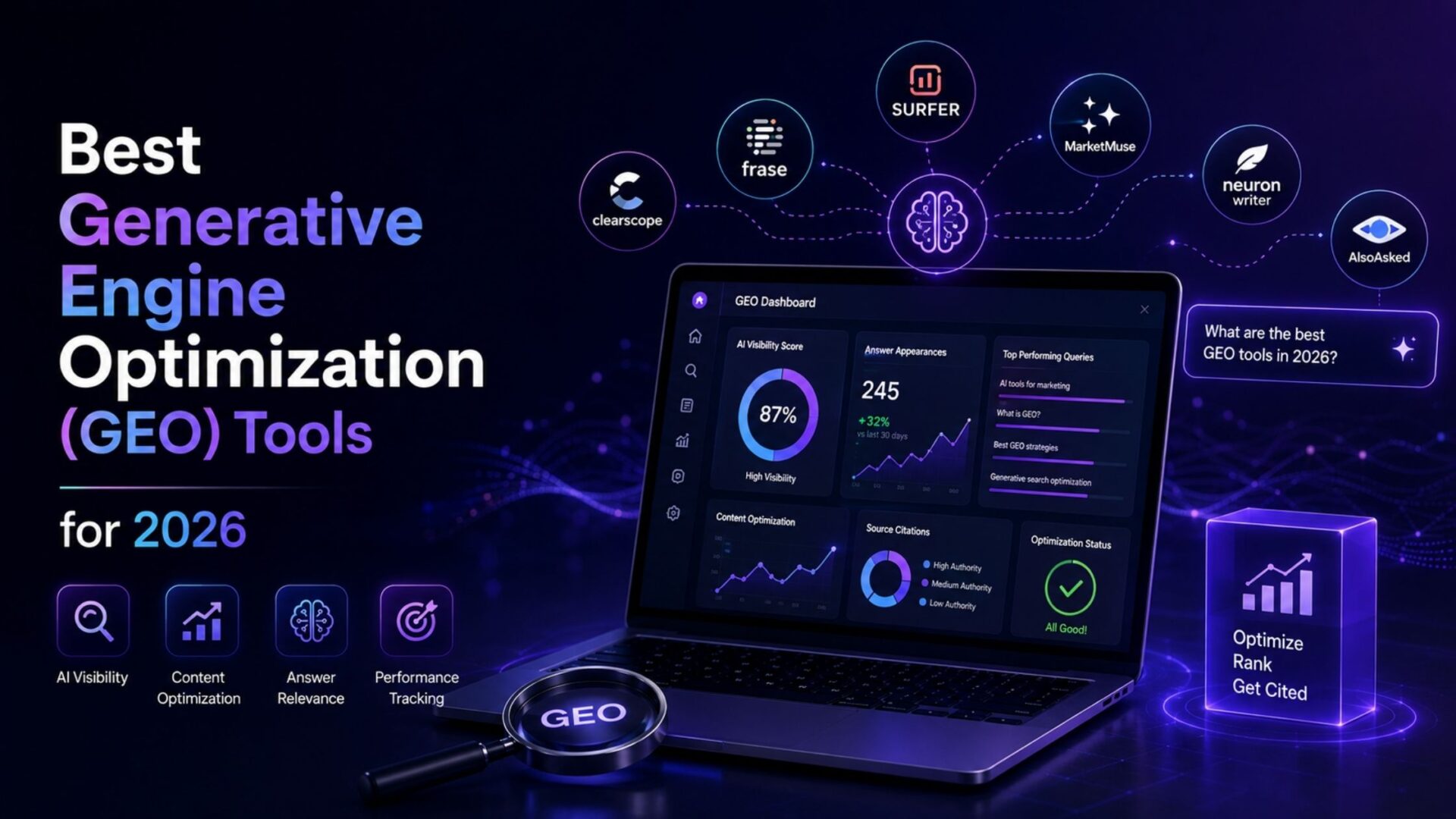





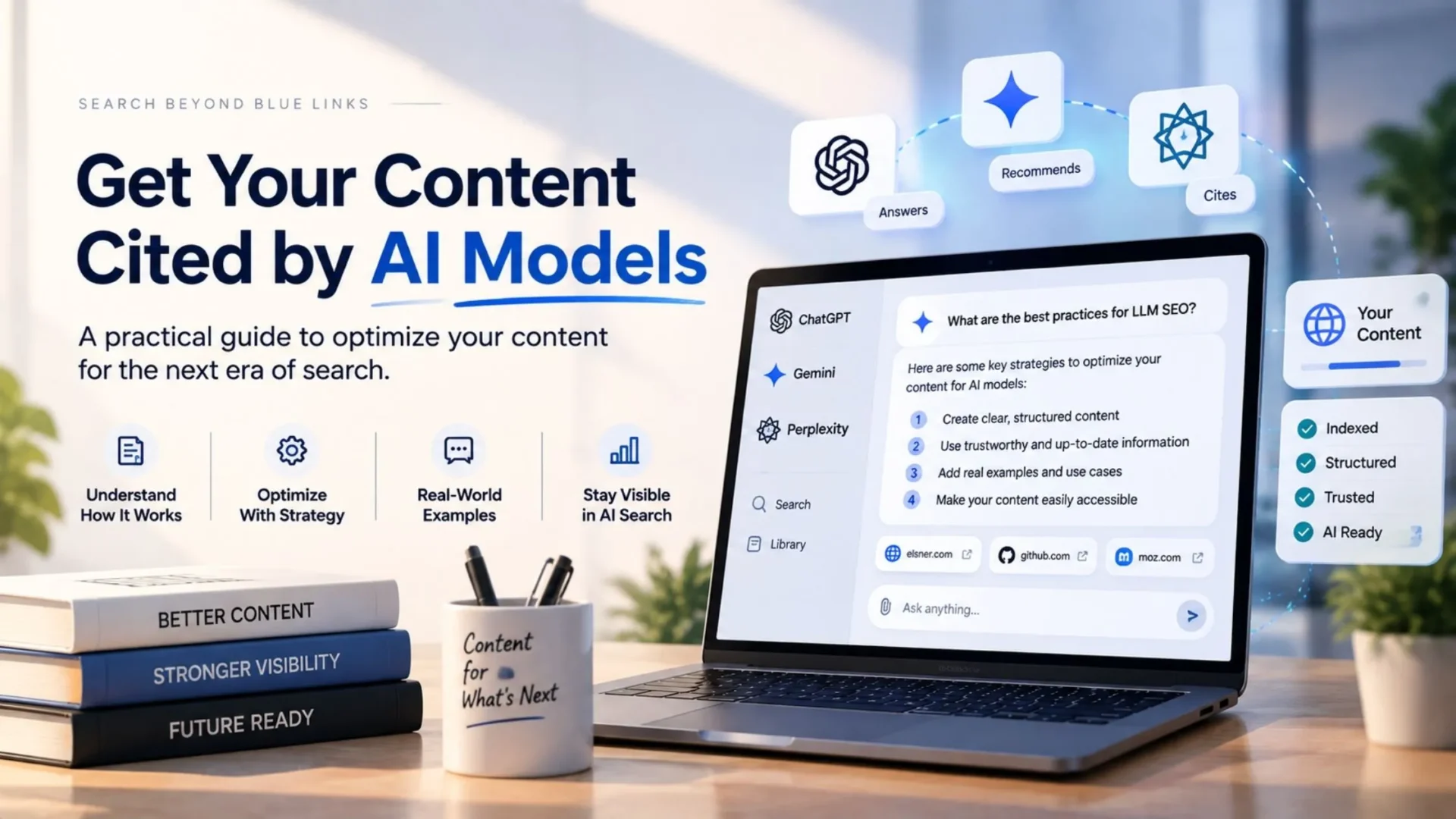
- What Is LLM SEO?
- How LLMs Actually Find and Cite Content
- LLM SEO vs SEO, GEO, and AEO
- How to Optimize Your Content for AI Models
- LLM SEO for Ecommerce
- Common LLM SEO Mistakes
- How to Measure LLM SEO
- A Starter LLM SEO Checklist
- The Bottom Line
- FAQs
- What is LLM SEO?
- How is LLM SEO different from traditional SEO?
- How do I get my content cited by ChatGPT or Perplexity?
- Does schema help with LLM SEO?
- How do I measure LLM SEO results?
- Ready to See Where Your Content Stands With AI Models?
Search is splitting in two right now. Half of it still runs through blue links on a results page. The other half runs through a model that reads, reasons, and answers before a user ever sees a URL. LLM SEO is how you stay visible in that second half, where a chatbot does the recommending instead of a ranking algorithm.
This guide skips the definitions most posts stop at. You’ll get an actual method: how models retrieve content, why some pages get cited and others get ignored, and what to change on your site this week. Ecommerce examples are woven in throughout, since that’s where the stakes are highest right now.
What Is LLM SEO?
LLM SEO is making your content understood, trusted, and cited by large language models like ChatGPT, Gemini, and Perplexity. It is not simply keyword research repackaged. It is defining how to make your content comprehensible for a system that reads for understanding before search signals.
Think of it this way. Classic SEO earns a spot on a results page. LLM SEO earns a mention inside an answer the user never has to click away from. Same battlefield, different weapons.
How LLMs Actually Find and Cite Content
Here’s where most competitor articles go quiet, and it’s the part that actually matters.
This distinction changes what you optimize for. You’re not trying to get baked into a future model’s weights, since you have no control over that and no reliable way to measure it. You are trying to be the page a retrieval system reaches for right now.
So how does retrieval actually pick winners? Usually a mix of signals:
- Clarity: can the model tell what your page is actually about within the first few lines?
- Structure: is the answer easy to lift out, or buried in a wall of text?
- Authority: does other content on the web back up what you’re saying?
- Freshness: is this the most current explanation available on the topic?
Thin content gets passed over almost every time. So does content that scatters one idea across ten vague paragraphs instead of stating it once, clearly. Models optimize for the reader’s time, not your word count.
For a deeper look at how AI systems are reshaping search behavior more broadly, our take on the future of SEO with LLMs, GEO, and AEO goes deeper into where this is headed next.
LLM SEO vs SEO, GEO, and AEO
These four terms get thrown around like synonyms. They are not. Here’s the plain version.
SEO still gets your page crawled, indexed, and ranked in the first place. Without that foundation, none of the rest matters, since a model that can’t find your page can’t cite it either. AEO layers on top, structuring content so it can be lifted directly into a snippet or a voice answer. Generative Engine Optimization (GEO) is the broader discipline of earning citations across generative platforms, and LLM SEO is closer to its execution layer: the specific, hands-on work of making a given piece of content legible and trustworthy to a model.
Honestly, most teams don’t need to pick one. You need all four working together, in that order, and SEO is not going anywhere just because AI answers are grabbing attention. It underpins everything else, which is worth remembering the next time someone asks, “Can AI replace SEO experts” entirely.
If you want the fuller breakdown of where each discipline starts and stops, our GEO vs AEO vs SEO comparison guide covers it without recycling this same table.
How to Optimize Your Content for AI Models
This is the part worth bookmarking. Treat these as ordered plays, not a checklist to skim once.
|
1
|
Make Entities Clear and ConsistentAn entity is any distinct thing your content refers to: your brand, your product line, a specific feature, a person. Models build an internal map of entities and how they relate. If your brand name, product names, and key terms shift wording across your site (a plugin called one thing on the homepage and something slightly different on a blog post), you’re making that map harder to build. Keep naming exact. Every time. |
|
2
|
Structure Content for ExtractionLead with the direct answer, then support it. Don’t warm up for three paragraphs before answering the question in your own H1. Use clean, descriptive headings. Keep logical order: definition, then mechanism, then application. A model extracting a paragraph needs that paragraph to stand mostly on its own. |
|
3
|
Add Schema So Machines Can Parse MeaningFAQ schema, Article schema, and Product schema all give a model structured hints about what your content is and how its pieces relate. It won’t guarantee a citation. It does remove ambiguity, and ambiguity is what gets pages skipped. |
|
4
|
Create Genuinely Citable ContentOriginal data, clear original definitions, and useful frameworks get cited. Rehashed competitor summaries usually don’t, because a model has no reason to prefer your version of the same three points everyone else already made. If you have a process, a framework, or a number nobody else has published, that’s the edge worth building on. Worth a warning: don’t overthink this into a research department you don’t have. A clearly stated internal benchmark, a documented process you actually run with clients, or an honest breakdown of a tradeoff most vendors avoid mentioning, that’s often enough. |
|
5
|
Build Presence Beyond Your Own SiteAI models also consider what other reliable sources say about an entity, not just its own self-presentation. Reviews, mentions in industry roundups, guest articles, and citations from other websites all contribute to how much weight a model places on your brand as a single entity. It’s slower work, and the most neglected part, because it’s hard to sell as a quick fix, which is exactly why most competitor guides skip it. |
|
6
|
Keep Content Accurate and CurrentModels prefer up-to-date, reliable sources over stale ones, mainly when the topics are tools, pricing, and platform features, which change regularly. So schedule and set a review cycle. Outdated content doesn’t just rank worse; it actively deteriorates the trust signals you’re trying to generate. |
|
7
|
Cover the Full Question Space Around a TopicA single answer to a single query rarely signals real authority. A cluster of content that answers the adjacent questions too (the “how,” the “why not,” the “what about”) tells a model you actually know the subject rather than having found one good angle on it. |
The single biggest shift here, more than any tactic on this list: you’re writing to be quoted, not just clicked. That changes how you open a paragraph, how you structure a list, and how much throat-clearing you allow yourself before the actual point.
Our AI search and AEO strategies resource digs further into the technical side of structuring content for this shift, and our answer engine optimization services team applies this framework directly for clients who want it built into their content program.
LLM SEO for Ecommerce
Ecommerce brands have a specific version of this problem, and it’s usually a data problem before it’s a content problem.
Clean Product Data Matters More Than Merchandising Teams Realize
Specs, materials, sizing, compatibility: all of it needs to be structured and consistent, because AI shopping answers increasingly pull directly from product feeds and structured markup rather than marketing copy. A product page with vague, adjective-heavy descriptions and no real spec table is invisible to a model trying to answer “which of these actually fits a size 10.”
Reviews and Comparison Content Feed AI Shopping Answers Directly
When a model answers “best running shoes for flat feet under $150,” it’s synthesizing from review sentiment and comparison pages, not from a single brand’s product description. Build that content deliberately instead of hoping it accumulates.
Category and Buying-Guide Depth Builds Product-Entity Authority
A thin category page with a product grid and no supporting context gives a model nothing to work with. A category page that also answers the buyer’s actual research questions (how to choose, what matters, common mistakes) gives it plenty.
For teams building this out specifically for online stores, our ecommerce SEO services work covers the technical and content foundation this all sits on.
Common LLM SEO Mistakes
- Treating it as classic SEO with a new label slapped on top. It shares DNA with SEO. It is not the same job.
- Writing for keywords instead of clear answers. A page stuffed with variations of “llm seo strategy” reads worse to a model than one clean paragraph that actually answers the question.
- Ignoring off-site mentions and authority, then wondering why a much smaller competitor keeps getting cited instead.
- Publishing thin content and expecting citations anyway. It doesn’t happen.
- Chasing every AI platform at once instead of the two or three your actual audience uses. Spreading effort across ChatGPT, Gemini, Perplexity, Claude, and whatever launches next month usually means doing none of them well.
How to Measure LLM SEO
Honestly, this is the weakest part of the discipline right now, and any guide that pretends otherwise is overselling.
Track brand mentions and citations inside AI answers where you can. Manual prompt testing across ChatGPT, Perplexity, and Gemini still works, even if it doesn’t scale well. Watch branded search volume and direct or referral traffic patterns as a proxy signal, since a citation inside an AI answer often drives someone to search your name directly afterward rather than clicking straight through.
Measurement tooling in this space is young. Some platforms are folding AI visibility tracking into existing SEO suites, and third-party tools are emerging to fill the gap, but none of it approaches the reliability of standard rank tracking yet. Treat any tool’s numbers here as directional, not exact.
A Starter LLM SEO Checklist
Run through this in order:
- Audit entity consistency across your site (brand name, product names, key terms)
- Rewrite your top pages to lead with the direct answer before the supporting detail
- Add FAQ and Article schema to your highest-priority content
- Identify one piece of genuinely original data, framework, or process you can publish
- List three to five sites where a mention or citation would carry real authority, and start outreach
- Set a quarterly review cadence for anything tied to pricing, tools, or platform features
- Map the adjacent questions around your core topics and fill the gaps
- Set up manual prompt testing across the two or three AI platforms your audience actually uses
The Bottom Line
LLM SEO is not a shortcut and it is not a rebrand. It’s clarity, authority, and citable content, built deliberately rather than hoped for. The teams getting cited right now aren’t the ones chasing every new AI platform. They’re the ones doing the unglamorous work: clean entity naming, extractable structure, real off-site presence, and content that actually says something worth quoting.
If you’re not sure where your own content stands against any of this, that’s usually the right moment to get a second set of eyes on it before guessing further.
FAQs
What is LLM SEO?
LLM SEO is the technique of creating content that large language models like ChatGPT, Gemini, and Perplexity find comprehensible and reliable to the point where they reference it in their answers or even quote it. In LLM SEO, besides considering the search engines’ rankings, content also matters a lot in convincing the LLMs to trust and cite it.
How is LLM SEO different from traditional SEO?
Traditional SEO focuses on ranking a page in search results using relevance and links. LLM SEO focuses on being understood and cited inside an AI-generated answer, which relies more on clarity, structure, and off-site authority than on ranking factors alone.
How do I get my content cited by ChatGPT or Perplexity?
Lead with clear, direct answers, keep entity naming consistent, add schema markup, and build genuine authority through original data and off-site mentions. There’s no single trick that guarantees a citation, and any claim otherwise should be treated with suspicion.
Does schema help with LLM SEO?
Yes, though it’s not a guarantee. FAQ, Article, and Product schema give models structured signals about what your content is, which reduces ambiguity. It supports the other work rather than replacing it.
How do I measure LLM SEO results?
Track brand mentions inside AI answers through manual prompt testing, watch branded search and referral patterns as a proxy, and treat current measurement tools as directional rather than precise, since this space is still maturing.
Ready to See Where Your Content Stands With AI Models?
Elsner’s GEO and AEO teams can audit your current setup, flag the gaps costing you citations, and build the entity, structure, and authority work into a plan you can run this quarter. Talk to us before your competitors get there first.