





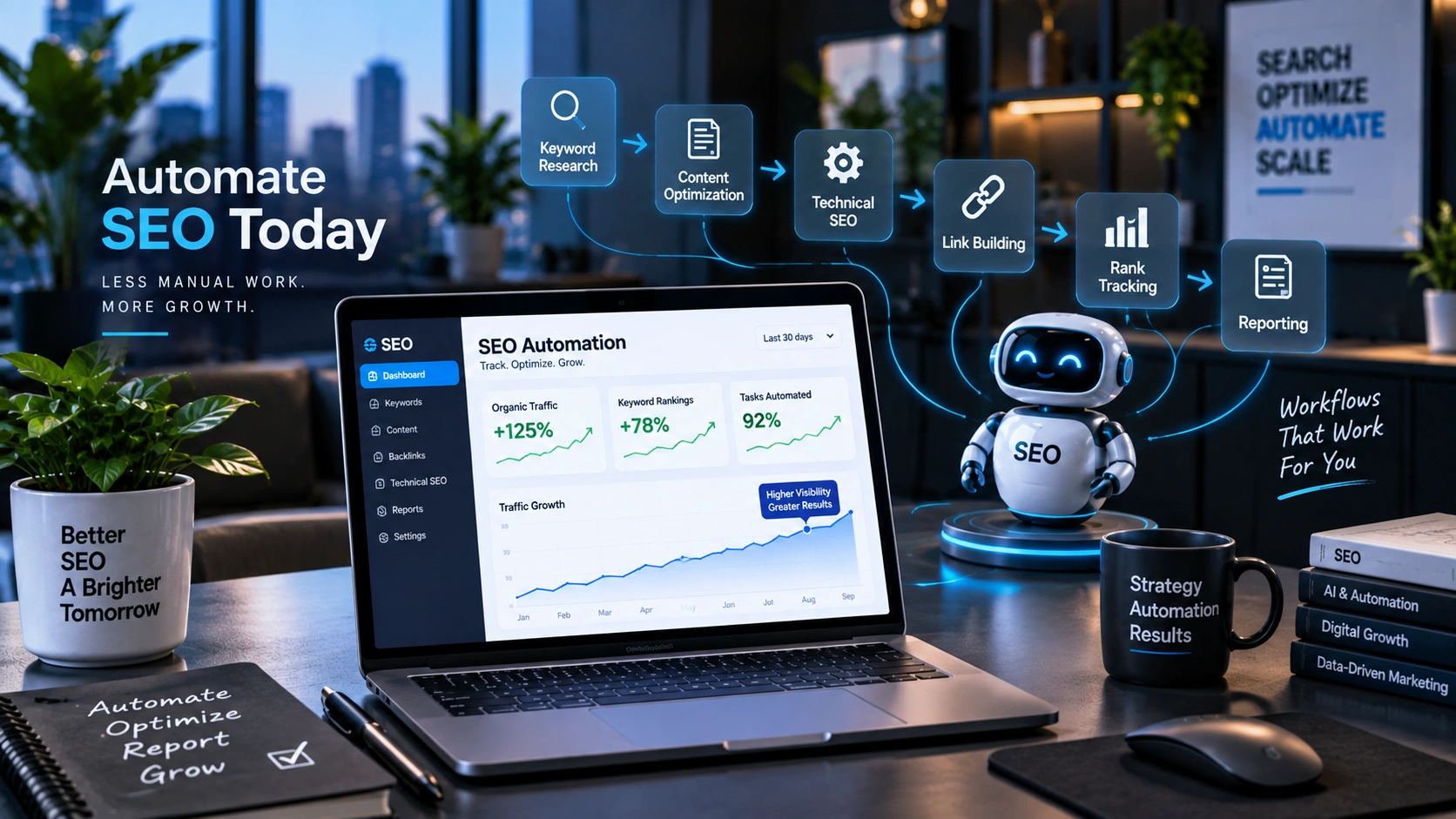
- What Is SEO Automation?
- What SEO Tasks Can Be Automated?
- Keyword Research and Clustering
- Technical SEO Audits
- Rank Tracking and SERP Monitoring
- Content Planning and Content Briefs
- On-Page SEO
- Internal Linking
- Backlink and Link Monitoring
- SEO Reporting
- Benefits of SEO Automation
- What SEO Tasks Should Not Be Fully Automated?
- SEO Automation vs. Manual SEO
- How to Build an SEO Automation Workflow
- Practical SEO Automation Workflow Examples
- A Real-World Scenario: Ecommerce Site With 10,000+ URLs
- How AI Is Changing SEO Automation
- SEO Automation Tools and Software
- How to Automate SEO Reporting
- SEO Automation, AI Content, and Search Quality
- How to Start Automating SEO
- How to Measure SEO Automation ROI
- SEO Automation Checklist
- Frequently Asked Questions
SEO Automation
Quick Answer
SEO automation means using software, APIs, rule-based triggers, and increasingly AI agents to handle repetitive SEO work such as rank tracking, technical audits, keyword clustering, and reporting. It is not about replacing SEO judgment. The goal is to remove repetitive execution work so strategists spend their time on decisions automation cannot safely make: what to prioritize, what to publish, and what to change on the site.
On this page
- What Is SEO Automation?
- What SEO Tasks Can Be Automated?
- Benefits of SEO Automation
- What SEO Tasks Should Not Be Fully Automated?
- SEO Automation vs. Manual SEO
- How to Build an SEO Automation Workflow
- Practical SEO Automation Workflow Examples
- How AI Is Changing SEO Automation
- SEO Automation Tools and Software
- How to Automate SEO Reporting
- SEO Automation, AI Content, and Search Quality
- How to Start Automating SEO
- How to Measure SEO Automation ROI
- SEO Automation Checklist
- FAQs
SEO rarely breaks because a team lacks data. It breaks because too much of that data still has to be collected, checked, sorted, and reported by hand before anyone can act on it. Pulling ranking positions, checking Search Console for crawl errors, comparing this month’s traffic against last month’s, scanning for broken links, and assembling a report that mostly describes what already happened: none of that work is strategic. It is necessary, but it is also exactly the kind of work that software handles more reliably than a person checking a dashboard every Monday morning.
SEO automation is the practice of offloading that repetitive layer to tools, scripts, and workflows, while SEO Automation Services can help teams connect those systems into a reliable process. This lets people spend their time on the parts of SEO that still require judgment: deciding what to prioritize, what a ranking drop actually means, what a piece of content should say, and which technical fix is worth the engineering time. This guide breaks down what can realistically be automated today, what should stay in human hands, how to connect individual tasks into working automation systems, and how AI agents are starting to change what “automated SEO” even means.
What Is SEO Automation?
SEO automation is the use of software, APIs, scheduled scripts, rule-based logic, and AI systems to carry out SEO tasks that would otherwise require someone to do them manually, on a recurring basis. That covers a wide range of maturity levels, from a simple scheduled export of Search Console data to an AI agent that reviews ranking changes and drafts a recommendation on its own.
It helps to think about SEO automation in three distinct levels, because most teams conflate them and end up either under-automating or handing over more control than they intended to.
Level 1
Task Automation
A single, isolated job runs on a schedule, like daily rank tracking. Nothing downstream happens automatically; a person still decides what the data means.
Level 2
Workflow Automation
Several tasks connect into a sequence with a trigger and an outcome, such as keyword data flowing into a brief and then a project task. A person still reviews the output before anything publishes.
Level 3
Agentic Automation
An AI agent collects data, analyzes it against a defined goal, prioritizes what matters, and drafts or takes an action within set limits before flagging it for approval.
None of these levels are inherently better than the others. A well-run SEO program typically uses all three at once: heavy task automation for monitoring, workflow automation for anything that touches production output like content briefs or internal link suggestions, and agentic automation introduced carefully, once the underlying data and rules are reliable enough to trust.
What SEO Tasks Can Be Automated?
The honest answer is: most of the data collection, monitoring, and first-draft work. The parts that require interpreting intent, making a judgment call, or representing the brand publicly are a different story, and we’ll get to those in the next section. Here’s a breakdown of what automation genuinely handles well today, organized by what happens manually, what a tool can take over, and where a person still needs to be involved.
Keyword Research and Clustering
Manually, keyword research means pulling volume and difficulty data, scanning SERPs for each term, and grouping related queries by hand in a spreadsheet that’s out of date within a month. Automation handles the collection and grouping reliably: pulling data from an API, clustering terms by shared SERP overlap or semantic similarity, and flagging competitor keyword gaps. What still needs a person is prioritization. A tool can tell you that a cluster of 40 keywords shares intent. It can’t tell you whether that cluster fits your business model or the service lines you actually want to grow this quarter.
Technical SEO Audits
Recurring crawls can flag broken links, redirect chains, missing or duplicate metadata, canonical conflicts, sitemap and robots.txt issues, indexability problems, structured data errors, and Core Web Vitals regressions, all on a schedule. What automation should not do is push fixes live unsupervised. A redirect rule that looks correct in isolation can break an entire category of pages if nobody checks the blast radius first, which is why this work belongs alongside careful custom software development practices rather than one-off scripts nobody owns.
Rank Tracking and SERP Monitoring
Position tracking, SERP feature changes, competitor movement, and ranking-drop alerts are some of the most mature and reliable automation use cases in SEO. Daily or weekly checks, scheduled and stored automatically, mean nobody has to remember to look. The judgment call is separating noise from a real signal: a two-position wobble on a low-volume term rarely means anything, while a sudden drop on a page that previously performed strongly deserves investigation, especially when clicks or conversions decline alongside the ranking.
Content Planning and Content Briefs
Automation can map keywords to topics, pull competitor content structure, flag content gaps against what’s already ranking, and generate a first-draft brief with target headings and suggested entities to cover. This genuinely speeds up the front end of content production. It becomes a problem only when teams treat the automated brief as the finished product and skip expert input, editorial review, and fact-checking, which is how low-value, interchangeable content ends up on a site.
On-Page SEO
Title tag and meta description suggestions, heading structure checks, internal link opportunity detection, alt text gaps, and schema recommendations can all be surfaced automatically for a human to accept, edit, or reject. Very few teams should let this run unsupervised, since even small wording choices on a title tag affect click-through rate and brand tone in ways a rule-based system doesn’t fully account for.
Internal Linking
A practical internal linking workflow looks like this: crawl the existing content, identify pages with topical overlap, suggest contextually relevant link opportunities and anchor text, route the suggestions to an editor for approval, implement the approved links, then recrawl to confirm they’re live and indexed correctly. Automation is excellent at surfacing the opportunities that a person would otherwise miss simply because they don’t remember every page on the site. It should not be making the final call on which pages get linked. Internal links help both users and search engines understand how pages relate to each other, so deciding which pages deserve stronger contextual connections stays a strategic decision.
Backlink and Link Monitoring
New and lost backlinks, referring domain changes, anchor text distribution, and competitor backlink movement are straightforward to monitor on a schedule, with alerts for anything unusual, such as an unexpected change in referring domains that may warrant a closer quality review. Whether that review ends in a disavow is a separate, situation-specific decision, not something a monitoring alert should trigger on its own.
SEO Reporting
This deserves its own weight here, since it’s one of the highest-friction recurring tasks for most SEO teams. Data from Search Console, analytics platforms, and rank trackers can be aggregated automatically, processed into period-over-period comparisons, visualized in a dashboard, and delivered on a schedule. Automation can surface patterns and flag likely causes, but connecting those patterns to a confident explanation still needs a person, which is one of the areas where teams most often confuse “automated” with “finished.”
| SEO Activity | Automation Potential | Human Oversight Needed |
|---|---|---|
| Data collection and monitoring | High | Low |
| Rank tracking and alerts | High | Medium |
| Recurring technical audits | High | Medium |
| SEO reporting and dashboards | High | Medium |
| Keyword clustering | High | Medium |
| Content briefs | High | Medium |
| Internal link suggestions | Medium to High | High |
| Content creation | Medium | High |
| Technical fixes and redirects | Medium | High |
| SEO strategy | Low | High |
| Editorial and brand decisions | Low | High |
These categories are a starting point, not a fixed rule. The right level of automation for any task depends on the risk of getting it wrong, how complex the decision is, and how reliable your underlying data is.
Benefits of SEO Automation
Once the repetitive layer runs through workflows instead of people, the payoff tends to show up in a few consistent places.
Less time on repetitive work
Data pulls, rank checks, and crawl reviews stop competing with strategy and content work for the same hours in the week.
Faster issue detection
A scheduled crawl or monitoring alert catches a broken redirect or a ranking drop days before someone would have noticed it by chance.
More consistency and scale
A workflow runs the same check the same way every time, making it realistic to monitor a ten-thousand-page ecommerce catalog in a way manual review never is.
Less reporting overhead
Data collection and aggregation stop being a task someone has to remember to do at the end of every month.
More repeatable, auditable processes
A documented workflow with clear triggers and rules is easier to hand off and improve than habits that live in one person’s head, freeing up time for the decisions that actually move the needle.
What SEO Tasks Should Not Be Fully Automated?
The teams that get the most value out of SEO automation are usually just as deliberate about what they keep manual. A few categories consistently belong under human control, regardless of how good the tooling gets.
Keep these decisions under human control
- SEO strategy and prioritization: deciding which markets, service lines, or keyword clusters matter most is a judgment call informed by revenue and competitive positioning, none of which live in a ranking dataset.
- Search intent interpretation for ambiguous queries: tools classify obviously informational or transactional queries well, but are much weaker on the ones that sit in between.
- Brand positioning and editorial judgment: tone, claims made about your own expertise, and how content represents the company are not decisions to hand to a rules engine.
- Major technical changes: redirect strategies at scale, URL structure changes, and anything touching indexing settings need a human sign-off, even when the underlying analysis was automated.
- Content approval before publishing: whether a draft or fully AI-assisted article meets your quality bar is an editorial decision, not a checklist a script can complete.
- Link acquisition decisions and site migrations: both carry enough long-term consequences that automation should inform the decision, not make it.
The organizing principle worth keeping in mind across all of these: automate the execution, not the accountability. A tool can collect the data, flag the anomaly, and draft the recommendation. Someone still needs to own the outcome. If you’re weighing where automation fits into a broader technology roadmap, this is usually a good moment to loop in a partner who can assess your existing stack, which is the kind of scoping conversation our team at Elsner has regularly with in-house SEO leads.
SEO Automation vs. Manual SEO
Framing this as automation versus manual work suggests you have to pick a side. In practice, the strongest SEO operations combine both, using automation for the parts that benefit from speed and consistency, and human judgment for the parts that benefit from context.
| Manual SEO | Automated SEO |
|---|---|
| Repeated, one-off data pulls | Scheduled, recurring data collection |
| Manual rank checking in spreadsheets | Automated rank tracking with alerts |
| Manually assembled monthly reports | Automated dashboards and scheduled reports |
| Ad hoc crawl reviews | Recurring, scheduled technical audits |
| Checking for issues when someone remembers to | Automated notifications when thresholds are crossed |
| Human strategy and prioritization | Human strategy and prioritization (unchanged) |
| Human approval before publishing | Human approval before publishing (unchanged) |
The bottom two rows don’t change between columns, and that’s intentional: automation replaces the mechanics of data collection and monitoring, not strategic thinking or accountability for what goes live. The real shift isn’t speed. It’s that repetitive execution stops competing for the same hours as judgment-heavy work.
How to Build an SEO Automation Workflow
Most SEO automation efforts fail not because the tools don’t work, but because teams automate individual tasks without connecting them into an actual workflow with a clear trigger, decision logic, and an endpoint. Here’s a repeatable process for building one properly.
Step 1: Identify repetitive work. Look for tasks that are recurring, rule-based, data-heavy, and low-risk if something goes slightly wrong. Weekly rank checks and monthly reporting are usually the easiest starting points.
Step 2: Define the trigger. Every workflow needs a clear starting condition: a schedule, a new URL going live, a ranking drop past a defined threshold, a completed crawl, or new keyword data arriving.
Step 3: Connect your data sources. Search Console, analytics platforms, crawling tools, rank trackers, keyword databases, your CMS, and internal spreadsheets all need to feed the workflow through APIs or integrations rather than manual export and import.
Step 4: Define decision rules. This is where workflows most often break down, because teams either skip this step or set rules so broad they generate constant false alarms. A reasonable rule might flag a URL if organic clicks drop alongside a ranking decline, rather than acting on ranking movement alone. Avoid hardcoding arbitrary thresholds as universal best practice; what counts as significant depends on your traffic volume and keyword competitiveness.
Step 5: Automate the action. Once a rule is triggered, the workflow should do something concrete: create a task, send an alert, generate a report, draft a content brief, suggest an internal link, or update a dashboard.
Step 6: Add human approval. For anything touching content, technical changes, redirects, or indexing, route the output to a person before it goes live. This is the step teams skip when moving fast, and it’s the one that prevents the most damage.
Step 7: Verify the result. Automation shouldn’t stop at execution. After a fix goes live or content publishes, the workflow should confirm the change actually happened correctly, not just that the action was sent.
Step 8: Measure the workflow itself. Track time saved, completion rate, error rate, and whether the outcomes you care about are moving in the right direction. A workflow that runs reliably but never surfaces anything useful isn’t worth maintaining.
Practical SEO Automation Workflow Examples
Abstract frameworks are easier to apply with concrete examples. Here are five common SEO automation use cases, each built around the trigger-to-action structure above.
Workflow 1: Automated Rank Monitoring. Keyword data updates daily, a ranking change past a defined threshold triggers an alert, the affected URL and its traffic data are pulled for context, a person reviews the cause, and an action is assigned if needed.
Workflow 2: Technical SEO Monitoring. A scheduled crawl runs weekly, issues are detected and classified by severity, high-priority items are assigned as tasks, a person implements the fix, and a follow-up crawl verifies it’s resolved.
Workflow 3: Content Opportunity Workflow. Keyword data is checked against competitor content to identify gaps, a topic is flagged, a brief is generated automatically, an expert adds original insight, content is produced and edited, it publishes, and performance is monitored against the original opportunity.
Workflow 4: Automated SEO Reporting. Search Console, analytics, and rank data feed an aggregation step, key metrics are calculated, a dashboard updates, a scheduled report goes out, and a human adds commentary explaining what changed before it reaches stakeholders.
Workflow 5: Internal Linking Workflow. Site content is crawled, contextual relationships between pages are identified, link and anchor text suggestions are generated, an editor approves them, links go live, and a recrawl confirms they’re indexed.
A Real-World Scenario: Ecommerce Site With 10,000+ URLs
These workflows are easier to picture on a large catalog, where the manual version of the work stops being realistic well before the automated version does. Before automation, a typical setup looks like a weekly crawl covering only a sample of pages, rank tracking in a spreadsheet that’s usually a week out of date, and monthly reporting assembled by hand from several separate tools. After connecting the same tasks into a workflow: Search Console, a full-site crawler, and a rank tracker feed a centralized store on a schedule, anomaly detection flags pages with unusual movement, flagged issues create tasks with the relevant data attached, a person reviews and decides, approved fixes go live, a follow-up crawl verifies the change, and reporting picks up the result automatically. The tasks haven’t changed. What changed is that nothing depends on someone remembering to check a spreadsheet.
Need help connecting SEO tools, your CMS, APIs, and reporting into one workflow?
Elsner builds the integrations and automation logic behind SEO programs like this one.
How AI Is Changing SEO Automation
Traditional automation runs on explicit logic: if a ranking drops by a set amount, send an alert. AI-assisted automation replaces the fixed rule with analysis, reviewing the change alongside traffic and competitor movement to recommend what’s worth investigating. AI agents go further, running a full loop on their own: researching, analyzing, prioritizing, drafting or executing a defined action, and reporting back for review.
$2.6T–$4.4T
Estimated annual value generative AI could add to the global economy, with marketing and sales among the four business functions expected to capture roughly 75% of that value. Source: McKinsey
60–70%
Share of current employee work time that generative AI and related technologies have the potential to automate, concentrated in knowledge-heavy roles. Source: McKinsey
That last figure is a statement about automatable time, not about tasks that should run without oversight. An AI agent that drafts a technical audit summary or clusters a thousand keywords in minutes is genuinely useful. The same agent making unsupervised changes to canonical tags across a large site is a different risk profile entirely. The realistic position on AI agents in SEO today is that they’re strong at research, synthesis, and drafting, and still error-prone enough that consequential actions need defined permissions and a human checkpoint before anything ships. Teams evaluating AI and machine learning development for this work should treat agent permissions as a design decision from day one, not something bolted on after a mistake.
SEO Automation Tools and Software
Rather than another ranked list of platforms, it’s more useful to think about the ecosystem by function, since most teams end up combining tools from several categories rather than relying on one all-in-one platform.
- Research and competitor analysis: keyword discovery, volume and difficulty data, backlink gap analysis
- Technical SEO: scheduled crawlers, audit tools, Core Web Vitals monitoring
- Rank tracking: position and SERP feature monitoring with historical trends
- Content optimization: brief generation, on-page recommendations, gap analysis
- Workflow automation: the connective layer, usually built on API integrations through platforms like Make or n8n, that ties everything above into triggers and approval steps
- Reporting: dashboards that aggregate Search Console, analytics, and rank data into one scheduled view
Most vendor claims about accuracy, coverage, or pricing change often enough that they’re worth verifying directly with the vendor rather than relying on secondhand comparisons. The category a tool belongs to tells you more about where it fits in your workflow than any specific feature list.
It also helps to see how these categories stack together rather than treating each one as a separate purchase. A typical SEO automation stack runs in layers, with human approval sitting across every layer rather than as a separate step tacked on at the end, since that’s what keeps the stack accountable rather than autonomous.
| Layer | What It Does | Typical Components |
|---|---|---|
| Data layer | Generates the raw inputs everything else depends on | Search Console, analytics, rank tracking, crawlers |
| Processing layer | Turns raw data into something worth acting on | Keyword clustering, anomaly detection, issue classification |
| Automation layer | Connects processing to task management and scheduling | APIs, workflow platforms such as Make or n8n |
| AI layer | Adds research synthesis and prioritized recommendations | LLM-based analysis and drafting tools |
| Execution layer | Where approved actions actually happen | CMS, project management tools, reporting dashboards |
How to Automate SEO Reporting
Reporting is named directly in the title of this guide for a reason: it’s one of the most time-consuming recurring tasks in SEO, and also one of the easiest to over-automate into a report nobody reads. Data collection covers rankings, organic traffic, clicks, impressions, conversions, technical issues, and backlink changes, pulled automatically on a schedule. Data processing compares periods, segments by page or keyword group, and flags anomalies rather than presenting every metric equally. Reporting delivery can run through a live dashboard, a weekly summary, a monthly stakeholder report, or automated alerts for anything urgent.
Human interpretation is the step that actually makes a report useful. A dashboard can flag that organic traffic to a category page dropped in a given month and even surface a plausible cause, such as a competitor launching a comparable page around the same time. Automation can surface patterns and generate possible explanations, but important conclusions still need human validation: connecting the drop to what it means for the quarter’s targets, and deciding what should happen next, is a judgment call. Automation collects and organizes what changed. A person still needs to confirm why it matters and what to do about it.
SEO Automation, AI Content, and Search Quality
Where automation goes wrong
Google’s spam policies define scaled content abuse as producing large volumes of unoriginal content primarily to manipulate rankings, regardless of whether it was generated by humans, AI, or a combination of both. The method isn’t the issue. Intent and reader value are. Automating the pipeline that turns a keyword list into published pages, without expert review or original insight at any stage, is the fastest way to trigger this policy.
It’s worth being precise here, since this area gets misrepresented often. Google has not said AI-generated content is penalized for being AI-generated, and it hasn’t said human-written content is automatically rewarded for being human-written. Its published spam policies focus on whether content is useful, original, and created primarily to help the reader rather than to manipulate rankings.
The distinction that matters is between two automation patterns. Low-value scaled content looks like: take a keyword, generate a page, publish it, repeat across hundreds of terms with minimal variation. A quality-first workflow looks like: research a genuine content gap, develop an angle the existing top results don’t cover, bring in expert input, produce the content, put it through editorial and fact-check review, publish, then monitor and improve. The tooling in both can be nearly identical. What separates them is whether a human adds real judgment somewhere in the process, and whether the result is something a reader would genuinely want to find.
How to Start Automating SEO
Jumping straight to AI agents without a reliable foundation is one of the more common mistakes teams make once automation starts trending. A phased maturity model works better.
| Level | Stage | What It Looks Like |
|---|---|---|
| 1 | Manual SEO | Everything runs by hand, useful as a baseline but unsustainable at scale |
| 2 | Task automation | Start with rank tracking, monitoring, and basic reporting; low risk with immediate time savings |
| 3 | Workflow automation | Connect research and monitoring into content briefs, task creation, and structured reporting |
| 4 | AI-assisted SEO | Introduce AI for research synthesis and pattern detection, with human review on every step touching published output |
| 5 | Agentic SEO | Once data and decision rules have proven reliable, introduce agents with clearly scoped permissions for specific, lower-risk actions, expanding authority gradually as trust builds |
Don’t automate a broken process. If your keyword mapping is inconsistent or your reporting data is unreliable, automation will just make those problems move faster, not go away.
How to Measure SEO Automation ROI
Whether a workflow was worth building is separate from whether it runs without errors. It can execute perfectly and still not justify the overhead if it isn’t saving time or improving outcomes. A few measures are worth tracking from the start: time saved (hours the task took before automation versus now, including review time), cost saved (time saved multiplied by the internal hourly cost of the people who used to do the work), workflow reliability (successful runs as a share of total runs), error rate (incorrect outputs as a share of total outputs, tracked separately from reliability), and SEO impact (whether detected issues lead to actions, and whether those actions move the metrics that matter). None of this needs decimal-point precision. What matters is checking it on a set cadence, quarterly is usually reasonable, so a workflow that’s quietly stopped earning its keep gets fixed or retired.
SEO Automation Checklist
- Repetitive, low-risk SEO tasks identified
- Automation suitability assessed per task
- Workflow triggers clearly defined
- Data sources connected via API or integration
- Decision rules established and tested
- Actions mapped to each triggered rule
- Human approval step added for anything published or changed live
- Verification step added after each action
- Monitoring configured for the workflow itself
- Reporting automated with a human commentary step
- Error and failure rate tracked
- Time saved and SEO outcomes measured on a set cadence
Frequently Asked Questions
What is SEO automation?
SEO automation is the use of software, APIs, and AI to handle repetitive SEO tasks such as rank tracking, technical audits, and reporting, so that people can focus on strategy, judgment, and decisions that carry real risk if they go wrong.
What SEO tasks can be automated?
Data collection, rank tracking, recurring technical audits, keyword clustering, first-draft content briefs, backlink monitoring, and reporting are well-suited to automation. Strategy, content approval, and major technical changes should stay with a person.
Can SEO be fully automated?
No, not responsibly. Execution and monitoring can be automated extensively. Strategy, editorial judgment, and accountability for what a site publishes or changes need to stay under human control.
Is SEO automation different from marketing automation?
Yes. Marketing automation typically covers email, lead nurturing, and campaign management. SEO automation is narrower: it focuses on organic search tasks like rank tracking, technical audits, and reporting, though the two often share workflow tooling.
What is an SEO automation workflow?
A connected sequence built around a trigger, data collection, analysis, a decision rule, an automated action, human review, and measurement, rather than a single isolated task running on its own.
How does AI improve SEO automation?
AI shifts automation from fixed if-then rules toward analysis and recommendation, and AI agents can run a full research-to-draft-action loop. Current agents are strong at synthesis and drafting but still need defined permissions and human review for anything consequential.
Is SEO automation allowed by Google?
Yes. Automation itself isn’t prohibited. Google’s concern is using automation, or any method, to create or publish content primarily to manipulate rankings rather than to help users. Using automation for monitoring, reporting, and well-reviewed content production doesn’t conflict with that policy.
Key Takeaways
- SEO automation works best as a layered system: task automation for monitoring, workflow automation for connected processes, and AI agents introduced carefully once the basics are reliable.
- A workflow needs a trigger, data, a decision rule, an action, human approval, and measurement, not just a task running on a schedule.
- Google’s scaled content abuse policy targets unoriginal content produced to manipulate rankings, not automation itself.
- Start with low-risk, high-volume tasks like monitoring and reporting, measure whether each workflow is actually earning its keep, then expand into AI-assisted or agentic automation.
SEO automation isn’t a question of how much you can hand off. It’s a question of getting the right level of automation for each task, based on how repetitive it is and how much it costs you if it goes wrong. Start with the low-risk, high-volume work, connect it into real workflows with clear triggers and decision rules, keep human approval anywhere the output touches your live site or brand content, and measure whether each workflow is actually earning its keep. Once that foundation is solid, introduce AI-assisted and agentic automation where it genuinely earns its place, rather than because it’s the current trend.
Building an SEO automation system from scratch, or fixing one that never quite got connected?
Elsner works with ecommerce and B2B teams on the integrations, dashboards, and AI workflows behind a real SEO automation program, across Shopify and Odoo-based stores alike.