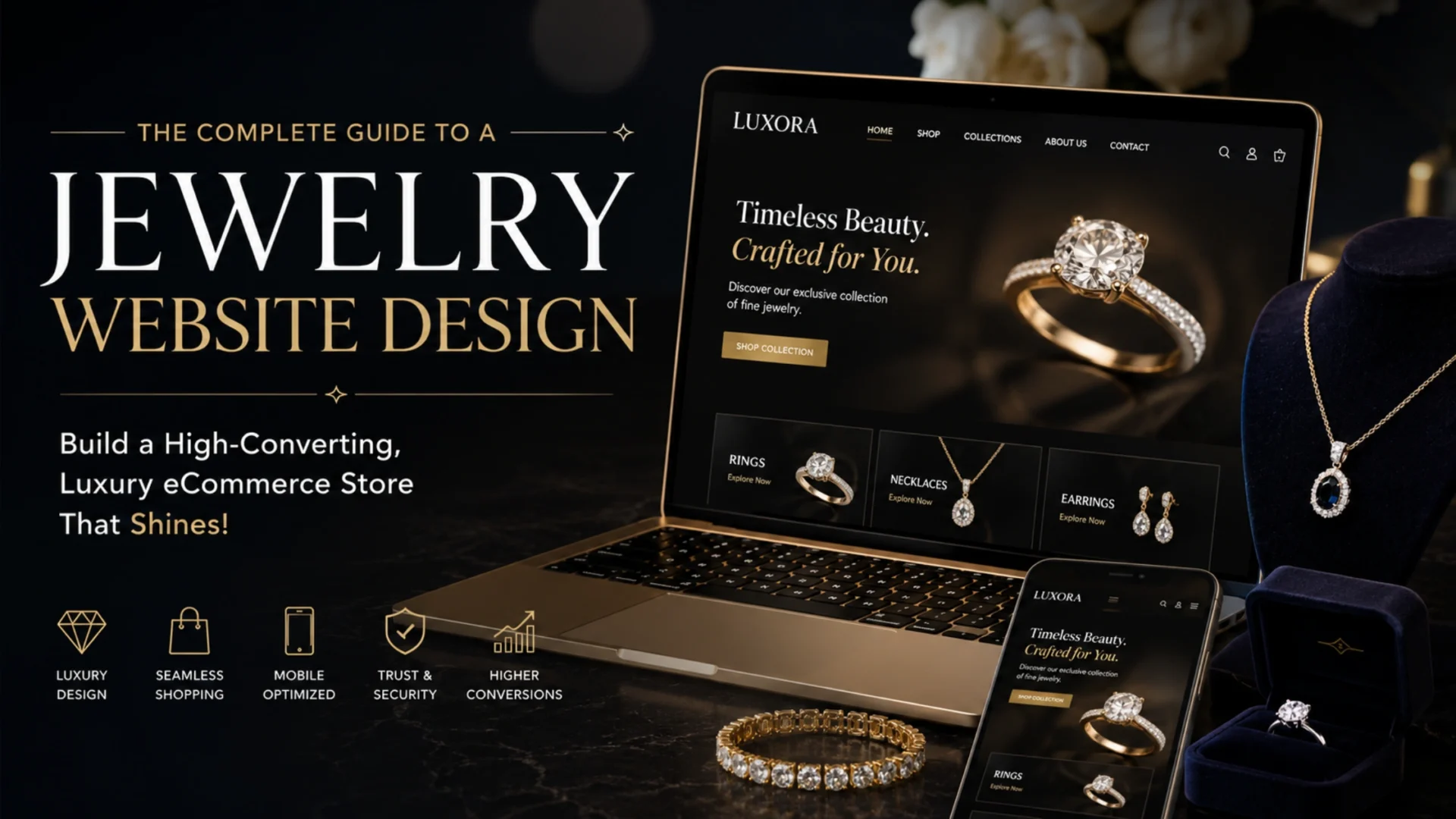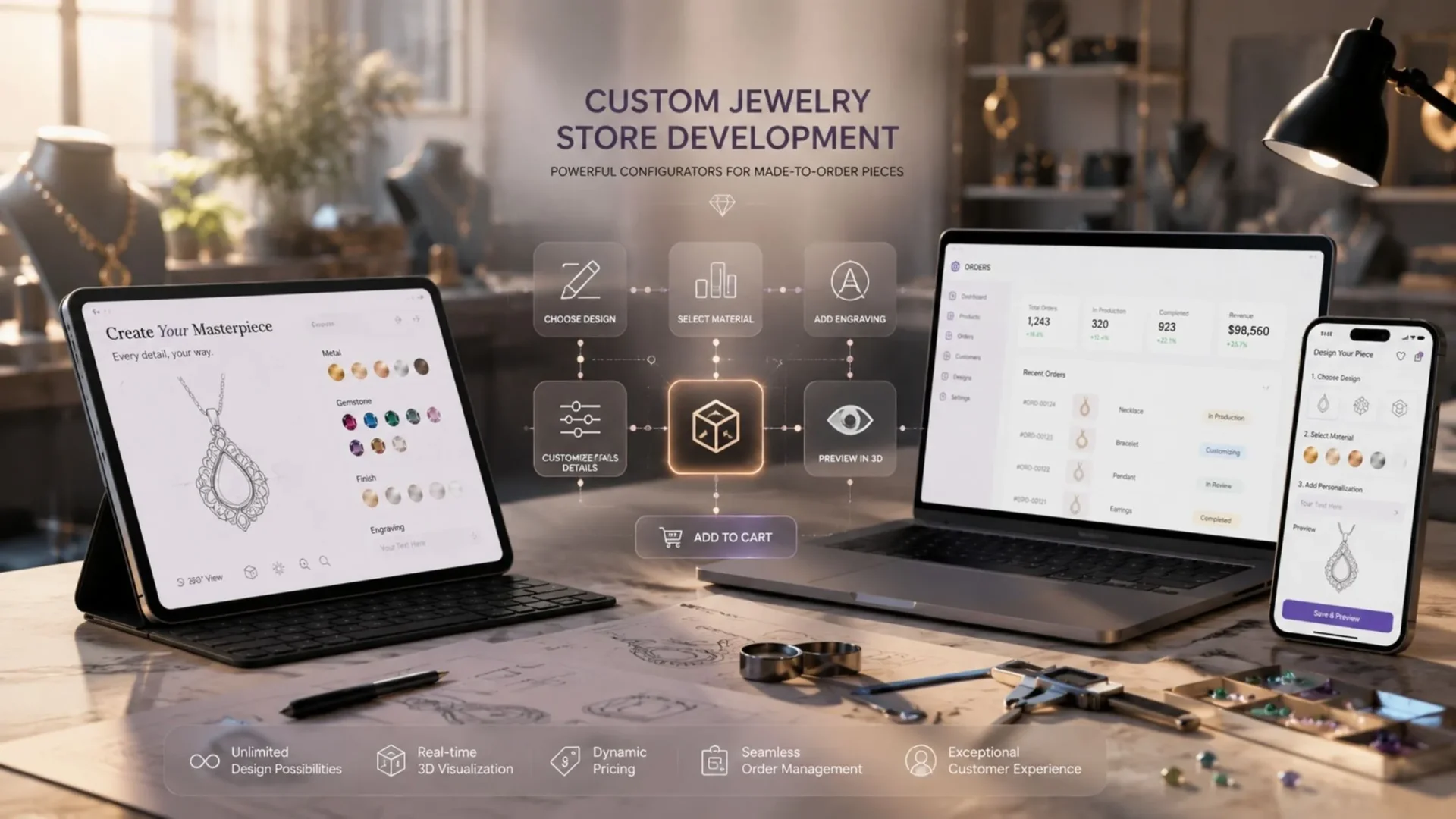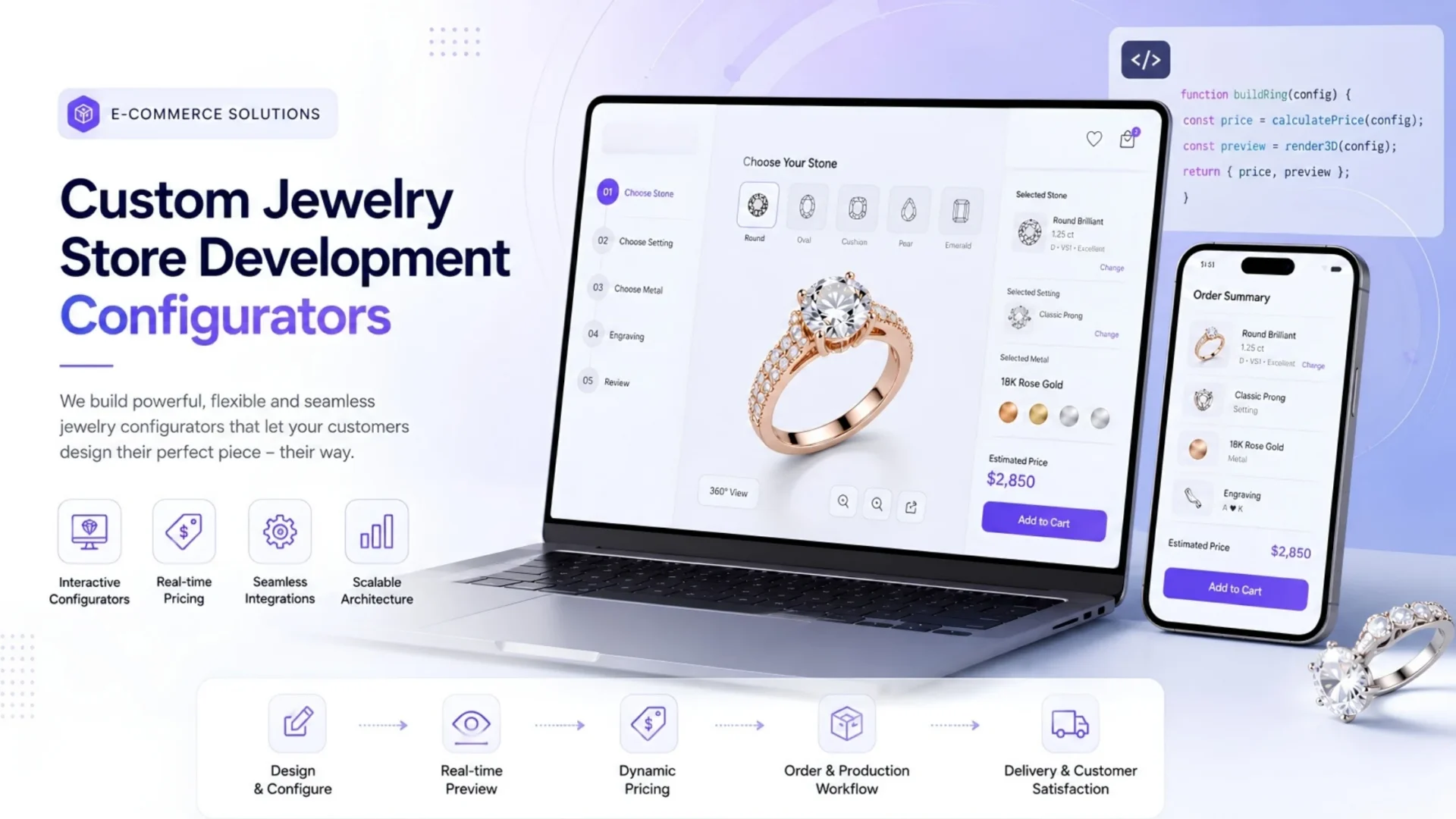




- Why Digital Transformation Is Now a Business Priority for Jewellery Brands
- Key Challenges in Jewellery Digital Transformation
- Complex Product Configuration
- Dynamic Pricing at Scale
- Multi-Location Inventory
- The Trust Problem
- Offline Systems That Predate Everything
- Core Technologies Powering Jewellery Digital Transformation
- eCommerce Platforms: Magento / Adobe Commerce
- AI-Driven Personalization
- Virtual Try-On Technology
- Headless Commerce Architecture
- ERP and CRM Integrations
- Essential Features for Enterprise Jewellery eCommerce
- Jewellery Digital Transformation Strategy: A Practical Roadmap
- 1. Business Requirement Analysis
- 2. Platform Selection
- 3. Architecture Planning
- 4. Custom Feature Development
- 5. ERP and CRM Integration
- 6. Performance Optimization
- 7. Testing and Deployment
- Ready to Transform Your Jewellery Business?
- Business Impact: What Actually Changes
- Common Implementation Challenges and How to Approach Them
- Who Should Be Investing in This Right Now?
- Future Trends Shaping Jewellery Digital Transformation in 2026
- AI personalization gets more granular.
- Virtual try-on completes its shift from differentiator to expectation.
- Headless and composable commerce keeps growing.
- Predictive analytics
- Omnichannel stops being a strategy conversation
- Why Work with a Jewellery eCommerce Development Company?
- Scale Your Jewellery Business with Confidence
- Conclusion
- Frequently Asked Questions
- What is digital transformation in the jewellery industry?
- Why is digital transformation important for jewellery brands?
- Which platform is best for jewellery ecommerce?
- How much does jewellery ecommerce development cost?
- What features are essential for jewellery websites?
- Can small jewellery businesses benefit from digital transformation?
- How long does jewellery digital transformation take?
The jewellery industry has always been about emotion. The weight of the metal, the story behind the stone, the moment it creates. None of that has changed. How people find, compare, and actually buy jewellery.
The buying journey begins on a phone screen now. Or a product configurator. Or a personalized email that arrived at exactly the right time. Brands still running on legacy infrastructure are not just missing that moment. They are funding their competitors’ growth while doing it.
Jewellery digital transformation is not a technology upgrade. It is an operational rethink.
Why Digital Transformation Is Now a Business Priority for Jewellery Brands
Five-figure transactions are completed on mobile. Buyers who once refused to purchase anything above a few hundred dollars without physically handling it are now configuring custom rings on a Tuesday afternoon and checking out before dinner. That behavior is not a trend anymore. It is just how people buy.
What is pushing this:
- The omnichannel expectation is no longer impressive. Customers assume price consistency, catalog accuracy, and a seamless handoff between in-store and online. When it breaks, they notice immediately.
- Digital-first jewellery brands operate leaner and move faster. Lower overhead, shorter release cycles, and no legacy baggage. They are not catching up to established players. In some segments, they have already passed them.
- B2B buyers are done with email order forms. Wholesale customers want live inventory, self-service portals, and account dashboards. The brands building a proper B2B eCommerce portal are winning distributor relationships that older portals are quietly losing.
- Every post-sale touchpoint runs digital now. Loyalty, repurchase, upsell, referral. If those flows are disconnected or clunky, you are leaving money on the table every single day.
Staying on a siloed, manually updated, offline-first system is not a neutral choice. It is a slow retreat.
Key Challenges in Jewellery Digital Transformation
The problems are specific. Generic ecommerce advice does not really apply here.
Complex Product Configuration
A single ring style can carry 40, 50, sometimes more variations. Metal type, stone weight, carat, band width, engraving, finish. Most platforms treat that as a SKU management problem. It is not. It is a customer experience problem that manifests as SKU complexity. Build it wrong and you get either a stripped-down product page or code held together by custom patches that break whenever anything upstream changes.
Dynamic Pricing at Scale
Gold does not wait for your team to log in Monday morning. Rates shift daily, sometimes intraday. A $3,200 product listed at the wrong price is either a margin erosion or a customer service issue depending on which direction the market moved. Real-time pricing rules tied to commodity feeds are not optional. They are a baseline operational requirement.
Multi-Location Inventory
Physical retail, warehouse stock, third-party fulfillment. Without proper jewelry inventory management, when those systems do not communicate in real time, you are operating on assumptions. Overselling a one-of-a-kind piece does not generate a refund request. It generates a trust problem, which is significantly harder to fix.
The Trust Problem
Nobody buys a $4,000 bracelet on a website they find confusing. Hallmarking details, certificate documentation, return policy clarity, payment security. All of it matters more here than in almost any other retail category. And when UX is poor, customers do not complain. They disappear.
Offline Systems That Predate Everything
POS platforms from 2014, ERPs that required a specialist to configure inventory tools that export CSV files. The challenge in digital transformation in the jewellery industry is usually not finding the right new system. It is connecting it to everything old without breaking what currently works.
Core Technologies Powering Jewellery Digital Transformation
Each of these solves something real.
eCommerce Platforms: Magento / Adobe Commerce
Adobe Commerce handles complex catalogs, multi-store setups, and custom pricing logic better than most alternatives at the enterprise level. The extensibility matters. Jewellery operations require integrations that generic platforms treat as edge cases. Magento treats them as design requirements.
AI-Driven Personalization
Not “customers also viewed.” Actual eCommerce personalization built on real behavioral data. Anniversary prompts based on purchase history. Homepage merchandising that adapts to browsing patterns. Segment-level email automation that does not feel like a broadcast. Average order value climbs. Marketing spend does not have to.
Virtual Try-On Technology
Conversion rates go up. Returns go down. The ROI math is not complicated. Adoption of virtual try-on technology has accelerated sharply and customers shopping for rings or earrings increasingly expect it. Brands that still treat it as a premium feature are misreading where the baseline sits.
Headless Commerce Architecture
Decouple the frontend from the backend and you gain the ability to build fast, visually refined experiences across web, mobile, and in-store screens without rebuilding commerce logic every time. For multi-region operations running different storefronts, this stops being architecture theory and becomes practical necessity.
ERP and CRM Integrations
A jewellery ecommerce platform that does not talk to your ERP is a storefront with a data problem. Real jewellery digital transformation means one operational picture: inventory, pricing, customer data, order management, all connected. Most implementations that fail do not fail at launch. They fall apart six months in because the integrations were shallow.
Essential Features for Enterprise Jewellery eCommerce
|
Feature |
Why It Matters |
|
Custom product configurator |
Reduces pre-sale friction and increases conversion on complex, high-value items |
|
Real-time pricing engine |
Eliminates manual updates and closes the margin-erosion window |
|
Advanced search and filtering |
Large catalogs become navigable; customers stop bouncing |
|
AI-powered recommendations |
Order value increases without proportional ad spend |
|
Secure, flexible checkout |
High-value cart abandonment is expensive. This fixes it. |
|
Multi-store and multi-region support |
Expand without rebuilding from scratch each time |
|
Certificate and compliance documentation |
Non-negotiable for fine and certified jewellery |
|
B2B ordering portal |
Trade customers get the self-service experience they expect |
Feature priority should map to where your revenue is leaking right now. Not where you want to be in three years.
Jewellery Digital Transformation Strategy: A Practical Roadmap
No two implementations look identical. But the sequence below reduces the most common failure points.
1. Business Requirement Analysis
Start with pain, not aspiration. Where is work still manual? Where do customers drop off? What integrations need to exist on day one before any order ships?
2. Platform Selection
Adobe Commerce for deep catalog complexity and integration requirements. Shopify Plus for brands that need faster deployment with simpler SKU structures. Headless builds when performance and brand experience are genuinely non-negotiable. Choose for five years, not the next launch.
3. Architecture Planning
Headless vs. traditional. Multi-store vs. single-instance. These decisions have a long tail. Infrastructure choices made here will dictate development costs well beyond the initial build.
4. Custom Feature Development
The configurator, the pricing engine, the brand-specific workflows. This is where a specialist jewellery eCommerce development company saves months, not days. People who have built jewellery-specific logic before do not have to learn it at your expense.
5. ERP and CRM Integration
Connect the systems. Test for data consistency before anything goes live. Sync failures discovered post-launch are not just technical problems. They are customer experience problems with a timestamp.
6. Performance Optimization
Speed and visual quality both drive conversion in this category. Mobile performance, image delivery, page load time. Optimize before launch, not as a follow-up project.
7. Testing and Deployment
Load testing, user acceptance testing, phased rollout. A broken launch in fine jewellery does not just create support tickets. It creates doubt that lingers.
Ready to Transform Your Jewellery Business?
Map out your implementation plan and leverage digital transformation to streamline operations, improve customer experience, and scale your jewellery business.
Business Impact: What Actually Changes
Jewellery ecommerce strategy decisions should produce measurable outcomes. Here is what well-executed transformation actually delivers:
- Conversion rate improvements from faster load times, better UX, and relevant product discovery that does not require the customer to work for it
- Higher average order value through configurator upsells and AI recommendations surfacing the right product at the right moment
- Operational cost reduction from automated pricing, live inventory sync, and order management that does not require a human to touch every transaction
- Faster expansion because a properly architected jewellery ecommerce solution does not need to be rebuilt for each new market or channel
- Stronger retention because CRM-connected post-sale communication makes customers feel remembered, not marketed at
Documented results across enterprise jewellery ecommerce implementations. Not projections.
Common Implementation Challenges and How to Approach Them
|
Challenge |
What Actually Works |
|
Legacy ERP integration |
Middleware layers, phased rollout, avoid full cutover in one go |
|
Performance under load |
CDN, image optimization, auto-scaling. Before launch. Not after. |
|
Scope expanding mid-project |
Lock phase one by revenue impact. Everything else is phase two. |
|
Inconsistent product data |
Centralize in a PIM before touching the commerce layer |
|
Team adoption gaps |
Involve operations in UAT early. Change management is not optional. |
The brands that struggle after launch usually know about one of these risks. They just underestimated it.
Who Should Be Investing in This Right Now?
- Enterprise jewellery brands with large catalogs, multiple markets, and channels that do not yet talk to each other
- Multi-location retailers where in-store and online inventory still behave like separate businesses
- B2B manufacturers and wholesalers ready to move trade ordering online without losing the account relationships built over years
- High-growth startups that have outgrown their current platform or will within the next twelve months
If your platform was not designed for jewellery-specific complexity, the cost of staying is not static. It grows with every month of lost efficiency and every customer your competitors convert instead.
Future Trends Shaping Jewellery Digital Transformation in 2026
AI personalization gets more granular.
Full journey adaptation, not just homepage widgets. Pricing, content, product sequencing, all adjusting to individual behavior in real time.
Virtual try-on completes its shift from differentiator to expectation.
Brands without it for core categories will start seeing the gap in conversion data, if they are not already.
Headless and composable commerce keeps growing.
The flexibility argument has been won. Enterprise brands choosing platforms now are choosing composable by default.
Predictive analytics
It moves demand planning from reactive to anticipatory. Stock the right metals and styles before the spike, not after the stockout.
Omnichannel stops being a strategy conversation
It has now become a systems integration requirement. Either the data flows cleanly across every channel or the customer experience breaks somewhere. There is no middle version.
Why Work with a Jewellery eCommerce Development Company?
General ecommerce agencies know platforms. They do not always know jewellery. Dynamic commodity pricing logic, certificate integration requirements, configurator edge cases, compliance differences across markets. These are not abstract challenges. They are specific problems that emerge mid-build if your partner has not solved them before.
A specialist partner brings:
- Pre-built jewellery-specific modules that skip the discovery phase and cut development time
- Integration experience with the actual systems jewellery businesses run: ERP, POS, commodity feeds
- Architecture shaped by catalog complexity, not by what worked for a fashion brand last year
- Long-term support for a platform that will keep evolving because your business will keep changing
Elsner’s jewellery ecommerce development team works with enterprise brands and B2B manufacturers on exactly this. Our digital transformation solutions and ecommerce consulting services are for businesses that need their systems to actually work together, not just coexist.
Scale Your Jewellery Business with Confidence
Talk to our experts to build the right digital strategy, optimize your operations, and unlock scalable growth for your jewellery business.
Conclusion
The brands that called jewellery digital transformation optional five years ago are dealing with the consequences now. Platform debt. Operational drag. Ground lost to competitors who made the call earlier and built on it.
Technology is rarely the hard part. Getting the architecture right for your specific business, integrating it cleanly with what exists, executing without disrupting live operations. That is where strategy and prior experience matter more than any platform’s feature list.
If you are ready to move past internal planning cycles, talk to Elsner’s team about jewellery ecommerce solutions and a realistic path to scale.
Frequently Asked Questions
What is digital transformation in the jewellery industry?
Replacing disconnected, manual, or outdated systems with integrated digital infrastructure. Practically, that means ecommerce platforms, ERP and CRM connections, live pricing, and omnichannel operations built to work as one system rather than several that occasionally sync.
Why is digital transformation important for jewellery brands?
Buyer behavior has moved online and is not moving back. Brands that cannot deliver fast, accurate, personalized digital experiences lose sales to those that can. Operationally, the manual processes that held up at a smaller scale tend to create serious problems somewhere between growth stage and enterprise.
Which platform is best for jewellery ecommerce?
Adobe Commerce for enterprise-level catalog complexity, integration depth, and multi-store requirements. Shopify Plus for simpler SKU structures and faster deployment timelines. Headless builds when performance and brand experience are the non-negotiables. There is no universal answer, and anyone who gives one without knowing your business is guessing.
How much does jewellery ecommerce development cost?
Depends heavily on platform, feature scope, and integration complexity. A well-built Magento implementation with standard jewellery features starts around $30,000. Enterprise projects with custom configurators, ERP integrations, and multi-region support typically land between $80,000 and $200,000. Sometimes higher.
What features are essential for jewellery websites?
Product configurator, real-time pricing, advanced filtering, virtual try-on, certificate documentation, secure checkout, multi-store support. For B2B, add a self-service trade ordering portal. Start with what is costing you the most right now.
Can small jewellery businesses benefit from digital transformation?
Yes. The scope is different, not the logic. Smaller brands gain the most from moving to a platform designed for jewellery-specific complexity, automating pricing and inventory, and fixing mobile experience. ROI tends to arrive faster than on enterprise projects.
How long does jewellery digital transformation take?
A focused build covering platform, core features, and key integrations typically runs four to eight months. Complex multi-region projects with custom configurators and deep ERP integration often take twelve months or more. Scope clarity at the start matters more than budget when it comes to timeline.