



- Why Made-to-Order Is Reshaping Jewelry E-commerce
- What Is a Jewelry Product Configurator?
- The Main Types of Jewelry Configurators
- Engagement Ring Builder
- Pendant or Necklace Designer
- Bracelet and Bangle Builder
- Earring Configurator
- Full Bespoke Jewelry Studio
- The Technical Architecture Behind a Jewelry Configurator
- Choosing the Right Platform for Custom Jewelry Store Development
- Quick thoughts
- Pricing Logic That Actually Works for Custom Jewelry
- Why Static Pricing Breaks for Custom Jewelry
- Handling Daily Metal Price Updates
- Stone Pricing: More Than Just Carats
- Labor and Setting Costs
- Margin Protection
- What Should You Show the Customer?
- Deposits vs Full Payments
- A Simple Pricing Example
- Real Cost Ranges for Custom Jewelry Store Development
- Timeline Expectations
- Mistakes Jewelry Brands Make with Configurator Projects
- How AI and 3D are Changing the Game
- How Elsner Supports Custom Jewelry Store Development
- Conclusion
- Ready to Build a Jewelry Configurator That Actually Works?
- Frequently Asked Questions
- 1. How much does it cost to build a custom jewelry website with a configurator?
- 2. Which platform is best for custom jewelry store development?
- 3. How long does it take to build a jewelry product configurator?
- 4. Can Shopify handle real-time jewelry pricing?
- 5. Do I need 3D rendering for a configurator?
- 6. How do custom jewelry stores handle returns?
It has become an era of customisation, and it has gotten into each and every e-commerce space. Also, in Jewelry.
Customers don’t just want to browse anymore. They want to build. Pick the metal. Choose the stone. Adjust the size. Add a personal touch. And most importantly, see what they’re buying before they commit.
This shift toward made-to-order jewelry experiences is reshaping how brands sell online.
But here’s the part most businesses underestimate.
Building a real product configurator is not just a design task. It’s not even just a development task. It’s a full business system. Pricing, inventory, rendering, production workflows – everything gets connected.
If you’re planning custom jewelry store development, this guide will walk you through what actually matters. A clear direction on:
- How configurators work
- What it takes to build one
- What it costs (real numbers)
- And the mistakes that quietly drain budgets
Let’s get started.
Why Made-to-Order Is Reshaping Jewelry E-commerce
There was a time when a catalog of 200 rings was enough. Now? It feels limiting. Customers, especially younger buyers, expect personalization by default. Not as an add-on.
And when you offer real customization, a few interesting things happen:
- Average order value increases, often by 30% to 80%
- Returns drop because customers design exactly what they want
- Engagement goes up (people spend more time building their piece)
- Brand loyalty becomes stronger.
Think about it. A customer who creates a ring feels more connected to it than someone who just picks one. That connection is hard to replicate.
Brands that go beyond engraving and offer true customization are pulling ahead. Not just in conversion, but in retention too.
What Is a Jewelry Product Configurator?
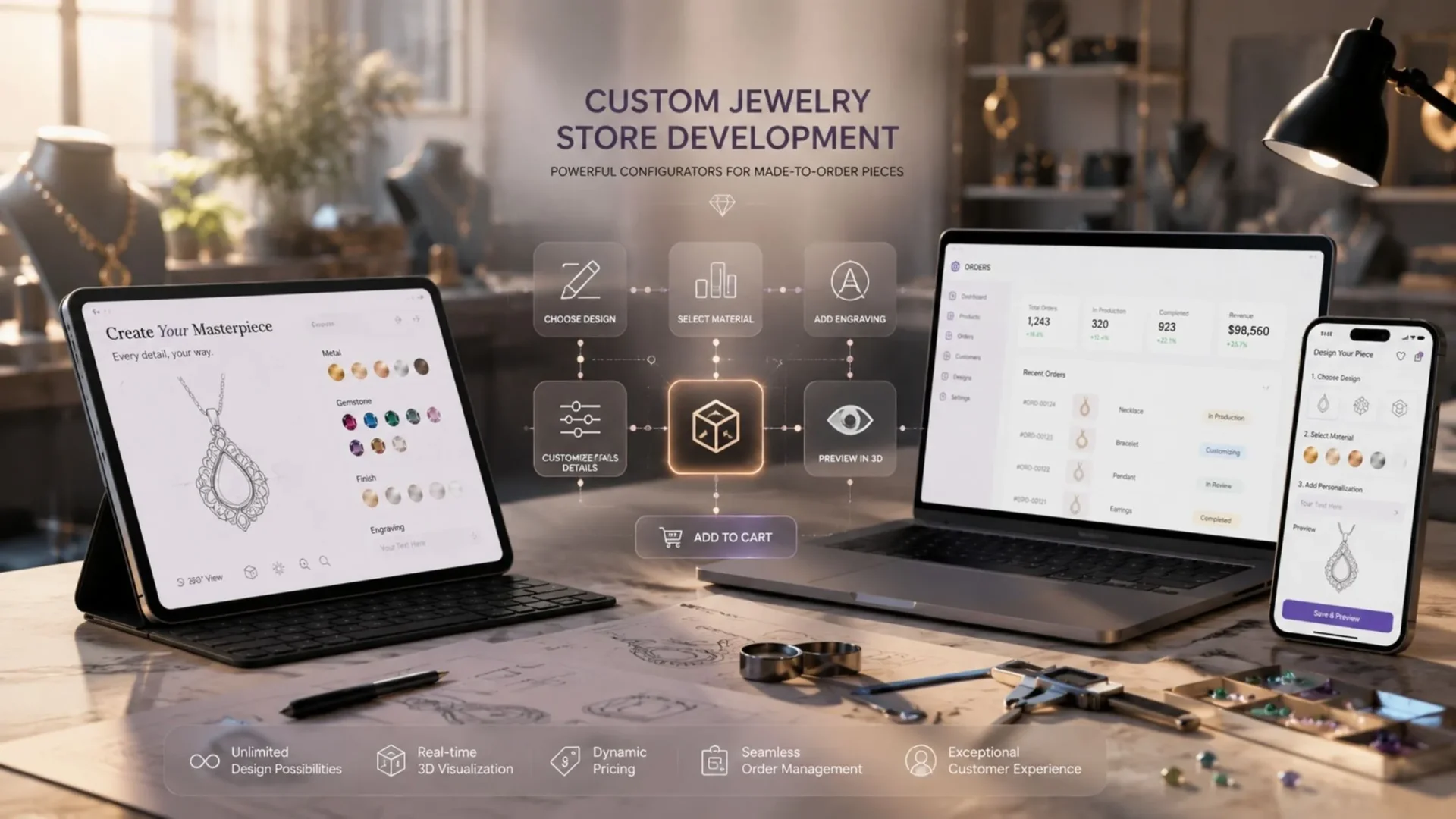
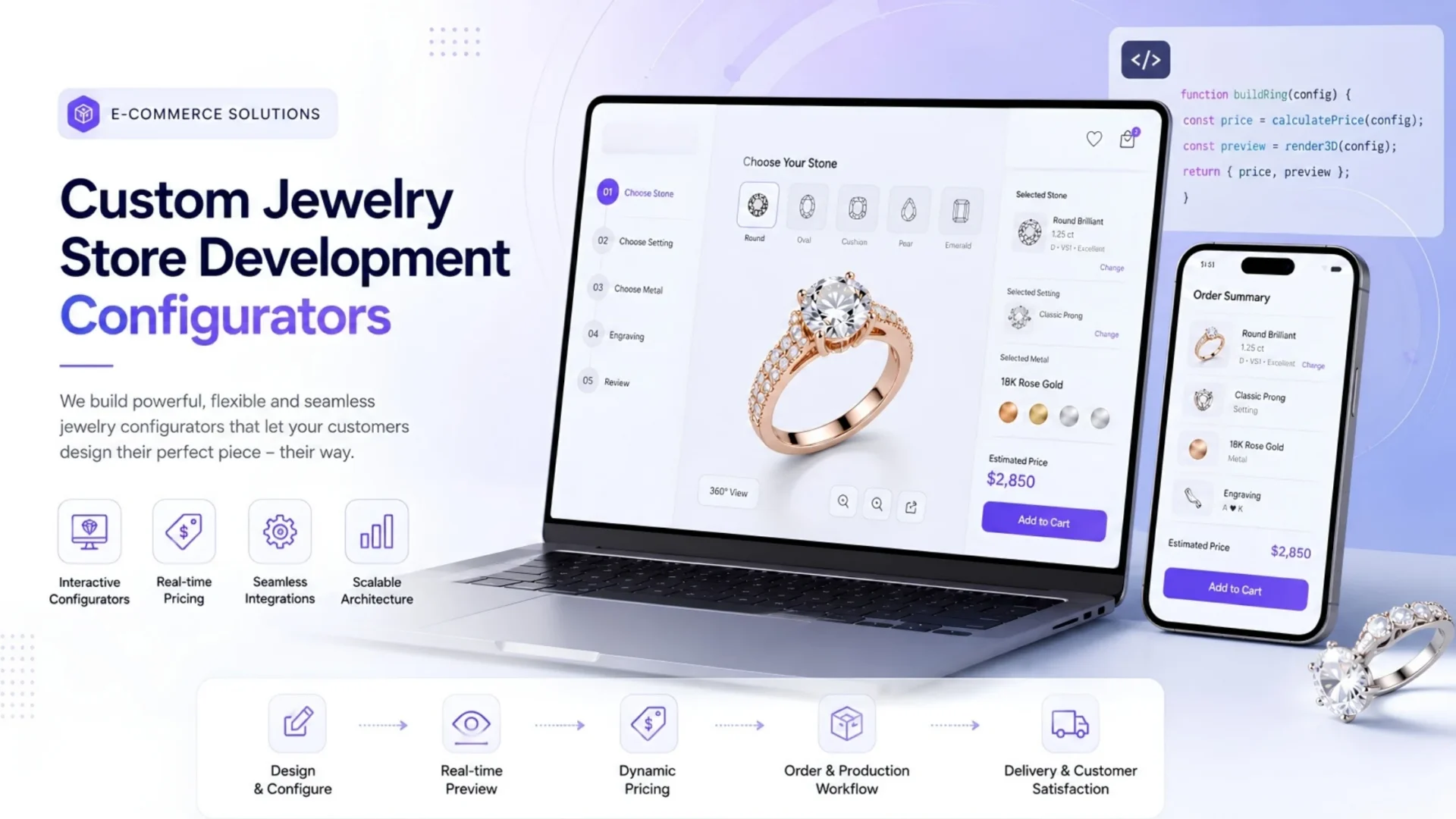
Basically, a jewelry product configurator is a tool that lets customers build their own jewelry. But this simple definition has a lot more to it.
A real configurator is not just a dropdown of options. It’s a dynamic system where multiple variables interact in real time.
Typical elements include:
- Metal type (gold, platinum, etc.)
- Stone type and size
- Setting style
- Band design
- Engraving
- Ring size
And then there’s the important part – real-time pricing and visual feedback.
- If a customer switches from 14K gold to platinum, the price updates instantly.
- If they choose a larger diamond, they see the difference immediately.
That’s what separates a true configurator from a basic product variant selector.
The Main Types of Jewelry Configurators
Not every brand needs a full-scale system on day one. Most start with one type and expand over time. Here are the common ones.
Engagement Ring Builder
This is the most popular. Usually a step-based flow:
- Choose the stone
- Select the setting
- Pick the metal
There’s heavy emphasis on stone details and certification. Customers want confidence here.
Pendant or Necklace Designer
More focused on personalization.
- Chain length
- Pendant style
- Engraving
This works well for gifting. People love adding initials or meaningful dates.
Bracelet and Bangle Builder
This is usually built in parts that you can mix and match.
Customers can add charms, stack elements, or build combinations. It’s flexible and slightly more complex on the backend.
Earring Configurator
This is quite simpler compared to others.
Studs, hoops, drops with stone and metal variations. Many brands use this as a starting point.
Full Bespoke Jewelry Studio
This is where things get serious. A mix of configurator + human consultation. It is used by premium brands offering high-end custom design.
Not a first-phase project for most businesses.
The Technical Architecture Behind a Jewelry Configurator
Let’s simplify this without losing clarity. Because this is where most projects either succeed or quietly struggle.
|
1
|
Product Data ModelTraditional e-commerce relies on fixed SKUs. But custom jewelry doesn’t fit neatly into that. You’re dealing with combinations. Hundreds, sometimes thousands. So instead of static SKUs, many setups use:
If this isn’t planned properly, things break later. Orders, stock, reporting, all get messy. |
|
2
|
Pricing EngineThis is critical. Pricing isn’t fixed. It depends on:
A good pricing engine calculates everything in real time. Miss this, and you either lose margin or confuse customers. |
|
3
|
Visualization LayerThis is what customers actually see. Options include:
3D looks amazing, yes. But it comes with performance and cost considerations. Sometimes 2D is enough. Sometimes not. It depends on your product. |
|
4
|
Backend IntegrationThis is where most brands underestimate the work. After the order is placed:
The configurator is just the front-end experience. The backend workflow decides whether your operations actually scale. |
Choosing the Right Platform for Custom Jewelry Store Development
There’s no “best” platform. Only the right fit for your needs. Here’s a quick comparison:
Quick thoughts
- Shopify is fast, but apps can get limiting for complex logic
- Magento offers control, but needs strong technical support
- WooCommerce is flexible, but it depends heavily on developers
- Custom builds give freedom, but demand long-term investment
Pick based on your business model, not just features.
Pricing Logic That Actually Works for Custom Jewelry
Custom jewelry pricing is not just about adding numbers. It’s about building a system that works in real time, covers your margins, and feels transparent to the customer. And that’s not easy.
Why Static Pricing Breaks for Custom Jewelry
Static pricing works fine when you’re selling fixed products. But when it is about customization, like metal type, purity, stone size, quality, or setting style, everything becomes dynamic.
Gold prices fluctuate daily. Diamond rates vary based on certification, clarity, and cut. Even labor changes depending on how complex the design is.
So if you’re using fixed pricing, you’re either:
- Losing money without realizing it, or
- Overpricing and losing conversions
There’s really no middle ground.
Handling Daily Metal Price Updates
Gold (and platinum) pricing is one of the biggest variables. Smart jewelry brands don’t hardcode this. They connect pricing to live or regularly updated metal rates. Typically, this works in one of two ways:
Your pricing logic then uses:
- Metal purity (14K, 18K, etc.)
- Final product weight (or estimated weight range)
So instead of saying “this ring costs ₹50,000,” your system calculates it dynamically based on today’s gold rate. It’s a small shift, but it completely changes how accurate your pricing is.
Stone Pricing: More Than Just Carats
Stone pricing gets tricky fast. A 1-carat diamond isn’t just a 1-carat diamond. Pricing depends on:
- Certification (GIA, IGI, etc.)
- Cut, clarity, color (the 4Cs)
- Origin (natural vs lab-grown)
Most brands handle this in one of three ways:
If you’re serious about customization, certification-based pricing is the most accurate. But also the most complex to implement.
Labor and Setting Costs
This is where many brands underestimate things. Not all rings cost the same to make. Labor is usually handled as:
- A fixed cost (for standard designs)
- A percentage of the total value
- Or complexity-based pricing tiers
If you ignore this layer, your margins quietly shrink, especially on intricate designs.
Margin Protection
Even with dynamic pricing, you need guardrails. Because sometimes:
- Gold prices spike suddenly
- Discounts stack up unexpectedly
- Custom combinations create edge cases
So brands set:
- Minimum profit floors (never go below X margin)
- Markup rules based on product type
- Price buffers for volatility
Think of this as your safety net. Without it, you’re basically gambling with every order.
What Should You Show the Customer?
This is more of a UX decision. But it directly impacts conversions. You can either:
Transparency builds trust, especially for high-value purchases. But too much detail can overwhelm.
Many brands strike a balance:
- Show the final price upfront
- Offer a “View Pricing Details” toggle
Simple, optional, and user-friendly.
Deposits vs Full Payments
Custom jewelry often isn’t ready to ship immediately. So, expecting full payment upfront can feel risky to customers. That’s why many brands offer:
- Partial payments (e.g., 30-50% deposit)
- Full payment with incentives (discounts or priority production)
Your pricing system should support both, without breaking the logic behind cost calculation.
A Simple Pricing Example
Let’s say a customer is building a 14K white gold engagement ring with a 1-carat lab-grown diamond. Here’s how pricing might work behind the scenes:
Component Costs
- Gold weight (approx): 5 grams
- Current gold rate (14K adjusted): ₹3,000 per gram → ₹15,000
- Lab diamond (1 ct, IGI certified): ₹40,000
- Setting & labor (moderate complexity): ₹8,000
Base cost = ₹63,000
Now add:
- Margin (say 25%) → ₹15,750
- Final price → ₹78,750
Then apply:
- Rounding logic (e.g., psychological pricing) → ₹78,499
If offering a deposit:
- 40% upfront → ₹31,400
- Remaining on completion
All of this happens instantly when the user selects options on your configurator.
And that’s really the point. A good jewelry configurator isn’t just about visuals. It’s about building a pricing engine that quietly does all this math without ever confusing the customer. That’s where advanced jewelry digital transformation solutions become essential.
Real Cost Ranges for Custom Jewelry Store Development
Let’s talk real numbers. Because this is where expectations often go wrong.
And yes, there are ongoing costs:
- Hosting
- Maintenance
- Rendering tools
- Data updates
This is not a one-time investment.
Timeline Expectations
Rushing this rarely ends well. A realistic breakdown:
Total: Around 5 to 10 months
Brands that try to compress this often rebuild within a year or so.
Mistakes Jewelry Brands Make with Configurator Projects
Avoid these mistakes and build credibility in your jewelry e-commerce store:
Choosing a platform based on hype
It’s easy to get impressed by fancy demos. But if the platform doesn’t align with how you need your pricing, inventory, or workflows to work, things start falling off later.
Ignoring backend workflows
What happens after the order is placed is often ignored. Then teams struggle with production tracking, approvals, and custom order handling.
Skipping metal price integration
Hardcoding gold prices might seem fine at first. But then, it slowly eats up your margins or leads to constant manual corrections.
Building too much in phase one
Trying to launch rings, pendants, bracelets, and everything at once slows everything down. It usually leads to a messy, half-working system.
Treating it as a UI project only
It’s not just about how it looks. It’s about pricing logic, order flow, production, and customer communication, all working together.
Ignoring mobile experience
If the configurator feels clunky on mobile, users drop off quickly. Even if the desktop version looks perfect.
Forgetting about the customer service
Some customers always have questions. Without a smooth handover to support, the high-intent buyers will just disappear.
Launching without a return and remake policy
Custom jewelry needs clear expectations; returns, resizing, and remakes turn into costly and frustrating situations.
How AI and 3D are Changing the Game
Things are evolving quickly. Some trends worth watching:
- AI-based style recommendations
- Visual search (upload a ring, find similar designs)
- Faster, browser-based 3D rendering
- AR try-on experiences
- AI-generated design inspiration
You don’t need all of this today. But if your foundation is strong, you can plug these in later.
How Elsner Supports Custom Jewelry Store Development
Building a configurator is not just about code. It’s about connecting systems that actually work together.
Elsner works with jewelry brands across platforms like Shopify, Magento, and custom builds. From pricing logic to rendering layers to backend production workflows, everything is handled with a long-term view.
The focus stays on usability, mobile experience, and scalability. Not just launch. If you’re planning a configurator, it’s worth having a proper scoping conversation before you start.
Conclusion
Custom jewelry store development is not a quick setup. It’s not a theme. Not an app. Not even just a feature. It’s a system that connects how your brand sells, prices, produces, and delivers.
The brands that succeed here take their time. They plan carefully. They build in phases. And they treat the configurator as a long-term asset, not just a launch milestone.
If you’re thinking about building one, start with clarity. Scope it right. Ask the uncomfortable questions early. It saves time. And a lot of money. And when done well, the payoff is real.
Ready to Build a Jewelry Configurator That Actually Works?
Get in touch. We help jewelry brands scope, design, and build product configurators that are built to sell, built to scale, and built to last.
Frequently Asked Questions
1. How much does it cost to build a custom jewelry website with a configurator?
Costs typically range from $20K for basic setups to over $300K for advanced systems. The final number depends on complexity, platform, and features like 3D or AR.
2. Which platform is best for custom jewelry store development?
There’s no one-size answer. Shopify works well for simpler builds, while Magento or custom platforms are better for complex pricing and workflows.
3. How long does it take to build a jewelry product configurator?
Most projects take between 5 to 10 months. Rushing often leads to rebuilds, which increases overall cost.
4. Can Shopify handle real-time jewelry pricing?
Yes, but with limitations. Advanced pricing logic often requires apps or custom development to work properly.
5. Do I need 3D rendering for a configurator?
Not always. Many brands start with 2D or 360-degree visuals and upgrade to 3D later based on budget and need.
6. How do custom jewelry stores handle returns?
Most use clear policies with remake options instead of full returns. Since items are made-to-order, flexibility needs to be balanced with cost control.