




- Three ways to build an Odoo dashboard, and why the cost question gets confusing
- What custom Odoo dashboard development actually costs in 2026
- The costs that don’t show up on the first invoice
- What an AI dashboard builder app costs, and what’s actually included
- Not sure which path fits your Odoo setup?
- The 3-year cost comparison, worked out with real numbers
- Where custom development still wins on cost
- Why the real cost driver is how often the question changes
- Data governance: the one place cost and risk overlap
- A decision framework, not a universal answer
- How Elsner works on both sides of this decision
- The bottom line
- Ready to stop paying full development rates for dashboards that just need to look different?
- Frequently Asked Questions
- How much does a custom Odoo dashboard cost?
- Does an AI dashboard builder replace custom Odoo development?
- Why do custom Odoo dashboards need ongoing maintenance?
- Does upgrading Odoo break custom dashboards?
- Is Odoo Studio cheaper than a custom module for dashboards?
- Is my business data shared when an AI dashboard builder generates a dashboard?
- What’s the total 3-year cost difference between the two approaches?
A finance manager asks for a dashboard tracking overdue receivables by region. Someone opens a ticket with the Odoo partner. Three weeks and an invoice later, the dashboard exists, and it works fine, right up until the next quarter, when someone asks for the same thing broken down by sales rep instead. Now it’s a change request.
That cycle is the real cost of a custom Odoo dashboard, and it rarely shows up on the invoice for the first build. This piece runs the actual numbers: what developer hours cost in 2026, what Odoo Studio work costs versus a full custom module, what happens to that cost when Odoo ships its next major version, and how all of it stacks up against a one-time-purchase AI dashboard app over a realistic three-year window.
Quick Answer
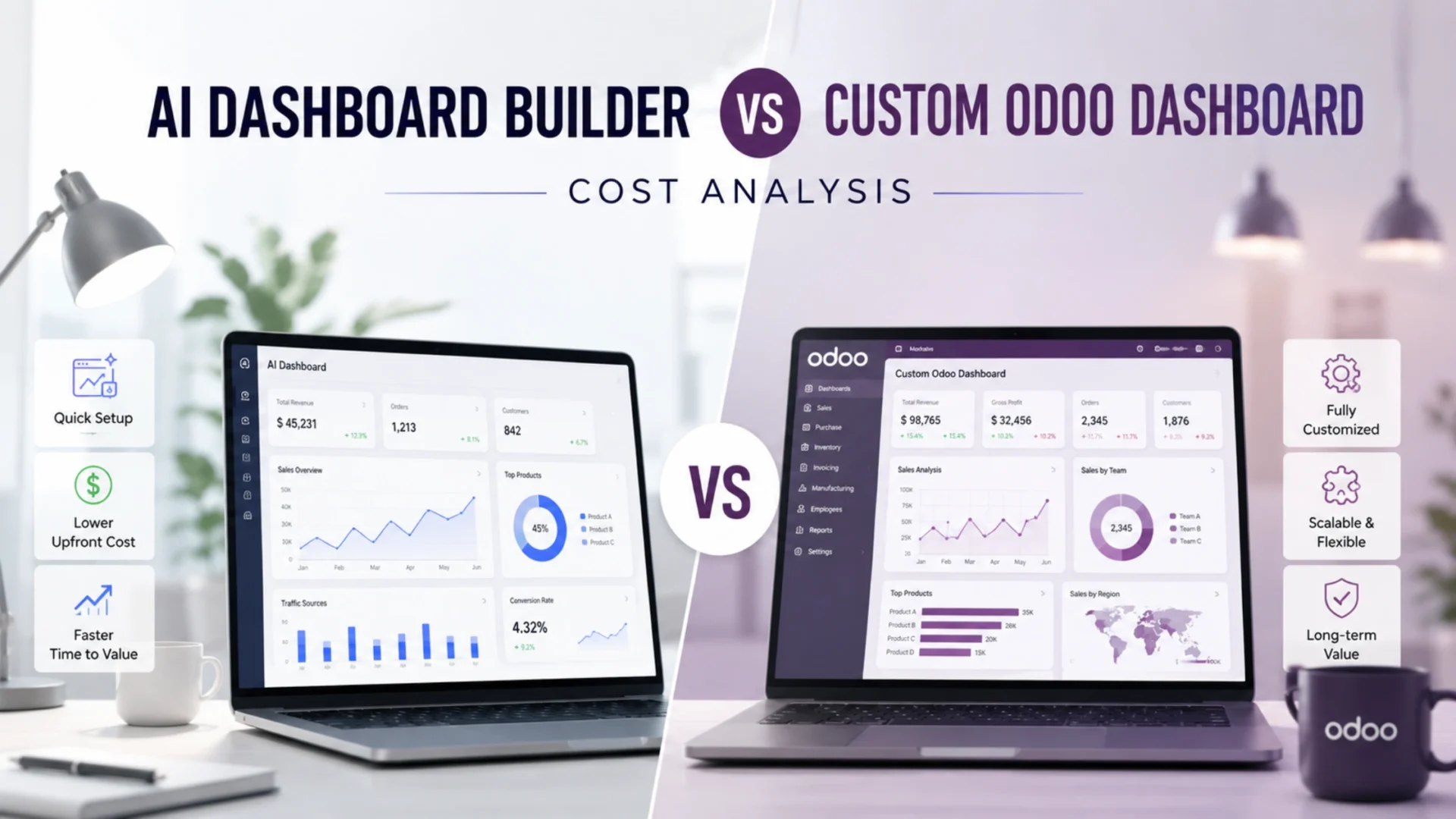
Custom Odoo dashboard development typically runs $2,000 to $10,000 per dashboard in build hours alone, plus 15 to 25 percent of that cost every year in maintenance, plus a separate rework bill each time Odoo ships a new major version. An AI dashboard builder app with a flat one-time license fee, by contrast, covers unlimited dashboards across any model for a fraction of that spend, though it trades away the ability to encode truly custom business logic that a hand-built module can handle. Which one costs less depends almost entirely on how often the underlying question changes.
Three ways to build an Odoo dashboard, and why the cost question gets confusing
Most cost comparisons treat “custom Odoo dashboard” as one thing. It isn’t. There are three distinct paths, and they carry three very different price tags.
The first is Odoo Studio, the no-code tool bundled with Enterprise. It handles field additions, basic layout changes, and simple automations without a developer. The second is a hand-coded custom module, built in Python by a developer, for anything Studio can’t touch: cross-model logic, external API pulls, conditional calculations. The third is an AI dashboard builder app, a purchased module that generates dashboards from a plain-language description and works across models without either of the first two paths.
Confusing these three is how cost conversations go sideways. A business quoted a Studio price assumes that covers cross-model reporting. It doesn’t. A business quoted a custom module price assumes it’s a one-time cost. It usually isn’t, once Odoo’s next major release ships. Getting the comparison right means pricing all three honestly, not picking whichever number sounds best in a sales deck.
What custom Odoo dashboard development actually costs in 2026
Odoo developer rates vary more than most vendors admit. Junior developers, usually offshore, run roughly $20 to $40 an hour. Mid-level developers with a few years of Odoo-specific experience run $40 to $70 an hour. Senior developers, the ones who can safely write logic that survives a version upgrade, run $70 to $120 an hour, and that climbs higher for US-based talent.
A single dashboard, on its own, is not the $100,000 end of that range. A dashboard pulling from one model with straightforward grouping and filtering is a few hours of Studio work, often under $1,000. A dashboard that needs to combine Sales, CRM, and Inventory data with conditional logic and a custom calculation, the kind a finance team actually asks for, lands more realistically in the 40 to 80 hour range. At a blended mid to senior rate, that puts a single non-trivial dashboard somewhere between $2,400 and $8,000 in build cost alone.
That number is honest but incomplete. It’s the price of one dashboard, answering one question, at one point in time. The moment leadership asks for the same view sliced a different way, that’s a new change request, billed at the same hourly rate, starting the clock over.
The costs that don’t show up on the first invoice
Here’s what most vendor quotes leave out entirely: a dashboard built once doesn’t stay built. It needs maintenance, and it needs to survive Odoo’s release cycle, and both of those show up as bills that arrive later, after the project already feels finished.
Software maintenance follows a fairly consistent industry benchmark: 15 to 25 percent of the original development cost, every year, just to keep the thing running, patched, and compatible with everything around it. On a $5,000 custom dashboard build, that’s $750 to $1,250 a year, indefinitely, for one dashboard.
Then there’s the part specific to Odoo. Odoo ships a new major version roughly every 12 to 18 months, and every version introduces breaking changes to the ORM, view structure, and underlying APIs. Odoo’s own documentation is direct about this: if a version change breaks a customization, fixing it is the responsibility of whoever maintains that custom module, not Odoo itself. A custom dashboard built as a module inherits that risk directly.
What that looks like in dollars
A cost analysis from Braincuber on Odoo Studio versus custom module spend found that Studio changes typically run $500 to $3,000 per feature, while equivalent custom modules run $4,000 to $15,000. The twist is what happens next: over a 24-month window, that comparison often flips, since Studio rework and version-upgrade fixes added $12,000 to $22,000 in unplanned costs on average across the accounts studied. One manufacturing client in that analysis had spent $22,400 on Studio customizations over 18 months, then lost 43 percent of those changes to a single version upgrade.
That pattern isn’t unique to Studio. It applies to hand-coded custom dashboards too. A dashboard module written cleanly against Odoo 17 is not guaranteed to run cleanly on Odoo 19 without an audit and, frequently, a partial rewrite. Budget for that rework separately from the maintenance percentage above, since version upgrades are a distinct, less predictable cost event rather than a smooth annual line item.
What an AI dashboard builder app costs, and what’s actually included
Elsner’s AI Dashboard Builder is listed on the official Odoo Apps Store at a one-time price of $49.99. Not a monthly fee. Not a per-user license. One purchase, applied to the Odoo instance, covering dashboards across every model in the system, not just one.
The feature set behind that price includes 17 visualization types, drag-and-drop layout, real-time refresh through Odoo’s bus system, Excel and CSV upload as a data source alongside live Odoo models, and AI-assisted generation across 8 supported providers including OpenAI, Anthropic, and Google Gemini. AI generation is optional. Every layout and chart feature works fully without an AI provider connected at all, and only the model and field schema, never actual records, gets shared with an AI provider when generation is turned on.
The honest cost variable here isn’t the app license. It’s the optional AI provider usage, since that runs through the business’s own API key and gets billed by the provider directly, typically fractions of a cent per generation request for a dashboard-scale prompt. Even a team generating new dashboard drafts weekly is unlikely to see that add up to more than a few dollars a month.
Not sure which path fits your Odoo setup?
Elsner can review your current dashboard requests and tell you honestly whether an app, Studio, or a custom module makes more sense for your team.
The 3-year cost comparison, worked out with real numbers
Numbers mean more with an example attached. Take a mid-sized distribution business that needs three working dashboards: sales pipeline by rep, inventory health by warehouse, and overdue receivables by region. That’s a realistic starting scope for either path.
Path A: custom-built, three dashboards
Build cost at a mid-level rate of $60 an hour, 60 hours per dashboard for cross-model logic, comes to roughly $3,600 per dashboard, or $10,800 for all three. Annual maintenance at 15 to 25 percent adds $1,620 to $2,700 a year. Add one Odoo major version upgrade over three years, with rework realistically running $2,000 to $6,000 for three moderately complex custom modules. Rough 3-year total: $17,660 to $25,900, before a single new dashboard request comes in.
Path B: AI Dashboard Builder, unlimited dashboards
One-time license: $49.99. All three dashboards, plus any future ones the team wants to add, come from the same license with no additional build cost. Add generous optional AI provider usage at roughly $10 to $15 a month for a team generating drafts weekly, which comes to $360 to $540 over three years. Rough 3-year total: $410 to $590, and that figure barely changes whether the team builds three dashboards or thirty.
These are illustrative ranges, not a quote, and actual custom development costs swing based on region, partner tier, and how tangled the existing Odoo instance already is. But the shape of the comparison holds regardless of the exact numbers: custom development cost scales with the number of dashboards and the number of times a question changes, while an app license with a flat fee does not.
Where custom development still wins on cost
None of this means custom development is a bad investment. It means it’s the right investment for a narrower set of situations than most businesses assume.
A dashboard that needs proprietary calculation logic, like a commission engine pulling tiered rules across Sales, Invoicing, and HR, isn’t something a generation-based tool can safely produce. That kind of business logic needs to be written, tested, and version-controlled as code. A dashboard that needs to write data back into Odoo, not just display it, also sits outside what a visualization-focused app is built for.
A useful rule: if the dashboard is really a reporting surface, showing existing data in a clearer shape, an app-based approach is very likely cheaper and faster. If the dashboard is really a calculation engine wearing a dashboard’s interface, that’s a job for custom Odoo development, and the cost is worth paying because no off-the-shelf tool replicates that logic safely.
Regulatory or industry-specific reporting formats are another case where custom development tends to be non-negotiable. If a dashboard has to match an exact compliance layout, an AI-generated chart isn’t going to hit that spec reliably without significant manual correction each time, which erodes the cost advantage fast.
Why the real cost driver is how often the question changes
Business intelligence spending research puts this pattern in sharper focus. Across a broad set of BI cost studies compiled by ZipDo, licensing accounts for roughly 45 percent of total BI spend, with implementation and training making up another 35 percent, which leaves shockingly little of the total cost actually tied to the insight itself. The same research found enterprises typically recoup BI investment costs in around 8 months, but also that 75 percent of BI project failures trace back to poor data quality rather than a weak tool.
That last figure matters here. Neither path, custom or app-based, fixes bad underlying data. A dashboard, however it’s built, is only as trustworthy as the records feeding it. That’s a separate investment from the build-versus-buy decision, and skipping it undermines either option equally.
On the broader IT project side, a Harvard Business Review analysis by Flyvbjerg and Budzier, examining over 1,400 IT projects, found an average cost overrun of 27 percent, and one in six projects came in as a severe outlier averaging a 200 percent overrun. Custom dashboard work rarely reaches that scale of failure, since it’s a small project relative to a full ERP rollout, but the underlying reason projects blow past budget, scope creep from a question that keeps changing, applies just as directly to a dashboard that needs re-slicing every quarter.
Data governance: the one place cost and risk overlap
Cost isn’t the only variable worth checking before committing to either path, since a cheap dashboard that leaks the wrong data to the wrong audience costs far more than it saved.
Custom-built dashboards inherit whatever access control the developer configured, which is only as strong as the spec they were given. An AI-generation feature adds a second question: what data actually leaves the system when a dashboard gets generated. Confirm this explicitly rather than assuming. A schema-only setup, where only field names and types reach the AI provider and business records never leave Odoo, is the standard worth insisting on before turning generation features on for anything touching financial or customer data.
Access tiers matter equally on both paths. A finance dashboard and a general sales dashboard should never share one visibility level, regardless of whether the underlying tool is custom code or a purchased app.
A decision framework, not a universal answer
Skip the instinct to pick a side before scoping the actual need. These questions get to a defensible answer faster than a generic build-versus-buy debate.
- Does this dashboard need new business logic, or does it just need to display existing data more clearly?
- How many times has a similar dashboard request changed shape in the last 12 months?
- Does the business already have a partner on retainer, or would this trigger a new engagement from scratch?
- Is the data source a single clean model, or does it need custom joins across systems that don’t talk to each other yet?
- Would losing this dashboard’s logic in the next Odoo upgrade be a minor inconvenience or a real operational risk?
A team that answers “just display existing data” and “changes constantly” to the first two questions is looking at a strong case for an app-based approach. A team answering “needs new business logic” and “rarely changes” is looking at a strong case for a one-time custom build, since the maintenance and upgrade tax matters less when the logic barely moves.
How Elsner works on both sides of this decision
Elsner Technologies built and published AI Dashboard Builder on the official Odoo Apps Store, and separately runs full Odoo development engagements for businesses that need custom modules, integrations, or migrations. That combination matters for this specific decision, since it means the recommendation a business gets isn’t tilted toward whichever service happens to be more profitable to sell.
Some clients run entirely on the app. Others use it for the reporting layer and bring in custom development for the calculation-heavy pieces underneath. A fair number start with the app to validate what they actually need, then commission specific custom modules only for the two or three dashboards that genuinely require unique logic. Our full guide on the AI Dashboard Builder’s features and setup covers the practical side of getting started, including a realistic rollout plan for teams new to AI-generated dashboards.
For teams weighing this decision against a broader reporting strategy, it’s also worth reading how this fits into a wider business intelligence setup, since dashboards are only one piece of a properly governed reporting stack.
The bottom line
Custom Odoo dashboard development isn’t overpriced. It’s priced correctly for what it is: bespoke engineering work, billed by the hour, that needs upkeep and periodic rework as Odoo evolves. The mistake is applying that pricing model to a need that’s really just visualization of existing data, repeated across a dozen slightly different questions a year. An AI dashboard builder with a flat license fee solves that specific mismatch. It doesn’t replace custom development. It removes the cases where custom development was never really necessary in the first place.
Start by counting how many dashboard requests came in over the last year, and how many of them needed genuinely new logic versus a different slice of the same data. That number, more than any hourly rate, is what actually decides which path costs less for a specific business.
Ready to stop paying full development rates for dashboards that just need to look different?
Elsner can scope your reporting needs honestly and tell you whether an app, Studio, or a custom module actually makes financial sense for your team.
Key takeaways
- A single custom Odoo dashboard with cross-model logic typically costs $2,400 to $8,000 in build hours alone, before ongoing maintenance.
- Maintenance runs 15 to 25 percent of build cost annually, and Odoo’s 12 to 18 month major release cycle adds a separate, harder-to-predict rework cost on top.
- A flat-fee AI dashboard app removes the per-dashboard cost entirely, though it can’t replace custom-coded business logic like commission engines or compliance-format reports.
- The real cost driver isn’t the build price. It’s how often the underlying question changes, since custom development cost scales with change while a flat license doesn’t.
- Confirm what data leaves the system before turning on AI generation features, regardless of which path is chosen.
Frequently Asked Questions
How much does a custom Odoo dashboard cost?
A single dashboard combining data from more than one model typically costs $2,400 to $8,000 in developer hours, based on a mid to senior Odoo developer rate of $60 to $120 an hour and 40 to 80 hours of build time. Simple, single-model dashboards built through Odoo Studio cost far less, often under $1,000.
Does an AI dashboard builder replace custom Odoo development?
No. It replaces the subset of dashboard work that’s really about visualizing existing data in a new shape. Dashboards that need proprietary calculation logic, data write-back, or exact regulatory formatting still require custom module development.
Why do custom Odoo dashboards need ongoing maintenance?
Custom code needs to be reviewed against Odoo’s evolving ORM, security rules, and view structure. The industry benchmark for this ongoing work is 15 to 25 percent of the original build cost per year, separate from any rework triggered by an Odoo major version upgrade.
Does upgrading Odoo break custom dashboards?
It can. Odoo’s own documentation states that if a new version introduces a change that breaks a customization, fixing it is the responsibility of whoever maintains that custom module, not Odoo. Odoo ships a major version roughly every 12 to 18 months, so this is a recurring risk for hand-coded dashboards over a multi-year period.
Is Odoo Studio cheaper than a custom module for dashboards?
Upfront, yes, Studio changes typically run $500 to $3,000 per feature against $4,000 to $15,000 for an equivalent custom module. Over a longer window that gap can narrow or reverse, since Studio-built customizations are harder to version-control and can require significant rework during a version upgrade.
Is my business data shared when an AI dashboard builder generates a dashboard?
In a schema-only setup, only model and field structure, table and field names and types, is sent to the AI provider. Customer records, transaction amounts, and other business data stay inside Odoo and are used only to render the finished chart locally.
What’s the total 3-year cost difference between the two approaches?
For a business needing several dashboards, custom development including build, maintenance, and one version-upgrade rework cycle can realistically total $17,000 to $26,000 over three years. A flat-fee AI dashboard app covering the same scope, plus optional AI provider usage, typically totals under $600 over the same period, though the two aren’t a like-for-like comparison when custom business logic is required.