




- What is agentic process automation, exactly?
- The rise of agentic process automation in 2026
- How does agentic process automation work?
- Agentic process automation vs RPA vs intelligent automation
- Where agentic process automation is actually being used
- Key features to look for in an agentic process automation platform
- Popular agentic process automation tools in 2026
- Not sure which process is actually worth automating with agents?
- The real risks and hidden costs of getting it wrong
- When you should not use agentic process automation
- Building a business case and rollout roadmap
- Common mistakes to avoid
- How to choose the right agentic process automation approach
- How Elsner helps businesses adopt agentic process automation
- The bottom line
- Ready to find out if agentic AI actually fits your workflows?
- Frequently Asked Questions
- What is agentic process automation?
- What is the difference between agentic process automation and RPA?
- Is agentic process automation the same as agentic AI?
- What are examples of agentic process automation?
- Does agentic process automation replace RPA entirely?
- How much does implementing agentic process automation cost?
- Why do so many agentic AI projects fail?
- What industries use agentic process automation the most?
Most software still runs on a simple contract: a rule fires, an action follows. Robotic process automation made that contract fast, but it stayed brittle, since even a small change to a form field or an application layout could stop a script cold. Agentic process automation changes the contract itself. Instead of matching a rule, an AI agent looks at a situation, reasons about what it means, and decides what to do next.
That distinction sounds subtle until you watch it in practice. A traditional workflow tool can route an invoice to the right approver. An agentic system can read the invoice, catch that the vendor changed its bank details last week, flag the mismatch against the vendor master file, and decide on its own whether that is routine or worth a human’s attention, all before anyone opens their inbox. This guide breaks down what agentic process automation actually is, how it differs from RPA and intelligent automation, what it costs to get wrong, and how to evaluate it honestly instead of through a vendor’s demo.
Quick Answer
Agentic process automation (APA) is the use of goal-driven AI agents to plan, execute, and adapt entire business workflows with limited human oversight, rather than following a fixed sequence of pre-programmed rules. Compared with conventional RPA, which is built around static, rule-based scripts, agentic systems interpret context, make judgment calls, and adjust their approach when conditions shift. Done well, APA cuts cycle times and manual handoffs across finance, customer service, and IT operations. Done without governance, it becomes one of the fastest ways to burn budget on a project that never reaches production.
What is agentic process automation, exactly?
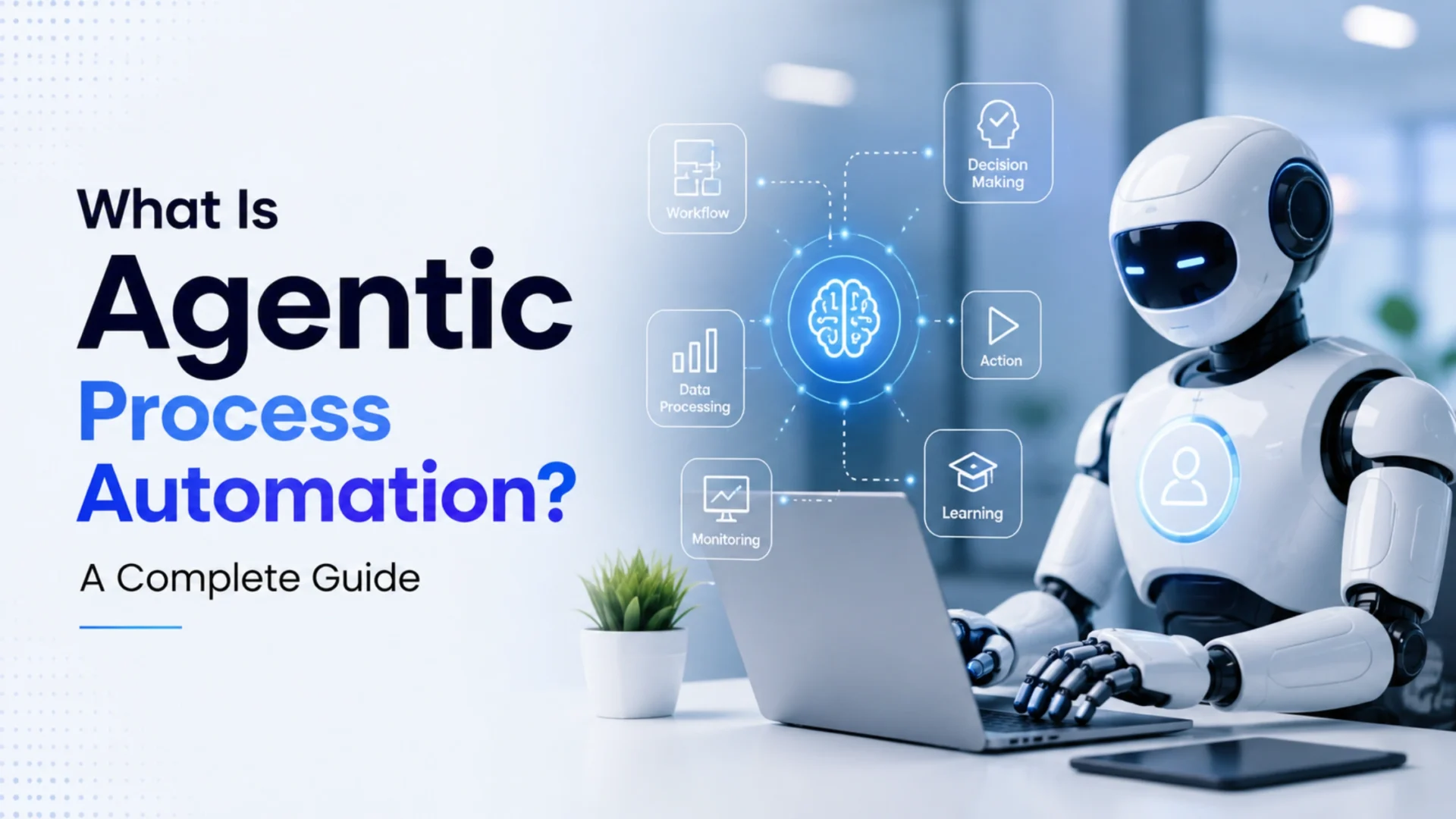
Agentic process automation, often shortened to APA, is a business automation model where AI agents handle a process end to end, from noticing that something needs to happen through deciding the right action and carrying it out. The word “agentic” is doing the real work in that sentence. It means the system has agency: it can set sub-goals, choose between multiple valid paths, and revise its plan when new information arrives, instead of executing a script line by line.
This is a meaningfully different animal from a chatbot or a generative AI writing assistant. Generative AI produces content: a draft, a summary, an answer. Agentic AI process automation takes that a step further and acts on the world, updating a record, sending a payment, rerouting a shipment, based on its own reasoning about what the situation calls for. The output is not text. The output is a completed task.
It is worth being precise about the definition because the term gets stretched thin in vendor marketing. A large language model that drafts an email is not agentic process automation. A rules engine rebranded with an “AI agent” label is not agentic process automation either. Genuine APA requires three things working together: the ability to perceive and interpret real-time data, the ability to reason about what that data means for a goal, and the ability to execute across connected systems without a human triggering every step.
The three-part test for real agentic process automation
Can it interpret context it was not explicitly told about. Can it choose between more than one valid next step. Can it complete the action itself, not just recommend one. If a tool fails any of those three, it is closer to workflow automation wearing an agentic label than the real thing.
The rise of agentic process automation in 2026
Enterprise software has spent the past two years absorbing AI agents at a pace few categories have matched. What started as isolated pilots inside IT and customer service teams is turning into a default expectation for how new software gets built, and the shift is showing up clearly in independent research rather than just vendor keynotes.
Look further out and the projections get more aggressive, though it is worth treating anything past a two-year horizon as directional rather than exact. Gartner’s own August 2025 release projects that agentic AI could drive roughly 30% of enterprise application software revenue by 2035, surpassing $450 billion, up from just 2% in 2025, under its stated best-case scenario. Separately, Gartner’s June 2025 research puts a nearer-term figure on it: at least 15% of everyday work decisions made autonomously through agentic AI by 2028, up from effectively 0% in 2024.
What is driving the urgency is not novelty. It is cost. Every manual handoff in a business process carries a delay, an error rate, and a headcount cost attached to it. McKinsey’s same November 2025 report found that 88% of organizations already report regular AI use in at least one business function, up from 78% a year earlier, which means the baseline expectation for “modern software” has quietly moved even while most agentic deployments remain in pilot stage.
How does agentic process automation work?
Strip away the vendor diagrams and agentic AI process automation runs on a repeating loop: perceive, reason, act, refine. The loop can run in seconds for a customer service query or over hours for a multi-step procurement decision, but the underlying mechanics stay consistent.
1. Trigger and goal-setting
A process starts from an event, a new support ticket, an incoming invoice, a change in inventory levels, or from a plain-language prompt someone gives the system. The agent translates that trigger into a concrete goal it needs to achieve.
2. Data ingestion and interpretation
The agent pulls in whatever context it needs, structured records from a database, unstructured text from an email or contract, or live signals from a connected system, and uses natural language processing to turn that into something it can reason over.
3. Planning and decision-making
This is the step that separates agentic systems from scripted ones. The agent breaks the goal into sub-tasks, weighs the options against business rules and prior outcomes, and picks a path rather than following one that was hard-coded in advance.
4. Multi-system execution
The agent acts through APIs and integrations, updating a CRM record, generating a document, issuing a refund, or handing a sub-task to a specialized agent built for that specific job. Orchestration keeps the sequence coherent when several agents are involved.
5. Escalation and human checkpoints
Well-designed agentic systems know their own limits. When confidence is low, stakes are high, or a policy explicitly requires sign-off, the agent routes the decision to a person instead of guessing, then resumes once approval comes back.
6. Monitoring and refinement
Outcomes get logged and reviewed, but the agent does not automatically get smarter just by running more often. Improvement usually comes from deliberate work: updating the retrieval data it draws on, adjusting the prompts and orchestration logic, incorporating human feedback on flagged decisions, or in some cases fine-tuning the underlying model. Teams that skip this step tend to see an agent’s performance plateau or quietly drift, not improve on its own.
None of this happens in isolation from the rest of a company’s tech stack. Agentic AI process automation is usually layered on top of existing systems rather than replacing them outright, which is why the integration work, not the AI model itself, tends to be where real implementations succeed or stall.
Agentic process automation vs RPA vs intelligent automation
This is the comparison most people are actually searching for when they land on this topic, and it deserves a straight answer instead of vague reassurance that “they work together.” They do work together in practice, but they are not the same technology, and the difference determines what each one should be trusted to handle.
| Dimension | Robotic Process Automation | Intelligent Automation | Agentic Process Automation |
|---|---|---|---|
| How it operates | Mimics clicks and keystrokes on fixed, rule-based scripts | Combines RPA with machine learning for pattern recognition inside defined flows | Plans, decides, and adapts its own path toward a goal |
| Handles process change | Limited. Well-built bots tolerate minor variance, but most need reconfiguration when a workflow changes meaningfully | Partial. Handles more variability than RPA but still needs manual tuning for genuinely new scenarios | Higher. Reasons through unfamiliar situations, though it is not immune to ambiguous or poorly defined edge cases |
| Best-fit tasks | High-volume, repetitive, rule-based tasks with structured inputs | Moderately complex workflows with some data variability | Multi-step, judgment-heavy processes involving unstructured data |
| Human oversight needed | High, any exception stops the process | Moderate, some exceptions handled automatically | Low for routine cases, escalates only genuine edge cases |
| Deployment complexity | Relatively low, fast to script | Moderate, needs data pipelines and model tuning | High, needs orchestration, governance, and monitoring infrastructure |
In practice, RPA does not disappear once agentic process automation enters the picture. It remains the fastest, cheapest way to handle stable, high-volume, rule-based work. What changes is the role it plays: RPA becomes the reliable hands an AI agent uses to execute a decision, rather than the decision-maker itself. Most mature deployments run agentic AI and RPA side by side, with the agent handling judgment and RPA handling the repetitive keystrokes underneath it.
Where agentic process automation is actually being used
The strongest early use cases share a common shape: high transaction volume, a real cost to delay, and enough structured data for an agent to reason about confidently. A few patterns show up repeatedly across industries.
Finance and accounting. Invoice processing agents extract data, match it against purchase orders, flag discrepancies, and route exceptions, cutting the manual reconciliation load that used to eat entire finance-team weeks around month-end close. Loan underwriting and risk assessment agents validate application data and flag inconsistencies before a human ever opens the file.
Customer service. Instead of a scripted chatbot that dead-ends on anything unexpected, agentic support systems can pull order history, check refund policy, process the refund, and follow up, resolving a full interaction rather than deflecting it to a queue.
IT operations. Agents monitor system logs continuously, detect anomalies, run diagnostics, and in many cases apply a fix or roll back a bad deployment before an outage becomes visible to end users.
Supply chain and procurement. Demand-forecasting agents watch sales velocity and external signals, then adjust reorder points and trigger purchase orders automatically instead of waiting for a planner to notice a stockout risk.
Public sector. State and local agencies are piloting agentic systems that walk a constituent through a permit application or benefits request end to end, handling incomplete forms and conflicting guidelines the way an experienced caseworker would, rather than stopping at the first exception the way traditional RPA typically does.
A quick framework for testing process fit
Before greenlighting an agentic build for any process, we run it against six factors that consistently separate strong candidates from expensive detours:
1. Process variability, how often the steps genuinely change
2. Transaction volume, whether there is enough repetition to justify the build cost
3. Decision complexity, how much genuine judgment each case requires
4. Data availability, whether the inputs the agent needs are clean and accessible
5. Risk tolerance, what happens if the agent gets a case wrong
6. Integration readiness, whether the surrounding systems can actually support real-time agent action
Key features to look for in an agentic process automation platform
Not every platform marketed as agentic actually delivers on the definition covered earlier. These are the capabilities worth verifying before committing budget to any agentic process automation tools.
Model flexibility. The platform should connect to more than one large language model rather than locking you into a single provider, since model quality and pricing both shift quickly in this market.
Multi-agent orchestration. Real business processes rarely fit inside a single agent. Look for the ability to coordinate specialized agents, an invoice agent handing off to a payment agent, for instance, with a clear record of who did what and when.
Permission-aware data access. An agent should only ever see and act on data the underlying user role is already permitted to touch. Platforms that bolt AI on top of a flat data layer create a compliance problem before they create any efficiency gain.
Audit trails and explainability. Every decision an agent makes should be traceable: what data it used, what reasoning it applied, and what action it took. Without this, troubleshooting a bad decision after the fact becomes guesswork.
Human-in-the-loop controls. The platform should make it simple to set confidence thresholds and approval gates, so higher-stakes actions route to a person while routine ones proceed automatically.
Enterprise-grade integrations. An agentic process automation platform is only as useful as the systems it can actually reach. Native, well-maintained connectors to your CRM, ERP, and core line-of-business applications matter more than a long feature list.
Popular agentic process automation tools in 2026
The agentic process automation platform market is crowded and still consolidating. The comparison below reflects each platform’s publicly stated positioning against the six criteria from the features section above: model flexibility, orchestration, governance, integrations, human-in-the-loop controls, and fit with existing RPA investments. It is a starting point for a shortlist, not a substitute for testing a platform against your own workflow.
| Platform | Best for | Standout strength |
|---|---|---|
| Automation Anywhere | Enterprises with an existing RPA footprint | Deep orchestration layered directly on top of established RPA workflows |
| UiPath | Organizations scaling from process mining into agentic workflows | Strong process discovery to identify which workflows are worth automating first |
| Salesforce Agentforce | Sales, service, and CRM-centric teams | Tight native integration with existing Salesforce data and workflows |
| Microsoft Copilot Studio | Businesses already standardized on Microsoft 365 and Azure | Low-code agent building tied into Teams, Outlook, and Power Platform |
| Box AI Studio | Content-heavy processes like contracts and compliance | Permission-aware document understanding across large content repositories |
| Nintex | Mid-market teams wanting a gentler learning curve | Accessible workflow builder with agentic capabilities layered in |
| C3 AI | Large industrial and operational deployments | Natural-language-to-workflow authoring for complex, cross-system processes |
A word of caution before shortlisting any of these based on a demo alone. Gartner’s June 2025 research estimates that only about 130 of the thousands of vendors marketing “agentic AI” today offer genuine agentic capability, a practice the firm calls agent washing, where existing chatbots and RPA tools get relabeled without any real change underneath. Ask any vendor to show a live example of the agent handling an exception it was not explicitly scripted for. If they cannot, the platform likely does not clear the three-part test covered earlier.
Not sure which process is actually worth automating with agents?
Elsner can map your highest-friction workflows and tell you honestly which ones justify an agentic build and which ones just need a simpler fix.
The real risks and hidden costs of getting it wrong
Agentic process automation is not a guaranteed win just because the technology is real. Gartner’s June 2025 research predicts that over 40% of agentic AI projects will be canceled by the end of 2027, and the reasons cited are almost never about the model being incapable. They are about organizations underestimating the cost, complexity, and governance a production deployment actually demands.
| Failure pattern | Where it actually hides | Typical impact |
|---|---|---|
| Unclear business value | Projects greenlit because agentic AI is trending, not because a workflow genuinely needs it | Pilot never graduates to production, budget gets pulled at renewal |
| Weak data foundation | Agents fed inconsistent, siloed, or poorly labeled data across systems | Wrong decisions made confidently, eroding trust faster than manual errors would |
| Escalating token and compute costs | Agents that re-reason from scratch on every step instead of caching stable context | Monthly model spend that grows faster than the labor cost it was meant to offset |
| Inadequate risk controls | No confidence thresholds, no audit trail, no rollback path for a bad agent decision | One high-visibility mistake stalls the entire program, even in unrelated areas |
| Agent washing by vendors | Rebranded chatbots and RPA scripts sold under an agentic label | Budget spent on a tool that cannot actually reason through an unscripted exception |
The organizations getting real value are not the ones deploying agents everywhere at once. They are the ones treating governance as a launch requirement rather than an afterthought, with clear ownership for what happens when an agent gets something wrong.
When you should not use agentic process automation
Not every process deserves an agent, and knowing where to hold back is as important as knowing where to build. A few signals suggest APA is the wrong tool for the job right now.
The process is simple, stable, and rule-based. If the steps never change and the inputs are always structured, standard RPA delivers the same outcome for a fraction of the cost and complexity.
The data foundation is not ready. An agent reasoning over incomplete or inconsistent data will produce confident, wrong decisions faster than a human would catch the same error manually.
The cost of a wrong decision is severe and hard to reverse. High-stakes, low-tolerance decisions such as final medical, legal, or large-scale financial approvals still warrant a human as the final decision-maker, with the agent limited to preparation and recommendation.
Volume does not justify the build. Agentic infrastructure has real setup and governance overhead. A process that happens a handful of times a month rarely earns back that investment.
Building a business case and rollout roadmap
A realistic agentic process automation rollout is closer to a phased infrastructure project than a software subscription you switch on overnight. This is roughly what a disciplined first deployment looks like.
Weeks 1 to 3
Run the process through the six-factor fit framework above and pick one candidate with high volume, real cost of delay, and enough historical data for an agent to reason about confidently. Resist the urge to start with the hardest problem first.
Weeks 4 to 7
Audit the data foundation and integration points that process depends on. Most delays at this stage come from data quality gaps, not model limitations.
Weeks 8 to 11
Build the agent with human-in-the-loop checkpoints active on every action, then run it in shadow mode alongside the existing manual process to compare outcomes before it goes live.
Weeks 12 to 16
Go live on low-risk cases first, expand the confidence threshold gradually, and set a recurring audit cadence before scaling the same pattern to a second process.
Common mistakes to avoid
Automating a broken process instead of fixing it first. An agent layered on top of a process nobody has questioned in years just executes the same inefficiency faster and with less visibility into what is actually happening.
Skipping the shadow-mode phase. Sending an untested agent straight into production because a demo looked convincing is how a single bad decision turns into a program-ending incident.
Treating governance as a later problem. Confidence thresholds, audit trails, and escalation paths are far cheaper to design in from day one than to retrofit after an agent has already made a costly call.
Chasing the trend instead of the workflow. Starting with “we need agentic AI somewhere” rather than “this specific process costs us this much every month” is the fastest route to a canceled pilot.
Ignoring change management. Employees who feel replaced rather than supported by an agent tend to work around it, quietly reintroducing the manual steps the project was meant to remove.
How to choose the right agentic process automation approach
Before evaluating a single vendor, work through these questions honestly with the team who actually runs the process day to day.
- Does this process involve enough judgment-based decisions to justify agentic reasoning, or is it stable enough for standard RPA to handle at a fraction of the cost?
- Is the underlying data clean, connected, and accessible enough for an agent to reason about it confidently?
- Who owns the outcome when the agent makes a wrong call, and what does the rollback path look like?
- Does the current platform ecosystem support the integrations this process depends on, or does it need development work first?
- What is the realistic budget once implementation time, governance setup, and ongoing monitoring are factored in, not just the software license?
Skip the demo-driven decision here too. Ask any shortlisted vendor for a reference customer running a process of similar complexity and volume, and ask them directly what broke during the first ninety days.
How Elsner helps businesses adopt agentic process automation
Elsner works on the layer most agentic AI vendors skip: connecting agent reasoning to the messy reality of your actual systems. Our AI agent development team builds custom agents scoped to a specific workflow, run through the same fit framework covered earlier, rather than a generic assistant dropped into your stack and left to figure things out.
That work sits alongside our broader AI and ML development practice, covering the demand forecasting, anomaly detection, and predictive models that agentic workflows often depend on for good decisions, and our custom software development team for the integration work that connects an agent to your CRM, ERP, or legacy systems without forcing a rebuild.
The bottom line
Agentic process automation is not a rebrand of RPA, and it is not a passing trend either. It is a genuine shift in what business software can be trusted to decide on its own, and the organizations getting real value from it are the ones treating it as an infrastructure investment, not a feature toggle. The technology can absolutely deliver the efficiency gains the market is promising. Whether it delivers them for your business depends far less on which vendor you pick and far more on whether you started with a real workflow problem, a clean data foundation, and governance built in from day one.
Ready to find out if agentic AI actually fits your workflows?
Elsner builds agentic systems that hold up in production, not just in a sales demo. Book a consultation and let’s map out where automation makes sense for your business.
Key takeaways
- Agentic process automation means AI agents that plan, decide, and act toward a goal, not another label for scripted RPA or a generative AI writing tool.
- Gartner expects 40% of enterprise apps to embed task-specific AI agents by the end of 2026, but McKinsey finds only 23% of organizations have actually scaled an agentic system into production.
- RPA does not disappear with APA. It usually becomes the reliable execution layer an AI agent directs, rather than the decision-maker itself.
- An agent does not automatically get smarter over time. Improvement requires deliberate work, updated data, adjusted prompts, or human feedback loops.
- Over 40% of agentic AI projects are forecast to be canceled by 2027, almost always due to unclear value, weak data, or missing governance rather than model limitations.
- Not every process deserves an agent. Simple, stable, low-volume, or irreversibly high-stakes processes are usually better served by RPA or a human decision-maker.
Frequently Asked Questions
What is agentic process automation?
Agentic process automation, or APA, is the use of goal-driven AI agents to plan, decide, and execute entire business workflows with minimal human intervention. Unlike traditional automation, it interprets context and adapts its approach when a process changes, instead of following a fixed script.
What is the difference between agentic process automation and RPA?
RPA follows fixed, rule-based scripts and generally needs reconfiguration when a process changes meaningfully. Agentic process automation uses AI reasoning to interpret context, make judgment calls, and adapt in real time, and it often directs RPA bots to handle the repetitive execution underneath its decisions.
Is agentic process automation the same as agentic AI?
They are closely related but not identical. Agentic AI refers broadly to AI systems capable of autonomous, goal-driven action. Agentic process automation is the applied use of that technology specifically to manage and execute business processes end to end.
What are examples of agentic process automation?
Common examples include an agent that processes an invoice, validates it against a purchase order, and routes exceptions on its own, a customer service agent that resolves a refund request end to end, and an IT operations agent that detects a system anomaly and applies a fix without waiting for a ticket to be assigned.
Does agentic process automation replace RPA entirely?
No. RPA remains the most cost-effective option for stable, high-volume, rule-based tasks. Most mature deployments run agentic AI and RPA together, with the agent making decisions and RPA handling the repetitive execution.
How much does implementing agentic process automation cost?
Cost varies widely based on process complexity, data readiness, and integration scope, and it rarely stops at a software license. Budget should also account for data cleanup, governance setup, ongoing model and compute costs, and monitoring, which is why a phased pilot on one process is a more realistic starting point than an enterprise-wide rollout.
Why do so many agentic AI projects fail?
Gartner attributes most cancellations to escalating costs, unclear business value, and inadequate risk controls rather than model limitations. Many failed projects also fall victim to agent washing, where a rebranded chatbot or RPA tool is sold as agentic without genuine reasoning capability.
What industries use agentic process automation the most?
Financial services, IT and technology, healthcare, and the public sector currently show the widest reported use of AI agents, largely because these industries combine high transaction volume with processes that involve enough judgment to benefit from agentic reasoning rather than simple rule-based automation.