





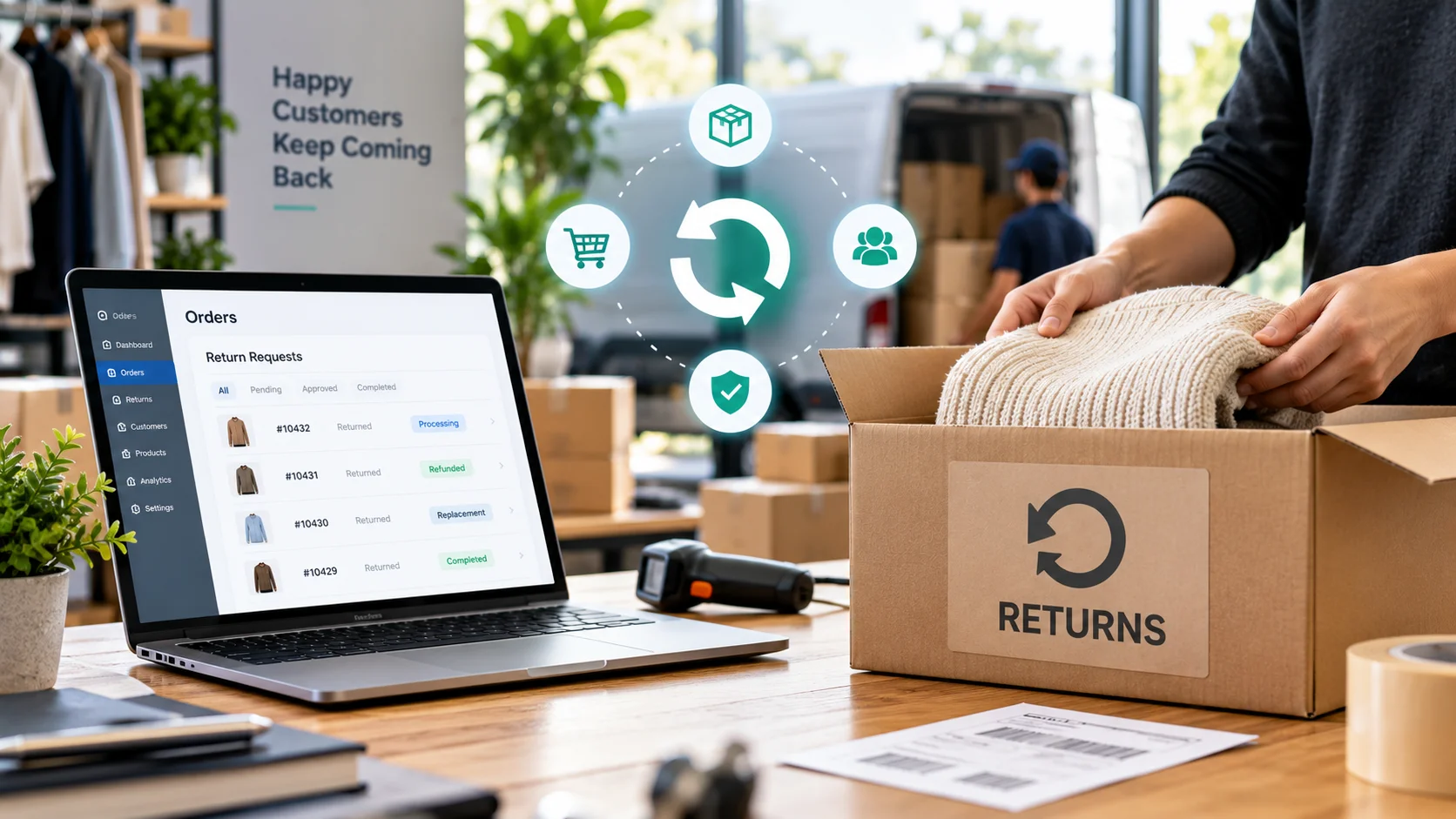
- The Prevent, Manage, Recover, Learn Framework
- What Is Ecommerce Returns Management?
- Returns Management vs. Reverse Logistics
- Why Ecommerce Returns Are a Growing Profitability Problem
- What Causes Most Ecommerce Returns?
- Why Bracketing Deserves a Closer Look
- Collect Return Reasons You Can Act On
- How to Reduce Ecommerce Returns Before the Customer Places an Order
- 1. Improve Product Descriptions
- 2. Improve Product Images and Videos
- 3. Improve Size and Fit Information
- 4. Use Reviews and Customer-Generated Content
- 5. Improve Product Recommendations
- 6. Set Accurate Delivery Expectations
- 7. Catch Order Errors Before Fulfillment
- How to Build a Customer-Friendly Ecommerce Return Policy
- 1. Make the Policy Easy to Find
- 2. Clearly Explain Eligibility
- 3. Be Transparent About Return Fees
- 4. Offer Exchanges Where Appropriate
- 5. Use Store Credit Strategically
- Free Returns vs. Paid Returns: What Should Ecommerce Businesses Consider?
- How Automation Can Improve Ecommerce Returns Management
- Ecommerce Return Fraud and Abuse: Protecting Margins Without Punishing Customers
- How to Recover More Value From Returned Inventory
- How to Use Returns Data to Reduce Future Returns
- The Returns Data Loop
- Two Patterns Worth Checking
- Who Owns the Report
- Ecommerce Returns KPIs Businesses Should Track
- Ecommerce Returns Management Best Practices Checklist
- Final Takeaway: Treat Returns as a Feedback Loop
- Key Takeaways
- Frequently Asked Questions
Online shoppers were expected to send back an estimated 19.3% of their online purchases in 2025, according to the NRF and Happy Returns 2025 Retail Returns Landscape report. Across all of retail, the same report projected $849.9 billion in returned merchandise.
Numbers like that tempt store owners to tighten the policy and call it a day. Honestly, that’s the wrong move. The same research found that about 71% of consumers are less likely to shop with a retailer again after a poor returns experience. Make returns painful, and margins look healthier on paper while repeat buyers quietly leave.
So the goal isn’t zero returns. It’s fewer preventable ones, plus an easy path for the legitimate ones. This guide covers what ecommerce returns management includes, what drives returns, how to prevent them, how to build a fair policy, where automation and fraud controls fit, how to recover value from returned stock, and which KPIs show whether it’s working.
Quick Answer
Ecommerce returns management is the set of policies, workflows, and systems a store uses to handle returned products, from the customer’s request through inspection, refund or exchange, and the final inventory decision. Strong programs prevent avoidable returns, make legitimate returns easy, recover value from returned stock, and use return data to fix products, suppliers, and listings. The aim is fewer preventable returns without losing customer trust.
The Prevent, Manage, Recover, Learn Framework
Treat returns as a feedback loop, not a cost center. Prevent unnecessary returns before a customer checks out. Handle the ones that still happen quickly and with a kind approach. Extract value from every product that comes back. Then use what customers told you to correct the product page, supplier, or packing step where the problem started.
Stage 1
Prevent
Fix product pages, sizing information, and delivery promises before the order is placed.
Covered in: product content, size and fit, order accuracy
Stage 2
Manage
Run policy, fees, exchanges, refunds, automation, and fraud controls so honest returns stay easy.
Covered in: return policy, free vs paid returns, automation, fraud
Stage 3
Recover
Grade, route, and resell returned stock fast so value doesn’t sit in a bin.
Covered in: restock, resell, refurbish, liquidate
Stage 4
Learn
Turn return reasons into fixes for listings, suppliers, and packing, then measure the result.
Covered in: returns data, KPIs, the audit checklist
What Is Ecommerce Returns Management?
Ecommerce returns management is everything a store does after a customer decides an order isn’t right. It covers the policies, workflows, and systems that move a product back and make things right for the buyer.
Every return follows the same basic path, whether a store handles ten a week or ten thousand. The customer asks to send something back. The seller approves it and issues an authorization. The package ships, arrives, and gets checked. A refund or exchange goes out, inventory is adjusted, and the item is restocked or passed to a reseller. Communication runs through all of it, and that’s typically where things fall apart. The difference at scale is how much of that path someone is still typing into a spreadsheet.
Returns Management vs. Reverse Logistics
People often mix the two up. Reverse logistics is the physical movement: transport, receiving, grading, sorting, and routing goods back through the supply chain. Returns management is the bigger umbrella. It includes policy, refunds, messaging, and data, with ecommerce reverse logistics as one piece.
| Area | Reverse Logistics | Returns Management |
|---|---|---|
| Main focus | Physical movement of returned goods | The full experience: policy, refunds, messaging, and data |
| Typical activities | Transport, receiving, grading, sorting, and routing | Eligibility rules, return portal, refunds and exchanges, status updates, reporting |
| Where it breaks down | Slow receiving, unclear grading, stock stuck in bins | Confusing policy, unclear refund status, vague return reasons |
You can run a tight warehouse operation and still frustrate customers with a confusing return portal. A good ecommerce returns management system keeps every step connected, so your team isn’t tracking returns in a spreadsheet or answering “where’s my refund?” emails one by one. A solid order management system helps here, because that’s where return records either connect to the original order or get lost. Returns management software can handle a lot of the rest. It just works best when your policy and data are in good shape first.
Why Ecommerce Returns Are a Growing Profitability Problem
Ecommerce return costs run well beyond the shipping label. Every return sets off a chain of expenses, and most never show up on the product’s margin line.
- Return shipping: whether you charge for it or absorb it.
- Warehouse labor: receiving, inspecting, and repackaging each item.
- Refund processing: payment fees that often aren’t refunded to you.
- Damaged or unsellable items: products that arrive back unfit to sell as new.
- Markdowns: stock that returns after its selling window has closed.
- Customer service time: status questions that pile up in the inbox.
- Tied-up revenue: money stuck while the item sits in transit.
Narvar research reported by Retail Dive in 2024 put shipping, support calls, damage, and related costs at roughly $25 to $30 per return. Your number will vary by category and fulfillment setup. Still, it’s a useful gut check.
Margin Math
Picture a $60 order with a 40% gross margin (an illustration, not a benchmark). That’s $24 of margin. One return at the low end of that cost range wipes out the profit on the sale, and the product may come back as used stock on top of it. Multiply by the share of orders coming back, and profitability looks very different from what the sales report suggests.
Retailers feel the squeeze. In the NRF and Happy Returns survey, the top reasons for charging for returns were higher processing costs (40%), higher carrier shipping costs (40%), and economic uncertainty including tariffs (33%).
Then there’s trust. The same research found that 71% of consumers are less likely to shop with a retailer again after a poor returns experience, and four in five said they’d tell friends and family about it. A bad return doesn’t just lose one order. It can cost future purchases and whatever word of mouth follows.
What Causes Most Ecommerce Returns?
Online shopping returns trace back to a short list of repeat causes, and the fixable ones tend to hide in plain sight. Here’s how the common ones break down.
| Return Reason | Why It Happens | How Businesses Can Prevent It |
|---|---|---|
| Wrong size or fit | Inconsistent sizing, thin size charts | Detailed size guides, measurement help, fit feedback from reviews |
| Not as expected | Photos, copy, or color don’t match the real product | Better photography, accurate descriptions, customer photos |
| Inaccurate product information | Supplier data errors, outdated specs | Product data audits, clear ownership for updates |
| Damaged in transit | Weak packaging, rough handling | Packaging tests, carrier performance reviews |
| Wrong item shipped | Picking or variant mistakes | Barcode scanning at packing, variant checks |
| Quality issues | Supplier inconsistency | Inspection at receiving, supplier scorecards |
| Changed mind | Impulse buying, second thoughts | Clear policy and expectations (some are unavoidable) |
| Bracketing | Buying several sizes or colors to keep one | Better fit tools, exchange-first return flows |
| Delivery problems | Late arrival, missed dates | Honest delivery estimates, proactive tracking |
Why Bracketing Deserves a Closer Look
Shoppers order two or three variants, keep one, and send the rest back. From the customer’s side it’s perfectly rational when sizing feels unreliable. NRF found that shoppers aged 18 to 30 made 7.7 online returns on average over the past 12 months, more than any other generation, so the habit isn’t fading.
One caveat. Not every return signals a mistake on your end. People change their minds, and that’s part of online shopping. The real job is separating the fixable from the unavoidable.
Collect Return Reasons You Can Act On
Reason data is only as good as how you collect it. If your return form offers six vague options and an “other” box, you’ll learn very little. Specific choices like “ran small” or “color looked different online” turn return reason analysis into something you can act on.
How to Reduce Ecommerce Returns Before the Customer Places an Order
Prevention is where most of the savings sit, because a return you never receive costs nothing to process. Start with the product page. It’s the only salesperson your customer meets.
1. Improve Product Descriptions
Vague copy invites disappointment. List exact dimensions, materials, compatibility, what’s in the box, and what the product can’t do. “Fits most laptops” is a return waiting to happen. “Fits laptops up to 15 inches” isn’t. Say the limits out loud. Also check how product data arrives, because if descriptions get pasted straight from supplier feeds, their errors travel with them.
Treat description changes as experiments. Teams running structured conversion rate optimization services programs should judge each test on returns as well as conversions, since a page that sells more but sends more back isn’t a win.
2. Improve Product Images and Videos
Show several angles, the product beside something familiar for scale, and the item in real use. Short demo videos matter most for anything with setup or moving parts. Zoomable detail shots help with texture and finish. Color mismatch is a classic “not as expected” trigger, so shoot in natural light and show variants honestly. For apparel, a short clip showing drape and movement answers questions photos can’t.
3. Improve Size and Fit Information
Skip the generic size chart. Post garment measurements in both centimeters and inches, add at-home measuring guides, and include fit notes like “runs small” or “roomy through the shoulders.” Where it suits the catalog, add a fit recommendation tool and compare its output with actual return data. Sizing can differ from brand to brand even inside a single store, so one shopper’s medium might be another’s too-small small. Call out those differences instead of hoping shoppers spot them. For categories where fit drives returns, this overview of virtual try-ons and augmented reality in ecommerce explains what these tools can and can’t do.
4. Use Reviews and Customer-Generated Content
Photo reviews, reviewer size and height details, and Q&A cut down guesswork. A shopper who sees how a jacket fits someone her size has less reason to bracket. Surface fit information near the size selector, not on page three of the reviews.
Questions and answers do double duty. A shopper asking whether a bag holds a 16-inch laptop gets the answer before ordering, and so does everyone who asks later.
5. Improve Product Recommendations
Personalization helps when it’s practical. Suggest the right size based on past orders, show compatible accessories, or steer a shopper from a poor match toward a better one. This guide to personalization in ecommerce covers the wider toolkit. AI can support it by spotting patterns in purchase and return data, but treat it as something to test, not a guaranteed fix.
A Useful Rule
If you can’t tie a recommendation feature to a measurable drop in returns for a specific product group, it’s still a guess.
6. Set Accurate Delivery Expectations
Overpromising on delivery creates returns. A gift that lands after the birthday is going back. Show realistic windows at checkout, account for processing time, and message customers early when something slips. Underpromise slightly and beat it. That’s cheaper than apologizing.
7. Catch Order Errors Before Fulfillment
Wrong variant, wrong quantity, wrong address. A short modification window after checkout, anywhere from a few minutes to an hour depending on how fast you pick orders, lets customers fix mistakes before anything ships. Address validation at checkout trims failed deliveries too.
How to Build a Customer-Friendly Ecommerce Return Policy
Policy is a business decision, and every choice pushes cost and experience in different directions. The aim is a customer-friendly return policy that manages avoidable cost without slowing down the shoppers who have a real problem.
1. Make the Policy Easy to Find
Link it from product pages, the footer, checkout, your help center, and the order confirmation email. If shoppers have to hunt for it, they’ll assume the worst. A policy buried in legal text counts as hidden, so write in plain language and put a short summary above the details.
2. Clearly Explain Eligibility
Spell out the return window, acceptable condition, exclusions (such as final sale or hygiene items), and the proof of purchase you require. Fuzzy rules lead to arguments and extra support tickets.
Return window length is a real lever. A shorter window limits exposure but raises anxiety at purchase. A longer one feels generous but delays inventory recovery. Pick by category, and keep in mind that 37% of retailers in the NRF and Happy Returns survey planned to extend return windows for the holiday season.
3. Be Transparent About Return Fees
Free, paid, and conditional models can all work. A surprise fee at the end of the process doesn’t. Tell customers what a return costs before they buy, not after they’ve boxed the item. If return shipping is deducted from the refund, show the amount in the return portal before the label prints.
4. Offer Exchanges Where Appropriate
A customer who ordered a medium and needs a large usually still wants the product. An exchange keeps the revenue and solves the real problem. Make it the first option in your return flow, not a buried one. Some categories need their own exchange rules, and this look at handling jewelry ecommerce returns and exchanges shows how that plays out for high-value items.
5. Use Store Credit Strategically
Store credit works when a customer prefers speed, when you add a small bonus, or when an item can’t be restocked. It shouldn’t replace a refund the customer is owed. Offer it as a choice with a clear upside. Whatever the outcome, keep refund management transparent: show the method, the expected timeline, and the status in the same place the customer started the return.
A Useful Principle
A good policy controls unnecessary costs without creating unnecessary friction.
Free Returns vs. Paid Returns: What Should Ecommerce Businesses Consider?
There’s no universal winner. NRF found that 82% of consumers call free returns an important factor when shopping online, so the pressure to offer them is real. The costs are just as real.
| Model | What It Helps With | The Tradeoff |
|---|---|---|
| Free returns | Eases purchase anxiety, builds confidence, can help conversion | Higher operating cost, more casual returns, greater exposure to abuse |
| Paid returns | Recovers some expense and may discourage unnecessary sends | Adds friction, and some shoppers will simply buy elsewhere |
| Hybrid models | Balances cost control with customer confidence | Needs clear communication and category-level math |
For online store returns, most businesses land somewhere in the middle. Common hybrid setups include:
- Free exchanges, paid refunds
- Different rules by category, such as apparel versus furniture
- Free returns for loyalty members
- Free returns above an order value threshold
- Risk-based controls for accounts with unusual patterns
Whatever model you choose, announce changes clearly. Consumers respond more to surprises than to the policy itself. Also run the numbers by category first, because a line with thin margins and frequent returns needs different handling than one with healthy margins and few.
It depends on your margins, your category, and how your customers shop. Test, measure, and don’t copy a competitor’s policy blindly.
How Automation Can Improve Ecommerce Returns Management
Ecommerce return automation works best when it handles what’s repetitive and rule based and leaves the judgment calls to people.
Return requests and eligibility checks are the obvious starting point. A customer enters an order number, the system checks the window and item condition rules, and an authorization and label come back in seconds. No email thread needed. Teams comparing ecommerce returns software should look past the demo and ask how it handles ERP integration, how it deals with exceptions, and whether raw data can be exported. From there, automate customer notifications and return tracking, so shoppers see status without contacting support.
Refund and exchange workflows deserve the same attention. Refunds that trigger as soon as a return scans in feel fast to customers, and fast matters. NRF found that 76% of consumers are more likely to choose a return option offering an instant refund or exchange, as noted in its 2025 returns research.
Exceptions are the catch. Automation should clear the straightforward cases so staff can spend time on damaged goods, high-value orders, and upset customers. Back-end automation is less visible but just as useful:
- Inventory updates the moment an item is graded
- Return analytics that feed merchandising reports
- Risk flagging that routes suspicious requests to a person
The real payoff comes from integration. When your platform, ERP, order management system, CRM, inventory tools, and analytics talk to each other, a return becomes one connected record instead of five disconnected ones. On Shopify, that often means custom workflows built through Shopify development services so returns data reaches the systems that need it.
Returns Process Held Together by Spreadsheets?
Map your return workflow, integrations, and data gaps before choosing tools. A clear scope keeps the build focused on fewer preventable returns and faster refunds.
Ecommerce Return Fraud and Abuse: Protecting Margins Without Punishing Customers
Fraud is real. NRF and Happy Returns found that 9% of all returns are fraudulent, and 45% of shoppers say it’s acceptable to “bend the rules” on returns. Retailers also report more empty boxes, counterfeit items, and exaggerated claims. The usual patterns are worth knowing:
- Wardrobing: wearing an item once, then returning it.
- Empty box returns: sending back a package without the product.
- Counterfeit returns: swapping in a fake for the original.
- Serial returning: habitual, high-volume return behavior.
Bracketing sits in a gray zone. It’s often a misuse of policy, but most shoppers doing it aren’t committing fraud.
Keep This in View
Most of your customers are honest. Locking down the whole return process because of a minority punishes everyone and, as the NRF numbers show, drives away buyers.
Risk-based controls work better. Look at customer history, order value, product category, return patterns, and other risk signals together, not any single one. Let low-risk customers sail through. Stores with enough order history can even train a scoring model, which is where AI and ML development services come in. Practical safeguards include:
- Serial number checks for electronics
- Photo evidence for damage claims
- Scanning packages on receipt
- Manual review for high-risk cases, with a human in the loop so a good customer with an unlucky streak doesn’t get flagged by a rule
How to Recover More Value From Returned Inventory
Every returned item ends up somewhere. Where it lands decides how much of the sale you keep.
| Route | What Happens |
|---|---|
| Restock | Sellable condition goes straight back to inventory |
| Exchange | The item leaves again, this time in the right size or color |
| Store credit | Value stays with your brand |
| Refurbish | Repair or repackage, then sell |
| Resell | Open box or outlet channels |
| Liquidate | Bulk sale when resale isn’t practical |
| Donate | Useful for goods with low resale value |
| Recycle or dispose | The last resort, where necessary |
Grading tiers help. A simple scale, like new, open box, refurbish, and scrap, lets staff route items in seconds instead of debating each one. Pair it with sound warehouse management practices so the returns area doesn’t turn into a backlog.
Speed matters more than people expect. An item sitting in a returns bin for three weeks is stock you can’t sell and may miss its season. Inspection and grading rules should be clear enough that staff make fast calls, and inventory counts should update the moment a decision is made.
For stores selling across web, marketplaces, and physical locations, that sync gets harder. Stores with large catalogs on Magento usually need Adobe Commerce development services work to keep inventory records accurate across channels, which also matters for any omnichannel ecommerce plan.
Three Recoveries at Once
Think of returns management as customer recovery, inventory recovery, and revenue recovery happening together. If you only win one, you’re leaving money on the table.
How to Use Returns Data to Reduce Future Returns
A return isn’t only a cost. It’s customer and product data. Most stores process it and move on, which wastes one of the cheapest sources of product feedback available.
The Returns Data Loop
- Return: a customer sends an item back.
- Reason: capture a specific reason at the request stage, not a lazy “other.” Customer photos uploaded with damage or quality claims add evidence you can pass to suppliers and carriers.
- Pattern: look by SKU, product category, size, variant, customer segment, geography, supplier, warehouse, carrier, sales channel, and season. A spike in one slice usually points to one cause.
- Root cause: trace the pattern back to a page, a photo, a spec, a supplier, or a packing step.
- Fix: change the thing that caused it, not just the refund.
- Measure: watch whether that SKU’s return reasons shift over the next few weeks.
Two Patterns Worth Checking
A Linen Shirt With Repeated “Not as Expected” Returns
Don’t just refund and restock. Check the product page, the photography, the listed specs, what reviews say about color and fabric weight, the packaging, and what the supplier actually shipped. Maybe the main photo is overexposed. Maybe a supplier swapped the fabric. Fix the cause, then watch whether that SKU’s return reasons shift.
A Shoe Style Returned Mostly in One Size
That points to a fit problem in that size, not a general sizing issue. The fix might be a note on that variant or a conversation with the factory.
Who Owns the Report
Review the data on a schedule. Monthly works for most teams. Ecommerce returns analytics only help if someone owns the report and has the authority to change a product page or push back on a supplier.
Getting this data into one place usually means connecting the storefront, inventory, ERP, and customer systems. Businesses planning that work can explore ecommerce development services built around their existing stack.
Ecommerce Returns KPIs Businesses Should Track
You can’t improve what you don’t measure, and one number won’t tell the story.
| KPI | What It Tells You |
|---|---|
| Ecommerce return rate | Overall share of orders or revenue returned |
| Return rate by SKU and category | Where problem products cluster |
| Return reason distribution | The mix of fixable and unavoidable causes |
| Preventable return rate | Returns tied to errors you can fix |
| Average return processing time | Speed from request to receipt and inspection |
| Refund processing time | How long customers wait for money back |
| Exchange rate | Share of returns converted to exchanges |
| Store credit adoption | How often customers pick credit over refunds |
| Resale rate of returned items | How much returned stock sells again |
| Cost per return | Full handling cost, not just shipping |
| Return abuse rate | Share of returns flagged as abusive or fraudulent |
| Repeat purchase after return | Whether returners come back |
Two of these need careful definitions. Preventable return rate is returns with fixable causes, such as wrong item, inaccurate listing, or damage, divided by total orders. Cost per return should include shipping, labor, packaging, payment fees, and lost value from markdowns. Both take some manual coding at first, and that’s fine. Once the definitions hold, business intelligence services can turn them into dashboards the whole team reads the same way.
A Warning About Return Rate
Don’t chase a lower return rate on its own. A rate can fall because your policy got so strict that customers stopped trying, and that’s a loss that never appears in the metric. Balance return rate against profitability, customer experience, and retention. If the rate drops while repeat purchases after returns drop too, something’s off.
Ecommerce Returns Management Best Practices Checklist
Use this as a quick audit of your ecommerce returns best practices.
Prevent
- Improve product information
- Improve product visuals
- Improve sizing information
- Set accurate expectations
Manage
- Make policies easy to find
- Make legitimate returns convenient
- Encourage exchanges where appropriate
- Use store credit strategically
- Automate repetitive workflows
- Monitor return abuse
Recover
- Recover returned inventory
Learn
- Analyze return reasons
- Track return KPIs
- Feed return insights back into merchandising
- Review return performance regularly
Final Takeaway: Treat Returns as a Feedback Loop
The goal isn’t to eliminate returns. It’s to reduce preventable returns, manage legitimate returns efficiently, recover inventory value, and keep customer trust intact. Prevent what you can with better pages and clearer expectations. Manage the rest with a simple, honest process. Recover value from every item. Learn from the data, then feed it back into the first step.
Stores that work this way tend to make better decisions about products, suppliers, and platforms, because they’re listening to what customers are telling them. Handled well, a return supports retention and loyalty. Handled badly, it ends the relationship.
Key Takeaways
- Ecommerce returns management covers policy, refunds, messaging, and data. Reverse logistics is one piece of it.
- Return costs reach well beyond shipping, so check the math on a typical order before changing policy.
- Prevention is where most savings sit: accurate product pages, honest size guidance, and realistic delivery promises.
- A good policy is easy to find, clear about fees, and puts exchanges first.
- Automate the repetitive cases and keep people on exceptions, damaged goods, and high-value orders.
- Use risk-based fraud controls so honest customers are never treated like suspects.
- Track preventable return rate and cost per return, and never judge success by return rate alone.
If your returns process is held together by manual steps and disconnected systems, it may be time to look at how your ecommerce technology supports it.
Frequently Asked Questions
What is ecommerce returns management?
It’s the process of handling returned products from request to final inventory update, including policy, shipping, inspection, refunds or exchanges, and customer communication.
What is a good ecommerce return rate?
It depends on category. NRF and Happy Returns estimated that 19.3% of online sales would be returned in 2025. Apparel usually runs higher, so compare against similar products.
How can ecommerce businesses reduce returns?
Start with accurate descriptions, strong visuals, clear size guidance, honest delivery estimates, and fewer order errors. Then use return reasons to fix recurring problems.
What are the most common reasons for ecommerce returns?
Wrong size or fit, products not matching expectations, inaccurate information, damage, wrong items, quality problems, and changes of mind.
How can ecommerce stores reduce return costs?
Prevent avoidable returns, encourage exchanges, automate processing, speed up inspection, and resell or refurbish items quickly.
Should ecommerce stores offer free returns?
Not always. Free returns can build confidence but raise costs. Many stores use hybrid models, such as free exchanges or perks for loyalty members.
How can AI help reduce ecommerce returns?
It can support size recommendations, product matching, and return pattern analysis. Results depend on data quality, so test it against real return data.
What ecommerce returns KPIs should businesses track?
Return rate, rate by SKU, reason distribution, preventable return rate, processing and refund time, cost per return, and repeat purchase after return.
What is the difference between returns management and reverse logistics?
Reverse logistics is the physical movement of returned goods. Returns management also covers policy, communication, refunds, and data.
Make Returns Work for Your Margins
Want your storefront, inventory, and customer systems working together so returns stop being a drain on margin? Talk to Elsner’s ecommerce team about building a returns process that fits your platform and your customers.
Recommended Elsner Resources