




- What is Ecommerce ERP Integration?
- Key Data Synchronization Areas
- Why Integrate Ecommerce with ERP Systems?
- Key Benefits of Ecommerce ERP Integration
- Ecommerce ERP Integration Architecture Explained
- API-Based Integration
- Middleware Integration
- Custom Integration Solutions
- Types of Ecommerce ERP Integration
- Step-by-Step Process to Integrate Ecommerce with ERP
- Common Ecommerce ERP Integration Challenges
- Best Practices for Successful ERP Ecommerce Integration
- Ecommerce ERP Integration by Business Type
- How to Choose the Right Ecommerce ERP Integration Solution
- Conclusion
- Ready to Integrate Your Ecommerce and ERP Systems?
- Frequently Asked Questions
- What is ecommerce ERP integration?
- Why is ERP integration important for ecommerce businesses?
- How do you integrate ecommerce with ERP systems?
- What are the benefits of integrating ERP with ecommerce platforms?
- What are common ecommerce ERP integration challenges?
- What is the best ERP for ecommerce integration?
Most businesses don’t think about ecommerce ERP integration until something goes wrong — and it usually goes wrong in the most visible way possible. A customer emails asking where their order is. You’re suddenly checking three systems that all say something different. At that point, you’re not just dealing with a data problem. You’re dealing with the consequences of a data problem.
So if you’re scaling an ecommerce operation in 2026, this guide covers everything you need to know about ERP and ecommerce integration — what it is, why it matters, how it works, and how to do it without making expensive mistakes.
Quick context: “ERP integration” covers a huge range of setups — from a simple API sync between Shopify and NetSuite to a fully custom middleware layer connecting six systems across three warehouses. Understanding which one your business actually needs is the real work. This guide walks through all of it.
What is Ecommerce ERP Integration?
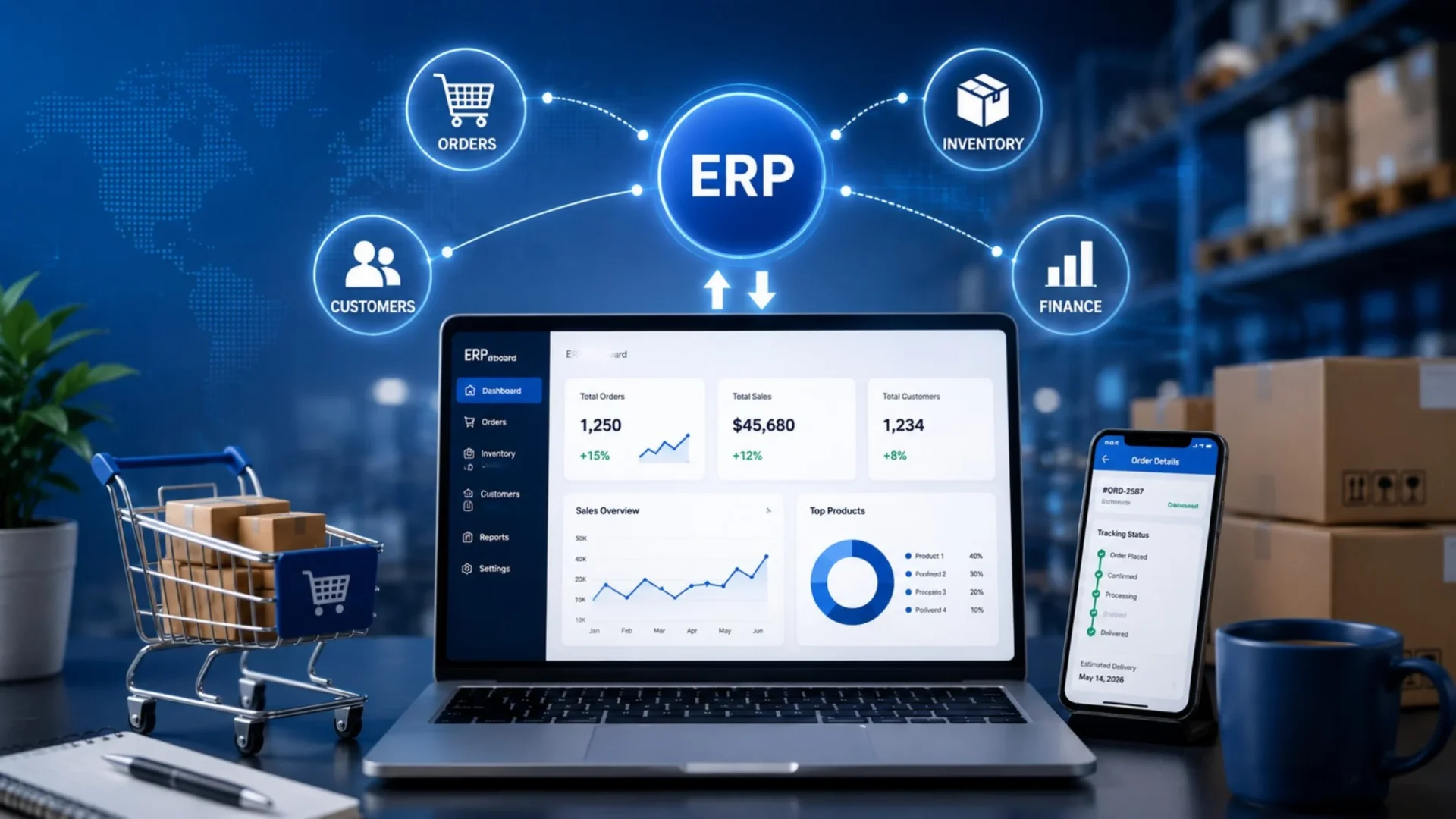
Ecommerce integration with an ERP system means connecting your online store directly to it so data moves between them automatically. No exports, no imports, no one manually re-entering orders at the start of each shift.
Your ecommerce platform — Shopify, WooCommerce, Magento, or BigCommerce — is where transactions happen. Your ERP — SAP, NetSuite, Oracle, or Microsoft Dynamics — is where your business actually runs. Finance, inventory, procurement, fulfillment. Without integration, those two worlds operate in parallel but rarely in sync.
If you’re still evaluating the right platform before integration, the ecommerce development path you choose will directly shape how complex or straightforward your ERP connection becomes.
Definition at a Glance
Ecommerce ERP integration creates a live connection between your store and your ERP. When something happens on one side, the other side knows immediately. An order is placed — the ERP sees it. Inventory drops below threshold — the ecommerce platform reflects it. A payment is processed — the books update. Conceptually simple. The complexity is in the details.
Key Data Synchronization Areas
Here’s what actually moves between systems in a typical integration:
Why Integrate Ecommerce with ERP Systems?
The practical answer is that manual processes don’t scale. But that framing undersells it. The real reason to understand why integrate ecommerce and ERP is what it does to the quality of decisions across your entire business. Three things capture almost all of the value.
|
1
|
Eliminating Manual ProcessesAt 20 orders a day, manual entry is manageable. At 200, you’ve hired someone just to do that. At 2,000, you’ve got a team and they’re still making mistakes. ERP integration with ecommerce removes that loop entirely — the data moves without anyone touching it. |
|
2
|
Real-Time Data VisibilityInventory managers stop relying on morning reports. Customer service can look up order status without calling anyone. Finance doesn’t wait until end of week to know where revenue stands. It quietly removes a lot of friction that people had learned to work around. |
|
3
|
Improved Customer ExperienceFaster fulfillment, accurate stock availability on product pages, fewer support tickets about order status. Customers don’t know the integration exists. They just notice things work. |
Key Benefits of Ecommerce ERP Integration
Here’s a practical summary of what actually changes after a proper ERP ecommerce integration:
- Operational efficiency — routine data tasks run automatically. Your team handles work that genuinely requires judgment, not copy-paste.
- Faster order processing — orders enter fulfillment workflows immediately rather than waiting for a batch import or a manual handoff.
- Accurate inventory — stock counts update the moment something is sold, returned, or received. Overselling becomes a much rarer problem.
- Better reporting — finance, ops, and ecommerce data all live in one place, pulling from the same records at the same time.
- Scalability — your order volume can grow without a proportional increase in back-office headcount. The system handles the volume the same way at 500 or 50,000 orders.
The compounding effect: The benefits of integrating ERP with ecommerce platforms tend to build over time rather than plateau. The efficiency you gain at 500 orders a month looks even better at 5,000 — because the system handles the volume the same way regardless.
Ecommerce ERP Integration Architecture Explained
There are three main ways to build this connection. The right approach depends on your systems, your team’s technical capacity, and how much customization your business actually needs.
API-Based Integration
The most direct method. Your ecommerce platform and ERP communicate through APIs. When an order is placed, the data moves immediately via an API call — fast, reliable, and clean to maintain when both systems have well-documented APIs. Most modern ecommerce platforms do. Some ERPs make this easier than others.
Middleware Integration
Platforms like MuleSoft, Boomi, or Celigo sit between your two systems and manage the translation layer. If your ERP uses a different data structure than your ecommerce platform, the middleware maps and converts data as it passes through. If you’re on WooCommerce, for example, it helps to understand how to connect Zoho with your WooCommerce store — a practical walkthrough of this middleware architecture in action.
Best fit for most businesses: Middleware hits the right balance for mid-market businesses — flexible enough to handle real complexity, without the cost and risk of a fully custom build. It also makes it easier to add more systems later without rebuilding the whole integration from scratch.
Custom Integration Solutions
Sometimes the off-the-shelf options genuinely don’t fit. Complex pricing logic, unusual fulfillment rules, internal tools that need to be part of the data flow. Custom integration gives you full control, but costs more to build and requires ongoing maintenance. Worth it when your requirements are truly specific. Not worth it when a middleware solution would do the job.
Types of Ecommerce ERP Integration
Not all integrations look the same. The right setup depends heavily on what kind of ecommerce business you’re running.
B2C Ecommerce Integration
High volume, fast-moving, lots of smaller orders. B2C integration is mostly about speed and accuracy at scale. Orders need to route to fulfillment quickly. Inventory needs to update in real time, and customer data needs to stay clean across potentially very large record sets. The main challenge here is sync frequency and volume handling.
B2B Ecommerce ERP Integration ★ Most Complex
B2B ecommerce ERP integration is meaningfully more complex — and it’s worth being direct about that. You’re not just syncing orders. You’re syncing purchase orders, account-specific pricing, credit terms, approval workflows, and multi-contact company accounts. A wholesale distributor selling to 300 accounts, each with their own pricing tier, needs all of that reflected accurately in the ERP without anyone manually reconciling it. Without integration, that’s someone’s entire job. Probably two people’s.
Omnichannel Integration
If you’re selling through your own website, a physical store, Amazon, and a wholesale portal, omnichannel integration connects all of those channels through your ERP. Businesses exploring multi-platform integration tools for ecommerce will find this particularly relevant — the right toolset makes omnichannel data management far less painful. More complex to set up, but the only realistic way to run a multi-channel operation without constant reconciliation headaches.
Step-by-Step Process to Integrate Ecommerce with ERP
When you’re ready to actually integrate ecommerce with ERP, here’s how the process tends to unfold.
|
1
|
Define RequirementsBefore anything technical happens, you need clear answers to some unglamorous questions. What data needs to move? In which direction? How often? What’s the source of truth for inventory when systems conflict? What happens if an order is placed while the ERP sync is temporarily offline? These feel tedious upfront. They feel much worse after something has already gone live and broken. |
|
2
|
Choose Integration MethodAPI, middleware, or custom — there’s no universally right answer. It depends on your platforms, your technical resources, and how much ongoing maintenance you’re prepared to handle. A good integration partner should help you think through this honestly rather than defaulting to whatever they sell. |
|
3
|
Data MappingThis is where the real work happens. How does a customer record in Shopify correspond to an account in NetSuite? How do product variants map between systems? How do order statuses translate? Data mapping determines whether everything downstream functions correctly. Skimping on it creates problems you’ll be chasing for months. |
|
4
|
TestingTest the scenarios that actually happen in your business — not just the clean ones. Partial returns. Split shipments. A product that goes out of stock between order placement and fulfillment. Orders that arrive with addresses that don’t match your ERP’s formatting. Edge cases are where integrations break, and it’s much better to find them before go-live. |
|
5
|
Deployment & MonitoringLaunch with monitoring in place. You want alerts when a sync job fails or data stops flowing as expected. The first few weeks after deployment are typically when most issues surface — catching them quickly matters. Don’t go live dark. |
Common Ecommerce ERP Integration Challenges
Going in with realistic expectations helps. Ecommerce ERP integration challenges are common and most of them are solvable — but they’re easier to solve when you’re not surprised by them.
|
1
|
Data Sync IssuesMismatches in data formats, timing gaps, or conflicting logic cause records to fall out of sync. A product SKU formatted one way in your ecommerce platform and slightly differently in your ERP will cause downstream problems that can be genuinely difficult to trace. Usually configuration issues — but they require methodical resolution. |
|
2
|
Complex Product StructuresBundles, kits, configurable products, and items assembled from components tracked separately in the ERP don’t map cleanly between systems without explicit logic. If your catalog is straightforward, this isn’t a big issue. If it isn’t, plan for it early. |
|
3
|
Underestimated Integration CostsBoth the initial build and ongoing maintenance are regularly underestimated. When your ecommerce platform updates its API version or your ERP releases a major upgrade, someone has to maintain compatibility. That cost doesn’t disappear after launch. |
|
4
|
Custom Business LogicChannel-specific pricing, multi-warehouse allocation, specific tax handling, discount stacking rules — these need to be explicitly built into the integration. Assuming they’ll “just work” is one of the more expensive assumptions you can make. |
The right question to ask any integration partner before signing: Based on our current systems and order volume, where are the most likely points of failure? If they answer in concrete terms, they understand your setup. If they skip straight to the sales pitch, keep shopping.
Best Practices for Successful ERP Ecommerce Integration
A few things consistently separate integrations that run well from ones that cause ongoing frustration. Before you start building, it also helps to ensure your storefront itself is solid — understanding what goes into building a scalable digital storefront for ecommerce will directly influence how straightforward your integration architecture becomes.
- Define workflows before you build. If your current processes are messy, integration will automate the mess. Clean up the logic first.
- Choose a scalable architecture. What works at your current volume should still work when you’ve doubled. Think about that before committing to an approach.
- Prioritize accuracy over speed. A slightly delayed sync is far preferable to a fast sync with errors in it.
- Work with people who’ve done this before. ERP and ecommerce integration has a lot of edge cases. Experienced partners know where the problems tend to hide.
- Document everything. A well-documented integration is one your team can actually maintain and troubleshoot when something goes wrong — and something goes wrong eventually. Good documentation is what makes it recoverable.
Ecommerce ERP Integration by Business Type
A different way to think about the same question — instead of starting with the technical approach, start with what kind of ecommerce business you’re running:
How to Choose the Right Ecommerce ERP Integration Solution
When evaluating ecommerce ERP integration services, the factors that actually matter tend to be pretty practical. Pay equal attention to what’s missing from a proposal — that’s usually where buyers get caught out later.
- Business size and order volume — enterprise-scale solutions are often overkill and overpriced for a growing mid-market business.
- Budget — for the build, and for ongoing maintenance and support. Not just the initial number.
- Customization needs — how much of your business logic is genuinely unique versus fairly standard?
- Integration complexity — how many systems, channels, and data types are involved?
- Long-term scalability — will this still work when your business is twice the size it is today?
For most growing businesses, a middleware-based solution with an experienced integration partner strikes the right balance. The honest conversation to have before signing is simple: based on our specific situation, what do we actually need? If they steer you toward a more complex solution without a clear reason, shop elsewhere.
Conclusion
Ecommerce ERP integration is infrastructure. It’s not a project you complete and move on from. It’s something that runs quietly in the background while your business operates on top of it.
When it’s working well, you stop thinking about it. Orders flow. Inventory stays accurate. Finance has current data. Your team focuses on actual decisions instead of data management tasks.
If you’re planning to hire ecommerce developers for ERP integration projects, the focus should be on building a system that remains reliable as your business grows.
The question isn’t really whether integration is worth it. It’s how long your current setup can keep up with where your business is headed.
The right measure isn’t what integration costs — it’s what it returns. A well-integrated system that eliminates a full-time manual data role pays for itself in year one. A poorly scoped one that breaks on edge cases costs far more than the invoice suggests.
Ready to Integrate Your Ecommerce and ERP Systems?
Elsner has helped businesses integrate ecommerce platforms with ERP systems since 2004. Get a clear integration roadmap tailored to your business needs.
Frequently Asked Questions
What is ecommerce ERP integration?
Ecommerce ERP integration is the real-time connection between your online store and your ERP system that allows orders, inventory, customer records, and financial data to sync automatically between the two. When an order comes in, your ERP knows about it immediately — no manual entry required.
Why is ERP integration important for ecommerce businesses?
Because manual data management doesn’t scale. ERP and ecommerce integration removes the human bottleneck from routine data tasks — reducing errors, speeding up operations, and giving every team in your business access to accurate, current information without waiting for a report or a phone call.
How do you integrate ecommerce with ERP systems?
Through API connections, middleware platforms, or custom-built integrations. The right method depends on which systems you’re connecting, how complex your data model is, and how much customization your workflows require. Most mid-market businesses land on middleware — flexible enough to handle real complexity without the full cost of custom development.
What are the benefits of integrating ERP with ecommerce platforms?
Faster order processing, accurate inventory, better reporting, significantly less manual work, and an operational foundation that scales with your business. The benefits tend to compound over time rather than plateau — the efficiency you gain at 500 orders a month looks even better at 5,000.
What are common ecommerce ERP integration challenges?
Data sync errors, product structures that don’t map cleanly between systems, underestimated maintenance costs, and custom business logic that standard connectors weren’t designed to handle. All solvable — but far easier to deal with when anticipated upfront rather than discovered after go-live.
What is the best ERP for ecommerce integration?
There’s no single answer. SAP, NetSuite, and Microsoft Dynamics are common choices, but the right fit depends on your industry, business size, and the ecommerce platform you’re on. The integration layer matters just as much as the ERP you choose — and that’s where experienced partners add the most value.