



- What Is an Ecommerce Order Management System?
- OMS vs Inventory Management vs ERP
- Why Centralized Visibility Matters
- Ecommerce Order Management Process Flow
- Order Capture Across Channels
- Inventory Reservation and Sync
- Fulfillment Routing
- Carrier Selection and Labels
- Tracking and Customer Updates
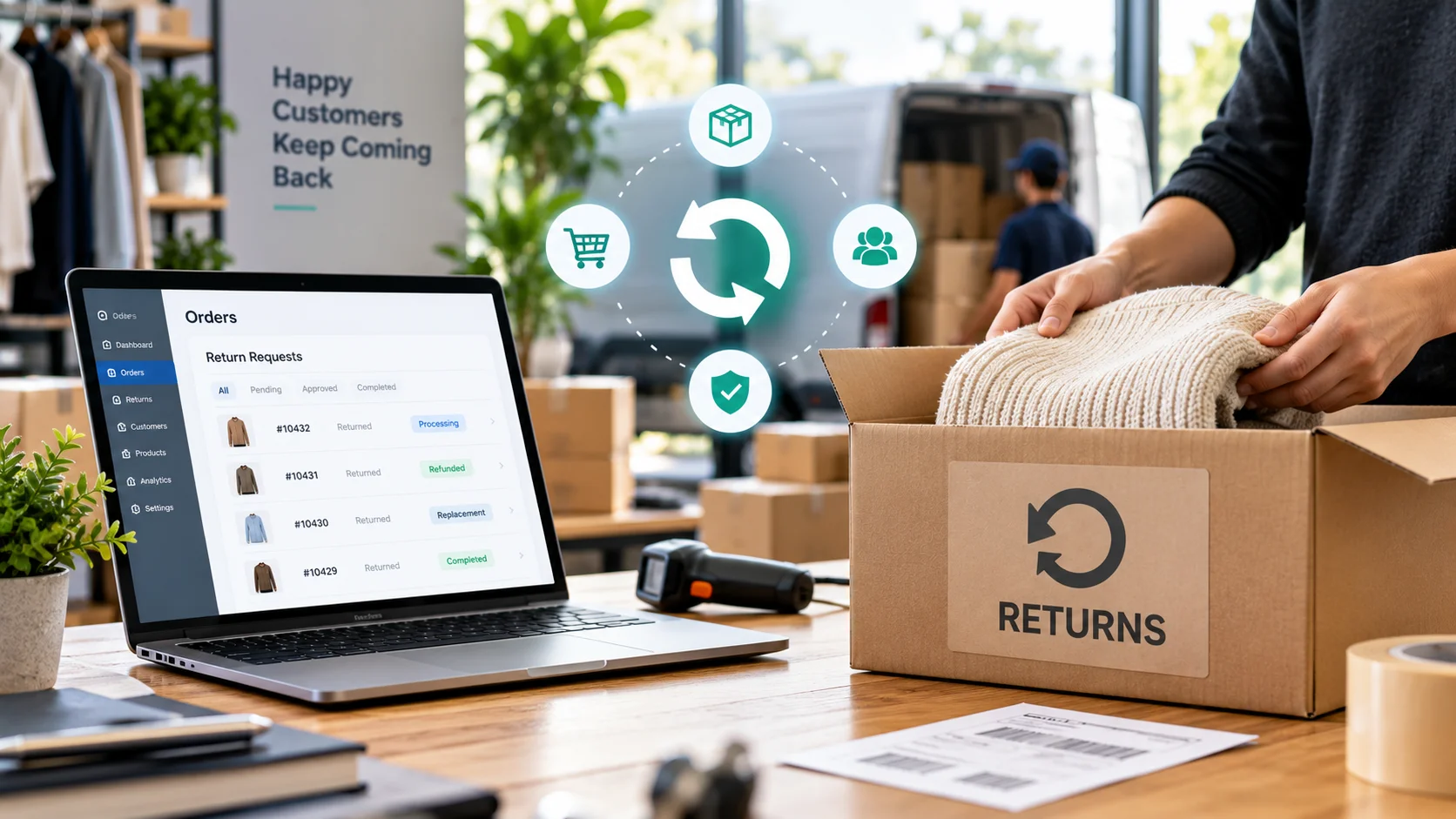
- Returns and Reverse Logistics
- Reconciliation and Reporting
- Essential Features of Ecommerce Order Management Software
- Major Benefits of an Ecommerce Order Management System
- Faster Order Processing
- Improved Inventory Accuracy
- Fewer Costly Returns and Disputes
- Better Customer Experience
- Lower Operational Costs
- Stronger Multichannel Coordination
- Business Impact Beyond Operations
- How to Choose the Right Ecommerce Order Management Software
- Buy Off the Shelf or Build Custom?
- Emerging Trends in Ecommerce Order Management
- Build a Smarter Ecommerce Operation
- Frequently Asked Questions
Most ecommerce brands hit the same wall around year two. Orders arrive from six different channels at once. Stock counts stop matching what’s actually on the shelf. A customer emails asking where their package is, and nobody can pull an answer together in under ten minutes.
That’s the operational tax of growth. Add a channel without a system underneath, and you multiply the chaos instead of the revenue. An ecommerce order management system fixes that exact problem. It pulls every order into one place, syncs stock in real time, routes fulfillment automatically, and keeps buyers informed without anyone firing off manual update emails.
This guide breaks down what these platforms do, the features worth paying for, the process flow behind every order, and the business impact you can expect after rolling one out. If you’re scaling past spreadsheets and patched together tools, this matters more than most teams realize until it’s too late.
Quick Answer
An ecommerce order management system (OMS) is software that captures orders from every sales channel, syncs inventory in real time, routes fulfillment automatically, and tracks shipments through to delivery. It sits between your storefronts and your warehouses, replacing manual spreadsheets and disconnected tools with one operational hub.
$6.86B
Projected multichannel order management market by 2030
11.6%
Compound annual growth rate, 2023 to 2030
~19%
Estimated ecommerce return rate driving returns automation demand
Market figures: Grand View Research. Return rate: National Retail Federation.
What Is an Ecommerce Order Management System?
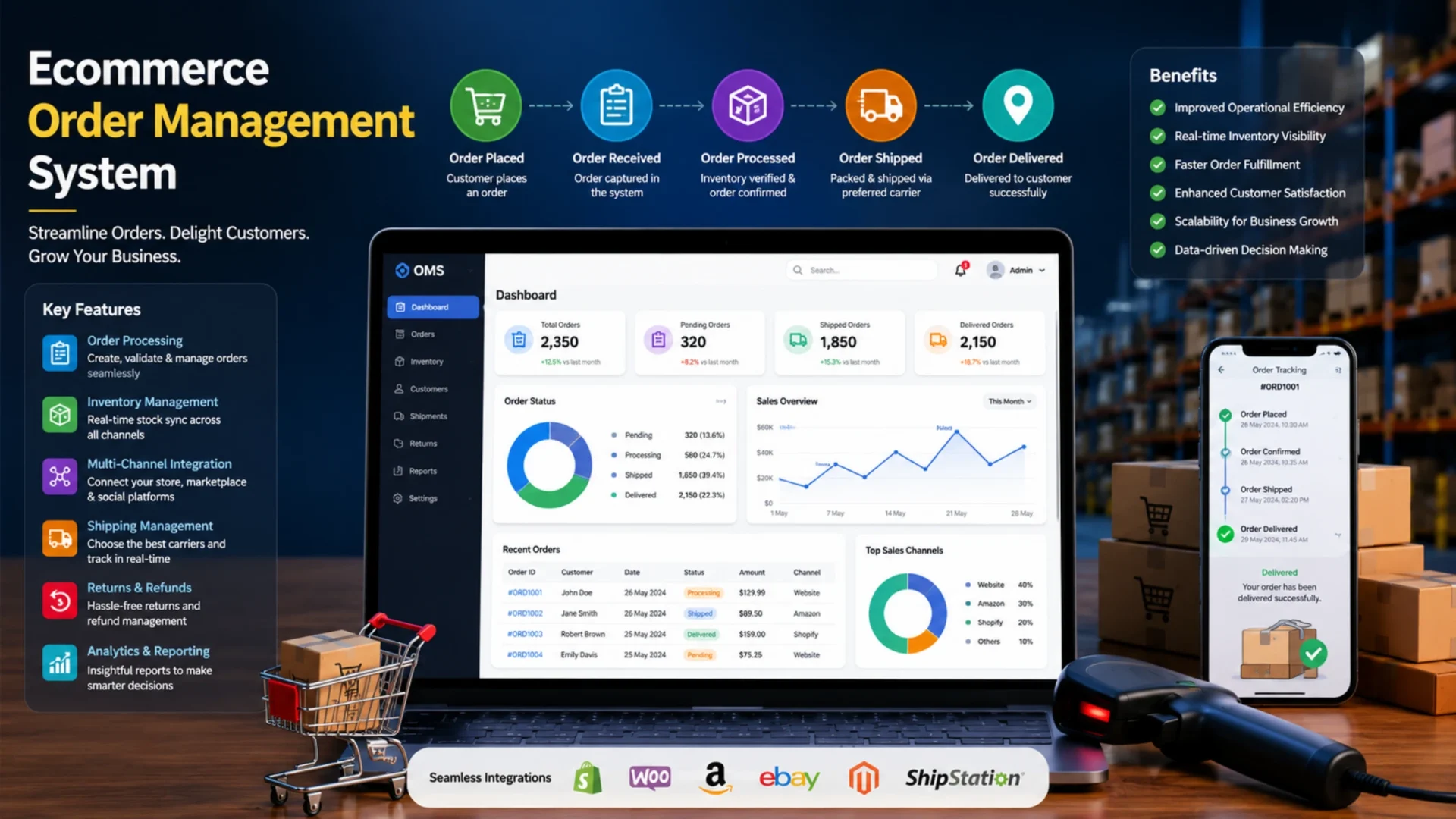
An ecommerce order management system, usually shortened to OMS or called order management software, captures every order across your channels, reserves inventory in real time, and routes fulfillment from one central place. Think of it as the operational brain sitting between your storefronts and your warehouses.
A working OMS handles four big jobs. It captures orders wherever they came from. It checks and reserves inventory the instant a sale lands. It decides which warehouse or supplier ships what. And it keeps the customer in the loop until delivery. Skip the system, and those four jobs scatter across spreadsheets and the patience of whoever happens to be on shift.
OMS vs Inventory Management vs ERP
People mix these up constantly. They overlap, but each one owns a different slice of your operations. Here’s the clean version.
| System | Primary Job | Best Thought Of As |
|---|---|---|
| Inventory Management | Tracks stock levels and warehouse activity | A stock counter |
| Order Management (OMS) | Runs the full order lifecycle from cart to delivery | The order traffic controller |
| ERP | Runs the whole business including finance and HR | The company nervous system |
Inventory tools count things. ERP platforms run the business end to end. An OMS focuses on the order itself, from the moment a buyer clicks pay to the moment a return is restocked. A pure ecommerce OMS puts order flow first, inventory second.
Why Centralized Visibility Matters
Picture a DTC brand selling on Shopify, Amazon, eBay, and Walmart Marketplace. Without centralized order management, the team logs into four dashboards every morning. Stock counts drift apart. Addresses get rekeyed by hand. One late status update on Amazon turns into a refund three days later.
A central OMS replaces that with one screen. Every order, every status, every customer in one view. That single source of truth is the baseline for any brand running more than one channel. If you’re architecting your operations stack from scratch, our ecommerce development services team can build a foundation that an OMS plugs into cleanly from day one.
Ecommerce Order Management Process Flow
Every order moves through the same lifecycle once an OMS is connected and configured. Understanding this flow helps you spot where manual work creeps in and where automation pays off fastest. Here’s the seven step path an order travels from click to closed loop.
Order Capture Across Channels
Every place a customer can buy connects through APIs or native integrations. Shopify, Amazon Seller Central, Etsy, TikTok Shop, Instagram checkout, wholesale portals. Orders flow into one queue instead of seven browser tabs.
Inventory Reservation and Sync
The OMS reserves stock the moment an order lands and pushes updated counts to every channel within seconds. Sell the last red sweater on Shopify, and Amazon and eBay reflect it almost instantly. This is what kills oversells at the source.
Fulfillment Routing
The system picks which warehouse ships based on rules you build. Proximity, available stock, shipping cost targets, peak season load. A West Coast order routes to Reno automatically while East Coast volume flows out of Atlanta.
Carrier Selection and Labels
Rate shopping runs in the background. The OMS matches the carrier to the order’s weight, destination, and delivery promise. Labels print, manifests build, and 3PL handoffs happen through API instead of CSV uploads.
Tracking and Customer Updates
Confirmation emails go out immediately. Tracking fires as the shipment moves. Exception alerts surface internally before the buyer notices. Support pulls full order context in seconds rather than chasing answers across tools.
Returns and Reverse Logistics
RMA requests get logged. Return labels generate automatically. Inventory updates the moment items hit the dock. Refunds or exchanges trigger without three rounds of email with customer service.
Reconciliation and Reporting
Finance gets clean order data. Channel performance, fulfillment times, and return rates feed reporting automatically. The loop closes inside the same system, ready for the next order.
This end to end flow runs automatically for every order, regardless of volume. That’s what separates teams driving growth from teams stuck firefighting. Coordination across channels and suppliers extends well beyond order capture, and our deeper look at supply chain management in ecommerce covers where the OMS layer connects to the broader operations stack.
Essential Features of Ecommerce Order Management Software
Plenty of tools call themselves an OMS without earning it. Three things separate real order management software from a glorified order viewer.
The three non-negotiables: true multichannel support, not just one or two integrations. Rules based automation, not canned workflows that force you into rigid processes. Real time data, not the 15 minute sync delays older tools tolerate. Anything missing all three is just a dashboard with a price tag.
Beyond those basics, here are the features that genuinely matter when you’re shortlisting platforms.
- Centralized Order Dashboard. One screen showing every order across every channel, filterable by status, channel, value, or fulfillment location. Lose this, and you’re back to spreadsheet chaos within a quarter.
- Real Time Inventory Tracking. Live stock counts that update across all channels the second an order is placed. Bonus points for stock holds during checkout, so the same unit isn’t promised twice.
- Multichannel Integrations. Native connectors for Shopify, WooCommerce, Magento, Amazon, eBay, Walmart, Etsy, TikTok Shop, and Instagram. The more native the link, the less you babysit it.
- Workflow Automation. If order ships West Coast, fulfill from Reno. If value over 500 dollars, flag for fraud review. If wholesale buyer, apply NET 30 terms. Repetitive decisions disappear.
- Shipping and Carrier Integrations. Labels for UPS, FedEx, USPS, DHL, and regional carriers without a separate shipping app. Rate shopping saves real money at volume.
- Analytics and Reporting. Order volume trends, fulfillment times, channel performance, return rates, stockout frequency. Pair this with broader ecommerce metrics worth tracking for full visibility.
- Returns Management. Handles RMAs, generates return labels, manages restocking, and triggers refunds. Can cut customer service ticket volume by a third for fashion brands.
- Scalability Architecture. Cloud platforms handle 10,000 orders a day if you grow into that. Older on premise tools hit walls right when you can least afford it. Test peak capacity, not average.
Most of these features only deliver once they’re wired into smart automation. Our breakdown of ecommerce automation strategies shows how a small team can fulfill thousands of orders daily without scaling headcount in lockstep.
Major Benefits of an Ecommerce Order Management System
Benefits stack up fast. Most brands feel the impact within the first 30 days of going live. A few stand out more than the rest.
Faster Order Processing
Manual processing eats hours. An OMS cuts per order touch time from minutes to seconds. A team handling 200 orders a day can suddenly handle 500 with the same headcount. That’s the difference between hiring more people and reinvesting in growth.
Improved Inventory Accuracy
Real time sync across every channel removes the most common cause of cancellations: overselling. Brands moving from spreadsheets to a proper OMS often see oversell rates drop sharply within a single quarter. Fewer refunds. Less goodwill burned.
Fewer Costly Returns and Disputes
Returns are expensive, and online returns run higher than in-store. Accurate stock and correct shipments cut the avoidable share of that, which protects margin directly.
Returns remain a heavy drag on retail profit. The National Retail Federation estimated roughly $849.9 billion in total returns for 2025, with ecommerce return rates running near 19 percent, well above in-store rates. An OMS that catches errors before shipping reduces the returns you never needed to absorb.
Source: National Retail Federation.
Better Customer Experience
Customers never see the OMS. They see what it enables. Accurate stock at checkout. Fast shipping confirmations. Live tracking that actually works. Returns handled without a back and forth. The brand looks competent because operations actually are.
Lower Operational Costs
Less manual labor. Fewer errors. Smarter shipping rate selection. Smaller support ticket volume. A mid size brand processing 2,000 orders a month typically recovers OMS costs within six months through labor and shipping savings alone.
Stronger Multichannel Coordination
A big win for brands selling across Shopify, Amazon, retail, and wholesale at once. Those channels share one inventory pool, one fulfillment process, one customer database. Multichannel finally feels like one business instead of four. Shopify merchants can start capturing some of this even before a full OMS, and our Shopify development team covers the highest impact native automation available on the platform today.
Illustrative Example
Consider a skincare brand running Shopify direct, Amazon FBA, a wholesale account, and a marketplace separately. Each channel has its own spreadsheet. Inventory gets rounded down everywhere just to avoid oversells, leaving effective stock well below true levels. Connect all four channels to a single OMS, and a large share of that hidden inventory becomes sellable again. Same warehouse, same SKUs, just honest visibility. That kind of result can pay back an implementation inside a quarter.
Business Impact Beyond Operations
Operational wins are the obvious story. The business impact runs deeper than most founders expect.
Revenue growth. Accurate inventory means fewer lost sales. Faster processing means more orders shipped per day. Better coordination means confidently expanding into new marketplaces without breaking what already works.
Customer retention. A buyer who got their package on time, with accurate tracking, comes back. One who waited a week for a status update doesn’t. Retention is built on operational reliability, and an OMS makes reliability the default.
Operational scalability. This is the part founders underestimate most. A team that runs smoothly at 500 orders a month often breaks somewhere between 1,500 and 3,000. An OMS pushes that break point far higher. Brands grow 5x or 10x without hiring operations staff in proportion.
Brand reputation. Reviews about late shipments and oversells damage brands faster than mediocre products do. Operational excellence quietly builds trust. The brands customers rely on are the ones that invested in the unglamorous infrastructure behind the storefront.
How to Choose the Right Ecommerce Order Management Software
Picking the right platform isn’t about whoever has the biggest marketing budget. It’s about fit. The wrong choice creates integration debt, migration pain, and daily frustration for the teams that depend on it. Walk through these six checks before you commit.
Evaluate business requirements. Start with order volume, channel mix, warehouse setup, and growth projections for the next 24 months. A brand at 500 orders a month doesn’t need the same platform as one at 50,000. Match the tool to operational reality, not where you wish you were.
Check integration capabilities. List every channel, carrier, accounting tool, and CRM you use. The OMS needs to plug into all of them, ideally natively. Custom integrations get expensive and fragile fast.
Review automation depth. Look at the rules engine. Can ops build routing logic without engineering help? Test it in a live demo, not a sales deck.
Analyze scalability. Ask exactly what happens at 10x volume. Many cloud platforms handle it well. Some legacy tools quietly fall over. Get answers from existing customers, not vendor promises. For high volume Magento storefronts, integration depth shapes performance under load, and our Magento development team builds architectures that handle complex OMS configurations without slowing the storefront.
Compare reporting. Build a mock dashboard during the demo. If the platform can’t show channel level profitability, fulfillment time by warehouse, and stockout frequency in three clicks, the analytics layer is too shallow.
Understand support and training. Migration is painful, and bad support during migration is brutal. Talk to current customers about the implementation experience, not just the sales process. Brands on WooCommerce should weigh platforms with deep native connectors, and our WooCommerce development services team can help with platform selection and integration architecture.
Six Questions to Ask Before You Sign
- Does it natively integrate with every channel where we sell or plan to sell?
- Can it scale cleanly to 10x our current volume during peak season?
- Does it connect to our existing carriers, 3PLs, ERP, and CRM stack?
- How long does implementation actually take from contract to go live?
- What’s the all in year one cost including setup, training, and support?
- Who handles support when something breaks at 11 PM on a Saturday flash sale?
Buy Off the Shelf or Build Custom?
Most brands should start with an off the shelf platform. It’s faster and cheaper to prove value. Custom builds make sense when your routing logic, channel mix, or compliance needs sit outside what packaged tools handle well. If that’s you, weigh it carefully. Our SaaS development team can scope whether a tailored order platform actually beats configuring an existing one.
Emerging Trends in Ecommerce Order Management
The OMS space isn’t standing still. A few shifts over the next 18 months should shape the platform you pick today.
AI driven routing. Routing is moving from fixed rules to prediction. Modern platforms forecast the optimal warehouse, carrier, and packaging from historical patterns. Costs drop, speed climbs. The AI layer is reshaping the whole stack, not just routing, and our piece on AI driven ecommerce covers where intelligent automation is changing fulfillment and customer experience right now.
Predictive inventory. Forecasting is folding into the OMS rather than living in a separate tool. Platforms predict stockouts, recommend reorder quantities, and flag slow movers automatically.
Cloud native by default. On premise is effectively dead for new deployments. Cloud platforms handle peak traffic better and ship updates faster than older systems.
Composable architecture. Buyers expect an OMS to act as one microservice plugging into a broader stack via API, not a monolith demanding full adoption.
Sustainability reporting. Carbon tracking and lower impact carrier selection are emerging as OMS features as brands respond to regulation and buyer expectations.
Build a Smarter Ecommerce Operation
Ecommerce growth lives or dies on operations. If your team is putting out fires more than driving growth, the bottleneck usually isn’t the team. It’s the lack of a system underneath them. Let’s map an OMS setup that fits how you actually sell.
Frequently Asked Questions
What is an ecommerce order management system?
What is the difference between an OMS and order management software?
What does the ecommerce order management process flow look like?
What features should ecommerce order management software include?
How does an OMS improve customer experience?
Can an ecommerce OMS integrate with marketplaces?
Is an ecommerce OMS worth it for small businesses?
How does automation improve order management?