



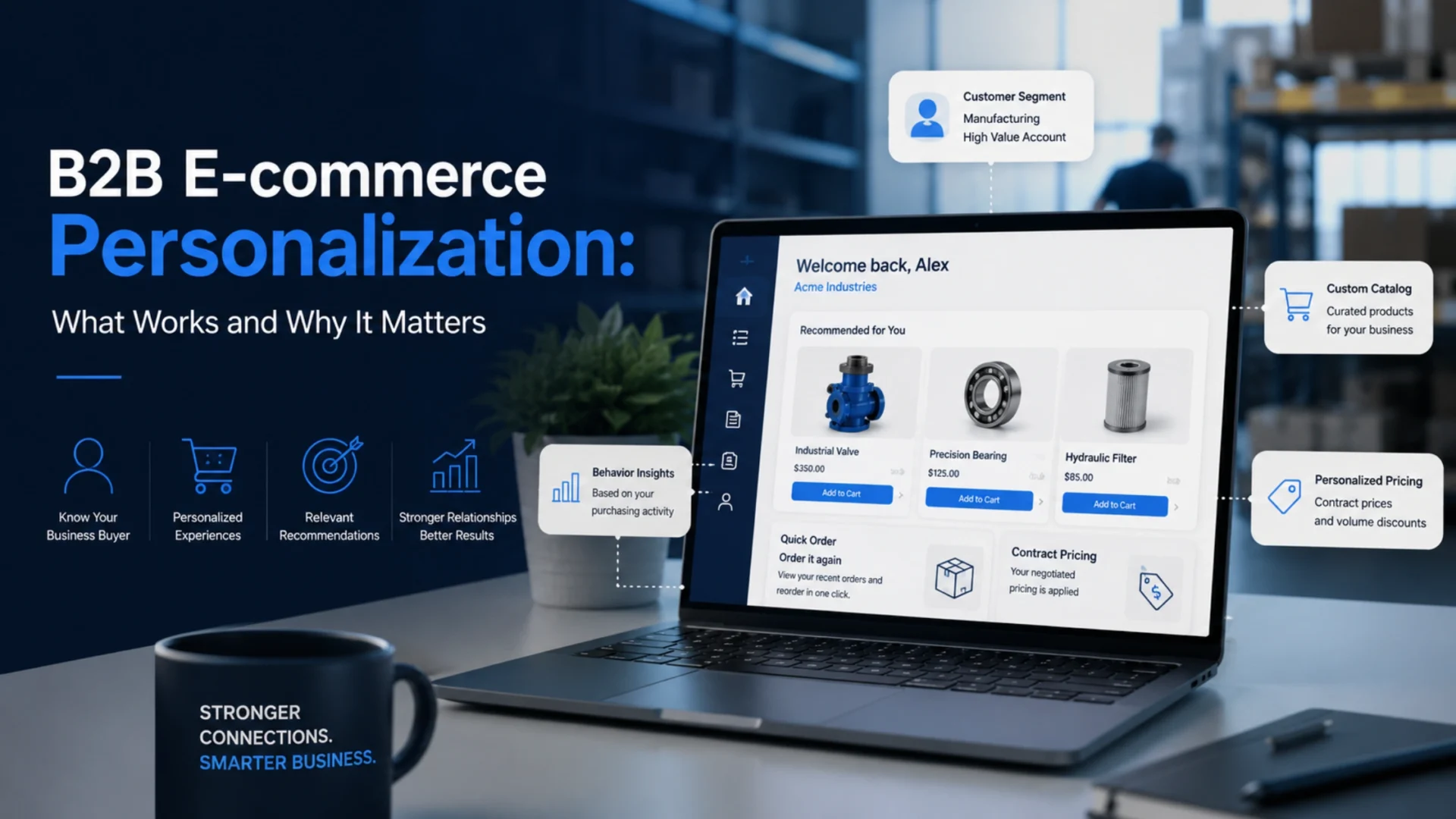
- Why B2B e-commerce personalization matters in 2026
- How B2B personalization is different from B2C
- Core B2B e-commerce personalization strategies that work
- Real-world B2B personalization examples
- Not sure where your catalog stands today?
- Technology and tools needed for B2B e-commerce personalization
- Benefits and ROI of B2B e-commerce personalization
- How to build a B2B e-commerce personalization strategy
- Common challenges and mistakes in B2B personalization
- B2B e-commerce personalization trends to watch in 2026
- Ready to build a B2B storefront that actually knows your buyers?
- Frequently Asked Questions
- What is B2B e-commerce personalization?
- How is B2B personalization different from B2C personalization?
- What tools are used for B2B e-commerce personalization?
- Does personalization really increase B2B e-commerce sales?
- How do you start a B2B personalization strategy?
- Is AI necessary for B2B e-commerce personalization?
- Wrapping up
Ask a B2B buyer why they’re still filling out a quote request form instead of just placing an order online, and you’ll get a long list of complaints. Most of them are fed up with it, honestly. Adobe research backs that up: 74 percent of B2B companies now expect their e-commerce site to be a primary source of total revenue. Forrester found something similar, with 66 percent of buyers expecting at least partially personalized shopping content when they land on a supplier’s site.
Until recently, personalization was a B2C thing. Retail brands used it to recommend sneakers or drop a discount code at checkout. B2B stayed out of it, mostly on the assumption that buyers only cared about specs and price. That’s not true anymore, and it probably never fully was. B2B e-commerce personalization isn’t a bonus you bolt on later. It’s a basic part of growing the business now, and companies still running a plain, static catalog are losing ground to competitors who convert more and get more repeat orders.
Quick Answer
B2B e-commerce personalization means tailoring an online buying experience, product recommendations, pricing, content, and navigation, to a specific business account and the individual stakeholders inside it, rather than showing every buyer the same generic storefront. Unlike B2C personalization, which targets one shopper and leans on emotional triggers, B2B personalization has to account for multiple decision makers, longer buying cycles, and rational drivers like cost, efficiency, and risk. Done well, it typically lifts revenue by 10 to 15 percent and roughly doubles the click-through rate on product recommendations.
Why B2B e-commerce personalization matters in 2026
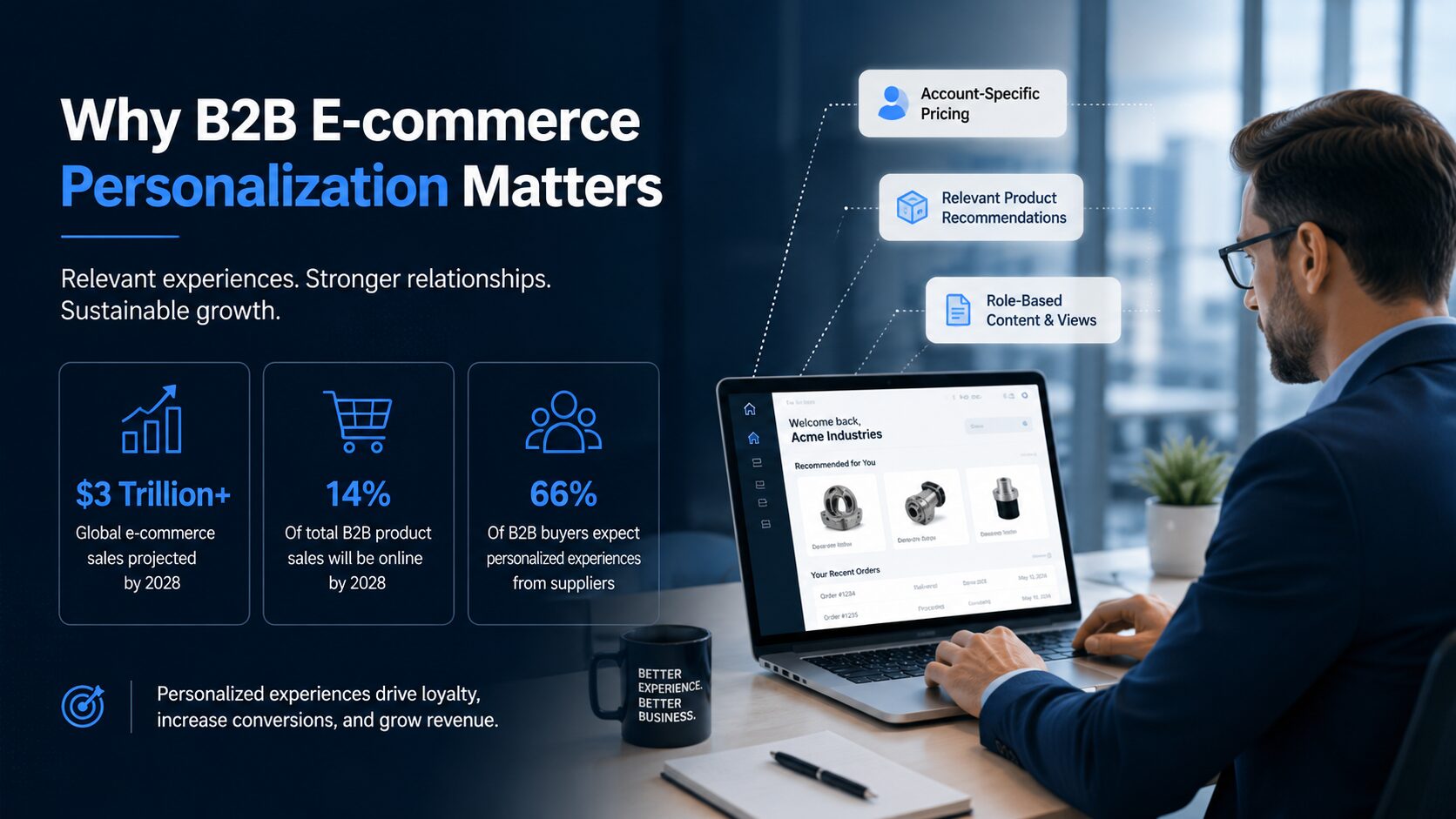
According to eMarketer, e-commerce sales are projected to grow 7.8 percent annually, crossing $3 trillion by 2028. B2B e-commerce is claiming a bigger slice of that every year and will account for nearly 14 percent of total B2B product sales by 2028. It’s not a side channel of procurement anymore. It’s becoming the default one.
Here’s the thing that’s changed the equation: today’s B2B buyer is also a regular consumer. The same person getting product recommendations from Amazon on a Tuesday night is placing a bulk order for industrial fasteners on Wednesday morning. They carry the same expectations into both experiences. A generic catalog with no memory of past orders and no relevance to their role feels dated fast, and buyers notice. Our own complete B2B e-commerce guide covers the foundational pieces this all sits on top of, if you’re still building out that base.
Personalized marketing isn’t just about converting someone once. It’s about building a relationship that lasts across renewal cycles. When customers feel like they’ve got a partner rather than a vendor, you can count on their loyalty. A lost deal at contract renewal looks like a single event, but it’s usually more than that. There’s a good chance that customer has been quietly evaluating other suppliers the whole time.
One thing worth clearing up early: personalization and customization aren’t the same thing. They sound similar. They aren’t. That distinction matters once you start building out a strategy, which is exactly what the next section gets into.
How B2B personalization is different from B2C
B2C personalization is mostly about the individual. B2B personalization has to account for something far messier: the buying group.
Multi-stakeholder accounts versus individual decisions
A consumer buys a jacket alone. A manufacturer buying industrial coatings might have a procurement lead negotiating terms, a plant manager checking specs, and a finance controller approving budget, all involved in one purchase. Each person needs something different from the same website visit. Procurement wants pricing history and contract terms front and center. The plant manager wants technical documentation. Finance wants order totals and approval workflows that don’t create friction. Personalizing a site around only one buying role is a common mistake, and it’s the kind of thing that quietly slows down a deal.
B2C personalization leans on emotional triggers: urgency, social proof, aspiration. B2B buyers respond to something more grounded. Cost-effectiveness. Efficiency. Risk reduction. A recommendation engine pushing “trending products” at a B2B buyer misses the point entirely. What actually lands is a system that surfaces relevant SKUs based on past orders, contract pricing, or industry-specific compliance requirements.
An online shopping trip for a consumer might take a few minutes. A B2B sales cycle can stretch across weeks or months, with the same company revisiting the site multiple times before a purchase gets made. Personalization has to hold across that whole journey. If a buyer was researching a product on Monday, that context should still be there when someone else on the same account logs in Thursday. That kind of continuity is where account-level B2B segmentation earns its keep, since a model built only around individual browsing behavior will miss the multi-stakeholder reality entirely.
Worth repeating: personalization and customization aren’t interchangeable. Customization means manually altering something, like ordering a fully specced product built to exact requirements. Personalization is the software automatically adjusting to a user’s preferences, actions, and account situation. Usually, an effective B2B strategy needs both working together rather than picking one over the other.
Core B2B e-commerce personalization strategies that work
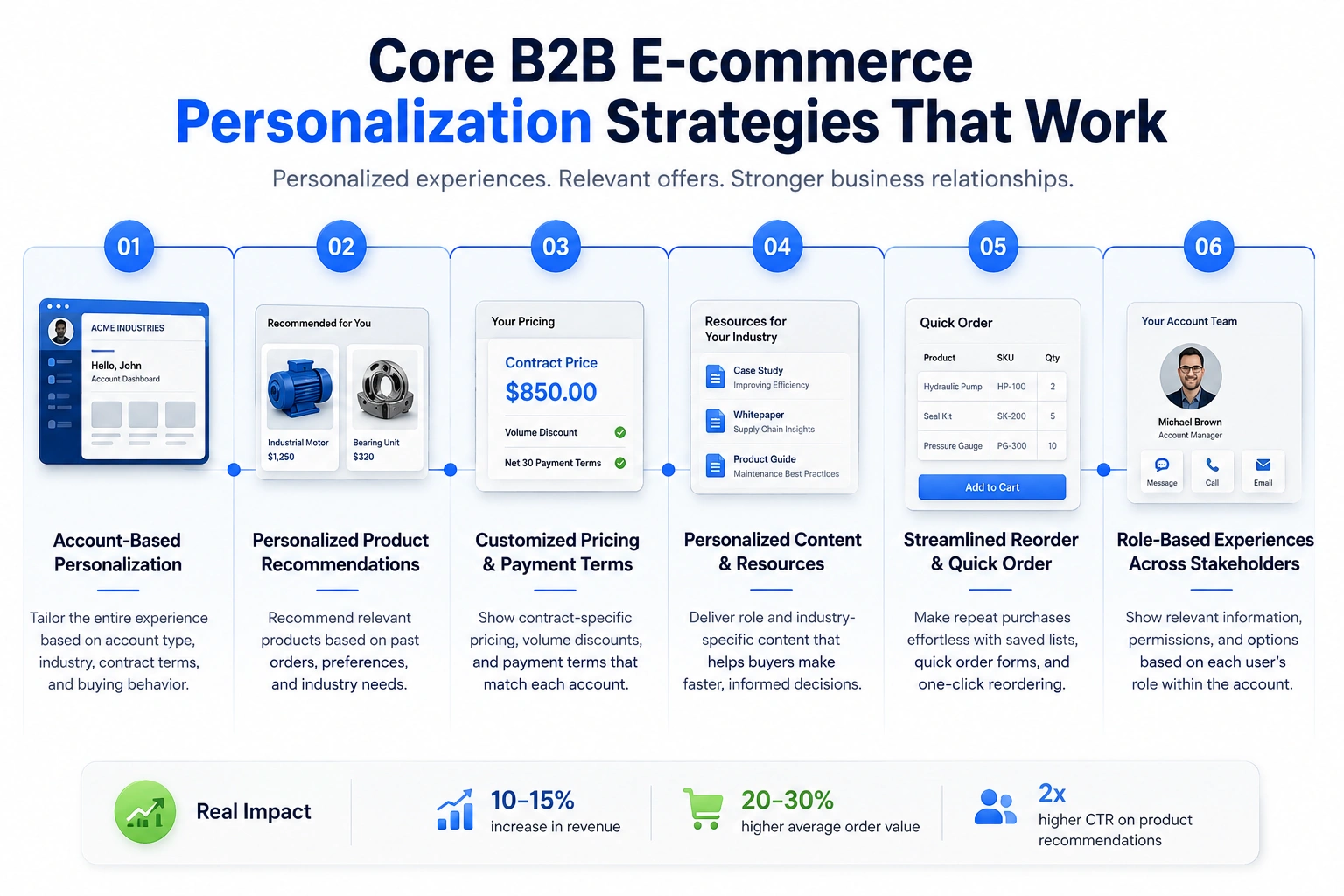
This is the part that matters most if you’re figuring out where to actually start. Not every tactic below fits every business, but most B2B brands can realistically implement three or four of these without a full platform overhaul.
Account-based personalization aligned with ABM. Your e-commerce channel should reflect the same targeting used in account-based campaigns. The moment a registered account signs in, a distributor serving hospitals, say, should see hospital-only catalogs, compliance documents, and the right price tier automatically. Sales and marketing stop working against each other once this is set up correctly. Platforms with real B2B commerce features baked in, rather than bolted on top of a B2C build, tend to handle this without constant workarounds.
Role-based and stakeholder-based content. A procurement manager and a technical buyer from the same company shouldn’t see identical homepages. One wants contract terms and reorder history front and center. The other wants spec sheets and compatibility data. Platforms supporting role tagging within an account can route each stakeholder to what they actually need, cutting down on the back and forth that slows deals down.
Where the biggest wins actually sit
Custom catalogs and account-specific pricing are among the highest-impact strategies for distributors and manufacturers with negotiated contracts. Instead of showing every buyer the same list price, the platform displays only the products, quantities, and pricing that apply to that account. Fewer irrelevant SKUs. Fewer pricing disputes. Faster checkout.
Personalized product recommendations are often built wrong. Most B2B platforms borrow recommendation logic straight from B2C, showing “customers also bought” widgets built for browsing behavior. B2B buyers don’t browse the way retail shoppers do. They reorder. A better approach surfaces products based on purchase cadence and bulk buying patterns. If a facilities manager orders the same 40 cases of cleaning supplies every six weeks, the system should have that reorder ready before they even ask.
Search matters more than most teams admit. B2B catalogs with hundreds of near-identical part numbers make it genuinely hard for a buyer to find what they need fast. Personalized search that learns from a buyer’s queries and purchase history, and weights results by industry or account, saves real time. A search that returns nothing is a hidden killer of conversion in B2B, and it rarely gets the attention it deserves.
Behavior-triggered email and SMS workflows are cheap to set up and tend to produce some of the fastest wins in a personalization roadmap. Reorder reminders timed to a buyer’s actual usage cycle. Restock alerts when a favorited product runs low. Cart abandonment follow-ups that reference the specific items left behind instead of a generic “come back” message.
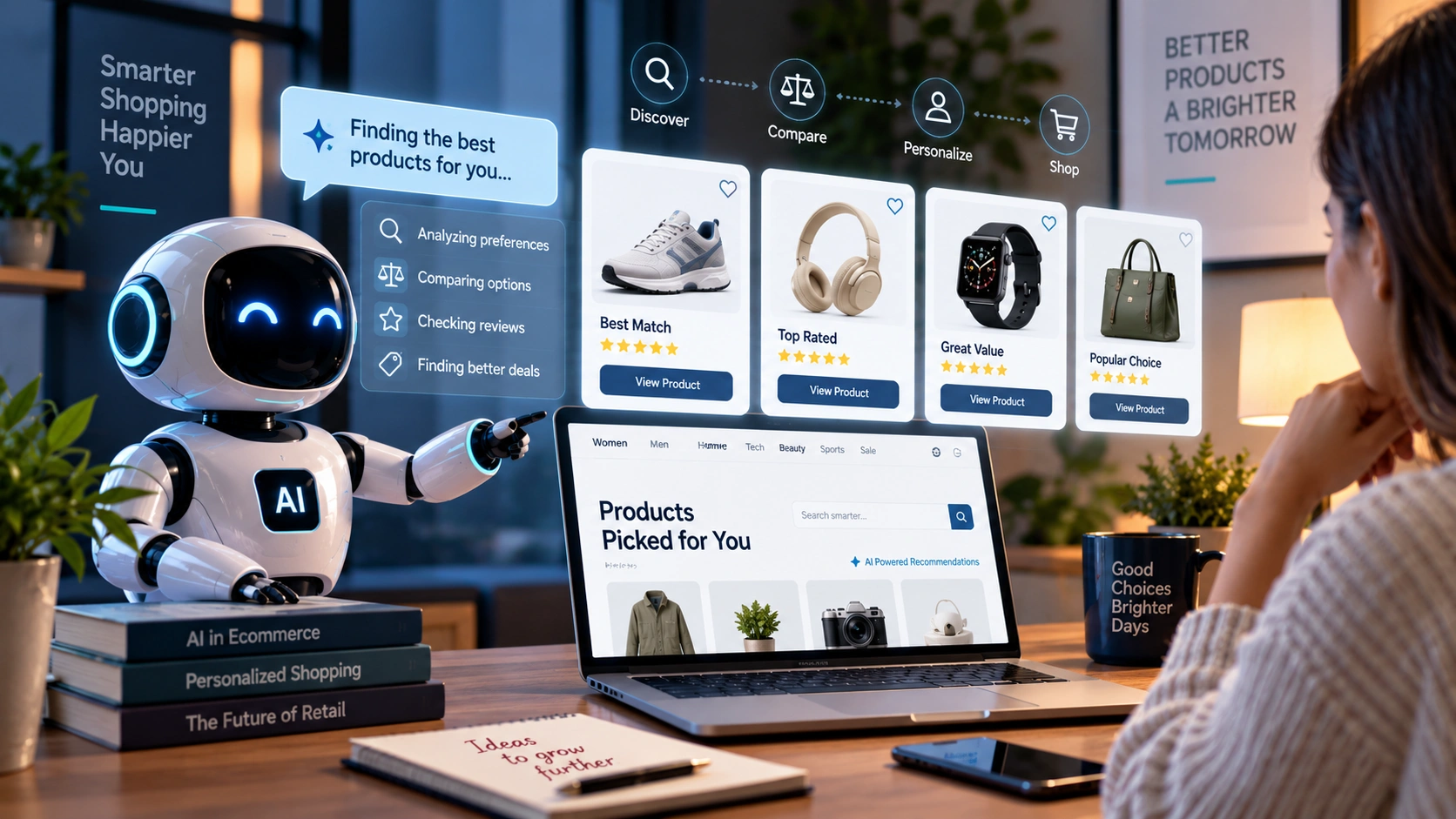
Predictive and agentic AI journey orchestration is the newest layer, and it’s developing fast heading into 2026. Instead of static rules, AI systems tailor the buying journey in real time based on signals like browsing intent, time on page, and account history. A buyer who looks like they’re comparing prices gets a sales rep offered proactively. A buyer close to checkout gets a cleaner path with fewer distractions. This kind of orchestration used to require a dedicated data science team. Now there are ready-made solutions that do most of the heavy lifting. Read more in our guide on AI agents for e-commerce.
Real-world B2B personalization examples
Strategy only means something once you see it working. Two examples are worth studying closely.
HellermannTyton
A global manufacturer of cable management systems operating in 39 countries, HellermannTyton replaced its legacy CMS with an AI-driven personalization platform to deliver persona-specific journeys across international markets in real time, instead of running one static site translated into different languages. The company went further with MyHellermannTyton, an exclusive portal giving registered customers saved favorites and a hardware registry built around their own purchase history. Sessions, search activity, and conversions all climbed steadily, and content now scales across markets far faster than the old CMS allowed.
Grainger
A major industrial distributor moving over 1.5 million products, Grainger ran a series of tests on where and how it surfaced sign-in and registration on its site. The changes led to a 7 percent increase in sign-ins and a 17 percent increase in completed registrations. That sounds like a small optimization, but for a distributor, getting more buyers into a recognized account status is the gateway to everything else, from tailored catalogs to reorder automation. Not every personalization win is a dramatic AI rollout. Sometimes it’s just getting more of your audience recognized in the first place.
Both examples share a common thread. Neither company treated personalization as a bolt-on feature. They built it into the core account experience. If you’re weighing what that build actually looks like for a manufacturer, our guide to developing a B2B portal for manufacturers walks through the specifics.
Not sure where your catalog stands today?
Elsner can review your current e-commerce setup and show you exactly where personalization would move the needle fastest for your accounts.
Technology and tools needed for B2B e-commerce personalization
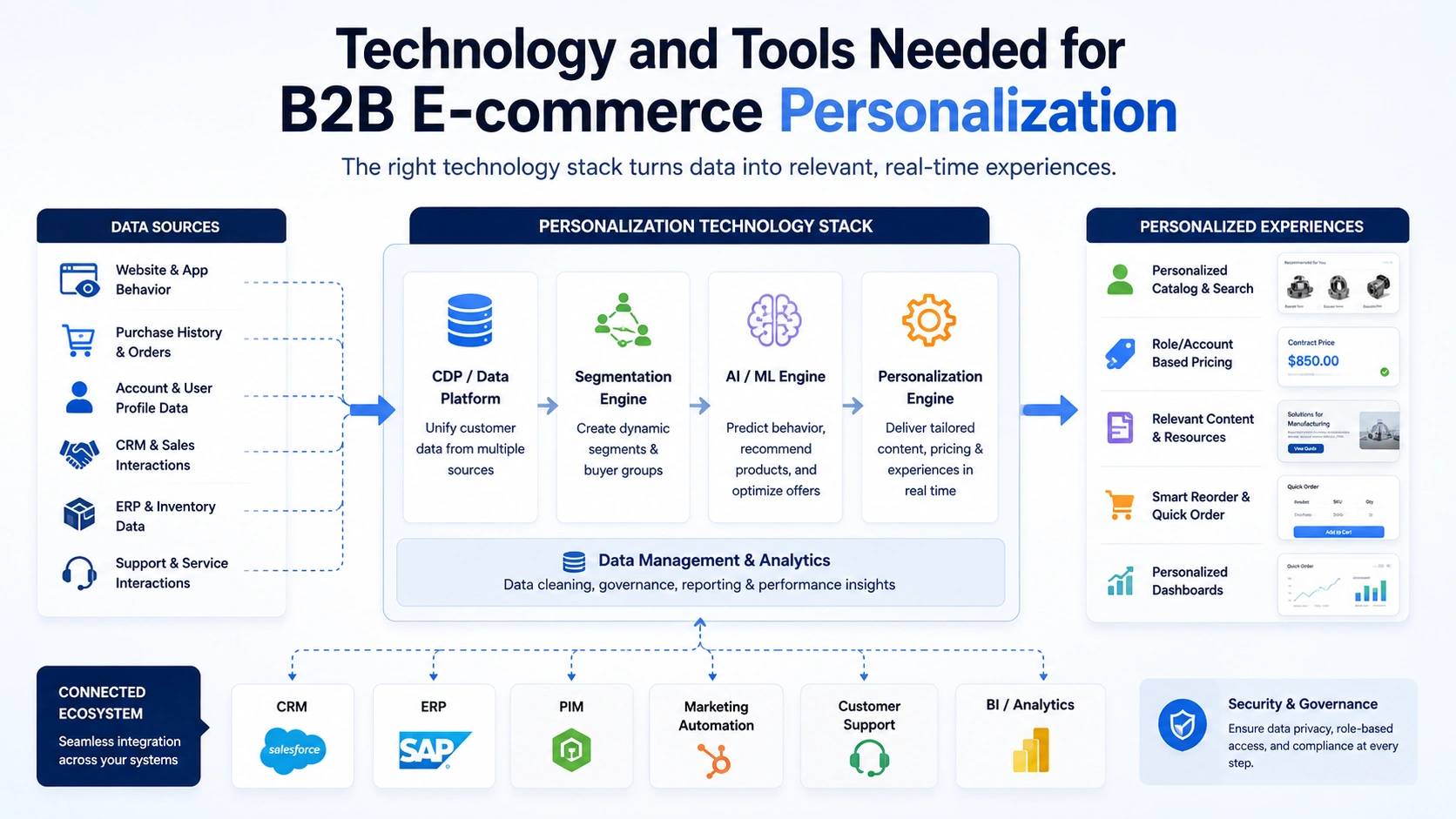
Personalization runs on data, and B2B data is more layered than most B2C equivalents. Gone are the days of managing just a couple of customer data types. There’s behavioral data that reveals what buyers search for and click on. There’s account-level and firmographic data like company size, industry, and contract terms. There’s contextual data such as location, device, and time of visit. And there’s zero-party data, the rarest kind, made up of information buyers volunteer directly through a form or configurator.
Generic B2C recommendation and personalization software usually isn’t built for B2B, since it doesn’t account for account hierarchies, multiple buyer roles, or negotiated pricing. Choose a platform built for B2B account structure, not individual customer profiles. The stronger platforms on the market now support ABM at the core level rather than as a plugin someone added later.
The part that quietly breaks most personalization projects
Your personalization engine is only as accurate as the data feeding it, and that data lives mostly in your CRM and ERP systems. Without a direct connection between those systems and your e-commerce platform, personalization ends up running on partial or outdated information. Recommend a product a customer already returned last quarter and you’ll lose their trust fast. Solid ERP integration isn’t a nice-to-have here. It’s the foundation everything else sits on.
AI fits into this stack in three practical ways: pattern recognition across large catalogs, predictive recommendations based on purchase cadence, and automation that scales personalization across thousands of accounts without needing a team to manage each one manually. Teams pairing this with proper business intelligence tooling get a clearer read on which accounts are worth personalizing for first, rather than spreading effort evenly across a catalog where most of the revenue sits with a fraction of the buyers.
Benefits and ROI of B2B e-commerce personalization
McKinsey’s research shows personalization brings an average revenue lift of 10 to 15 percent. Actual outcomes vary quite a bit by business, and some companies, depending on the industry and how well the strategy gets executed, see gains as high as 25 percent. Growth is particularly strong in technology and other fast-moving sectors, where companies scaling quickly tend to get more out of personalization than slower-growing ones.
Shoppers who engage with personalized recommendations also show meaningfully higher average order values. For B2B accounts placing large, recurring orders, that lift compounds fast across a year of purchasing. Predictive tools that surface the right SKU at the right moment, the kind covered in our piece on predictive analytics, tend to be where that compounding starts.
There’s a B2B-specific efficiency benefit too, and it’s easy to underestimate. Every stakeholder in a buying group is working under time pressure. When a procurement manager finds contract pricing in two clicks instead of ten, and a technical buyer pulls up specs without emailing a rep, the entire purchasing process speeds up. That gain doesn’t show up neatly in a revenue report, but ask any sales team what actually slows deals down, and data friction is usually near the top of the list.
How to build a B2B e-commerce personalization strategy
Common challenges and mistakes in B2B personalization
A few mistakes show up again and again across B2B personalization projects.
- Treating every stakeholder in a buying group the same way, instead of accounting for the different roles and priorities inside one account.
- Data silos between CRM, ERP, and the e-commerce platform, which leave personalization running on incomplete or outdated information.
- Over-personalization that starts to feel invasive, particularly when a platform surfaces information a buyer never explicitly shared.
- Ignoring account hierarchy and approval chains, which creates friction for buyers who need sign-off before completing a purchase.
Worth flagging separately: over-personalization is a real risk, not a hypothetical one. B2B buyers tend to be more sensitive to a platform that seems to know too much than B2C shoppers are. Keep personalization grounded in data buyers would expect you to have, like order history, rather than data that feels surveilled.
B2B e-commerce personalization trends to watch in 2026
A handful of shifts are shaping where this goes next.
Agentic AI and predictive journey orchestration are moving out of early-adopter territory and into mainstream use. AI in B2B e-commerce is increasingly about anticipating a buyer’s next move rather than reacting to their last one.
Conversational AI built specifically for B2B buying conversations is maturing past simple chatbots. These tools now handle genuinely complex questions, like configuring a multi-part order or explaining a contract-specific pricing rule, not just answering FAQs. Suppliers exploring this often start with conversational AI chatbot development built around their own catalog and pricing logic rather than a generic off-the-shelf bot.
Zero-party data is becoming more valuable as privacy expectations tighten and third-party data gets harder to rely on. Brands building direct, transparent ways for buyers to share preferences will have a real edge over ones still leaning on behavioral guesswork.
Enterprise personalization is scaling without losing account context. The technology now exists to personalize for thousands of accounts individually, but the brands doing it well aren’t sacrificing the account-based nuance that makes B2B different from B2C in the first place. That balance, hyper-personalization at scale without flattening it into something generic, is where the real edge sits for the rest of 2026.
Key takeaways
- 74 percent of B2B companies expect their e-commerce site to be a primary revenue source, and 66 percent of buyers expect at least partial personalization when they arrive.
- B2B personalization has to account for the whole buying group, not one shopper, since procurement, technical, and finance stakeholders each need something different from the same visit.
- Custom catalogs, account-specific pricing, and reorder-based recommendations tend to deliver the fastest, highest-impact wins.
- Personalization typically lifts revenue by 10 to 15 percent, per McKinsey, and personalized recommendations get roughly double the click-through rate of generic ones.
- Most personalization failures trace back to a data gap between CRM, ERP, and the e-commerce platform, not a weak strategy.
Ready to build a B2B storefront that actually knows your buyers?
Elsner helps manufacturers, distributors, and wholesalers build e-commerce experiences that reflect how their buyers actually work, from account-based catalogs to AI-driven recommendation engines. Talk to our team about a personalization audit for your current site.
Frequently Asked Questions
What is B2B e-commerce personalization?
B2B e-commerce personalization is the practice of tailoring an online buying experience, including product recommendations, pricing, content, and navigation, to a specific business account and the individual stakeholders within it, rather than showing every buyer the same generic storefront.
How is B2B personalization different from B2C personalization?
B2B personalization has to account for multiple stakeholders within a single account, longer buying cycles, and rational purchase drivers like cost and efficiency. B2C personalization typically targets one individual and leans more on emotional and behavioral triggers.
What tools are used for B2B e-commerce personalization?
Common tools include e-commerce personalization software built for account-based targeting, CRM and ERP integrations for account-level data, AI-driven recommendation engines, and behavior-triggered email and SMS platforms.
Does personalization really increase B2B e-commerce sales?
Yes. McKinsey research shows personalization typically drives a 10 to 15 percent revenue lift, and personalized product recommendations tend to get roughly double the click-through rate of non-personalized ones, with meaningfully higher average order values.
How do you start a B2B personalization strategy?
Start by defining goals tied to your highest-value accounts, auditing your current data and technology stack for gaps, segmenting by account and stakeholder role, choosing technology that matches your catalog complexity, and testing continuously rather than treating it as a one-time project.
Is AI necessary for B2B e-commerce personalization?
AI isn’t strictly required to begin, but it’s become the most efficient way to scale personalization across large catalogs and thousands of accounts. Predictive recommendations, pattern recognition, and journey orchestration are increasingly difficult to replicate manually at any meaningful scale.
Wrapping up
Personalization done right takes more than a plugin. It takes the platform, the data connections, and the strategy behind it all working together.
Elsner Technologies helps B2B manufacturers, distributors, and wholesalers with ecommerce development services that reflect how their buyers actually work, from account-based catalogs to AI-driven recommendation engines. If your current site still treats every buyer the same way, that’s worth a conversation. Talk to our team about a B2B ecommerce personalization audit.