





- What is a B2B ecommerce solution, exactly?
- Why B2B ecommerce solutions look different in 2026
- Types of B2B ecommerce solutions
- Core features every B2B ecommerce solution needs
- Not sure which features your current setup is actually missing?
- Benefits of B2B ecommerce solutions worth quantifying
- How to choose the right B2B ecommerce platform
- Where AI actually helps B2B ecommerce, and where it doesn’t
- B2B ecommerce integration: the ERP and CRM work that makes or breaks scale
- B2B ecommerce security considerations
- B2B ecommerce best practices that actually move the needle
- B2B ecommerce implementation roadmap
- Common B2B ecommerce mistakes to avoid
- How to choose a B2B ecommerce development partner
- How Elsner approaches B2B ecommerce solutions
- The bottom line
- Ready to see what a properly built B2B ecommerce solution could do for your business?
- Frequently Asked Questions
- What is a B2B ecommerce solution?
- What are the different types of B2B ecommerce solutions?
- What features should a B2B ecommerce platform have?
- Which B2B ecommerce platform is best?
- How much does a B2B ecommerce solution cost?
- Why do B2B ecommerce projects fail to deliver ROI?
- Does AI actually improve B2B ecommerce performance?
- How secure does a B2B ecommerce solution need to be?
- What’s the difference between a B2B ecommerce platform and a B2B ecommerce solution?
- How long does it take to build a B2B ecommerce solution?
US B2B ecommerce site sales hit $2.297 trillion in 2024, up 10.5% year over year, and eMarketer projects that figure will surpass $3 trillion by 2028. That growth isn’t coming from new buyers discovering digital commerce for the first time. It’s coming from a generational handover. Millennials and Gen Z now make up roughly 71% of B2B buyers, and they are bringing consumer-grade expectations into purchasing decisions that used to run through a phone call and a purchase order form.
This guide walks through what a real B2B ecommerce solution needs to do in 2026: the different types of solutions available, the features that actually matter, what the ROI case looks like once you build it, how the leading platforms compare, where AI genuinely earns its place versus where it’s just noise bolted onto an outdated portal, and the mistakes that quietly cap growth for manufacturers, wholesalers, and distributors who treat their online store as an afterthought. If you’re evaluating a new platform or trying to figure out why your current one isn’t converting, the sections below get specific instead of generic.
Quick Answer
A B2B ecommerce solution is a digital sales platform built for the way businesses actually buy from other businesses: account-specific pricing, bulk ordering, approval workflows, payment terms like Net 30, and deep integration with ERP and CRM systems. Unlike a standard online store, it has to serve multiple stakeholders per account, support complex catalogs, and hold up under order volumes that dwarf a typical consumer cart. In 2026, the strongest solutions combine self-service buying with AI-assisted personalization, though the underlying architecture and integration work still decide whether the platform actually scales.
What is a B2B ecommerce solution, exactly?
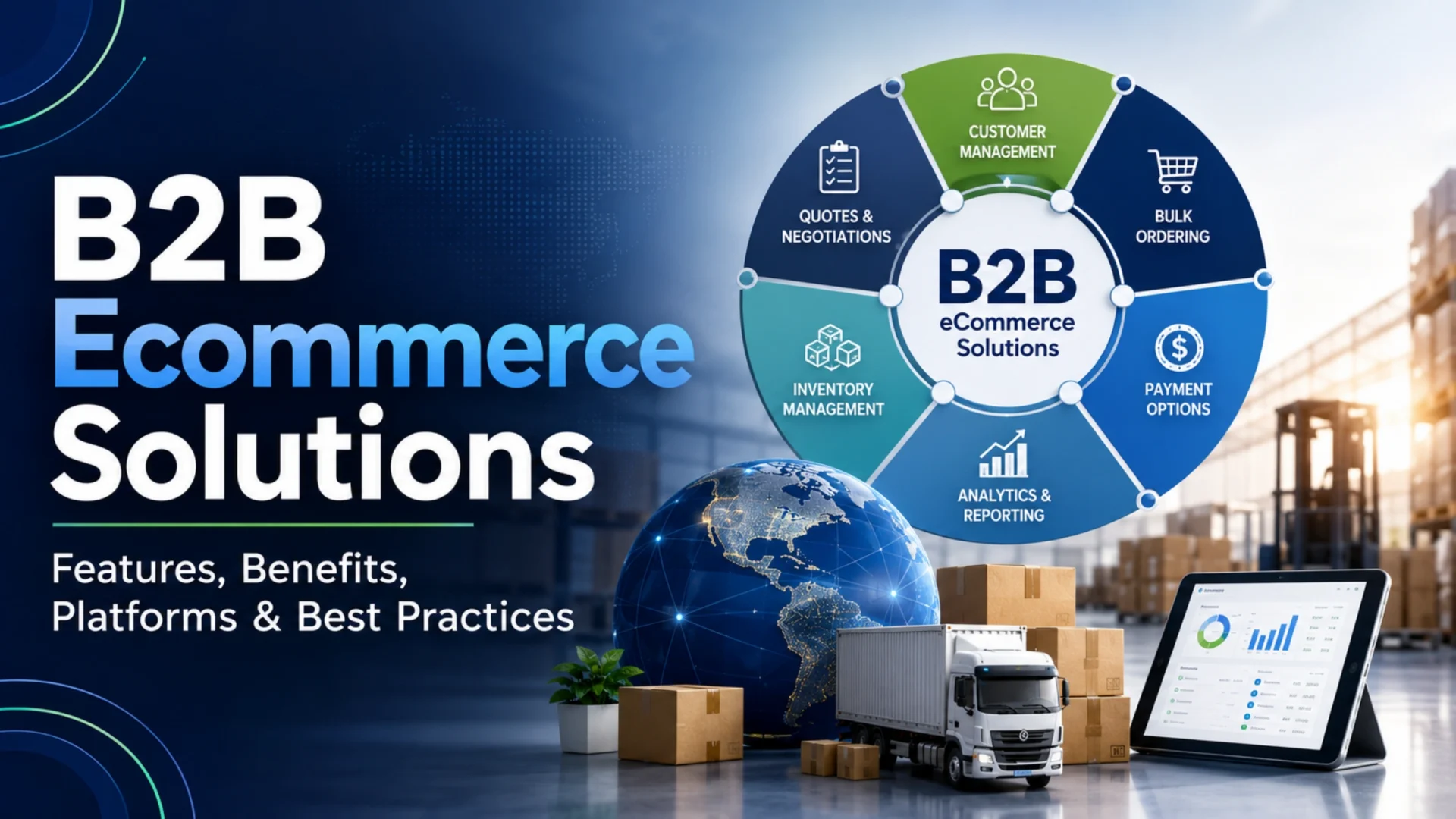
A B2B ecommerce solution is the combination of storefront, backend logic, and integrations that lets a business sell products or services to other businesses online, without a sales rep manually keying in every order. That sounds close to a regular online store, and on the surface it is. Underneath, the logic is almost entirely different.
A B2C shopper buys as an individual with their own card. A B2B buyer usually represents a company, and that company might have a finance director who needs to approve anything over $5,000, a warehouse manager who needs delivery windows, and a procurement lead who needs the order logged against a purchase order number. The average B2B buying group involves more than 8 stakeholders today, and younger decision-makers under 40 tend to involve nearly twice as many people in a purchase as older executives do. A platform that only handles single-user checkout simply can’t support that.
“A B2C store sells to one person making one decision. A B2B ecommerce solution sells to a committee, on account-specific terms, often against an existing relationship that predates the website entirely.”
That’s why “B2B ecommerce platform” and “B2B ecommerce solution” get used almost interchangeably but aren’t quite the same thing. The platform is the software: Shopify Plus, Adobe Commerce, BigCommerce, and similar systems. The solution is everything built around it, custom pricing logic, ERP synchronization, quote workflows, account hierarchies, and the ongoing strategy that keeps all of it working as the business grows. Buying a platform license doesn’t hand you a solution. Building the solution, through proper ecommerce development, is where most of the real work, and most of the real value, actually sits.
The table below lines up the two models side by side. It looks simple, but almost every feature decision later in this guide traces back to one of these rows.
| Dimension | B2B ecommerce | B2C ecommerce |
|---|---|---|
| Pricing | Account-specific, contract-based, tiered by volume | Fixed list pricing, same for every shopper |
| Buying group | Multiple stakeholders, often 8 or more per decision | Usually a single individual |
| Payment | Purchase orders, Net 30/60 terms, ACH, wire transfer | Card, digital wallet, immediate payment |
| Order size | Bulk, often hundreds of SKUs per order, recurring | Individual quantities, largely one-off |
| Checkout logic | Approval workflows, spending limits, quote requests | Simple, one-step checkout |
| Backend integration | Deep ERP and CRM sync for pricing, stock, and account data | Basic inventory and payment gateway integration |
Why B2B ecommerce solutions look different in 2026
Two forces are reshaping what “good” looks like this year, and neither is a passing trend. The first is generational. Millennials and Gen Z now represent 71% of B2B buyers, up from 64% just a few years ago, and 68% of millennial buyers say they’d rather research a purchase themselves than talk to a sales rep. Many of them complete a large share of the buying process online before a supplier even knows they’re evaluating a purchase. Frankly, a clunky portal that forces a phone call just to get a quote is losing deals it never even sees.
The second force is dissatisfaction with what’s already out there. In a Sana Commerce survey of more than 1,200 B2B buyers across seven countries, 94% reported some kind of customer experience challenge with B2B webstores, and half said those webstores weren’t fully meeting their expectations. That’s not a small gap. It means a lot of B2B ecommerce solutions live today are quietly pushing buyers toward competitors every time a catalog search returns nothing useful or a price shown online doesn’t match the contract.
94%
of B2B buyers report at least one customer experience challenge with online ordering, per Sana Commerce’s survey of over 1,200 B2B buyers. Inaccurate product information and unclear pricing were the two most cited complaints.
McKinsey’s Global B2B Pulse Survey, run annually since 2016 with nearly 30,000 cumulative respondents, offers a useful counterweight to any “digital replaces everything” narrative, though. Its “rule of thirds” finding shows buyers splitting their time fairly evenly across in-person interaction, remote human contact, and digital self-service, and this pattern holds regardless of industry, geography, or deal size. The practical takeaway isn’t that human sales reps are disappearing. It’s that a B2B ecommerce solution now has to be one strong leg of a three-legged stool, not the whole strategy on its own.
Types of B2B ecommerce solutions
“B2B ecommerce solution” isn’t one product category. It covers several genuinely different approaches, and picking the wrong type is a more common mistake than picking the wrong vendor within the right type.
Most mid-market manufacturers and distributors end up somewhere between the first and third type: a mainstream platform, heavily customized, wrapped around an existing ERP. That’s usually the pragmatic middle ground between “too rigid” and “too expensive to maintain.”
Core features every B2B ecommerce solution needs
Skip one of these and it usually shows up later as a support ticket, a lost account, or a sales rep quietly doing manual work the platform was supposed to eliminate. Here’s what actually needs to be in place, not the generic feature list every vendor site repeats.
Account-based pricing and custom catalogs:
Two customers buying the same product should never see the same price if their contracts say otherwise. Tiered pricing by volume, negotiated rates by account, and catalogs that hide products a specific buyer isn’t approved to purchase are table stakes, not add-ons.
Bulk ordering and quick reorder tools:
A buyer placing an order for 400 SKUs shouldn’t have to add each one individually. CSV upload, saved order templates, and one-click reordering of a previous purchase turn a 40-minute task into a two-minute one, which is a big part of why buyers keep coming back to a supplier’s own portal instead of picking up the phone.
Quote and RFQ workflows matter more in B2B than almost anywhere else in commerce. Not every buyer wants a fixed price online, especially for large or customized orders. A solid solution lets a buyer request a quote directly from the product page, routes it to the right person internally, and tracks the negotiation without dropping back into email threads that nobody can find three weeks later.
Account hierarchies and approval routing:
A parent company might have twelve locations, each with its own buyer, all needing separate budgets but shared pricing. Purchases above a set threshold might need a manager’s sign-off before they go through. This is the feature that separates a real B2B ecommerce solution from a B2C storefront with a wholesale plugin bolted on.
Round that out with flexible payment terms (Net 30, Net 60, purchase orders, ACH), multi-currency and tax handling for businesses selling across regions, and a self-service account portal where buyers can check order status, download invoices, and manage users without opening a support ticket. None of these are glamorous. All of them are the difference between a platform buyers tolerate and one they actually prefer.
Not sure which features your current setup is actually missing?
Elsner can audit your existing B2B storefront and map out exactly what’s costing you orders, and what it would take to fix.
Benefits of B2B ecommerce solutions worth quantifying
“It’ll grow your business” is true and also not a useful sentence for anyone signing off on a budget. Here’s where the actual, measurable benefit tends to show up once a B2B ecommerce solution is properly built and integrated, not just switched on.
| Benefit area | What the data shows | Source |
|---|---|---|
| Revenue growth | US B2B ecommerce site sales reached $2.297T in 2024, growing 10.5% year over year | eMarketer |
| Personalization lift | Companies using AI for personalization report meaningfully higher revenue per customer | McKinsey |
| Sales channel share | Ecommerce now accounts for more than a third of revenue at B2B organizations that offer it, overtaking in-person as the top channel | McKinsey B2B Pulse |
| Buyer retention | 94% of buyers hit friction on B2B webstores today, so fixing it directly protects revenue that’s currently at risk | Sana Commerce |
| Sales efficiency | Digital self-service frees reps for higher-value accounts rather than routine reorders | McKinsey B2B Pulse |
Worth saying plainly: none of these numbers show up automatically just because a company has a website that takes orders. They show up when the pricing logic, the search experience, and the checkout flow are actually built for how a business buyer works, not adapted from a consumer template.
How to choose the right B2B ecommerce platform
Ask this question to an AI search assistant right now and it will typically surface the same small cluster of names: Shopify Plus, Adobe Commerce, BigCommerce, Salesforce B2B Commerce, and Sana Commerce. That’s a reasonable starting shortlist, but it skips the part that actually determines whether the platform fits: your catalog complexity, your ERP, and how much customization your pricing logic genuinely requires.
| Platform | B2B capabilities | Customization | ERP integration | Best for |
|---|---|---|---|---|
| Shopify Plus | Native B2B module, tiered pricing, company accounts | Moderate; deep custom order logic can hit platform limits | Large prebuilt integration ecosystem | Fast-growing mid-market running unified B2B and B2C |
| Adobe Commerce | Company hierarchies, shared catalogs, requisition lists | Very high; near-unlimited custom logic | Deep custom API connections to virtually any ERP | Enterprises with complex catalogs and heavy customization needs |
| BigCommerce | Multi-store, advanced catalog, enterprise SLAs | High; open SaaS model, extensible via API | Solid API framework for custom ERP connections | Mid-market to enterprise wanting SaaS with more flexibility |
| Custom or ERP-native build | Built to match your exact workflow, not a generic feature set | Complete control, at the cost of a longer build | Tightest possible alignment, since the ERP governs the logic directly | Manufacturers and distributors where the ERP already drives pricing and fulfillment |
One deadline worth flagging for enterprise teams still running on legacy Hybris infrastructure: SAP Commerce Cloud reaches end of mainstream maintenance in mid-2026, which is quietly becoming one of the larger forced migration events in enterprise B2B ecommerce this decade. If that applies to you, the platform decision isn’t optional anymore, it’s a timeline. Elsner’s guide to Shopify’s B2B capabilities covers what a unified B2B and B2C build actually looks like in practice, and it’s worth reading before assuming a full replatform is the only path forward.
Adobe Commerce still holds a meaningful share of the enterprise B2B market, largely because manufacturers and distributors with genuinely complex catalogs haven’t found a faster route to that level of control. If that sounds like your business, Elsner’s breakdown of Magento’s B2B features walks through where that complexity is actually worth the tradeoff and where it isn’t.
Where AI actually helps B2B ecommerce, and where it doesn’t
This is where a lot of 2026 content gets vague, so let’s be specific. AI’s clearest, best-documented win in B2B ecommerce is personalization at a scale no rep team could match manually. Businesses applying AI to product recommendations, predictive reorder suggestions, and account-aware search are reporting meaningfully higher revenue per customer than those relying on static catalogs and generic search.
Dynamic pricing is the second real win, though it’s less talked about. AI-driven pricing engines are helping distributors and manufacturers protect margin by adjusting for demand, inventory levels, and account history in ways that static price lists simply can’t. Gartner projects that 40% of enterprise applications will include some form of task-specific AI agent by the end of 2026, up from under 5% in 2025, and its longer-range view points toward AI agents taking on a growing share of routine B2B procurement over the next few years. That’s a genuinely new development, and it’s worth watching closely rather than dismissing as hype.
Where AI is far less reliable is judgment about what’s actually broken. A recommendation engine is excellent at surfacing “accounts like yours also ordered.” It’s much weaker at explaining why a specific buyer abandoned a $40,000 quote request, or whether a redesigned catalog page will resonate with a niche industrial audience. That still takes human research and a strategist who can read behavioral data and ask the right follow-up question. Bolting an AI chatbot onto a portal with a broken approval workflow won’t fix the approval workflow. It usually just adds a new layer of friction on top of the old one.
There’s a discovery-layer shift worth naming too, since most B2B content skips it entirely. AI Overviews and conversational assistants are now shaping how buyers shortlist vendors before they ever land on a supplier’s site, meaning some traffic now arrives already narrowed to two or three options instead of ten. A B2B ecommerce solution paired with genuine AI agent development for internal workflows, quoting, and account management is positioning itself to capture that higher-intent traffic instead of only optimizing what happens after the click.
B2B ecommerce integration: the ERP and CRM work that makes or breaks scale
Honestly, this is the section most B2B ecommerce content skips, and it’s usually a big part of why a platform launch underdelivers. A storefront that isn’t synced in real time with the ERP will eventually sell something that’s out of stock, quote a price that’s already been renegotiated, or duplicate an order that was already fulfilled by phone. None of that is a platform failure. It’s an integration gap.
Illustrative scenario
Picture a mid-sized industrial parts distributor running an ERP that updates inventory once nightly. Their new storefront shows real-time stock, but “real-time” actually means “as of last night’s batch job.” A buyer orders 200 units that sold out that afternoon. The order gets flagged, the account manager has to call and apologize, and the buyer starts price-checking a competitor. This is a representative pattern based on common ERP-sync gaps, not a specific client result, but it’s one of the most frequent reasons a technically functional storefront still loses trust.
The fix isn’t glamorous. It’s proper API-level integration between the storefront and whatever runs the back office, whether that’s an ERP like Odoo, NetSuite, or SAP, or a CRM handling account-specific pricing and contract terms. Businesses running Odoo for inventory, procurement, and finance often get the most value from a B2B storefront built to sync directly against that system rather than treating it as a bolt-on afterthought, which is where Elsner’s Odoo development services tend to come in earliest in a project, well before the storefront design conversation even starts.
Poor ERP and CRM integration is one of the most common reasons B2B ecommerce projects underdeliver, which is also why a meaningful share of B2B organizations end up revisiting a platform decision they made just a few years earlier, usually to fix exactly this gap rather than to chase new features.
B2B ecommerce security considerations
A B2B storefront isn’t just processing card payments. It’s holding negotiated pricing data, purchase order histories, and financial terms for entire companies, which raises the stakes well past what a typical consumer store deals with. This section gets skipped in a lot of B2B ecommerce guides, but it shouldn’t be treated as optional.
- Role-based access control: buyers, approvers, and admins each see only what their role requires
- Granular account permissions: spending limits and catalog visibility set per user, not per company
- Payment and API security: PCI-compliant payment handling and authenticated, rate-limited API access for every integration
- Data encryption in transit and at rest, particularly for pricing and contract data synced from the ERP
- Fraud prevention: anomaly detection on order volume and payment behavior, especially for high-value accounts
- Audit logs: a clear record of who approved what, and when, for every order above a set threshold
- Compliance alignment with relevant standards for the industries and regions being served
Security here isn’t a one-time setup either. It needs the same ongoing attention as the storefront itself, which is usually where an ecommerce maintenance plan earns its keep, catching permission drift and outdated integrations before they turn into an actual incident.
B2B ecommerce best practices that actually move the needle
Design for search, not browsing: Business buyers usually know their SKU or part number before they land on the site. A search bar that handles typos, part numbers, and synonyms matters more here than merchandised category pages ever will.
Make reordering nearly frictionless. A large share of B2B revenue tends to come from repeat purchases rather than first-time discovery. A one-click reorder of a previous invoice, with quantities editable before checkout, usually does more for retention than any homepage redesign.
- Surface account-specific pricing immediately after login, not buried three clicks deep
- Show real, accurate stock levels tied to ERP data, not a static “in stock” badge
- Let buyers manage their own sub-users and spending limits without contacting support
- Offer Net terms and purchase order payment options alongside card payments
Not every best practice applies equally to every business, and that’s worth saying directly. A distributor selling thousands of low-cost SKUs needs a completely different search and catalog strategy than a manufacturer selling a handful of highly configurable industrial machines. Skip whichever of the above doesn’t match your actual buying pattern rather than implementing it because a checklist said to.
Mobile deserves a specific mention too. Buyers increasingly check stock, approve quotes, and reorder from a phone between meetings, and a portal that only really works on desktop is quietly losing that entire slice of usage. It doesn’t need to be flashy. It needs to load fast and let someone approve a $12,000 order from a warehouse floor without fighting a form built for a 27-inch monitor.
B2B ecommerce implementation roadmap
Knowing what a good solution looks like is only half the picture. Here’s roughly how a properly scoped build actually moves from decision to launch.
Timelines vary a lot by scope. A team that already knows its ERP well and picks a SaaS platform can move through these steps in a few months. A full custom build with multiple integrations usually runs closer to six months to a year, and teams weighing that investment often start by talking to someone who can hire an ecommerce developer for a scoped discovery phase before committing to a full build.
Common B2B ecommerce mistakes to avoid
These show up constantly across audits, and they’re rarely the result of a bad team. They’re usually the byproduct of treating a B2B build like a B2C project with extra login screens.
B2B ecommerce solution checklist
Before choosing or rebuilding a B2B ecommerce solution, confirm it supports: account-based pricing, company hierarchies with approval routing, bulk ordering and quick reorder, quote and RFQ workflows, real-time ERP or CRM integration, flexible payment terms, role-based security, AI-assisted personalization, SKU-level search, and a mobile experience buyers can actually use for approvals on the go.
How to choose a B2B ecommerce development partner
Most agency pitch decks look similar on the surface. What actually separates a partner who delivers a working B2B ecommerce solution from one who ships a pretty storefront with none of the backend logic working shows up in a handful of direct questions worth asking before signing anything.
- Have they integrated this exact ERP or CRM before, and can they show a real example, not a generic case study?
- Do they understand account hierarchies and approval routing well enough to design them before writing a line of code?
- Can they explain the tradeoffs between Shopify Plus, Adobe Commerce, and a custom build in plain terms, without steering toward whichever platform they resell?
- Who actually owns the post-launch relationship: a project manager who disappears at go-live, or a team that stays involved as the catalog and integrations evolve?
- How do they handle data migration from the current system without a gap in order history or pricing accuracy?
Be cautious of anyone quoting a fixed timeline before auditing your existing ERP setup and catalog complexity. That kind of confidence usually means they haven’t looked closely enough yet to know what they’re actually walking into.
How Elsner approaches B2B ecommerce solutions
Elsner builds B2B ecommerce solutions as integration-first projects, not storefront-first ones. That ordering matters, because a beautiful catalog page is worthless if the pricing behind it doesn’t match what’s in the ERP. Our teams work directly across Shopify Plus, Adobe Commerce, and BigCommerce, alongside the ERP and CRM systems most of our clients already run on, which means platform recommendations come with a real understanding of what’s genuinely feasible to build and maintain, not just what looks good in a proposal.
Where a project needs custom workflow logic that no off-the-shelf platform handles cleanly, our custom software development team steps in to build the approval routing, quoting engine, or account management layer the standard platform doesn’t offer out of the box, and every build carries forward into the ongoing maintenance and security work covered above rather than ending at go-live.
The bottom line
B2B ecommerce in 2026 has more sophisticated tooling behind it than it’s ever had, and the underlying test hasn’t changed at all: does the platform actually match how your buyers work, or does it force them to work around it. Younger, digital-first buyers now dominate B2B purchasing, and they’re not shy about switching suppliers when a portal wastes their time. AI genuinely helps with personalization and pricing at scale, but it can’t substitute for solid ERP integration, clean account logic, and a catalog that actually reflects what’s in stock. The businesses pulling ahead are treating their B2B ecommerce solution as core infrastructure worth investing in properly, not a checkbox next to the company website.
Ready to see what a properly built B2B ecommerce solution could do for your business?
Elsner audits your current setup, maps it against your ERP and CRM, and builds a B2B storefront that actually matches how your buyers work. Book a consultation and let’s figure out where to start.
Key takeaways
✓ US B2B ecommerce site sales reached $2.297 trillion in 2024, growing 10.5% year over year, and are projected to top $3 trillion by 2028, per eMarketer.
✓ Millennials and Gen Z now make up 71% of B2B buyers, and 68% of millennials prefer self-service research over talking to a sales rep.
✓ 94% of B2B buyers report at least one customer experience challenge with online ordering today, according to Sana Commerce’s survey of 1,200-plus buyers.
✓ B2B ecommerce solutions span several distinct types, platforms, marketplaces, custom builds, ERP-native, headless, and SaaS, and picking the wrong type is a common early mistake.
✓ Platform choice matters less than integration depth and security posture. Poor ERP and CRM synchronization is one of the most common reasons B2B ecommerce launches underdeliver.
✓ Elsner builds B2B ecommerce solutions integration-first, across Shopify Plus, Adobe Commerce, BigCommerce, and ERP systems like Odoo, rather than storefront-first.
Frequently Asked Questions
What is a B2B ecommerce solution?
A B2B ecommerce solution is a digital sales platform built for business-to-business transactions, including account-specific pricing, bulk ordering, approval workflows, flexible payment terms, and integration with ERP and CRM systems. It differs from standard ecommerce because it has to serve multiple stakeholders per account rather than a single buyer.
What are the different types of B2B ecommerce solutions?
The main types are B2B ecommerce platforms like Shopify Plus and Adobe Commerce, B2B marketplaces like Amazon Business, custom-built B2B solutions, ERP-native ecommerce built directly on a system like Odoo or NetSuite, headless B2B ecommerce, and B2B SaaS ecommerce for subscription-based products.
What features should a B2B ecommerce platform have?
Core features include account-based pricing, custom catalogs, bulk ordering and quick reorder tools, quote and RFQ workflows, account hierarchies with approval routing, flexible payment terms like Net 30, role-based security, and real-time ERP or CRM integration for accurate inventory and pricing.
Which B2B ecommerce platform is best?
There’s no single best platform. Shopify Plus tends to suit fast-growing mid-market brands unifying B2B and B2C, Adobe Commerce suits enterprises with complex catalogs and heavy customization needs, and BigCommerce fits businesses wanting an open SaaS model with strong API extensibility. The right choice depends on catalog complexity, ERP requirements, and budget.
How much does a B2B ecommerce solution cost?
Cost is driven by several factors rather than one number: the platform license or subscription, design and development time, ERP or CRM integration complexity, data migration from the current system, any custom workflows like quoting or approval routing, third-party integrations, testing, and ongoing maintenance. A SaaS-based build with straightforward integration costs meaningfully less than an enterprise build with multiple custom integrations, so an accurate estimate usually requires an audit of the existing systems first.
Why do B2B ecommerce projects fail to deliver ROI?
A common root cause is incomplete ERP or CRM integration. When inventory, pricing, or order data isn’t synced in real time, buyers encounter stale stock information or incorrect pricing, which quickly erodes trust and pushes them back toward manual ordering or a competitor.
Does AI actually improve B2B ecommerce performance?
Yes, particularly for personalization and dynamic pricing, where businesses using AI report meaningfully higher revenue per customer and better margin control, according to McKinsey research. AI works best layered on top of solid ERP integration and clean account logic, not as a substitute for them.
How secure does a B2B ecommerce solution need to be?
Very. A B2B storefront typically holds negotiated pricing, purchase order history, and financial terms for entire companies. It needs role-based access control, encrypted data in transit and at rest, secure API connections for every integration, audit logs for approvals, and ongoing monitoring rather than a one-time security setup.
What’s the difference between a B2B ecommerce platform and a B2B ecommerce solution?
The platform is the underlying software, such as Shopify Plus or Adobe Commerce. The solution is everything built around it, including ERP integration, custom pricing logic, quote workflows, and account hierarchies. Buying a platform license alone doesn’t deliver a working solution.
How long does it take to build a B2B ecommerce solution?
A mid-market build on a SaaS platform with straightforward ERP integration can launch in a few months. Enterprise builds involving complex catalogs, multiple ERP or CRM systems, and custom workflow logic typically take six months to a year, depending on data migration complexity and the number of integrations required.