




- Why Shopify Plus SEO is different from regular Shopify SEO
- Technical SEO foundations for Shopify Plus
- Site architecture and URL structure at scale
- Core Web Vitals and page speed
- Duplicate content issues
- Structured data and schema markup
- XML sitemap and crawl budget management
- Migrating to Shopify Plus: an SEO checklist
- International and multi-store SEO on Shopify Plus
- Headless (Hydrogen) and Shopify Plus SEO considerations
- Not sure if your catalog structure is holding rankings back?
- On-page and content SEO strategies for Shopify Plus stores
- B2B and wholesale SEO considerations on Shopify Plus
- Preparing for AI search (AEO) in 2026
- Common Shopify Plus SEO mistakes to avoid
- Final thoughts
- Ready to see what’s holding your rankings back?
- Frequently Asked Questions
- Does Shopify Plus have better SEO than regular Shopify?
- How much does Shopify Plus SEO cost?
- Do I need an SEO agency for Shopify Plus?
- How long does Shopify Plus SEO take to show results?
- Does migrating to Shopify Plus hurt my SEO rankings?
- Is Shopify Plus good for international SEO?
- Does going headless on Shopify Plus hurt SEO?
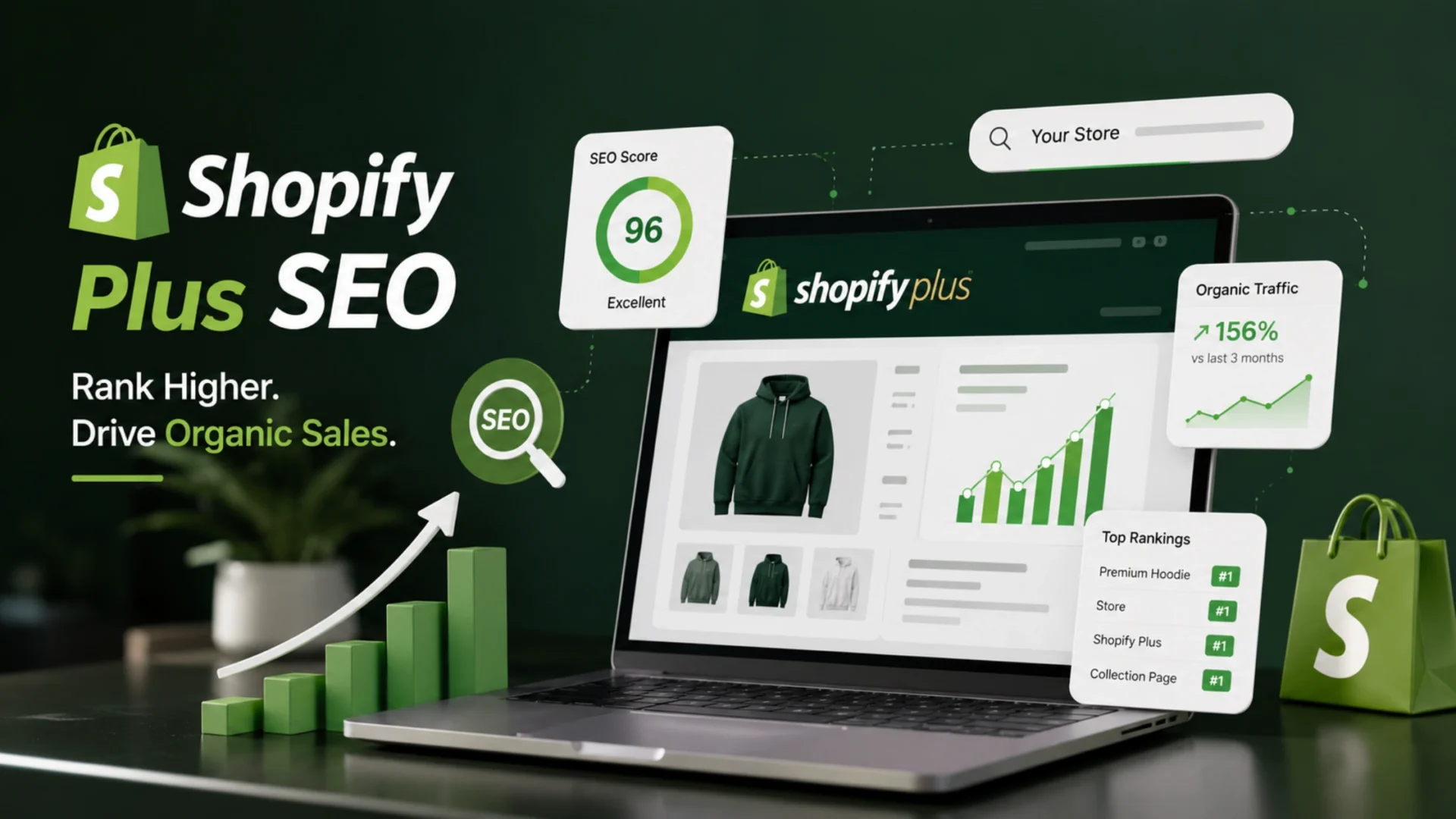
Organic search is still a major source of website traffic in the e-commerce world. Depending on which industry report you check, it sits somewhere between 40 and 41 percent on average. That’s rarely the smallest slice of the pie. Yet plenty of Shopify Plus merchants treat rankings as something the platform handles for them. It doesn’t. Shopify Plus gives you high-quality infrastructure, a flexible checkout, and an easier path to scale. What it doesn’t hand you is Shopify Plus SEO out of the box. If you want the store to actually rank, someone has to build that layer on top.
This guide breaks down what actually changes once you’re operating at Plus scale: thousands of SKUs, multiple storefronts, international expansion, sometimes a headless build sitting on top of all of it. None of that gets covered by a set it and forget it approach. Elsner works with Shopify Plus brands on exactly this problem, so treat this as the practical version of what we’d walk a client through in a strategy call.
Quick Answer
Shopify Plus SEO covers the technical, structural, and content work needed to rank a large-scale Shopify store, work the platform doesn’t do automatically. That means URL architecture across thousands of SKUs, Core Web Vitals management as apps pile up, canonical control on filtered and variant pages, international hreflang setup across Shopify Markets or separate stores, and increasingly, structured data built for AI search tools. Plus gives you a stable foundation. It doesn’t give you a strategy.
Why Shopify Plus SEO is different from regular Shopify SEO
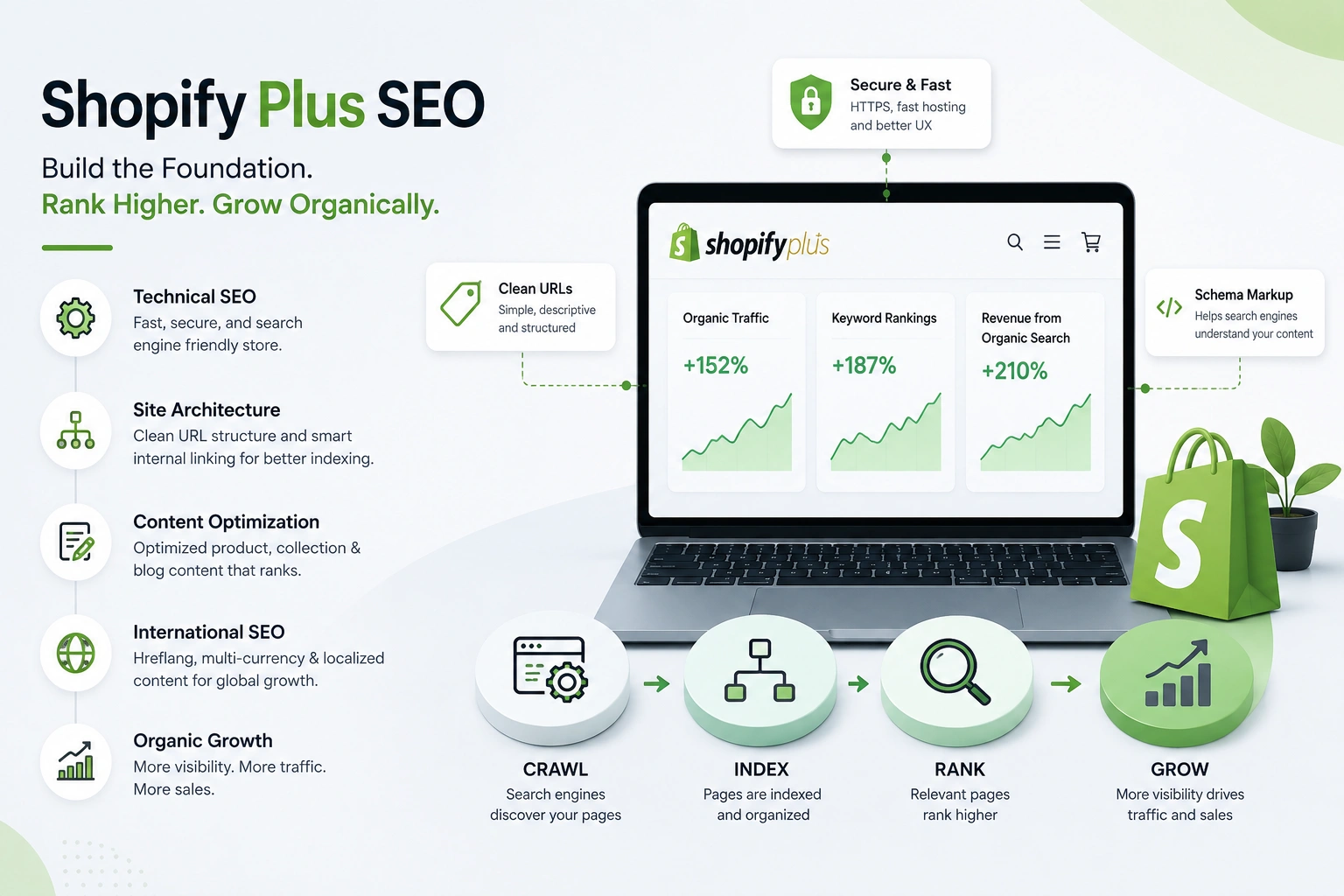
A standard Shopify store with 200 products and a single theme has a manageable SEO footprint. Shopify Plus stores rarely look like that. Once you’re dealing with thousands of SKUs and hundreds of collections, duplicate content risk goes up fast. Filtered views, variant URLs, and overlapping category pages can all get indexed if nobody’s watching, and that dilutes ranking signals across near-identical pages.
Checkout customization is another factor unique to Plus. The flexibility genuinely helps conversion work, but poorly built customizations can slow down page load or break the mobile experience, and Google notices both.
Then there’s scale itself. Multi-store setups and Shopify Markets solve real business problems: currency, language, regional pricing. They also create duplicate and international content challenges a single storefront never has to deal with. Add in the fact that enterprise merchants tend to run more apps and more third-party scripts, and Core Web Vitals risk climbs right alongside it.
Where errors get expensive at this scale
A single canonical issue is a small thing on a store with 300 products. That same mistake across 15,000 SKUs quietly bleeds organic revenue for months, and nobody notices until someone finally checks Search Console.
Worth saying plainly: none of this makes Shopify Plus a poor SEO choice. It’s actually a strong foundation compared to some enterprise platforms, mainly because the core infrastructure is stable and fast by default. The gap isn’t the platform. It’s the assumption that infrastructure equals strategy. Those are two different jobs, and most Plus contracts only cover the first one. That’s the exact gap our Shopify Plus development team gets brought in to close, usually after a merchant realizes the platform was never going to do it for them.
Technical SEO foundations for Shopify Plus
This is where the real technical depth of Shopify Plus SEO lives, and it’s usually where the biggest wins are hiding.
Site architecture and URL structure at scale
Think top to bottom, starting with collections and only then getting to specifics like products. When you’re managing something like 8,000 SKUs across 40 collections, a well-defined hierarchy matters: top-level categories, then subcategories, then product pages, with each URL actually reflecting that structure instead of just listing products flat. We’ve worked with a furniture brand that made exactly this change, and category page rankings improved within a short window once crawlers could correctly interpret how the site was organized.
Core Web Vitals and page speed
Theme bloat is the most common culprit here. Every app you install loads a new script, and scripts add up to render-blocking weight fast. Keep a running list of installed apps and cut the ones nobody’s actually using. Lazy-load images below the fold, and route product imagery through a proper image CDN instead of uploading high-resolution files across every page. If you haven’t audited this in a while, our Shopify speed audit checklist is a decent place to start before app bloat quietly costs you more rankings than you’d expect.
Duplicate content issues
Multiple URLs (think ?variant=1234567), filtered collection pages, and paginated series essentially copy the same content at scale. A canonical tag pointing back to the main URL is the fix, but it’s not a one-time task. Filters and variants get added constantly, so canonical logic needs a recurring audit, not just a moment of attention at launch.
Structured data and schema markup
Product schema, breadcrumb schema, FAQ schema, and review schema all matter here, and not just for blue links anymore. Clean structured data is increasingly how AI Overviews and other AI search tools decide what to cite in 2026. If your product data isn’t marked up clearly, you’re invisible to that layer of search entirely, regardless of how well you rank the traditional way.
XML sitemap and crawl budget management
Large catalogs burn through crawl budget fast. Submit segmented sitemaps (products, collections, blog) instead of one giant file. Keep them current, and pull discontinued products out promptly. Googlebot has finite attention for any given site, and a bloated sitemap full of dead SKUs wastes it.
A store with 10,000 SKUs and one unsegmented sitemap is basically asking Google to figure out priority on its own. It usually doesn’t do a great job of that. Splitting sitemaps by content type gives you a much clearer read in Search Console, so you can see exactly which segment has indexing trouble instead of guessing across one combined report.
Migrating to Shopify Plus: an SEO checklist
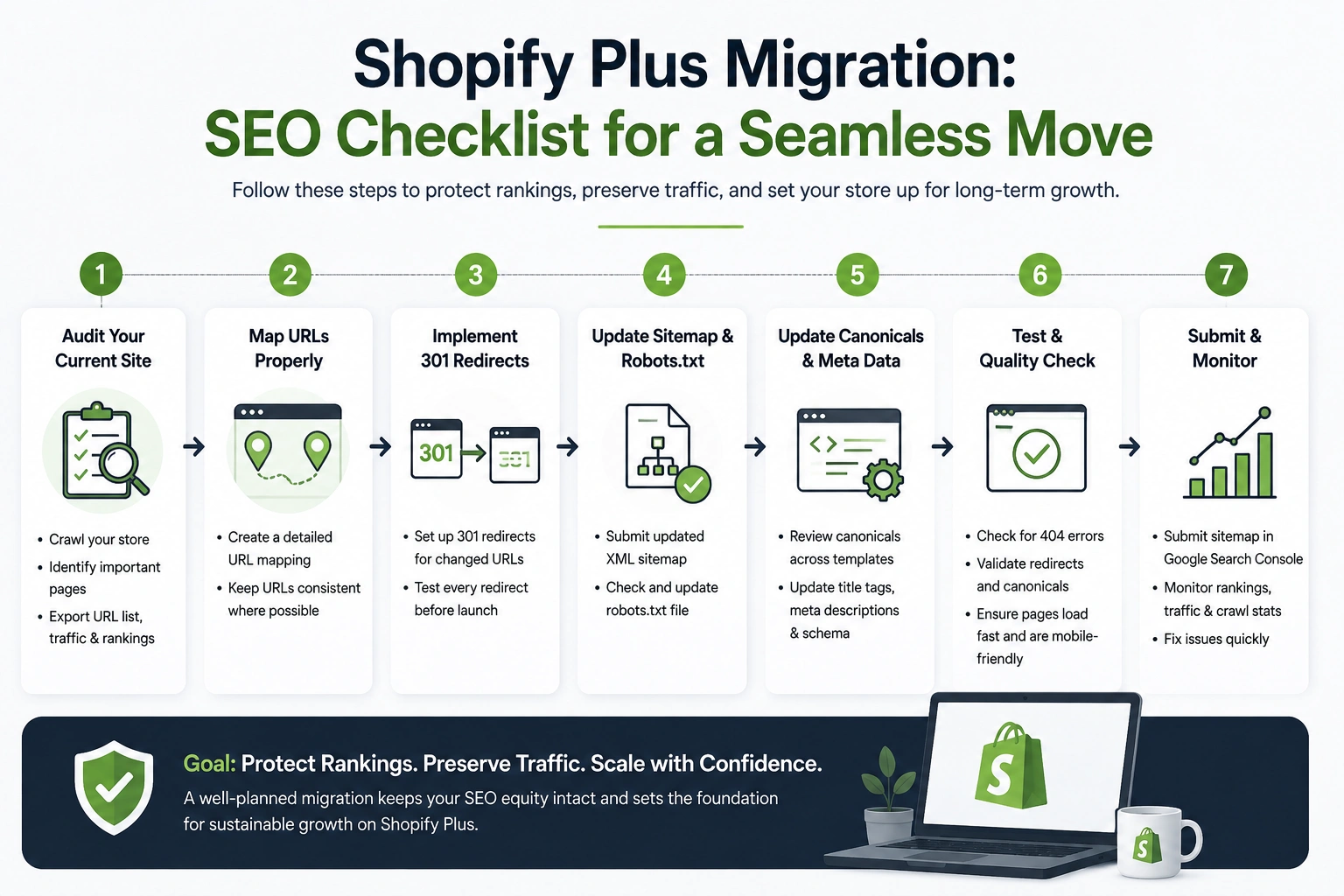
Migrating from Magento or BigCommerce is where rankings die if nobody’s paying attention. Run through our full Shopify migration checklist before launch, but at minimum, these five items are non-negotiable.
Skip any of these and expect a ranking dip that can take a full quarter to recover from.
International and multi-store SEO on Shopify Plus
Expansion is where a lot of otherwise solid Shopify Plus SEO work falls apart, mostly because these decisions are structural and hard to undo later. Choosing between Shopify Markets versus separate stores is the first fork in the road. Markets is simpler to manage and keeps everything under one domain, consolidating authority. Separate country stores or subdomains give more control over localized content but split link equity across multiple properties. Most mid-sized Plus merchants are better served by Markets. Enterprise brands with genuinely different catalogs per region sometimes need the separate store approach anyway.
hreflang implementation frustrates a lot of merchants, and usually for the same reason: hreflang tags pointing to language or region pages that don’t exist, or a missing self-referencing tag on the page itself. Get this wrong and Google might show the wrong language version to the wrong audience, or worse, treat your country pages as duplicates of each other.
Avoiding duplicate content across regional stores means each market needs at least some unique copy, not just a currency swap on identical text. A UK page with US spelling and US-only shipping details sitting under a UK URL is a signal that something’s off. Currency and language localization signals matter too. Google looks at more than the hreflang tag alone. Local currency display, local phone formats, and region-appropriate trust badges all reinforce that a page is genuinely built for that market.
A quick scenario
Take a typical US apparel brand expanding into the UK, the EU, and Canada. Without Shopify Markets, that’s three separate storefronts to build, correct hreflang tags across every product and collection page in all three, and fresh meta descriptions written around how each market actually searches, not a translated copy of the US version.
One detail that’s often overlooked: shipping and returns copy needs to be genuinely accurate per region, not a single global paragraph reused everywhere. A Canadian shopper reading US-only return windows loses trust fast, and that hesitation shows up in conversion data long before it shows up as an SEO problem. It’s a content issue with a ranking consequence, not the other way around.
Headless (Hydrogen) and Shopify Plus SEO considerations
Going headless with Hydrogen changes a lot of what Shopify normally handles automatically, and not always in ways merchants expect going in.
Metadata management is the first thing that breaks. On a standard Shopify theme, title tags and meta descriptions live in the admin with minimal setup. On Hydrogen, someone has to build that logic directly into the storefront code, page by page, or it simply won’t exist. Sitemaps stop being automatic too. A standard store generates and updates its sitemap without any input. A headless build needs a custom sitemap generation process, and if nobody owns that task, new products can sit unindexed for weeks.
Rendering is the biggest technical fork. Hydrogen storefronts render server-side on Oxygen by default, which is good for crawlability. But if a team configures client-side rendering for parts of the site to improve perceived speed, search engines can struggle to see that content at all. Worth confirming explicitly with whoever builds the storefront, not assuming.
So when does headless actually make sense for SEO? Usually when a brand needs a highly custom front-end experience a standard theme genuinely can’t deliver, and has the development resources to maintain the SEO layer manually going forward. When budget or team bandwidth is tight, a well-built standard theme is often the safer bet. Headless adds real technical risk that only pays off when someone’s actively managing it.
There’s a middle ground too, worth mentioning. Some Plus merchants go headless for a handful of high-traffic landing pages while keeping the rest of the catalog on a standard theme. It’s a reasonable way to get custom design where it matters most without taking on SEO risk across the entire site at once. Not every brand needs to go all in on Hydrogen just because the option exists.
Not sure if your catalog structure is holding rankings back?
Elsner can run a straightforward technical audit and show you exactly where the leaks are, whether it’s canonical issues, app bloat, or a migration that never got redirects mapped properly.
On-page and content SEO strategies for Shopify Plus stores
Collection pages deserve more strategic attention than most merchants give them. Per 2026 search behavior, collection pages capture a higher volume of commercial-intent keywords than individual product pages do. Someone searching “men’s running shoes” wants a collection, not one specific SKU. Prioritize real intro copy on category pages, not just a filtered product grid with zero text.
Product pages are still a great channel, just handled differently. Writing one description and swapping the product name technically creates unique URLs, but users and Google will both see thin, repetitive content. A title like “Blue Cotton Shirt – Size M” reads weak, while “Men’s Organic Cotton Shirt in Slate Blue, Sizes S to XXL” is a much stronger choice. The same logic applies to meta descriptions: specific fabric, fit, and use case beat generic filler every time.
Internal linking across a large catalog needs actual structure, not random cross-sells. Link from blog content into relevant collections, from collections into featured products, and from product pages back into buying guides. That structure helps both crawlers and shoppers navigate a catalog that might otherwise feel like a maze.
Content strategy for Plus brands should follow the buyer’s actual journey instead of publishing generic ultimate guides that try to cover everything at once. Top-of-funnel content answers broad questions, like how to choose running shoes for flat feet. Middle-of-funnel content compares options. Bottom-of-funnel content addresses purchase-specific concerns like sizing, returns, or shipping. Publishing only top-of-funnel content, which is what most brands default to, hands conversion-focused searches straight to competitors. Our own breakdown of Shopify SEO secrets to dominate search rankings goes deeper into structuring that content calendar around actual purchase intent.
Frankly, bottom-of-funnel content gets skipped more than anything else on this list, and it’s usually the fastest content to convert once it ranks. A page answering “does this jacket run small” or “what’s the return window on final sale items” targets a smaller audience than a broad buying guide, sure. But that audience is a click away from checkout. That’s a different kind of value than a top-of-funnel article ever delivers.
B2B and wholesale SEO considerations on Shopify Plus
If your Plus store runs a B2B storefront alongside the public catalog, indexing needs a second look. Gated wholesale pricing pages should never be indexed. That’s obvious once you say it out loud, but it’s a surprisingly common oversight, especially after a platform migration when robots.txt rules don’t carry over cleanly.
The bigger strategic point: public catalog SEO and wholesale SEO are not the same project. Public pages target consumer search intent. B2B pages, if you want any of them indexed at all, target completely different keywords: procurement language, bulk order terms, industry-specific phrasing a retail shopper would never type. Treating both as one undifferentiated SEO effort usually means neither gets done well.
Worth a quick gut check here: if your B2B portal sits entirely behind a login wall, there’s likely nothing to index in the first place, and that’s fine. The mistake only happens when a brand builds a public-facing B2B landing page meant to attract search traffic, then buries it under the same robots rules meant for the gated pricing tool. Those need to be treated as separate assets from day one.
Preparing for AI search (AEO) in 2026
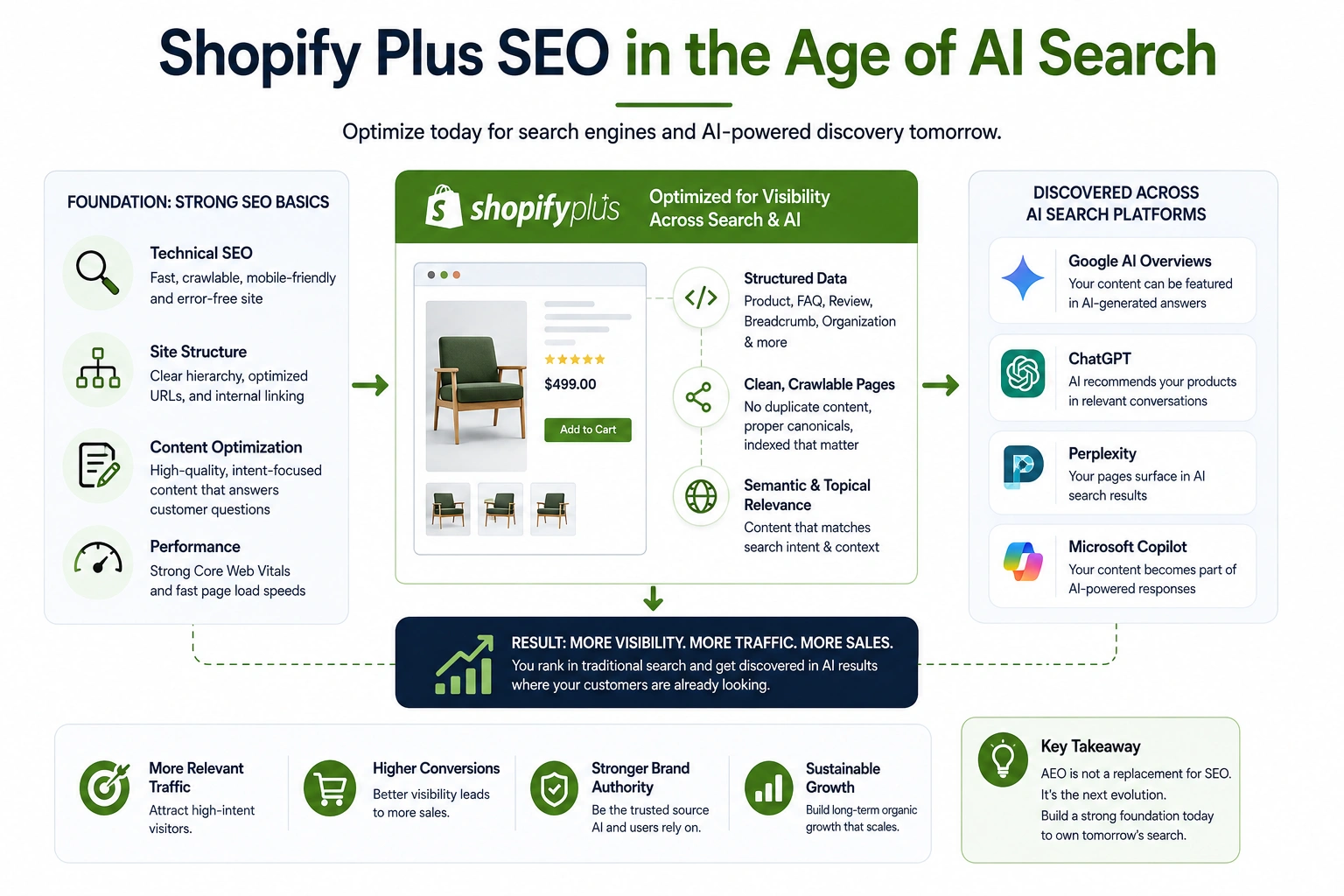
Answer engine optimization has moved from a nice-to-have to a core part of Shopify Plus SEO. AI Overviews, ChatGPT, and Perplexity increasingly pull from structured, direct-answer content blocks rather than long narrative paragraphs. If you want a fuller sense of where this fits against traditional ranking work, our GEO vs AEO vs SEO comparison guide lays out the differences without the buzzwords.
FAQ schema is doing double duty now. It still helps with the classic Google featured snippet, but it’s also one of the clearest signals AI systems use to extract a direct answer from your page. A product FAQ that answers “does this run true to size?” in one clean sentence has a real shot at being cited, where three paragraphs of brand voice copy doesn’t.
This connects directly back to the structured data work covered earlier. Product schema and FAQ schema aren’t separate initiatives from your technical SEO foundation. They’re the same foundation, just serving a newer audience of search systems.
None of this means traditional ranking work stops mattering. It doesn’t. AEO is additive, not a replacement for the fundamentals covered earlier in this guide. Skip the technical foundation, and there’s nothing solid for the AI layer to cite in the first place.
Common Shopify Plus SEO mistakes to avoid
- App overload. Every app is a trade-off. Installing ten apps for marginal features while ignoring their cumulative speed impact is one of the most common, and most fixable, mistakes on Plus stores.
- Ignoring Search Console. Enterprise teams sometimes assume their agency or dev team is watching this. Often nobody is, and indexing errors go unnoticed for months.
- Treating SEO as a one-time setup. A migration audit or a theme launch is a starting point, not a finish line.
- No monthly content cadence. Publishing sporadically means losing momentum on the keywords that actually build authority over time.
- Broken redirects post-migration. This one alone can undo months of prior ranking work if it’s not caught early.
Shopify Plus SEO checklist
A quick recap for anyone scanning before a launch or an audit:
- Clean, hierarchical URL structure across collections and products
- Core Web Vitals monitored and app bloat audited regularly
- Canonical tags managing variant and filtered page duplication
- Product, breadcrumb, FAQ, and review schema implemented sitewide
- Segmented XML sitemaps kept current
- Full 301 redirect mapping for any platform migration
- hreflang correctly implemented for every international market
- Collection pages optimized with real, unique copy
- Content built around the full buyer journey, not just top of funnel
- B2B pages and pricing kept separate from public catalog indexing strategy
Final thoughts
Shopify Plus SEO isn’t a checkbox you tick once during setup. It’s an ongoing discipline across technical health, international structure, content, and now AI search visibility too. If your store is sitting on unrealized organic traffic, or you’re planning a migration and want the redirects handled right the first time, our team of Shopify Plus developers can start with a straightforward audit of where you stand today.
Ready to see what’s holding your rankings back?
Book a free Shopify Plus SEO audit with Elsner and get a clear, honest read on your technical health, migration readiness, and content gaps.
Frequently Asked Questions
Does Shopify Plus have better SEO than regular Shopify?
Not automatically. The underlying SEO capability is similar. What Plus adds is complexity, more stores, higher SKU counts, international markets, that requires more deliberate technical work to manage well.
How much does Shopify Plus SEO cost?
It varies by scope. A technical audit alone might run a few thousand dollars, while ongoing Shopify Plus SEO services with content, technical maintenance, and reporting typically run as a monthly retainer scaled to catalog size and competitive difficulty.
Do I need an SEO agency for Shopify Plus?
Not always. But in-house teams usually lack the bandwidth to manage technical SEO, content, and international setup at the same time. It’s often worth bringing in a Shopify Plus SEO agency once your catalog or market presence outgrows what one in-house person can realistically handle.
How long does Shopify Plus SEO take to show results?
Broadly, expect three to six months for meaningful progress, longer in competitive categories. Technical fixes tend to show impact faster than fresh content, which takes time to rank and be recognized as authoritative.
Does migrating to Shopify Plus hurt my SEO rankings?
It can, if redirects and URL mapping aren’t handled correctly. Done properly, most brands see a short dip followed by recovery within one to two months.
Is Shopify Plus good for international SEO?
Yes, particularly with Shopify Markets, but only if hreflang, localized content, and regional tracking are configured deliberately. The platform provides the tools. It doesn’t configure them for you.
Does going headless on Shopify Plus hurt SEO?
Not inherently, but it removes automation that standard Shopify handles for you: metadata, sitemaps, and rendering all need manual setup. The real SEO risk with headless comes from under-resourcing ongoing maintenance, not from the framework itself.