



- What IT services actually means in 2026
- What digital transformation actually means in 2026
- Why CIOs keep confusing the two
- The CIO decision framework for sequencing both
- How company size changes the calculus
- Cost, timeline, and ROI compared
- Funding the right initiative without a budget fight
- Common mistakes CIOs make when choosing
- Where AI is blurring the line between the two
- A real-world scenario
- How Elsner approaches this decision with clients
- Key takeaways
- Ready to figure out which one your organization needs first?
- Frequently Asked Questions
- What is the difference between IT services and digital transformation?
- Should we fix our IT systems before starting digital transformation?
- How much does digital transformation cost compared to IT modernization?
- Why do most digital transformation initiatives fail?
- How do I know if my company needs IT services or digital transformation?
- Can digital transformation and IT modernization happen at the same time?
- Does company size affect the choice between IT services and digital transformation?
- How should we budget for IT services versus digital transformation?
- Is AI part of IT services or digital transformation?
- What’s the biggest mistake companies make when choosing between the two?
A regional insurer spent four years and eleven million dollars on what its board called a digital transformation. New customer portal, new mobile app, a chatbot with a friendly name. Eighteen months after launch, claims processing time hadn’t moved. The real bottleneck was never customer facing. It was a claims routing system built in 2009 that nobody wanted to touch because nobody fully understood it anymore. The company had funded digital transformation while what it actually needed, at least first, was IT modernization. That mix-up cost more than money. It cost the CIO two years of credibility with a board that stopped believing the next budget request would fix anything either.
This happens more than anyone in a boardroom wants to admit. IT services and digital transformation get used almost interchangeably in budget decks, RFPs, and vendor pitches, and that looseness has a cost. Pick the wrong one first, or fund the wrong one entirely, and you end up with a shinier front end sitting on top of the same broken plumbing, or a modernized back end that never actually changes how the business competes.
This guide breaks down what each term actually means in practice, why CIOs keep conflating them, and gives you a working framework for deciding which one your organization needs first, how to sequence both, and how to fund the right initiative without setting up a fight with your CFO. We’ll also cover realistic cost and timeline expectations, the mistakes that derail these decisions most often, and where AI is starting to blur the line between the two categories entirely.
Quick Answer
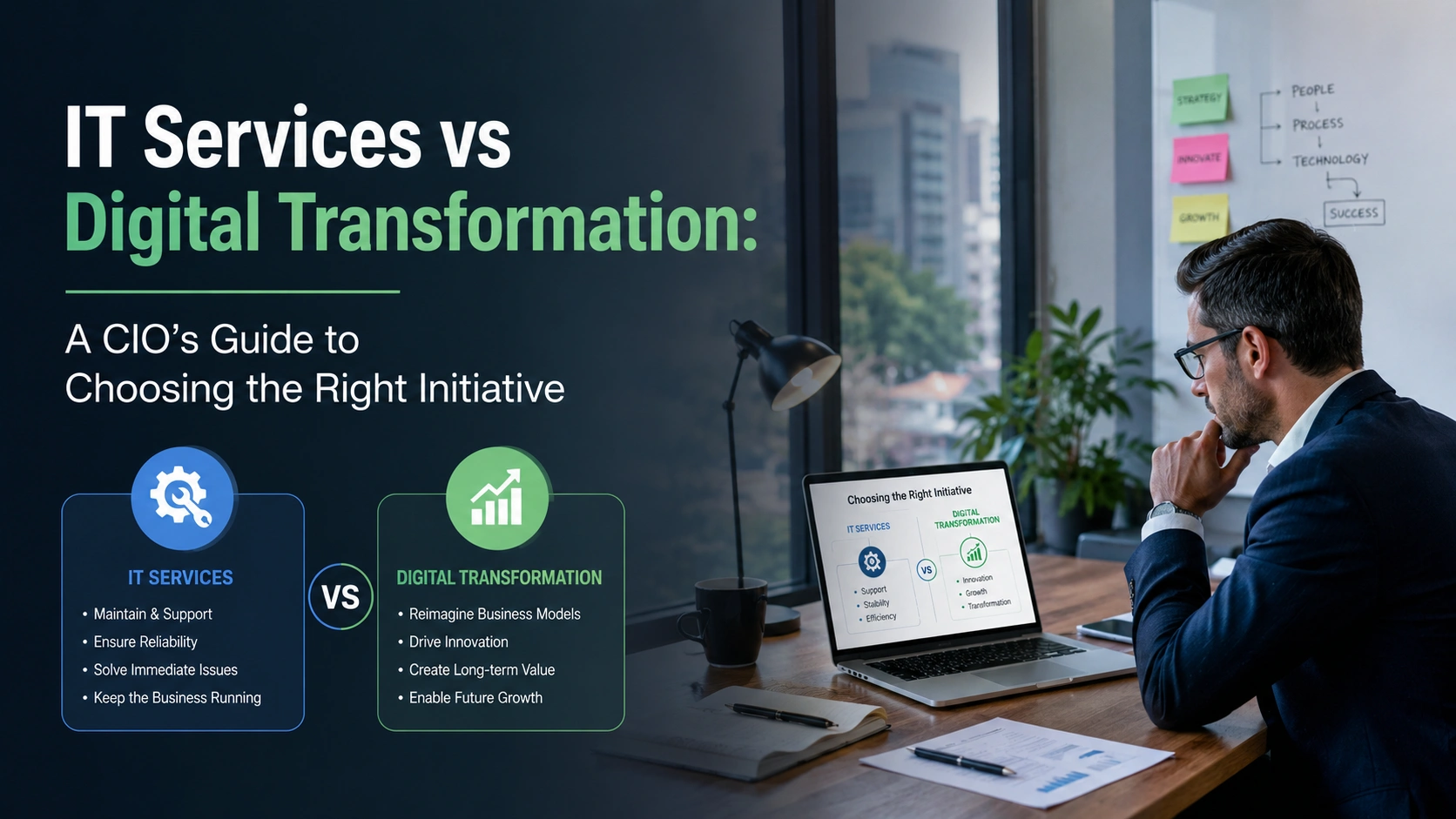
IT services focus on keeping infrastructure, systems, and support running reliably. Digital transformation focuses on reshaping how a business creates value, competes, and serves customers, using technology as the enabler rather than the goal. The two aren’t competing choices. IT services build the foundation that determines whether a digital transformation initiative can actually deliver, which is why most transformation failures trace back to systems that were never modernized in the first place. Research from McKinsey has consistently found that fewer than 30 percent of transformation efforts succeed at improving performance and sustaining that improvement over time, and sequencing is one of the biggest reasons why.
What’s Covered
- What IT services actually means in 2026
- What digital transformation actually means in 2026
- Why CIOs keep confusing the two
- The CIO decision framework for sequencing both
- How company size changes the calculus
- Cost, timeline, and ROI compared
- Funding the right initiative without a budget fight
- Common mistakes CIOs make when choosing
- Where AI is blurring the line between the two
- A real-world scenario
- FAQs
What IT services actually means in 2026
In one sentence: IT services keep the systems a business already depends on running, secure, and available, measured by uptime and cost efficiency rather than by new revenue or market share.
IT services cover infrastructure management, network administration, helpdesk support, cybersecurity operations, cloud hosting, and the modernization of existing systems so they keep pace with current demands. The scope is broad, but the intent underneath it is narrow: make sure the technology that already exists works, works securely, and doesn’t become the reason the business can’t operate on a given Tuesday.
Global spending in this category isn’t shrinking either. Gartner’s latest forecast puts worldwide IT spending at $6.37 trillion for 2026, a 14.2 percent increase over 2025, with IT services representing the single largest spending segment ahead of software, devices, and communications. That’s not a sign organizations are experimenting more. It’s a sign the baseline cost of keeping technology running has climbed, largely because AI workloads, cloud complexity, and security requirements have all gotten more expensive to maintain at the same time.
Source: Gartner, https://www.gartner.com/en/newsroom/press-releases/2026-07-27-gartner-forecasts-worldwide-it-spending-to-grow-14-point-2-percent-in-2026-totaling-6-point-37-trillion
IT services get measured on operational metrics. Uptime. Mean time to resolution. Cost per ticket. Compliance audit results. None of that is glamorous, and none of it shows up in an annual report as a growth story, but it’s the layer everything else sits on. A digital transformation initiative running on top of an unstable, poorly documented IT environment is building on sand, no matter how good the front-end strategy looks in a slide deck.
Worth separating out here: IT modernization is a subset of IT services, not a synonym for it. Modernization means upgrading legacy infrastructure, migrating off outdated platforms, and consolidating fragmented systems. It’s proactive rather than purely maintenance-driven, but the goal is still operational, making existing processes faster, cheaper, and more reliable rather than reinventing what the business does or how it competes. Our own legacy software modernization guide goes deeper into what this work actually involves and when it’s worth prioritizing.
Key takeaways
- IT services keep existing systems running, secure, and cost-efficient
- Success gets measured by uptime, resolution time, and compliance, not revenue growth
- IT modernization sits inside IT services, upgrading infrastructure without reinventing the business model
- Global IT spending has climbed past $6 trillion, and services remains the largest category within it
What digital transformation actually means in 2026
In one sentence: Digital transformation reimagines how a business creates value and serves customers, using technology as the mechanism rather than the outcome, and it’s measured by revenue, retention, and market position instead of uptime.
Here’s a distinction worth sitting with for a second, because it trips up more executives than any other part of this conversation. Digitizing a process, taking a paper form and turning it into a PDF, isn’t transformation. Digitalizing a workflow, adding a chatbot to handle after-hours support, isn’t transformation either. Both are useful. Neither reimagines anything. Digital transformation is what happens when a company rethinks the entire approach: not “how do we make the existing support process faster” but “what would customer support look like if we built it from scratch today, with the technology and data we actually have available.”
That distinction matters because it changes what gets measured. Digital transformation initiatives get judged on business outcomes: new revenue streams, faster time to market, improved customer retention, expanded market share. A successful IT modernization project can hit every operational target and still fail to move any of those numbers, because that was never what it was built to do. Our piece on revenue growth through strategic digital optimization walks through what that outcome-first thinking actually looks like in practice.
The honest part CIOs don’t love saying out loud in board meetings: most digital transformation efforts don’t succeed. McKinsey’s research on this, tracked consistently across multiple survey cycles, has found that fewer than 30 percent of transformation efforts fully succeed at improving performance and sustaining that improvement over time. In their most detailed digital-specific survey, only 16 percent of respondents said their organization’s digital transformation had both improved performance and equipped the business to sustain those gains long term. That’s not a reason to avoid transformation. It’s a reason to take sequencing and readiness seriously before committing a multi-year budget to it.
Source: McKinsey & Company, https://www.mckinsey.com/capabilities/quantumblack/our-insights/unlocking-success-in-digital-transformations
Industry matters here too, and it isn’t distributed evenly. That same McKinsey research found digitally mature sectors like high tech, media, and telecom hit only around a 26 percent success rate. Traditional industries such as oil and gas, automotive, and pharmaceuticals fared considerably worse, landing between 4 and 11 percent. If your organization sits in one of those slower-moving industries, that’s not a reason to skip transformation. It’s a signal to weight the readiness work more heavily before you start, because the base rate is working against you already.
Key takeaways
- Digitizing a form or adding a chatbot is digitalization, not transformation
- Transformation gets judged on revenue, retention, and market position, not uptime
- Less than 30 percent of transformation efforts fully succeed and sustain that success over time
- Success rates vary sharply by industry, from around 26 percent in digitally mature sectors down to single digits in traditional ones
Why CIOs keep confusing the two
Honestly, the confusion is understandable. Vendors sell “digital transformation” packages that are really infrastructure upgrades with a new name attached, because transformation sounds more compelling in a sales deck than “server migration” does. Boards ask for transformation because they’ve read about it, without necessarily understanding that the systems underneath need to be stable first. And CIOs, under pressure to show strategic value rather than just operational competence, sometimes label modernization work as transformation because it plays better internally.
There’s a structural reason too. Splunk’s research on this distinction notes that roughly 75 percent of businesses are already using AI in some capacity, which means the technology layer that used to separate “modern IT” from “transformation” has largely dissolved. AI shows up in both categories now. A fraud detection model is IT infrastructure. A personalized product recommendation engine is customer-facing transformation. Both might run on nearly identical underlying architecture, which makes the line genuinely harder to draw than it was five years ago.
Source: Splunk, https://www.splunk.com/en_us/blog/learn/digital-transformation.html
None of that changes what actually matters for a budget decision, though. Ask what the initiative is meant to change. If the answer is “make an existing process faster, cheaper, or more reliable,” that’s IT services, whatever label ends up on the project charter. If the answer is “change what customers can do, how they experience the business, or what revenue looks like,” that’s transformation. Mislabeling doesn’t cause the failure by itself, but it does mean the initiative gets measured against the wrong success criteria, and that mismatch is usually where board confidence starts to erode. Our product strategy consulting guide covers how to define that outcome clearly before any budget gets committed.
Common mistake
Labeling an infrastructure upgrade as digital transformation to make it sound strategic. It sets up the project to be judged on revenue and market impact it was never designed to deliver, and that mismatch is what erodes executive confidence months later, not the technology itself.
The CIO decision framework for sequencing both
This is the part most comparison articles skip entirely. Knowing the difference between IT services and digital transformation is step one. Knowing which one your organization needs first, and how to sequence the other, is the part that actually determines whether the budget gets spent well. We use a four-step version of this internally during scoping conversations, and it tends to surface the real constraint faster than a generic maturity questionnaire does.
Step one: audit current IT maturity honestly. Before any transformation conversation, get a clear picture of what’s actually running underneath the business today. Legacy system age, documentation quality, integration complexity, and technical debt all belong in this audit. If your core systems are fifteen or more years old with thin documentation, or if three or more platforms need to sync in real time and currently don’t, transformation initiatives built on top of that foundation are at serious risk before they even start. This is usually where a dedicated legacy software modernization engagement earns its budget line, before any transformation work even gets scoped.
Step two: identify the actual business outcome gap. This step gets skipped more than any other. What specific business result is missing right now? Slower time to market than competitors. Customers churning to a more digitally native alternative. Revenue concentrated in a shrinking channel. Write the gap down in business terms, not technology terms, because that’s the test for whether you need transformation at all. TEKsystems’ 2026 research on this found that digital transformation leaders are far more likely to define desired business outcomes before starting any digital initiative, at 72 percent, compared to just 42 percent among transformation laggards. That gap alone predicts a lot about which projects succeed.
Source: TEKsystems, https://www.teksystems.com/en/insights/state-of-digital-transformation-2026
Step three: decide whether to sequence or run in parallel. If the maturity audit from step one flagged serious gaps, sequence: fix the foundation first, then layer transformation on top of stable ground. If the IT environment is reasonably solid and the outcome gap from step two is urgent and customer facing, running both in parallel, with the IT work scoped tightly and separately funded, usually beats waiting. The mistake isn’t choosing either path. It’s defaulting to parallel work by habit without checking whether the foundation can actually support it.
Step four: fund and govern separately, but report jointly. IT modernization and digital transformation should usually sit in separate budget lines, since mixing them makes it nearly impossible to tell later which spend actually drove which result. Governance and reporting, though, should stay connected, ideally through a joint steering structure with both IT and business stakeholders in the room. TEKsystems found that transformation leaders are significantly more likely to involve the right mix of both groups during planning, at 73 percent versus 42 percent for laggards. Separate funding with shared visibility tends to outperform either fully merged budgets or fully siloed ones.
| Signal | Fix IT first | Run in parallel |
|---|---|---|
| Core system age | 15+ years old, thin documentation | Stable, reasonably documented |
| Integration load | Three or more systems need real-time sync | One or two systems, documented APIs |
| Data readiness | Siloed, inconsistent, spreadsheet-driven | Centralized and reasonably clean |
| Urgency of outcome gap | Moderate, no immediate competitive threat | High, active customer or revenue erosion |
| Internal capability | Limited change management or digital skills | Existing digital team with capacity to absorb change |
How company size changes the calculus
Size shifts this decision more than most CIOs expect going in. McKinsey’s research found that organizations with fewer than 100 employees are 2.7 times more likely to report a successful transformation than organizations with over 50,000 employees. That’s not because smaller companies have better technology. It’s because they carry less legacy weight, fewer competing stakeholders, and shorter decision chains, all of which make sequencing easier to execute even when the plan on paper looks identical.
Source: McKinsey & Company, https://www.mckinsey.com/capabilities/quantumblack/our-insights/unlocking-success-in-digital-transformations
For a mid-market business, this usually means the IT and transformation work can realistically run closer together, since there are fewer legacy systems to untangle and fewer departments that need to align before a decision gets made. A 200-person company can often greenlight a parallel approach that would take an enterprise eighteen months of committee review just to approve.
Enterprise organizations face a different reality. Deloitte’s long-running CIO research shows technology spending as a share of revenue climbing from 3.28 percent in 2016 to 5.49 percent by 2022, with banking and securities running as high as 7.88 percent of revenue while construction and manufacturing sit under 2 percent. That spread matters because it shows technology investment isn’t a fixed formula. It scales with how digitally exposed the business actually is, and enterprises in high-exposure industries need to treat both IT modernization and transformation as ongoing programs rather than one-time projects, closer to the model our product modernization team runs for long-tenured platforms.
Source: Deloitte, https://www.deloitte.com/us/en/insights/topics/business-strategy-growth/technology-investments-value-creation.html
The practical implication: don’t copy a Fortune 500 transformation roadmap onto a mid-market budget, and don’t assume a mid-market sequencing plan scales cleanly to an enterprise with forty legacy systems and six business units. The framework in the previous section stays the same. The pace, governance structure, and risk tolerance around each step change substantially with size.
Expert recommendation
Smaller and mid-market organizations should lean toward parallel execution more readily than enterprises. The lower legacy burden and shorter approval chains genuinely change the risk calculation, not just the pace.
Cost, timeline, and ROI compared
Quick summary: Focused IT modernization projects typically run $50,000 to $250,000 over three to six months. Digital transformation initiatives usually start around $200,000 for a focused pilot and can exceed $2 million for enterprise-wide programs spanning twelve to thirty-six months.
Cost is where these two categories diverge most sharply, and conflating them in a budget request is a fast way to lose credibility with a CFO who’s done this before. Here’s how the ranges typically break down in practice, and how they compare with the broader SaaS development cost benchmarks we see across similar-scoped engagements.
| Initiative type | Typical cost range | Typical timeline | Primary ROI metric |
|---|---|---|---|
| IT infrastructure upgrade | $50,000 to $150,000 | 2 to 4 months | Uptime, cost per incident |
| Legacy system modernization | $150,000 to $400,000 | 4 to 9 months | Maintenance cost reduction, incident rate |
| Focused transformation pilot | $200,000 to $600,000 | 6 to 12 months | Adoption rate, early revenue signal |
| Enterprise-wide transformation | $1 million to $2 million+ | 18 to 36 months | Revenue growth, retention, market share |
Ranges assume a blended onshore and offshore development team. Highly regulated industries and multi-country rollouts typically land at the higher end of each range.
The ROI conversation needs different language for each category too. IT services ROI is a cost-avoidance and efficiency argument: fewer outages, lower support tickets, reduced security incident exposure. Digital transformation ROI is a growth argument: new revenue, higher retention, faster time to market. Presenting an IT modernization business case using growth language sets up an unfair comparison against actual transformation work, and it usually backfires the first time a CFO asks for the revenue number a maintenance project was never going to produce.
Worked example
A mid-market retailer scoping a customer experience transformation might budget it as: discovery and outcome mapping at $25,000, a focused pilot covering one customer journey at $220,000 over five months, then a phased expansion to the remaining journeys at $450,000 over the following year. Total first-year spend lands around $700,000, with the pilot’s adoption and early revenue data used to justify or adjust the expansion budget before it’s fully committed.
Funding the right initiative without a budget fight
Budget conflict between IT and transformation initiatives is common, and it’s rarely about the total dollar amount. It’s about which line item gets credit and which one gets blamed when results are slow to show. A few funding patterns consistently reduce that friction.
Separate run-the-business from change-the-business budgets. Deloitte’s CIO research has long recommended tracking investment across operational spend, incremental improvement, and genuine innovation as three distinct categories rather than one combined technology line. When everything sits in a single bucket, transformation work competes directly with keep-the-lights-on spending for the same dollars, and maintenance almost always wins that fight because the cost of letting it slip is immediate and visible. Our guide on integrating business intelligence with ERP and CRM systems touches on why keeping these budgets legible to each other, without merging them, matters for reporting later.
Fund transformation in stages tied to evidence, not a single annual approval. A twelve-month, seven-figure transformation budget approved in one sitting is a bet, not a plan. Structuring the spend so a pilot has to show adoption or early revenue signal before the next stage releases gives the CFO a genuine off-ramp if the initiative isn’t working, which paradoxically makes the full budget easier to approve upfront.
Create a shared innovation fund for cross-functional bets. Some organizations have moved to a model where business and technology leaders jointly control a portion of the transformation budget rather than technology owning it unilaterally. This tends to reduce the “IT built something the business didn’t ask for” complaint that derails a lot of transformation initiatives after launch, which is part of why our product strategy consulting engagements start with joint stakeholder workshops rather than a one-sided technical roadmap.
One caveat worth stating plainly: none of these funding models fix a bad sequencing decision. They make the budget conversation smoother once you’ve already decided what to fund and in what order. Get the sequencing wrong from the framework earlier in this guide, and the smartest funding model in the world just makes the failure better organized.
Key takeaways
- Separate run-the-business and change-the-business budgets to stop maintenance from crowding out transformation spend
- Stage transformation funding against evidence rather than approving a full multi-year budget in one sitting
- Joint business and IT ownership of the transformation budget reduces friction after launch
- Good funding structure can’t fix a sequencing decision made in the wrong order
Common mistakes CIOs make when choosing
Starting transformation before the IT audit
Skipping the maturity check because the business is impatient for visible results almost guarantees the transformation stalls once it hits a legacy system nobody scoped for. Run the audit first, even if it adds a few weeks upfront.
Measuring transformation on IT metrics
Reporting a customer experience transformation using uptime and ticket volume tells the board nothing about whether it worked. Track the business outcome the initiative was actually built to move, and be specific about it before launch, not after.
Copying another company’s sequencing decision
A competitor’s transformation timeline was built around their legacy load, their org size, and their industry exposure, not yours. Benchmark for context, not for a template to copy directly.
Treating both as a one-time project instead of an ongoing program
IT services never really end, and transformation rarely does either once market expectations keep moving. Budgeting for a single project with a clean finish line sets up disappointment when year two arrives and the work isn’t actually done.
Underinvesting in change management
A technically sound transformation still fails if the workforce isn’t equipped or motivated to work differently. Reskilling and communication deserve real budget, not an afterthought line item added at the end of the plan.
Best practice
Run a pre-mortem before either type of project starts. Ask the team to imagine it failed twelve months from now and work backward to the likely cause. Sequencing errors and mismatched success metrics surface in that exercise far more often than in a standard planning review.
Where AI is blurring the line between the two
AI is the biggest reason this comparison has gotten harder to make cleanly over the past two years. A model that flags fraudulent transactions is unmistakably IT infrastructure. A model that personalizes a customer’s entire shopping experience is unmistakably transformation. Increasingly, both run on the same underlying data pipeline and the same team, which means the old habit of separating “infrastructure” from “customer facing” doesn’t map onto reality as cleanly as it used to.
Cloud spending trends reflect the same shift. Gartner’s most recent forecast shows data center systems spending growing 55.8 percent in 2026, the fastest of any category, driven almost entirely by AI infrastructure demand. That’s technically an IT services line item, servers, compute, storage, but the reason organizations are spending on it is transformation-driven: AI-powered products and experiences that didn’t exist in most technology roadmaps three years ago. Our data engineering and MLOps team sees this collision firsthand, since the same pipeline work now supports both operational stability and customer-facing AI features.
Source: Gartner, https://www.gartner.com/en/newsroom/press-releases/2026-07-27-gartner-forecasts-worldwide-it-spending-to-grow-14-point-2-percent-in-2026-totaling-6-point-37-trillion
Practically, this means the audit step in the decision framework earlier in this guide needs to include AI readiness alongside the usual legacy system checks. Clean, centralized, well-governed data isn’t optional groundwork anymore. It’s the shared foundation both IT modernization and digital transformation increasingly depend on, and organizations that treat it as a transformation-only concern tend to discover the gap the hard way, mid-project, once the model they built turns out to be only as good as the data feeding it.
Agentic AI is pushing this further still. Systems that don’t just answer a question but actually execute a multi-step task, processing a loan application end to end, rerouting a support ticket, reconciling accounts overnight, sit at the exact intersection of operational reliability and customer-facing value. Governing that kind of system properly needs both an IT services discipline around uptime and security, and a transformation discipline around the business outcome it’s meant to drive. This is exactly the territory our AI agent development team works in, since treating an agentic system as purely one discipline or the other is how these projects end up under-resourced on whichever side got ignored.
A real-world scenario
Picture a mid-market industrial distributor with roughly 40 million dollars in annual revenue. The sales team had been asking for a customer-facing ordering portal for two years, framed internally as “our digital transformation initiative.” Every proposal stalled once the vendor scoping call started, because pricing logic lived across three disconnected legacy systems that had never been designed to talk to each other.
The diagnosis. An honest IT maturity audit found the real blocker wasn’t the customer portal idea at all. It was a decade-old ERP system with undocumented custom pricing rules that no new front end could reliably pull data from without significant rework underneath.
The sequencing decision. Rather than continuing to fund portal proposals that kept failing at the scoping stage, the company split the work into two separately funded phases. Phase one: a four-month IT modernization project building a clean, documented pricing API on top of the existing ERP, with no customer-facing component at all. Phase two: the actual ordering portal, built as a piece of custom software development against that new API instead of the legacy system directly.
The outcome. Phase one cost $140,000 and delivered nothing customers could see, which was a hard sell to a board expecting transformation results. Phase two, once it started, took eleven weeks instead of the nine months earlier vendor proposals had estimated, because the messy pricing logic problem was already solved. The portal launched, order volume through the new channel grew steadily in the following two quarters, and the CIO’s next budget request got approved without the skepticism the first one had faced.
How Elsner approaches this decision with clients
We don’t start these conversations by asking what a client wants to build. We start by asking what’s actually broken and what business outcome is missing, because those two questions usually point to different starting points, and getting that order wrong is the single biggest reason transformation budgets underperform.
For organizations carrying real legacy weight, our legacy software modernization team typically recommends a phased approach that stabilizes the foundation without freezing the business in place for a year while it happens. That work often becomes the unglamorous first phase that makes everything built afterward actually deliver.
That first phase rarely gets applause from a board expecting visible change, and that’s fine. It isn’t meant to be the story anyone tells later. It’s meant to make the next phase possible at all.
Once the foundation is solid, our custom software development and SaaS development teams focus on the transformation layer, the customer-facing systems, internal platforms, and workflows that actually move the business outcomes a client scoped in step two of the framework above. We stay technology agnostic on purpose here, since the right architecture depends entirely on what a client already runs, not a default stack we push regardless of context.
Whichever phase a client is in, the sequencing question above always comes before the tooling question.
For clients further down the maturity curve, our work in business intelligence and data architecture usually comes before any AI-driven transformation feature gets scoped, since a personalization engine or predictive model is only as good as the data pipeline underneath it. Mid-market organizations in particular benefit from this sequencing, since our experience with mid-market technology partnerships consistently shows that the businesses getting real value aren’t the ones with the biggest budgets. They’re the ones sequencing the work correctly and validating each phase before committing to the next.
Key takeaways
IT services and digital transformation aren’t competing budget lines fighting for the same dollar. They’re sequential, sometimes parallel, layers of the same overall technology strategy, and the failure mode that shows up most often isn’t picking the wrong one. It’s picking the right one in the wrong order, or funding transformation work while measuring it against operational metrics it was never built to hit.
The CIOs getting real results from this in 2026 aren’t necessarily spending the most. They’re the ones running an honest maturity audit before committing to transformation, defining the specific business outcome gap in advance, sequencing or parallelizing deliberately based on what that audit actually shows, and funding each layer with metrics that match what it was actually designed to deliver.
Ready to figure out which one your organization needs first?
Talk to a team that scopes IT modernization and digital transformation as connected decisions, not competing budget lines, and can give you a realistic sequencing plan before you commit spend to either one.
Frequently Asked Questions
What is the difference between IT services and digital transformation?
IT services keep existing infrastructure, systems, and support running reliably, measured by uptime and cost efficiency. Digital transformation reimagines how a business creates value and serves customers, measured by revenue growth, retention, and market position. IT services are usually the foundation that determines whether a transformation initiative can succeed.
Should we fix our IT systems before starting digital transformation?
In most cases, yes, particularly if a maturity audit shows core systems older than fifteen years, thin documentation, or three or more platforms that need real-time synchronization. Organizations with a stable, well-documented IT environment and an urgent, customer-facing outcome gap can often run both in parallel instead.
How much does digital transformation cost compared to IT modernization?
IT modernization projects typically run $50,000 to $400,000 over two to nine months, depending on scope. Digital transformation initiatives usually start around $200,000 for a focused pilot and can exceed $2 million for enterprise-wide programs spanning eighteen to thirty-six months.
Why do most digital transformation initiatives fail?
Research from McKinsey has consistently found that fewer than 30 percent of transformation efforts fully succeed and sustain those gains over time. The most common causes are starting on top of an unstable IT foundation, skipping a clear definition of the target business outcome, and underinvesting in the change management needed to get the workforce to actually adopt the new way of working.
How do I know if my company needs IT services or digital transformation?
Ask what the initiative is meant to change. If the goal is making an existing process faster, cheaper, or more reliable, that’s IT services. If the goal is changing what customers can do, how they experience the business, or what revenue looks like, that’s digital transformation. Many organizations need both, sequenced based on how stable the current IT environment already is.
Can digital transformation and IT modernization happen at the same time?
Yes, when the existing IT environment is reasonably stable and well documented, and when the business outcome gap is urgent enough to justify the added coordination. Smaller and mid-market organizations, which carry less legacy complexity, are generally better positioned to run both in parallel than large enterprises with extensive legacy systems.
Does company size affect the choice between IT services and digital transformation?
Significantly. McKinsey’s research found organizations with fewer than 100 employees are 2.7 times more likely to report a successful transformation than organizations with over 50,000 employees, largely because smaller companies carry less legacy technical debt and have shorter decision chains that make sequencing easier to execute.
How should we budget for IT services versus digital transformation?
Keep run-the-business IT spending and change-the-business transformation spending in separate budget lines so maintenance work doesn’t crowd out transformation funding by default. Stage transformation budgets against evidence from an initial pilot rather than approving a full multi-year spend in one sitting, and keep governance connected through joint IT and business reporting even though the funding stays separate.
Is AI part of IT services or digital transformation?
It can be either, depending on the application. A fraud detection model is IT infrastructure. A personalized customer recommendation engine is transformation. Both increasingly run on the same underlying data pipeline, which is why AI readiness and clean, centralized data have become foundational to both categories rather than belonging exclusively to one.
What’s the biggest mistake companies make when choosing between the two?
Starting a transformation initiative before auditing IT maturity, then measuring the results against the wrong success metrics once the project underdelivers. Skipping the audit step is what causes most of the expensive rework and stalled timelines that show up months into a project.