




- What a digital transformation strategy actually means in 2026
- Why digital transformation strategy is a boardroom conversation now
- The core pillars a working strategy has to cover
- What to have in place before writing the strategy document
- A practical digital transformation framework: seven phases
- Building a digital transformation roadmap that survives contact with reality
- Common challenges that derail digital transformation strategies
- Not sure which initiatives actually deserve budget first?
- How to measure digital transformation, without hiding behind vanity metrics
- The real benefits of a well-run digital transformation strategy
- Where AI and agentic automation actually change the strategy
- The digital transformation journey is a curve, not a finish line
- Where a technology partner fits into the strategy
- Frequently Asked Questions
- What is a digital transformation strategy?
- What is the digital transformation framework?
- What is a digital transformation roadmap?
- What are the biggest digital transformation challenges?
- How do you measure digital transformation success?
- What are the benefits of digital transformation?
- How long does a digital transformation strategy take to show results?
- What role does AI play in digital transformation strategy?
- Why do most digital transformation initiatives fail?
- The bottom line
- Ready to build a digital transformation strategy that actually delivers?
Ask ten executives what “digital transformation” means and you will likely get ten different answers. Some point to a new CRM rollout. Others mean an ERP migration that has been running for three years and counting. A few will honestly admit it is whatever the board asked them to have a slide about. That confusion is not a branding problem. It is the actual reason so many transformation programs stall out somewhere between the kickoff deck and the results that were promised in it.
A digital transformation strategy is supposed to fix that confusion before a single dollar gets spent on new software. Done properly, it is not a technology purchase plan. It is a decision framework that connects business outcomes to the systems, data, and workflows that will actually produce them, and it forces hard choices about sequencing, ownership, and what gets measured along the way. This is the same thinking behind how Elsner approaches digital transformation consulting: start with the outcome, then work backward to the systems. This guide walks through what a working digital transformation strategy looks like in 2026, the framework that separates programs which deliver from ones that quietly fade out, how to build a realistic roadmap, what to measure, and where AI and automation genuinely change the calculus rather than just adding another line item to the plan.
Quick Answer
A digital transformation strategy is a structured plan that aligns technology investment, data infrastructure, and process change with specific business outcomes, rather than adopting new tools for their own sake. A practical framework moves through assessment, goal definition, prioritization, modernization, implementation, measurement, and continuous optimization. IDC’s Worldwide Digital Transformation Spending Guide has tracked global spending toward $3.4 trillion in 2026, part of a five-year climb toward nearly $4 trillion by 2027 at a 16.3 percent compound annual growth rate. Yet only 48 percent of digital initiatives meet or exceed their business targets, according to Gartner’s 2026 CIO and Technology Executive Survey. The gap between spending and results is almost always a strategy problem, not a technology one.
What a digital transformation strategy actually means in 2026
The phrase got stretched thin over the past decade. It has been used to describe everything from moving files off a shared drive to a full rearchitecture of how a manufacturer runs its supply chain. That elasticity is part of why so many programs struggle. When a term can mean almost anything, it stops giving teams a clear target to build against.
A tighter, more useful definition: digital transformation strategy is the plan for how a business uses digital technology, data, and automation to change how it creates value, not just how it operates day to day. That distinction matters. Digitizing a paper process into a PDF form is not transformation. Rebuilding that process so it feeds live data into decision-making, removes manual handoffs, and changes what the business can offer customers, that is transformation, even if the individual project looks small on paper.
In 2026 specifically, three things separate a modern strategy from the version most companies wrote five years ago. First, AI is no longer a separate workstream bolted onto the plan. It is expected to run through the data layer, the customer experience layer, and the operations layer at once. Second, composability matters more than monolithic platform decisions. Businesses that can swap and recombine capabilities move faster than ones locked into a single vendor’s roadmap. Third, governance and measurement are built in from day one instead of retrofitted after the board asks why the numbers do not add up. This shift, from transformation as a one-time platform decision to transformation as an ongoing operating capability, is covered in more depth in how businesses are evolving in a digitally transformed market.
Why digital transformation strategy is a boardroom conversation now
Ten years ago, digital transformation mostly lived inside the IT budget. Somebody in operations pushed for a new system, procurement negotiated the contract, and the rest of the leadership team found out about it at the quarterly update. That arrangement does not hold anymore, and three forces explain why.
The first is scale of spend. When global investment in digital transformation is tracking toward almost $4 trillion by 2028 and accounting for roughly 70 percent of total ICT spending, according to IDC’s analysis on digital transformation investment, it stops being a line item and starts being a material part of how a company allocates capital. Boards ask about material capital allocation. That is simply what boards do.
The second is risk of falling behind competitors who are moving faster with the same technology. AI has compressed the window between “early adopter advantage” and “table stakes” for a growing list of capabilities, from customer service automation to predictive demand planning. Waiting an extra budget cycle to modernize a core system used to cost a company a modest efficiency gap. Now it can cost market position.
The third, and the one executives talk about least in public, is accountability for failure. Less than 30 percent of digital transformations succeed at improving performance and sustaining those gains over time, based on long-running research from McKinsey’s Global Survey on digital transformations. That is a sobering number for anyone signing off on a multi-year budget. It also explains why strategy documents get far more scrutiny now than they did when transformation was still a novelty.
None of this plays out identically across every company. A mid-sized distributor modernizing its order management system is solving a narrower, more contained problem than a multinational insurer trying to unify claims, underwriting, and customer service across a dozen legacy platforms acquired through years of mergers. Company size, industry regulation, and how much technical debt has quietly accumulated all change what a realistic strategy looks like. What does not change is the underlying discipline. Smaller, more focused organizations tend to move through the framework faster simply because they have fewer competing systems to reconcile, not because their strategy work is somehow easier.
The core pillars a working strategy has to cover
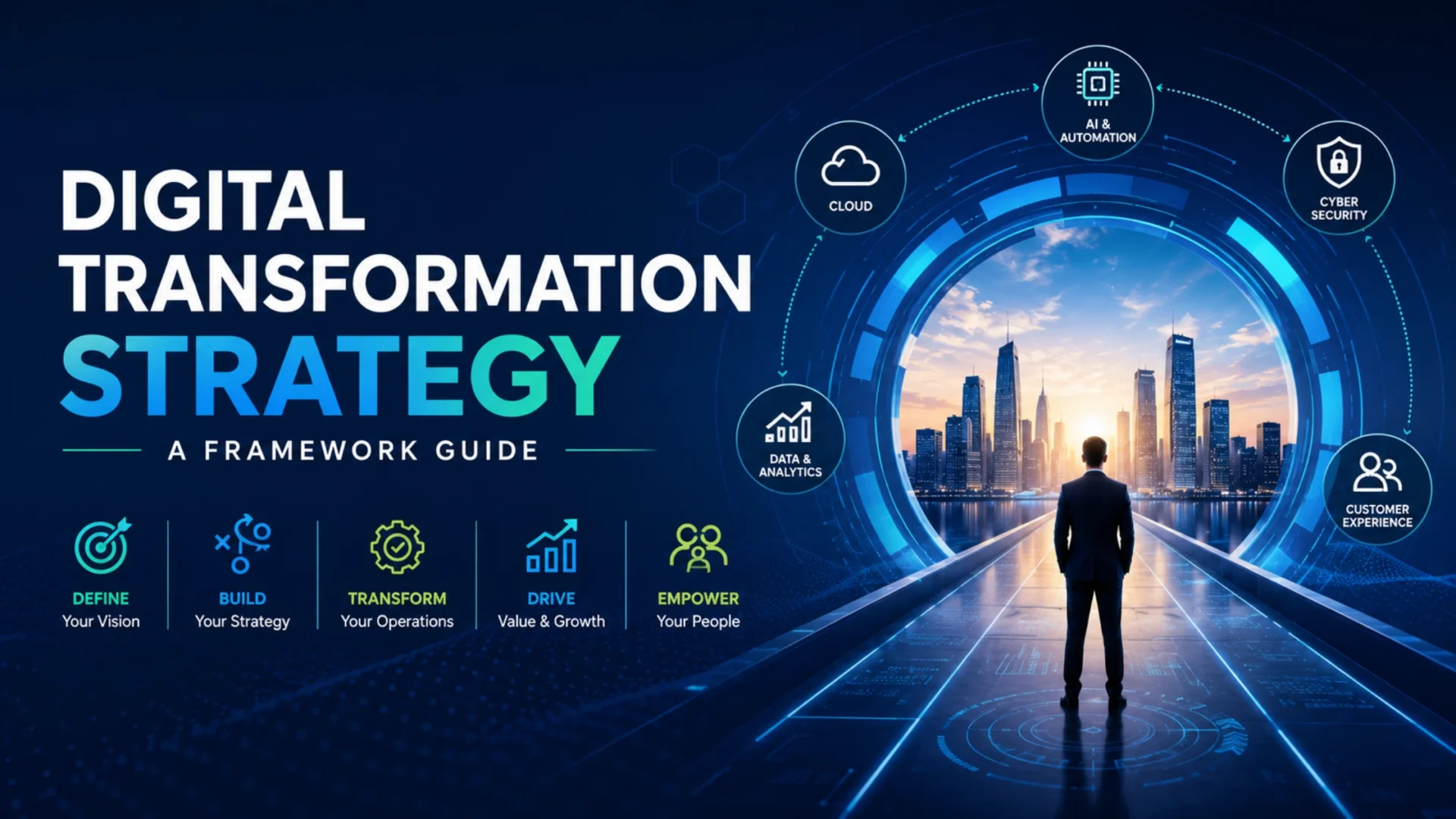
Strip away the buzzwords and most successful digital transformation strategies are built on the same handful of pillars, weighted differently depending on the industry. Skipping any one of them tends to show up later as a project that technically launched but never delivered the expected value.
- Business outcome alignment: Every initiative traces back to a specific revenue, cost, or risk metric, not a general sense that the company should “modernize”
- Technology and systems architecture: Decisions about which legacy systems get replaced, which get integrated, and which get retired outright
- Data foundation: Clean, accessible, governed data that feeds analytics, reporting, and AI, without which every downstream initiative underperforms
- Process redesign: Rebuilding how work actually flows through the organization, not just adding software on top of the old process
- Customer and employee experience: How the transformation changes what customers experience and what employees are actually asked to do differently
- AI and automation integration: Where machine learning, generative AI, and agentic automation genuinely change outcomes versus where they are added for optics
- Governance and change management: Who owns decisions, how progress gets tracked, and how the organization actually adopts new ways of working
Notice that technology is only one pillar out of seven. That ratio is intentional. Companies that treat digital transformation as primarily a technology purchase tend to end up with impressive systems nobody uses correctly, because the process and change management work never got funded at the same level as the software license.
What to have in place before writing the strategy document
A surprising number of transformation strategies get drafted before anyone has answered the basic questions that should shape them. That order gets things backwards. The document should be the output of a readiness process, not the starting point of one.
- A documented inventory of current systems, including which ones are business-critical, which are redundant, and which nobody can fully explain anymore
- An honest data quality audit, since AI and analytics initiatives inherit whatever quality problems already exist upstream
- A small set of business outcomes leadership actually agrees on, not a wish list where every department got its favorite line item included
- Budget clarity that separates one-time modernization cost from ongoing run cost, since the two get confused more often than they should
- Named executive sponsorship from the business side, not just from IT, so the program has authority to change how work actually gets done
- A realistic view of internal capacity, including whether the team has the skills to execute or needs outside support for specific phases
- A plan for how progress gets reported, agreed with finance and the board before the first initiative launches, not negotiated after results come in
Organizations that work through this list honestly, even in a rough form, tend to write shorter, more specific strategy documents than the ones that skip straight to a hundred-slide vision deck. That is usually a sign of a healthier program, not a less ambitious one. This is essentially the same discipline covered in this guide to product development strategy, where getting the goal-setting stage right upfront determines whether everything built afterward actually earns its budget.
A practical digital transformation framework: seven phases
Most frameworks that actually get finished, rather than abandoned halfway, follow a similar sequence. What differs between organizations is how much time and rigor gets spent at each stage. Rushing the first two phases to get to the “fun part” of building new systems is, honestly, the single most common reason transformation programs run over budget.
1. Assess the current state honestly
Map existing systems, data quality, process bottlenecks, and technical debt before proposing anything new. This step gets skipped more than any other, usually because leadership wants to see progress fast. Skipping it is exactly how a project discovers, six months in, that the CRM data was never clean enough to build the automation it was supposed to power.
2. Define goals in business terms, not IT terms
“Reduce order-to-cash cycle time by 30 percent” is a goal. “Modernize the ERP” is a project. Every initiative in the plan should tie back to a small set of business-defined outcomes that a CFO or COO would recognize as meaningful, not a technical milestone that only makes sense to the engineering team.
3. Prioritize by value versus effort, not by loudest stakeholder
Score every candidate initiative against expected business impact and realistic implementation effort. It sounds obvious. In practice, prioritization usually gets decided by whichever department head has the most influence in the room, which is how a company ends up rebuilding the intranet before fixing the inventory system that is actually losing money.
4. Modernize the technology and data foundation
This is where legacy systems get replaced, integrated, or retired, and where the data architecture gets rebuilt to support analytics and AI. It is usually the most expensive phase and the one most tempting to underfund, which tends to undercut every phase that comes after it.
5. Implement in waves, with real users involved early
Roll out changes to a defined group first, gather feedback, and adjust before scaling company-wide. Programs that go straight to a full rollout tend to discover usability problems at the worst possible moment, in front of every employee at once, instead of in front of twenty pilot users who can flag issues quietly.
6. Measure against the original business goals
Track the metrics defined in phase two, not a new set of vanity metrics that happen to look good in the launch quarter. If the goal was cycle time reduction, report cycle time. Resist the temptation to substitute in adoption rates or login counts once the real number is less flattering than hoped.
7. Optimize continuously, not once a year
Digital transformation does not end at go-live. Processes drift, new tools become available, and what counted as best practice eighteen months ago can quietly become the new bottleneck. Building a quarterly review cadence into the operating model, rather than treating optimization as a future project, is what keeps the gains from eroding.
Building a digital transformation roadmap that survives contact with reality
A framework tells you the phases. A roadmap tells you the order, the timing, and, honestly, what gets cut if the budget shrinks halfway through the year. Three common sequencing approaches show up across most transformation programs, and each comes with a different risk profile.
| Approach | Speed to value | Risk profile | Best suited for |
|---|---|---|---|
| Big bang rollout | Fast on paper, slow in practice once issues surface | Highest, a single failure point can stall the whole program | Small organizations with simple systems and low interdependency |
| Phased by business unit | Moderate, value lands unevenly across the company | Moderate, contains failures but can create internal inconsistency | Larger enterprises with distinct, semi-independent divisions |
| Pilot-first, value-led | Slower start, compounding gains once patterns are proven | Lowest, mistakes are caught while the blast radius is still small | Most enterprises, especially those with legacy dependencies |
Pilot-first sequencing wins out in most enterprise environments, not because it is the most exciting option on a roadmap slide, but because it is the one that lets an organization learn cheaply before it commits expensively. A financial services firm running a claims automation pilot on one product line before touching the entire portfolio will always look slower in month three than a competitor who went all in. It usually looks considerably smarter by month eighteen.
A mistake worth avoiding
Roadmaps often get built around what is technically easiest to ship first, rather than what delivers the most business value first. That ordering makes the early project timeline look clean, but it also means the highest-value initiatives, the ones most likely to justify the next budget cycle, keep getting pushed to a later phase that may never get funded. Sequencing by expected value, even when it means tackling a harder problem earlier, protects the program’s credibility when leadership starts asking what the investment has actually returned.
Common challenges that derail digital transformation strategies
The failure patterns repeat often enough across industries that they are worth naming directly instead of dancing around them.
Leadership treats it as an IT project instead of a business one. When the CIO owns the strategy alone and the rest of the leadership team shows up only for status updates, adoption stalls. Transformation that actually changes how a business operates needs sponsorship from the people who own the operations, not just the systems.
Data quality gets discovered too late. A surprising number of AI and analytics initiatives get greenlit before anyone checks whether the underlying data is clean, consistent, or even complete. Fixing data quality after the AI model is already scoped is expensive and, frankly, avoidable.
Change management is underfunded relative to technology spend. New systems fail when employees are not trained, incentivized, or given time to adopt new workflows. This is not a soft, secondary concern. It is a budget line that deserves the same scrutiny as the software license.
Scope creep replaces the original business case. A project that started as “automate invoice processing” gradually becomes “rebuild the entire finance stack” without anyone formally re-approving the expanded budget or timeline. That drift is how a six-month project becomes an eighteen-month one nobody remembers approving.
Legacy dependencies surface mid-project. Older systems with undocumented integrations are consistently harder to untangle than the initial assessment suggested. Enterprises tackling legacy software modernization as a distinct workstream, rather than an afterthought bundled into a broader initiative, tend to surface these dependencies earlier, when they are still cheap to fix.
Security and compliance get treated as a final review, not a design input. Waiting until a system is nearly finished to bring in security and compliance review almost always produces rework. This is especially costly in regulated industries, where a system built without data residency, audit trail, or access control requirements in mind from the start can require a substantial redesign just to pass a compliance check that could have been anticipated months earlier.
Not sure which initiatives actually deserve budget first?
Elsner can walk through your current systems and priorities and give you an honest read on what should move first, what can wait, and what is quietly costing you more than it looks like.
How to measure digital transformation, without hiding behind vanity metrics
Measurement is where a lot of otherwise solid strategies quietly lose credibility. Login counts, dashboard views, and training completion rates get reported because they are easy to gather and they usually look good. None of them tell you whether the business actually improved.
Metrics worth tracking against the original business case
- Cycle time: How long it takes to complete a core business process, from order to fulfillment, from application to approval, and so on
- Cost per transaction or per unit of work: Whether automation and process redesign have actually lowered the cost of doing the work
- Revenue impact: New revenue enabled by digital channels, products, or improved customer experience, tracked against a clear baseline
- Error and rework rates: Whether manual mistakes and downstream corrections have dropped since the process changed
- Employee productivity and retention: Whether the transformation reduced friction for the people doing the work, or simply added another system to manage
- Customer satisfaction or retention: Whether the customer-facing changes actually moved the needle on loyalty and repeat business
- Time to value for new initiatives: How quickly a new capability starts paying for itself after launch, not just after it technically ships
The discipline that matters most here is deciding these metrics before the project starts, not after. A transformation program that defines success criteria in the goal-setting phase and reports against those same criteria a year later has a real conversation to have with the board. A program that redefines success after the fact, usually toward whatever looks best, tends to lose executive trust fast, and that trust is expensive to rebuild. Getting this right generally means treating business intelligence as part of the transformation build itself, not a reporting layer added once every other system is already live.
The real benefits of a well-run digital transformation strategy
The benefits case for digital transformation is well established, but it is worth separating what shows up quickly from what compounds over time.
- Operational efficiency: Fewer manual handoffs, less duplicated work, and processes that run faster with fewer errors
- Better decision-making: Leaders working from real-time, accurate data instead of month-old spreadsheets pieced together from three systems
- Improved customer experience: Faster response times, more personalized service, and channels that actually connect to each other
- Stronger competitive position: The ability to launch new products, enter new markets, or respond to disruption faster than competitors still running legacy processes
- Talent attraction and retention: Modern tools and less repetitive manual work make a measurable difference in whether skilled employees stay
- Resilience: Businesses with modern, flexible infrastructure adapt faster to supply chain shocks, regulatory change, and shifting customer expectations
None of these benefits are automatic. They show up when the strategy is built around specific outcomes and tracked against them, and they tend to stay invisible when a transformation program is measured by how much technology got deployed rather than by what changed for the business as a result. The operational efficiency gains in particular depend on getting workflow automation right, which is covered in more detail in Elsner’s enterprise workflow automation guide.
Where AI and agentic automation actually change the strategy
AI has been part of digital transformation conversations for years, but 2026 marks a real shift in how it gets applied. Instead of a chatbot bolted onto a support page, AI is increasingly built into the workflows themselves, and a growing share of that work is agentic: systems that can plan and carry out multi-step tasks with limited human input, rather than answering a single question and stopping there.
Gartner predicts that up to 40 percent of enterprise applications will include integrated, task-specific AI agents by the end of 2026, up from less than 5 percent in 2025, according to a Gartner press release on task-specific AI agents. That is a fast curve. It also means agentic process automation is no longer a future-looking bullet point on a strategy deck. For a growing number of enterprises it is already showing up in claims processing, invoice reconciliation, supply chain exception handling, and tiered customer support, where an agent can triage, gather context, and resolve a routine case end to end without a human touching every step.
That said, the enthusiasm needs a caveat that most vendor pitches leave out. Gartner also predicts that over 40 percent of agentic AI projects will be canceled by the end of 2027, due to escalating costs, unclear business value, or inadequate risk controls, based on a separate Gartner press release on agentic AI project cancellations. The pattern behind most of those cancellations is familiar: organizations bolt an agent onto a process that was never well understood in the first place, skip the governance work, and discover the failure only after something has gone wrong in production.
A digital transformation strategy that wants AI to actually stick treats agentic automation the same way it treats any other high-impact initiative: scoped narrowly at first, measured against a defined outcome, and expanded only once the pattern is proven. Enterprises building this into their AI agent development roadmap tend to start with a single, well-bounded process rather than an organization-wide rollout, precisely because the risk of a poorly governed agent is not hypothetical anymore. It is a documented, quantified failure pattern that shows up in analyst research every quarter.
Governance is the part of the AI conversation that gets the least airtime and matters the most. An agent that can act autonomously across systems needs clear boundaries around what it is allowed to touch, an audit trail for what it actually did, and a defined escalation path for cases it cannot resolve confidently on its own. Skipping that groundwork to hit a launch date is usually where things go wrong, not in the underlying model itself. Treating governance as a design requirement from the first pilot, rather than a policy written after something breaks, is consistently what separates the AI initiatives that survive their second year from the ones that quietly get shut down.
The digital transformation journey is a curve, not a finish line
One of the more persistent myths around this topic is that digital transformation has an end date. It does not. Businesses that treat it as a project with a launch party tend to plateau, while ones that treat it as an ongoing capability keep compounding gains long after the original budget line has closed out.
- Digitized: Individual processes have been moved to digital tools, but they largely mirror the old paper or manual workflow
- Connected: Systems talk to each other, reducing duplicate data entry and manual reconciliation between departments
- Data-driven: Decisions are increasingly informed by real-time, trusted data rather than gut instinct or outdated reports
- Automated: Routine, repeatable work is handled by rules-based and AI-driven automation, freeing people for judgment-heavy tasks
- Adaptive: The organization can reconfigure processes and technology quickly in response to new opportunities or disruptions, without a multi-year project every time
Very few organizations sit neatly at one stage across the whole business. A retailer might be adaptive in its e-commerce operations and still digitized, at best, in its warehouse logistics. That unevenness is normal. What matters is having an honest read on where each part of the business actually sits, instead of assuming a single high-profile project moved the entire company up the curve. Moving from data-driven to genuinely adaptive is largely an AI strategy question at that point, one Elsner covers in how to build an AI strategy for business growth.
Where a technology partner fits into the strategy
Not every organization wants to build strategy, architecture, and execution capability entirely in-house, and honestly, few internal teams have spare bandwidth to run a multi-year transformation while also keeping the lights on for day-to-day operations. This is usually where a technology partner earns its place, not as a vendor selling a platform, but as an extension of the team that can move faster because it has done this sequencing before.
In practice, the most useful partner engagements start with a defined problem, a specific process, system, or business unit, rather than an open-ended mandate to “transform everything.” A dedicated team takes ownership of one phase, establishes the patterns and governance the rest of the program will follow, and hands off a documented approach the internal team can repeat elsewhere on its own. What separates a genuine transformation partner from a vendor that simply staffs up a project team is whether they insist on proof before scale, a working result on one process before touching the next ten.
The data and analytics layer deserves the same scoped approach, with visibility into what is actually working built in from the assessment phase onward rather than added once the full program is finished. Elsner works with enterprises this way, through product strategy consulting that defines a scoped starting point before any system gets touched, rather than opening with a company-wide platform pitch.
Key takeaways
- A digital transformation strategy is a decision framework connecting technology and data investment to specific business outcomes, not a technology purchase plan on its own.
- Global digital transformation spending is tracking toward $3.4 trillion in 2026 on IDC’s spending guide, yet only 48 percent of digital initiatives meet or exceed their business targets, which points to a strategy gap rather than a spending gap.
- Less than 30 percent of digital transformations succeed at improving and sustaining performance, according to long-running McKinsey research, which is why the assessment and goal-setting phases deserve more rigor than most programs give them.
- A seven-phase framework, assess, define, prioritize, modernize, implement, measure, optimize, keeps initiatives tied to business value instead of drifting into scope creep.
- Pilot-first, value-led sequencing carries the lowest risk for most enterprises, even though it looks slower than a big bang rollout in the early months.
- Agentic AI is moving fast, with up to 40 percent of enterprise applications expected to carry task-specific agents by the end of 2026, but over 40 percent of agentic AI projects are also projected to be canceled by 2027 due to weak governance and unclear value.
- Digital transformation does not have a finish line. Businesses that build continuous optimization into the operating model keep compounding gains long after the original project budget closes.
Frequently Asked Questions
What is a digital transformation strategy?
A digital transformation strategy is a structured plan that connects technology, data, and process changes to specific business outcomes, such as revenue growth, cost reduction, or improved customer experience. It defines what gets built, in what order, and how success will be measured, rather than treating technology adoption as the goal in itself.
What is the digital transformation framework?
A practical digital transformation framework typically moves through seven phases: assessing the current state, defining business-focused goals, prioritizing initiatives by value versus effort, modernizing systems and data, implementing in controlled waves, measuring against the original goals, and continuously optimizing. The exact steps vary by organization, but the sequence of assess before build and measure before scale stays consistent.
What is a digital transformation roadmap?
A digital transformation roadmap is the timeline and sequencing plan that turns a strategy into scheduled work. It decides which initiatives happen first, how they are grouped, whether the organization rolls out changes all at once or in phases, and how dependencies between systems and teams get managed along the way.
What are the biggest digital transformation challenges?
The most common challenges are treating transformation as an IT project rather than a business one, discovering poor data quality after AI or analytics initiatives are already scoped, underfunding change management relative to technology spend, scope creep that expands a project beyond its original business case, and legacy system dependencies that surface mid-project instead of during the initial assessment.
How do you measure digital transformation success?
Success should be measured against the specific business goals defined before the project started, such as cycle time, cost per transaction, error and rework rates, revenue impact, and customer retention. Vanity metrics like login counts or dashboard views are easy to report but rarely indicate whether the business actually improved.
What are the benefits of digital transformation?
The main benefits are improved operational efficiency, better decision-making from real-time data, stronger customer experience, faster competitive response, improved talent retention, and greater organizational resilience against disruption. These benefits depend on the strategy being tied to measurable outcomes rather than technology adoption for its own sake.
How long does a digital transformation strategy take to show results?
Timelines vary by scope, but a pilot-first program often shows measurable results within the first three to six months on a narrowly scoped initiative, while an enterprise-wide transformation involving multiple legacy systems is typically planned in phases across twelve to twenty-four months, with early wins used to build momentum for later, harder phases.
What role does AI play in digital transformation strategy?
AI, including agentic automation, is increasingly built into workflows rather than added as a separate feature. It works best when scoped to a specific, well-understood process and measured against a defined outcome, since a large share of agentic AI projects fail when governance and business value are not established before deployment.
Why do most digital transformation initiatives fail?
Most failures trace back to weak alignment between the technology plan and actual business goals, underinvestment in change management, and skipping a thorough assessment of current systems and data quality before building new solutions. Technology rarely fails on its own. It fails when the strategy around it was never rigorous to begin with.
The bottom line
A digital transformation strategy that works is not the one with the most ambitious slide deck or the biggest technology budget. It is the one that ties every initiative back to a specific business outcome, sequences work by realistic value instead of internal politics, and treats measurement as a discipline built in from the start rather than a report assembled after the fact to justify the spend. The gap between the $3.4 trillion being invested globally this year and the roughly half of digital initiatives that actually hit their targets is not a technology gap. It is a strategy and execution gap, and it is closable with the right framework, the right sequencing, honest measurement along the way, and, where internal capacity runs thin, a flexible engagement model that scales with the roadmap instead of forcing the business into a fixed structure that stops fitting halfway through the year.
Ready to build a digital transformation strategy that actually delivers?
Elsner works with businesses to assess where they actually stand, prioritize what matters, and build a roadmap that holds up past the first budget review. Let’s talk through what your next phase should look like.