




- What Is PIM Software?
- What a Modern PIM Platform Handles
- How PIM Differs From DAM, PXM, and MDM
- Why Businesses Need PIM in 2026
- AI in Product Information Management
- How to Choose the Best PIM Software
- Catalog size and complexity
- Channel count
- Existing tech stack
- Internal technical capacity
- Budget for the full lifecycle, not just the license
- Best PIM Software Comparison Table
- Detailed Review of Top PIM Platforms
- Pimcore
- Akeneo
- Plytix
- PIM Pricing & Implementation Considerations (TCO)
- What ROI Actually Looks Like
- Common Mistakes When Choosing a PIM
- Which PIM Is Right for Your Business?
- Key Takeaways
- Conclusion
- Frequently Asked Questions
- What is the best PIM software?
- What is Product Information Management software?
- Pimcore vs Akeneo: which is better?
- How much does PIM software cost?
- Which industries need PIM software?
- Can PIM integrate with Shopify and Magento?
- Is Pimcore free to use?
- What’s the difference between PIM and DAM?
Quick Answer
The best PIM software in 2026 for the majority of growing ecommerce businesses is largely based on the number of products and the level of technical support available. PIMcore is typically the top option for enterprises looking for a flexible and open environment that can be thoroughly customized and are ready to make a substantial investment in implementation. But Akeneo is a great option for teams who are used to a structured process, and the SaaS pricing, starting at about $45,000 per year, comes with no problems. Plytix has been developed for small to mid-sized product directories, mainly D2C brands of up to 50,000 SKUs, and has the advantage of lower price and quick setup.
No product can be best for all. The choice is based on your number of products, your needs for system integration, and most probably the availability of technical personnel support.
Picking a PIM platform used to be a fairly narrow decision. Not anymore. Product catalogs have grown messier, channels have multiplied, and customers expect the same accurate details whether they’re browsing your Shopify store, scrolling a marketplace listing, or asking an AI assistant to compare two products for them. A spreadsheet can’t keep up with that. Neither can a half-built internal tool that someone’s cousin coded in 2019.
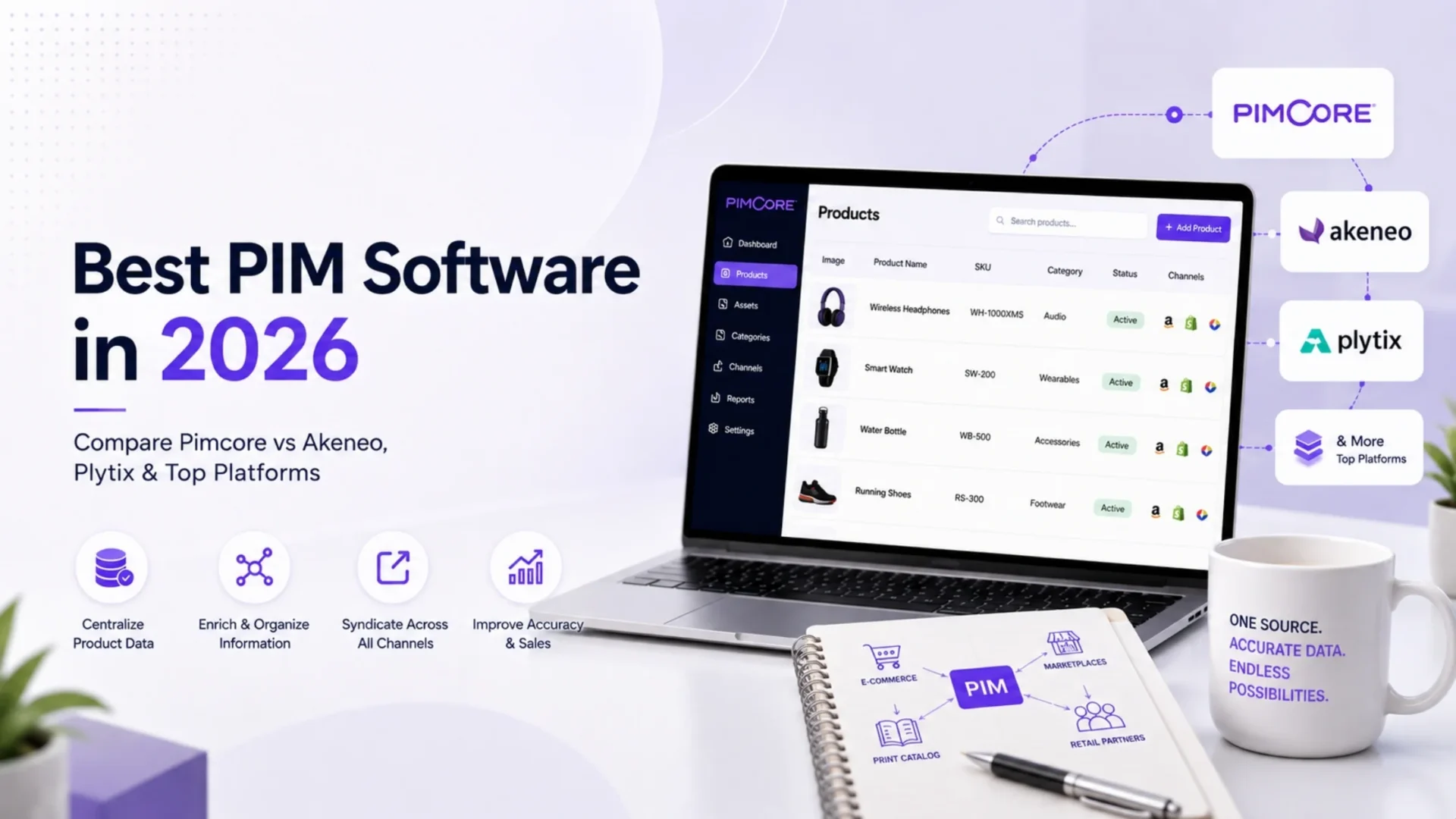
This guide breaks down the best PIM software options for 2026, how they stack up in terms of price and capability, and which one actually fits your business rather than just the vendor’s sales pitch. We’ll get into Pimcore vs Akeneo specifically, since that comparison comes up constantly among mid-market and enterprise teams, and we’ll cover where Plytix and other lighter platforms make more sense.
What Is PIM Software?
Let’s understand what PIM actually is. PIM stands for Product Information Management. Fundamentally, PIM is a centralized system responsible for organising product information, including descriptions, specifications, pictures, prices, etc., stored systematically and distributed across all the channels you sell through. You can imagine the situation when there is a product description to be changed: it needs to be modified on the Shopify page, then updated in the marketplace feed, and finally, a new print catalog has to be created. It is a very time-consuming process and very repetitive. Whereas with PIM, a user can just make a change in the PIM database, and all the sales platforms will get updated automatically.
That seems very straightforward. But it is not really. Businesses usually resort to using PIM only after they are completely frustrated: the product data are spread across five spreadsheets, the warehouse team uses different naming practices from the marketing department, and a product launch ends up being delayed because no one is able to figure out which is the latest spec sheet. Sound familiar?
What a Modern PIM Platform Handles
A modern PIM platform typically handles:
|
Centralized product data storage and enrichment
|
Attribute and taxonomy management across categories
|
|
Digital asset management (images, videos, spec sheets)
|
Syndication to marketplaces, storefronts, and retail partners
|
|
Workflow and approval processes for large teams
|
API-driven distribution to Shopify, Magento, WooCommerce, and ERP systems
|
How PIM Differs From DAM, PXM, and MDM
|
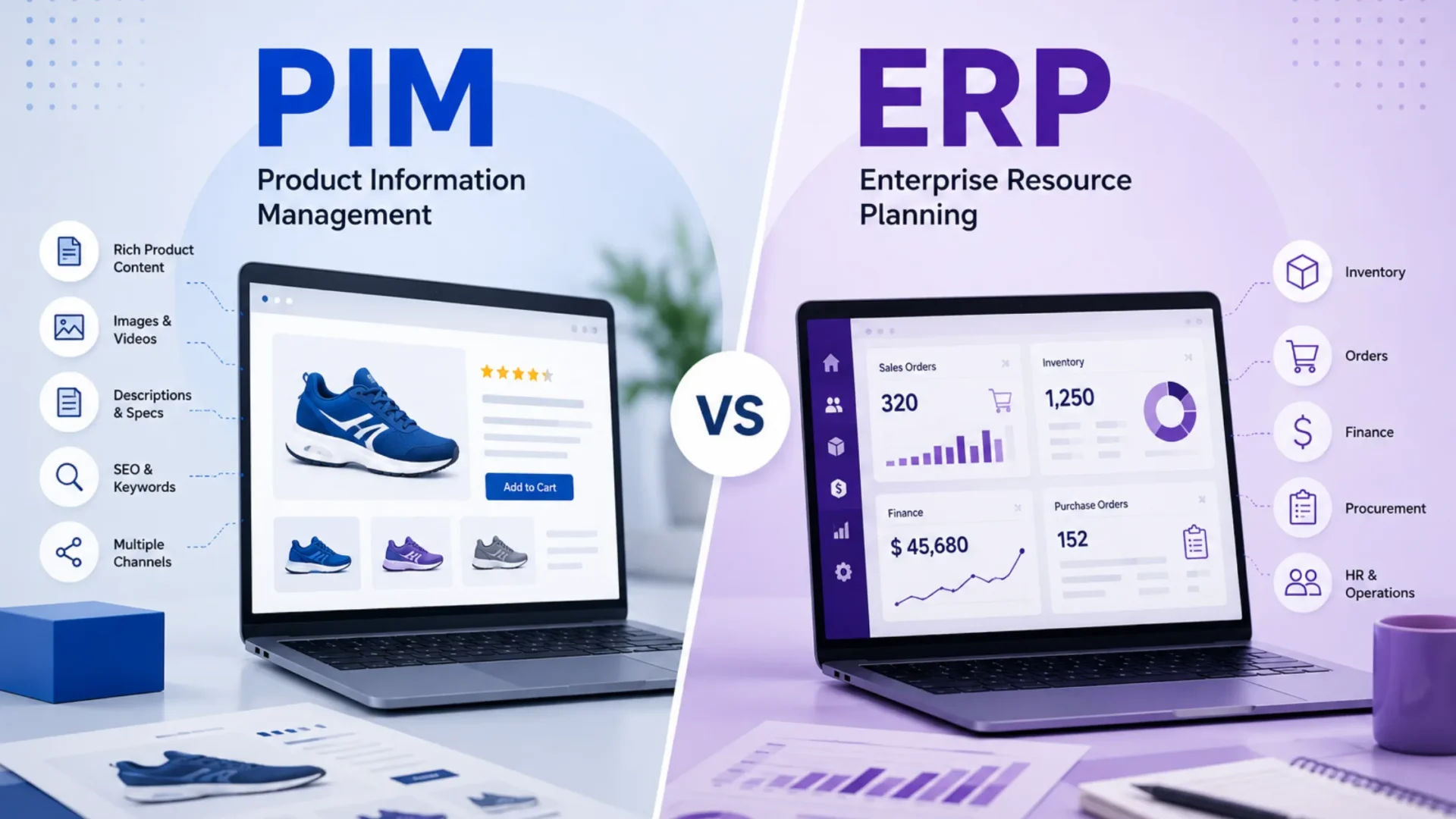
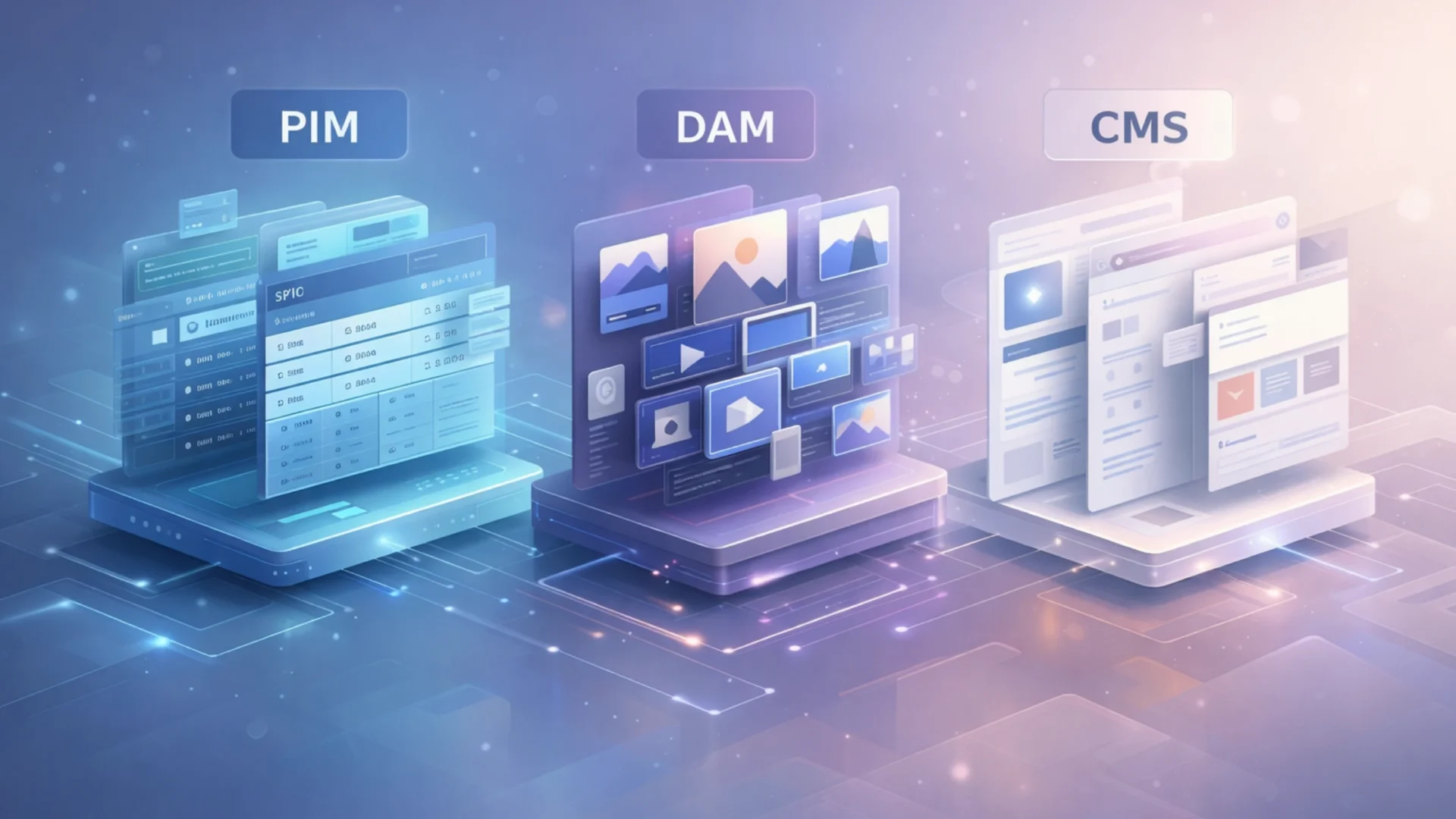
PIM vs DAM vs PXM Worth noting: PIM is not the same as a DAM (digital asset manager) or a PXM (product experience management) suite, though the terms get used loosely in vendor marketing. Most platforms today, Pimcore especially, blend all three into one system. Know more about the difference between PIM, DAM, and CMS. |
PIM vs MDM It also isn’t the same as MDM, or master data management, even though vendors sometimes bundle both under one roof. MDM governs core business data across an entire organization, customer records, supplier data, and financial entities, while PIM focuses specifically on product data destined for customer-facing channels. Some businesses need both. Plenty only need one. If a vendor pitches you an MDM upgrade before you’ve even fully implemented PIM, that’s usually a sign to slow down and ask what problem it’s actually solving for your catalog today. |
Why Businesses Need PIM in 2026
A few things have changed that make PIM less optional than it was five years ago. Let’s look at how Pimcore helps ecommerce businesses.
|
1
|
AI Overviews and generative search results pull directly from structured product data. If your specs are inconsistent or incomplete, AI-driven search can’t accurately represent your products, and that’s a real visibility problem now, not a future one. |
|
2
|
Omnichannel sales were just a bonus at first. Now, brands sell not only through their own stores but also on Amazon, B2B portals, and often through retail partners, where each requests data in a slightly different format. |
|
3
|
Catalogs got bigger and messier at the same time. Manufacturers and retailers managing tens of thousands of SKUs, each with variants, regional pricing, and compliance requirements, simply can’t govern that in Excel without someone eventually shipping the wrong spec sheet to a customer. |
None of this means every business needs an enterprise PIM tomorrow. A company with 200 SKUs and one sales channel probably doesn’t. But once you’re syncing product data across three or more platforms, or your catalog crosses a few thousand SKUs, the ROI conversation usually shifts in PIM’s favor pretty quickly.
AI in Product Information Management
AI showed up in PIM tools faster than most buyers expected, and honestly, some of it is genuinely useful while some of it is marketing dressed up as innovation. Worth separating the two before a vendor demo talks you into a feature you’ll never touch.
A number of practical AI features are expected to stand out in the year 2026:
|
Automated attribute tagging Software reads a product image or specification sheet and fills in structured fields, instead of a human having to do the typing manually. |
AI-assisted content generation Product descriptions generated on a wide scale, instead of writing each one manually. |
Predictive data quality checks Pinpoint missing or inconsistent fields before any content ever reaches the storefront. |
Pimcore’s Copilot, available in its Enterprise plan, seamlessly integrates these features right into the workflow automation. Similar enrichment tools have been launched by Akeneo and Plytix in their 2026 release cycles. Plytix is offering AI credits based on usage rather than charging for them as an added cost in an already fixed subscription.
This actually has implications for e-commerce businesses. AI Overviews and other generative search tools rely on structured product data to answer questions. Incomplete and poor product attributes make it more likely for your product to be excluded from the search results. Having your product data clean and properly tagged is no longer just about optimizing your internal processes. It is also about AEO compliance now.
How to Choose the Best PIM Software
Skip the vendor comparison charts for a minute. Before you even look at platforms, get clear on these:
|
1
|
Catalog size and complexityA 5,000-SKU catalog with simple attributes is a different project than a 200,000-SKU catalog with regional variants and compliance data. |
|
2
|
Channel countOne storefront is manageable almost anywhere. Five channels, each with unique feed requirements, change what you need from syndication. |
|
3
|
Existing tech stackWhich e-commerce platform are you on? Shopify, Magento, and WooCommerce all integrate differently with PIM vendors, and some integrations are far more mature than others. |
|
4
|
Internal technical capacityOpen-source, highly flexible platforms like Pimcore reward teams with in-house developers or an implementation partner. SaaS-first tools trade flexibility for a gentler learning curve. |
|
5
|
Budget for the full lifecycle, not just the licenseThis one gets missed constantly. License cost is an easy number to find. Implementation, data migration, and ongoing admin time are where budgets actually blow past expectations. |
A quick gut check: if you can’t answer “how many SKUs, how many channels, and how technical is our team” in one sentence, that’s the conversation to have internally before requesting demos.
Best PIM Software Comparison Table
Pricing across all three vendors shifts fairly often, and enterprise tiers are frequently quote-based rather than published. Treat these figures as a starting benchmark for budgeting conversations, not a locked-in number, and confirm current pricing directly with each vendor before finalizing a proposal.
Detailed Review of Top PIM Platforms
Pimcore
Pimcore is an open-source platform that combines PIM, DAM, master data management, and digital experience management in one system. That breadth is its biggest selling point and also the reason it can feel like overkill for a smaller catalog.
Community Edition is truly free, but only for non-production use cases, educational & nonprofit use, or companies with less than approximately $5 million in annual revenue. If you are above that threshold and require support, Enterprise features like enhanced workflow automation, enhanced user management, and AI-augmented enrichment with Pimcore Copilot, then you would purchase the Professional (single-tenant) or Enterprise(PaaS multi-tenant) editions.
The honest trade-off: Pimcore’s flexibility is real. Businesses with complex, multi-entity data models (think manufacturers with technical specs, BOM structures, or multi-brand retailers) get a lot of long-term value from it. But that flexibility comes with a steeper implementation curve. Most organizations bring in a certified partner rather than going it alone, and that implementation cost often exceeds the first year’s license fee. Not always. It depends on scope, data volume, and how many systems you’re connecting.
Akeneo
Akeneo built its reputation on structured, guided PIM implementations, and it still does that well. The platform’s Serenity SaaS offering has become the default path forward, since Akeneo has been winding down its older PaaS and on-premise support timelines for legacy versions.
Growth SaaS pricing generally starts in the $45,000 per year range, which puts Akeneo squarely in mid-market to enterprise territory rather than competing with lighter tools like Plytix. What you get for that: a Rules Engine and Asset Manager that now ship in the base tier, a genuinely capable data modeling system, and AI-driven enrichment tools rolled out steadily through 2026’s release cycle.
The catch worth flagging to clients: entry-tier Akeneo plans typically cap you at a single sales channel. If multi-channel or multi-region distribution is on your roadmap within the next year or two, that limitation matters more than the sticker price does. Worth modeling out before signing.
Plytix
Plytix takes a different approach entirely. It’s built for smaller and mid-sized catalogs that need centralized product data without the implementation overhead of Pimcore or the price tag of Akeneo.
The free Standard tier covers a modest SKU count with core PIM features and unlimited users, which is genuinely useful for brands replacing spreadsheets for the first time. Pro plans then scale up, generally starting near $499 a month for a significantly larger SKU allowance, with Enterprise tiers available for custom needs like multi-brand or multi-account management.
For D2C brands selling on Shopify or WooCommerce with a catalog under 50,000 SKUs, Plytix is often the pragmatic choice. It won’t handle the deep customization Pimcore offers, and it’s not trying to. That’s a feature, not a gap, if your use case fits.
PIM Pricing & Implementation Considerations (TCO)
License cost is the number every vendor leads with. It’s also the least useful figure for actual budgeting.
Total cost of ownership across PIM vendors generally includes:
|
1
|
License or subscription fees: the published number, though enterprise tiers are frequently custom-quoted |
|
2
|
Implementation and data migration: It often adds 50% to 200% of the first year’s license cost, particularly for open-source platforms |
|
3
|
Integration work: connecting your PIM to Shopify, Magento, WooCommerce, or ERP systems isn’t always included out of the box |
|
4
|
Ongoing admin and governance: someone has to own taxonomy decisions, attribute rules, and data quality checks |
|
5
|
Training and change management: frequently underestimated, especially for teams moving off spreadsheets for the first time |
A useful rule of thumb: ask every vendor to break these costs out separately in their proposal. A single bundled number makes it nearly impossible to compare fairly across platforms, and it makes budget overruns much harder to catch early.
What ROI Actually Looks Like
Forget over-the-top case study figures that vendors love to throw around. The most significant ROI factors after a PIM implementation are pretty much the same from industry to industry:
|
Reduced number of product data errors that go to the customers |
Shortened time-to-market of new SKUs |
Reduced return rates tied to wrong specs or lack of details. |
15–25%
If a business centralizes product information across all channels, it is quite typical that after consistent and complete listings, conversion rates increase by 15-25%. Yet, the actual boost is closely correlated to the original data quality: the worse it was, the higher the possible gain. In other words, an item that is relatively up-to-date will bring you less of an increase compared to a product that is being transferred from five completely separate, unconnected spreadsheets.
The harder-to-quantify win, and arguably the bigger one long-term, is the hours a product or marketing team stops spending on manual data reconciliation. That time usually gets redirected toward actual growth work instead of firefighting.
Common Mistakes When Choosing a PIM
Buying for the catalog you have today, not the one you’ll have in two years. Channel expansion plans should factor into platform choice now, not after you’ve signed a single-channel contract.
Underestimating implementation time. Especially with open-source platforms. A “quick” Pimcore rollout rarely stays quick once real data enters the picture.
Ignoring integration maturity. Not every PIM connects equally well to every ecommerce platform. Check for native or well-supported connectors to your specific stack before assuming custom API work will bridge the gap cheaply.
Skipping the data governance conversation. Someone on your team needs to own attribute standards and approval workflows. Without that, even the best PIM software just becomes an expensive place to store the same chaos.
Choosing based on price alone. The cheapest license often carries the highest hidden implementation and integration costs. TCO, not sticker price, is the number that matters.
Treating the vendor demo as the actual product experience. Demos run on clean, pre-loaded sample data. Your catalog probably has duplicate SKUs, inconsistent naming, and a few thousand products nobody has touched in years. Ask to see how the platform handles messy, real data before signing, not just the polished walkthrough.
Which PIM Is Right for Your Business?
Small catalog, single or dual-channel, limited technical staff: Plytix or Pimcore Community Edition (if revenue-eligible) are the practical starting points.
Mid-market, growing SKU count, planning multi-channel expansion: Akeneo Growth SaaS and Pimcore Professional both fit, depending on how much implementation support you’re prepared to invest in.
Enterprise, complex data relationships, multiple brands or business units: Pimcore Enterprise typically offers the most flexibility, particularly for businesses that also need DAM and MDM in the same ecosystem rather than stitching together separate tools.
There’s no shame in starting smaller than you think you need. Plenty of businesses overbuy enterprise PIM software for a catalog that doesn’t need it yet, and end up paying for capabilities they use once a quarter. A decent litmus test: if your product team can currently name every channel you sell on and every attribute that varies between them without opening a spreadsheet, you’re probably ready to scale up. If they can’t, that’s usually a data governance problem a bigger platform won’t fix on its own.
Key Takeaways
- PIM software centralizes product data so it stays accurate across every sales channel, and in 2026, that includes AI-driven search results, not just storefronts.
- Pimcore suits enterprises and technically capable teams wanting deep customization; Akeneo suits mid-market teams wanting structured SaaS onboarding; Plytix suits smaller D2C catalogs.
- License price is only part of the cost. Implementation, integration, and governance often exceed the subscription fee itself.
- Channel expansion plans should shape your platform choice now, since single-channel limits on entry tiers can force an expensive mid-contract upgrade later.
- The right PIM depends on catalog size, channel count, and internal technical capacity, not on which vendor has the flashiest demo.
Conclusion
There isn’t a single “best” PIM software in 2026. There’s a best fit for your catalog, your channels, and your team’s technical bandwidth, and getting that match right saves far more money over three years than shaving a few dollars off the monthly license. Pimcore, Akeneo, and Plytix each solve the product data problem differently, and honestly, all three can be the right answer depending on what the business is asking the question.
If you’re still weighing Pimcore vs Akeneo, or trying to figure out what implementation would actually cost for your specific catalog, that’s a conversation worth having before you sign anything.
Choosing between PIM platforms gets a lot clearer once you know your real implementation scope, not just the license price. Our Pimcore development services for ecommerce businesses help in managing complex, high-SKU catalogs across Shopify, Magento, and WooCommerce. Talk to our team about your product data setup and get a clear-eyed view of what a Pimcore implementation would look like for your business, no generic sales pitch, just an honest scope.
Frequently Asked Questions
What is the best PIM software?
There’s no single best PIM software for every business. Pimcore generally suits enterprises needing deep customization and unified PIM, DAM, and CMS capabilities. Akeneo fits mid-market teams wanting structured SaaS onboarding. Plytix works well for smaller D2C catalogs under 50,000 SKUs. The right choice depends on catalog size, channel count, and technical resources.
What is Product Information Management software?
Product Information Management (PIM) software is a centralized system that stores, organizes, and distributes product data, including descriptions, specifications, pricing, and images, across every sales channel. It replaces scattered spreadsheets with a single source of truth, so updates made once sync automatically to storefronts, marketplaces, and retail partners.
Pimcore vs Akeneo: which is better?
Neither is universally better. Pimcore offers more flexibility and unifies PIM, DAM, and CMS, which suits technically capable teams with complex data. Akeneo offers more guided SaaS onboarding but starts at around $45,000/year and often limits entry tiers to a single channel. Choose based on your team’s technical capacity and channel roadmap.
How much does PIM software cost?
PIM software pricing ranges widely. Plytix offers a free tier with paid plans starting near $499/month. Akeneo’s Growth SaaS typically starts around $45,000/year. Pimcore offers a free Community Edition for eligible small businesses, with commercial editions running from the low to high five figures annually. Implementation often adds significantly to license costs.
Which industries need PIM software?
Retail, manufacturing, consumer goods, and B2B distribution businesses benefit most from PIM software, especially those managing large catalogs, multiple sales channels, or complex product variants. Manufacturers with technical specifications and multi-brand retailers see particularly strong ROI, since manual data management becomes unmanageable past a few thousand SKUs.
Can PIM integrate with Shopify and Magento?
Yes. Most modern PIM platforms, including Pimcore and Akeneo, offer native or well-supported connectors for Shopify, Magento, and WooCommerce. Integration maturity varies by vendor and platform combination, so it’s worth confirming connector quality and API support directly rather than assuming compatibility.
Is Pimcore free to use?
Pimcore’s Community Edition is free, but eligibility is limited to non-production use, academic and nonprofit organizations, or businesses under approximately $5 million in annual revenue. Businesses above that threshold, or those needing commercial support and enterprise features, need a paid Professional or Enterprise edition.
What’s the difference between PIM and DAM?
PIM manages structured product data (attributes, pricing, specifications), while DAM (Digital Asset Management) manages unstructured media files like images and videos. Many modern platforms, Pimcore in particular, combine both into a single system so product data and its related assets stay linked and consistent.