




- What’s New at a Glance
- A More Comfortable Pimcore Studio Experience
- Faster, Easier Data Imports
- More Practical AI Support Through the Pimcore Agent Bundle
- Better Performance for Digital Assets
- Stronger Security and Better Transparency
- One More Thing Worth Knowing: The End of Feature Backporting
- Should You Upgrade to Pimcore 2026.2?
- Planning a Pimcore 2026.2 Upgrade?
- Final Thoughts
- Frequently Asked Questions
- Is Pimcore 2026.2 suitable for large product catalogs?
- How does Mapping Autofill improve product data imports?
- How can Pimcore 2026.2 help e-commerce businesses?
- Is the upgrade safe for a live Pimcore website?
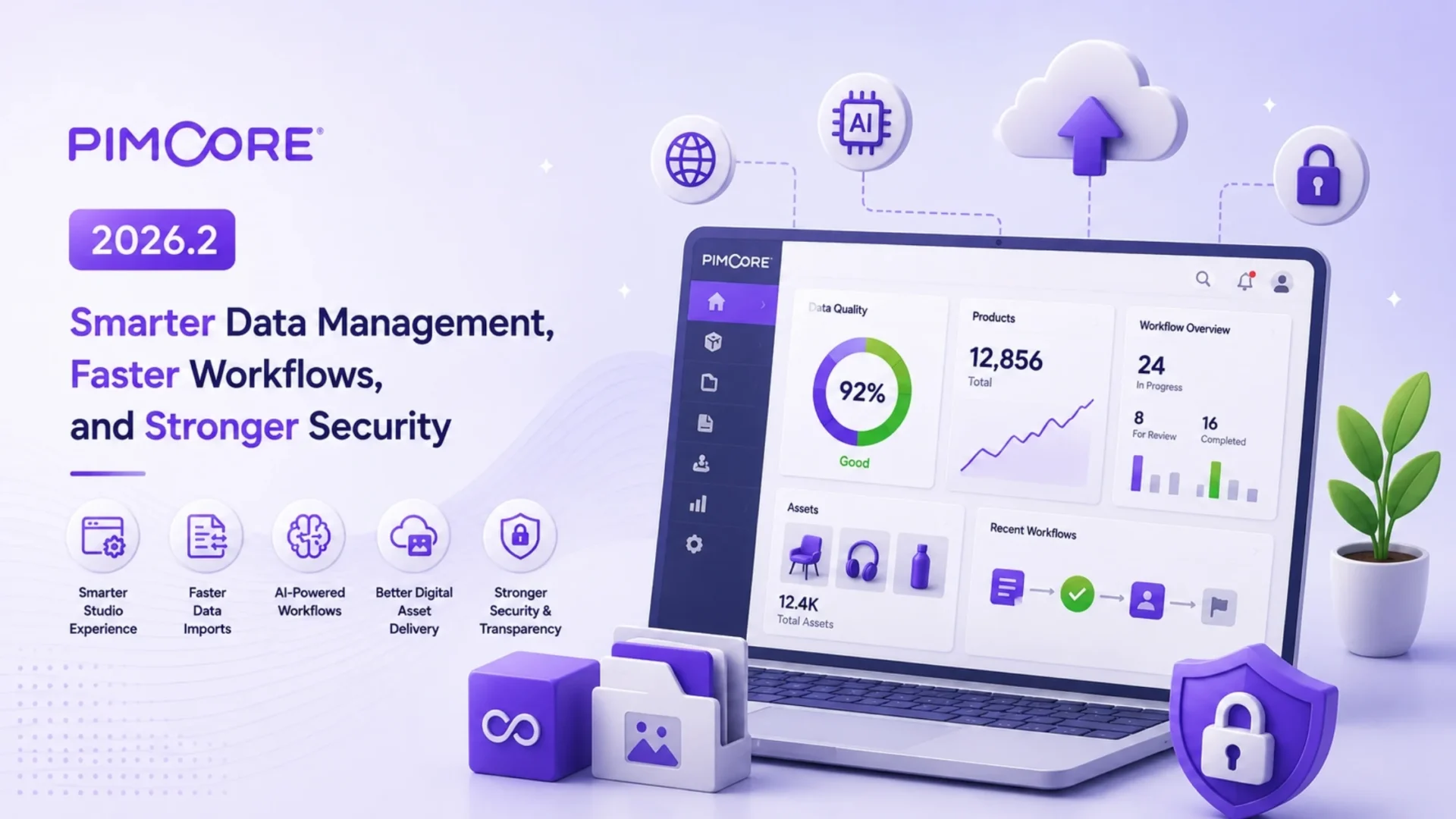
Quick answer: Pimcore 2026.2 sharpens Pimcore Studio with a translation split-screen, a Theme Manager (Enterprise license only), and new dashboard widgets. Data imports get easier with Mapping Autofill. The Pimcore Agent Bundle now handles more document and Twig template work. Digital assets load faster through CDN cache proxy support, and every release now ships with a Software Bill of Materials for security reviews. One thing worth flagging: this is the last release to backport features to Platform Version 2025.4, so if you’re still on 2025.4, the runway is closing.
Product data gets messy fast. A growing business is juggling product details, images, documents, and customer records across a website, a couple of marketplaces, maybe a mobile app too, and keeping all of it consistent stops being simple somewhere around the third channel.
So that’s roughly the problem Pimcore 2026.2 is chipping away at. Per Pimcore’s own release notes, this one touches Studio, imports, translations, the AI workflows, asset delivery, security, pretty much everything. Run Pimcore as your PIM, DAM, or DXP, and you’ll bump into most of this within a week of upgrading.
What’s New at a Glance
A More Comfortable Pimcore Studio Experience
Most teams basically live inside Pimcore Studio. So when it gets a bit easier to use, that’s not a footnote; that’s the whole job feeling less like a fight.
Take the Translation Split Screen. You used to bounce between separate language tabs; now you can sit with two languages side by side. Doesn’t sound like much until you’re a hundred product records deep and realize how much clicking that used to save.
There’s a Theme Manager now too, dark mode included finally. Quick heads up before you go hunting for it, though: it’s an Enterprise Edition feature, from Platform Version 2026.2 onward. If you’re on Community or Professional, you won’t see it in this release, and that’s worth knowing before someone on your team spends an hour looking for a setting that isn’t there.
Dashboards picked up new widgets for data quality and workflow monitoring, the kind of data visibility teams usually build separately. Instead of finding out three weeks later that a product record was half-empty, someone catches it that afternoon. Grid settings, columns, language selection, Entity Ownership Management- all got smaller upgrades on top, more control over how complex data actually gets viewed and managed.
Faster, Easier Data Imports
Anyone who’s imported a big product catalog knows this pain already: map every field by hand, then do it again next month when the supplier changes their file format slightly. Mapping Autofill in the Data Importer is Pimcore’s answer to that.
Instead of wiring up every single field yourself, Pimcore now guesses the match, going off field names and whatever mapping rules already exist. A column named product_name or sku lands on the right Pimcore field with a lot less clicking. Recurring imports are where this actually saves real time.
Translation management got a boost too, through a new Merge Translations feature. More control when you’re importing translated content and reconciling changes across languages, so a translator’s fix from last week doesn’t just get silently overwritten.
More Practical AI Support Through the Pimcore Agent Bundle
AI tools are worth having when they take boring work off someone’s plate without taking away their say in the matter. That’s basically the whole point behind the continued work on the Pimcore Agent Bundle here.
The bundle can now create and update documents on its own, manage target-group variants, create or edit Twig templates. Doesn’t replace anyone’s judgment. Just takes the repetitive parts off a content or dev team’s week.
Proposal workflows and approval traceability got attention too. You can see what the AI proposed, approve it if it’s right, keep a record of the whole thing. Matters a lot once you’re actually leaning on AI suggestions at scale, not just testing it once and forgetting about it.
Better Performance for Digital Assets
Big image libraries, product documents, videos- all that stuff needs to load fast, or customers bounce. Pimcore 2026.2 adds a couple of features aimed specifically at that.
The big one is CDN cache proxy integration. Update an image or file, and Pimcore now clears the cache for just that one asset or thumbnail, not the entire cache. Users get the newest version without the site taking a hit while everything rebuilds.
HTTP surrogate keys are in too; Fastly works out of the box, and there’s an interface if you want to hook up a different CDN provider. Run a large PIM or DAM setup and this translates to a faster, more responsive experience everywhere, not just on the main site.
Stronger Security and Better Transparency
Security isn’t only an engineering thing anymore. Procurement asks about it now, auditors ask about it, customers expect a straight answer when they ask too.
Starting with 2026.2, every Pimcore release ships with a Software Bill of Materials, basically a structured list of every software component in the platform. Handy during a vulnerability review, an internal or external audit, a procurement check, or when someone asks what dependencies you’re actually running. Easier access to that kind of detail means fewer awkward surprises when governance or regulatory questions land on your desk.
One More Thing Worth Knowing: The End of Feature Backporting
Here’s something easy to skim past that you really shouldn’t. Platform Version 2026.2 is the last release where new features and Studio bug fixes also get backported to 2025.4. After this one, anything new lands only in versions newer than 2026.2.
Still on 2025.4? Worth starting the upgrade conversation now rather than later. Wait another release cycle, and you’ll be behind on updates that used to just show up automatically.
Should You Upgrade to Pimcore 2026.2?
For most organizations, probably yes. The improvements to data, assets, translations, content, and e-commerce workflows are the practical kind, not the kind that just look good in a changelog.
Still, don’t treat a major platform upgrade like a routine patch. Custom bundles, integrations, heavy custom development on top of Pimcore? Plan it properly, test it before production sees any of it.
Running something older? Update to the latest release in your current major version first, then jump. Fewer things go wrong that way.
Planning a Pimcore 2026.2 Upgrade?
Elsner Technologies helps businesses plan, test, and roll out Pimcore upgrades without breaking custom integrations or losing data along the way. Got custom bundles or heavy development on top of Pimcore? We’ll scope it properly before production ever sees it.
Final Thoughts
Pimcore 2026.2 is built for businesses drowning in data and digital content. Studio feels smoother, imports go faster, translations stop being a headache, the AI does more of the boring parts, assets load quicker, and security reviews aren’t a scramble anymore.
No single feature here is the big win. It’s all of them together: less manual work, clearer visibility, assets that actually show up on time, tighter control when something changes- that’s where PIM, DAM, and e-commerce teams get the real payoff.
Weighing whether 2026.2 is worth the move? It usually is, as long as someone treats it like a real technical project and not something squeezed in over a weekend, ideally with a Pimcore development company in the loop for the parts that touch custom code or live data.
Frequently Asked Questions
|
Q
|
Is Pimcore 2026.2 suitable for large product catalogs?It’s a genuinely good fit, honestly. Mapping Autofill alone saves a lot of the manual field-matching that eats up hours once you’re dealing with thousands of SKUs. |
|
Q
|
How does Mapping Autofill improve product data imports?It looks at field names and mapping rules you’ve already set up, then guesses the right match on its own. Recurring imports especially get a lot less repetitive. |
|
Q
|
How can Pimcore 2026.2 help e-commerce businesses?Mostly by keeping product info, images, translations, and content in sync across every channel- your website, marketplaces, wherever else your ecommerce store sells- without someone manually chasing consistency. |
|
Q
|
Is the upgrade safe for a live Pimcore website?Yes, if you don’t rush it. Test in staging first, make sure your custom integrations aren’t broken, take a full backup, then deploy. Skip any of those steps, and you’re gambling. |