




- What is software modernization?
- Signs your business needs software modernization
- Common approaches to the software modernization process
- What software modernization services typically include
- Industry-specific considerations
- Not sure which end of the spectrum your system sits on?
- The role of AI in modern software modernization
- How much does software modernization cost?
- How to choose the right software modernization company
- Frequently Asked Questions
- What is the difference between software modernization and legacy software migration?
- What does a typical software modernization and migration project involve?
- How long does a typical software modernization project take?
- Will modernization disrupt daily business operations?
- Do small and mid-size businesses need modernization, or is it only for enterprises?
- Final thoughts
- Ready to find out where your system actually stands?
Modernizing software is not a decision made in an instant, after which a company wakes up with brand-new software already in place. Most of the time, it is a gradual realization that something should be updated. A task that used to take minutes now takes hours. A new employee questions why the whole team keeps three different documents to record a single order. Later, a customer files a complaint about an error at checkout that nobody on the team can quite explain, and the old system that “was fine until now” is suddenly no longer fine.
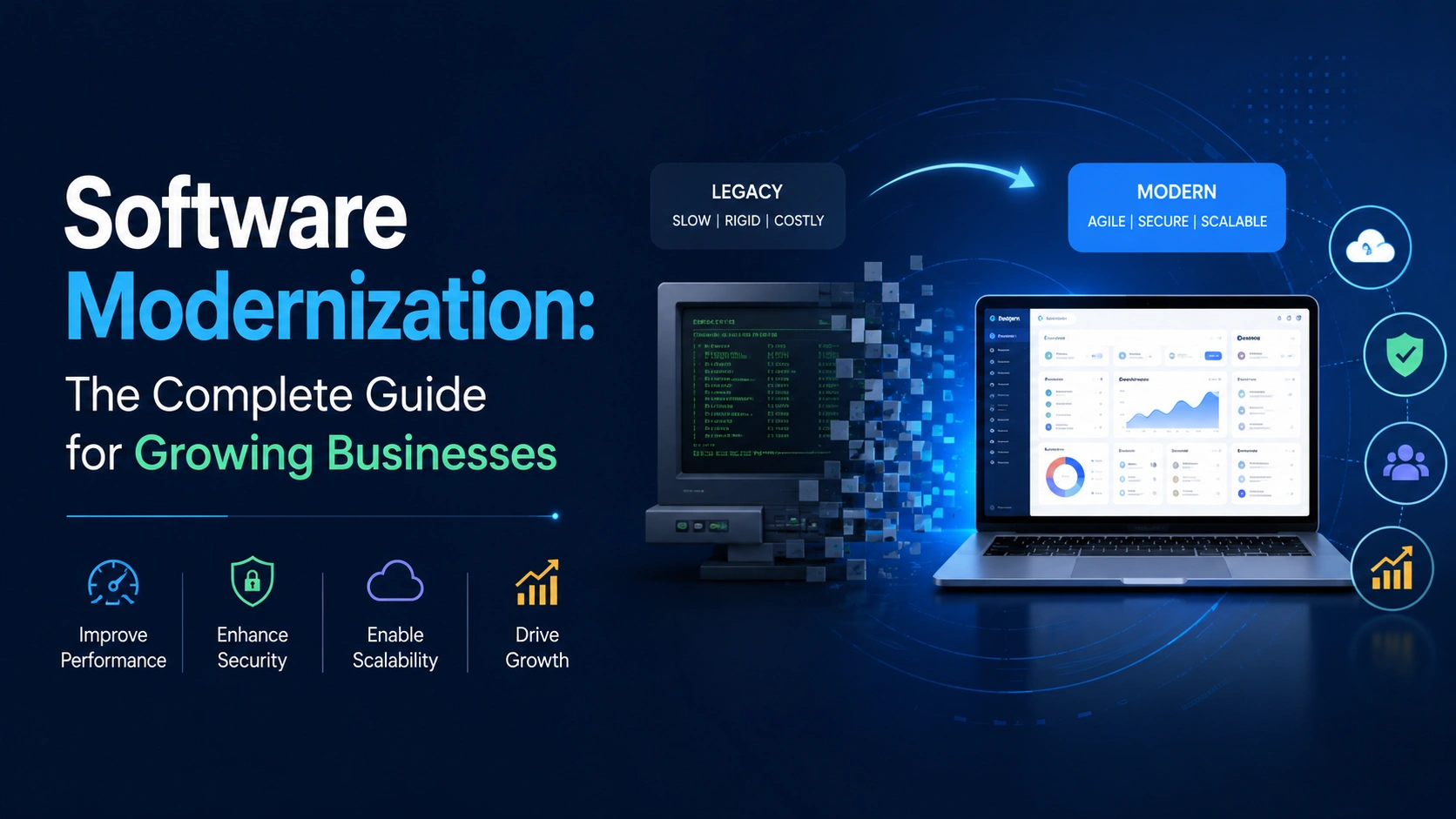
That moment, whenever it arrives, is usually the real starting point for software modernization. In simple terms, software modernization is the process of updating, restructuring, or partially rebuilding outdated systems so they can support how your business actually operates today, not how it operated when the software was first built. This guide walks step by step through what modernization really means, when to take action, the techniques different companies choose, how a usual project engagement looks, industry-specific factors, how AI is actually involved beyond the surface-level pitch, and what to look for when picking a partner who won’t disappear after the rebuilding effort has already started.
Quick Answer
Software modernization is the process of updating, restructuring, or partially rebuilding an outdated system so it fits how a business actually operates now, without necessarily replacing it entirely. Approaches range from a simple cloud lift and shift to a full rearchitecture into microservices, and the right one depends on system age, business risk, and growth plans rather than a fixed rule. Technical debt already accounts for an estimated 20 to 40 percent of a company’s total technology estate value, according to McKinsey’s research on tech debt, and waiting rarely makes the fix cheaper. It just pushes the same decision further down the road.
What is software modernization?
Apart from changing the look of software or adding new features, software modernization means replacing parts of a software system, or its entire structure, without rebuilding completely from scratch. The key is not to throw it away and start anew. A complete replacement, sometimes called rip and replace, is another approach, but it’s unlikely that a good technical partner will suggest it as the first course of action.
Think of it more as a process than a single action. At one end are minor, targeted changes like fixing security issues, version upgrades, or adding missing APIs. At the other end is a major architectural overhaul, where a monolithic application gets broken down and rebuilt using modern, modular elements. Most projects land somewhere in between. Legacy modernization software is how some groups refer to the same work when they discuss outdated, monolithic systems that weren’t originally designed to talk to outside systems.
What’s changed by 2026 is the baseline expectation. Composable, API-first architecture used to be something only enterprise IT teams worried about. Now it’s closer to table stakes. Customers expect real-time data. New tools need to plug into existing systems within days, not months. AI features increasingly require clean, structured data flowing through open interfaces. A system built as a closed box in 2015 simply wasn’t designed for any of that, and retrofitting it usually costs more, in time and money, than planning for it from the start would have.
None of this means older software is automatically a liability. Plenty of ten-year-old systems still run reliably and don’t need touching. The real question isn’t age. It’s whether the system still lets your business move at the speed it needs to.
Here’s a simple way to picture the spectrum in practice. A mid-size distributor running a fifteen-year-old order management system might only need a database upgrade and a new API layer to connect with a modern CRM, nothing close to a rebuild. A financial services firm running the same age of core system, but facing new open banking requirements, might genuinely need a rearchitecture, because the compliance and integration demands have simply outgrown what the old structure can support. Same age, same general category of problem, completely different scope of work. That’s why a proper assessment matters more than a generic checklist. It tells you which end of the spectrum your business actually sits on.
Signs your business needs software modernization
Some warning signs are loud. Others build quietly for years before anyone flags them. Here are the ones worth taking seriously.
- Under normal load, the system slows down or crashes: If peak-hour operations grind to a halt, or a monthly report hangs the entire database, that’s not a minor annoyance. It’s a capacity issue built into the design.
- Teams rely on manual workarounds or spreadsheets to get real work done: This one’s sneaky because it often looks like normal process rather than a technology gap. If your finance team exports data into Excel every week to do something the software should handle, that’s a modernization signal hiding in plain sight.
- Connecting new tools is a fight: Trying to link your CRM, a payment gateway, or an AI tool to the core system and hitting a wall every time usually means the underlying architecture wasn’t built with integration in mind. Modern systems expose APIs. Legacy ones often don’t, or expose the wrong ones.
- Maintenance costs keep climbing for a system that keeps doing less: Industry benchmarks commonly put the range at 60 to 80 percent of IT budgets spent simply keeping aging systems alive, leaving little for growth work, and McKinsey’s research found one insurer where technical debt reached as high as 60 percent of IT spend on a subset of its systems. If your support renewal keeps rising while your feature list stays flat, that ratio is working against you.
- Security or compliance gaps that used to be manageable now feel risky: Outdated frameworks stop receiving security patches. Vendors deprecate the underlying tech. An acceptable risk two years ago can become a real liability once regulators or auditors start asking pointed questions.
- The vendor no longer supports the software or its tech stack: This is often the clearest sign of all. No support means no patches, no bug fixes, and no path forward except staying frozen in place or finally addressing it.
- Scaling gets harder every time the business grows: More customers, more transactions, more data. If each growth milestone requires an emergency infrastructure scramble instead of a planned scale-up, the software is holding the business back rather than supporting it.
Not every business will hit all seven. Even two or three of these, especially the ones tied to security or scaling, are usually reason enough to get a proper technical assessment done.
Here’s something worth saying plainly: none of these signs mean the business made a bad decision years ago by building or buying the system in the first place. Software that was right for a fifty-person company often genuinely isn’t right for the same company at five hundred people. That’s growth outpacing infrastructure, a solvable problem, not a permanent one. The businesses that struggle most are usually the ones that wait until two or three of these signs stack up at once, turning a planned project into an emergency one.
Common approaches to the software modernization process
Every legacy software modernization services engagement starts with the same honest question: does this system need to be replaced, or does it need to evolve? The answer shapes which approach makes sense, and there’s rarely just one right answer. Most modernization programs blend a few of these depending on which part of the system is being worked on.
Rehosting (lift and shift)
Moving the application to the cloud with minimal modifications. It’s probably one of the fastest and cheapest options. Companies migrating this way often seek a broader enterprise cloud migration strategy, which helps ensure the move actually paves the way for future phases rather than creating a new set of obstacles. But this method doesn’t address the root architectural problems of the system. It simply shifts them elsewhere, at least for the time being.
Replatforming
A step further. The application moves to a different platform, most likely the cloud, with a few modifications along the way, like changing an old-fashioned database engine or packaging some components into containers. It’s a middle ground: bigger rewards than a plain move, smaller risk than a complete revamp. Teams often use this phase to gradually remove the most problematic elements of a codebase without touching everything at once.
Refactoring
Restructuring existing code to make it more efficient, easier to manage, less error-prone, and safer, while the software stays just as functional as before from the user’s perspective. Refactoring is the right choice when the business logic is healthy and important, but the underlying code has become fragile, undocumented, and unsafe to extend. Most users won’t notice a refactor happened. They’ll just notice that things stop constantly breaking.
Rearchitecting
The major change. The core architecture shifts, usually from a single monolithic application into microservices or a modular, API-driven design. It’s essentially the same principle behind product modernization services, aimed at scalability rather than a temporary fix. It costs more and takes longer, but it’s the right call once the company’s old architecture genuinely can’t support its operations anymore. That’s a business outgrowing its architecture, not a company that simply finds the architecture inconvenient.
A quick comparison: rehosting suits firms under pressure for fast results on a limited budget. Replatforming suits teams chasing cloud advantages without a total rebuild. Refactoring targets systems where the logic is good but the code is outdated. Rearchitecting only makes sense when scaling or AI readiness demands a genuinely new foundation. These options aren’t mutually exclusive either. A single project can involve rehosting one module while completely redesigning the architecture of another feature.
| Approach | Cost and speed | Risk profile | Best suited for |
|---|---|---|---|
| Rehosting | Lowest cost, fastest to complete | Low, but leaves root architecture problems untouched | Tight budgets and timelines, stable applications |
| Replatforming | Moderate cost, moderate speed | Moderate, contained to specific components | Teams wanting cloud benefits without a full rebuild |
| Refactoring | Moderate cost, ongoing over cycles | Low, invisible to end users when done well | Healthy business logic sitting on fragile code |
| Rearchitecting | Highest cost, longest timeline | Higher upfront risk, largest long-term payoff | Systems that have genuinely outgrown their architecture |
A red flag worth noticing
A capable partner won’t push every client toward the most expensive option. Frankly, that’s a warning sign when it happens. Instead, they’ll recommend an approach that matches actual business risk and budget, not a template applied to every engagement regardless of fit.
What software modernization services typically include
Software modernization services generally follow a similar structure across providers, even though the specific work varies by system and industry. Here’s what a properly scoped engagement usually covers.
It starts with a legacy system audit and technical assessment. Before anyone recommends an approach, a good team documents what the current system actually does, where the risk sits, and which components are worth preserving. Skipping this step is one of the more common, and expensive, mistakes businesses make.
From there comes roadmap and modernization strategy planning, translating the assessment into a phased plan with priorities, timelines, and clear milestones rather than one giant undifferentiated project.
Cloud migration is often part of the plan, particularly when scalability or infrastructure cost is a driving concern.
API integration and enablement services let a company’s system communicate with its various tools and external products, CRMs, payment processors, analytics platforms, and AI tools that need real-time structured data. That’s usually where a dedicated integration strategy is a wise move, since linking five different systems manually tends to create as many new problems as it solves.
Data migration and cleanup happen alongside the technical work. Old systems accumulate years of inconsistent, duplicated, or poorly structured data, and moving it cleanly is often more work than the code changes themselves. It’s not glamorous work. It’s also the step most likely to get rushed, and rushing it is usually where projects run into trouble months later.
Security and compliance upgrades address the gaps that accumulate over years of an aging system: outdated authentication, missing encryption, or controls that no longer meet current regulatory standards. Good custom software development practices treat this as foundational architecture rather than a checklist added near launch, which matters more than it sounds like it should.
Finally, post-modernization support and maintenance keeps the new system stable and current instead of quietly aging into the same problems all over again five years later. Skip this step and, honestly, you’re just scheduling the next modernization project a little early.
Industry-specific considerations
Modernization doesn’t look identical across industries. Regulatory pressure and operational risk shift what “done right” actually means, sometimes dramatically.
Healthcare
HIPAA compliance and EHR interoperability sit at the center of almost every healthcare modernization project. Patient data protection isn’t optional, and any new system needs to integrate cleanly with existing clinical workflows rather than disrupting them. A modernized scheduling system that saves the front desk time but breaks the handoff to the EHR isn’t actually a win, it’s just a different problem wearing a nicer interface. Timelines here tend to run longer too, mostly because every change needs a compliance review before it ships, not after.
Fintech and banking
Compliance requirements, real-time fraud detection, and open banking standards raise the stakes considerably. A phased, carefully sequenced approach usually beats a rushed replacement, since even brief downtime in financial systems carries real consequences, both regulatory and reputational. Teams working through this space, including the sidecar approach often used in financial software modernization, tend to favor running old and new systems in parallel for a stretch rather than flipping a switch overnight.
Logistics
Real-time tracking and supply chain integration depend on systems that can exchange data instantly with partners, carriers, and warehouses. Legacy logistics platforms that can’t support real-time visibility become a competitive disadvantage fast, particularly once customers expect delivery updates down to the hour. A lot of this work overlaps with broader ERP and supply chain integration planning, since tracking data rarely lives in isolation from inventory and fulfillment systems.
Insurance
Claims processing systems and legacy core platforms in insurance tend to be deeply entrenched, often decades old, and tightly woven into daily operations. Modernization here typically favors incremental refactoring over a disruptive rebuild, given how much operational risk sits in getting claims processing wrong. A single miscalculated claim isn’t a bug report, it’s a customer trust problem, which is exactly why insurers tend to move slower and test harder than most other industries.
Across every industry, the underlying principle stays the same: modernize around what’s regulated and business-critical first, and treat everything else as a secondary priority. Trying to modernize everything at once, regardless of industry, is usually how projects stall out around month six.
Not sure which end of the spectrum your system sits on?
Elsner can run a proper technical assessment and give you an honest read on whether you need a database upgrade, a rearchitecture, or something in between.
The role of AI in modern software modernization
AI has genuinely changed parts of the modernization process, though probably not in the way most vendor marketing suggests.
AI-assisted code analysis can scan large, poorly documented codebases far faster than a human team working alone, flagging dead code, security vulnerabilities, and dependencies that would otherwise take weeks to map manually. That cuts a meaningful chunk of the manual effort that used to eat up the early phases of a modernization project.
AI tooling also speeds up migration timelines in specific, narrow ways: automated code translation between languages, pattern-based refactoring suggestions, and faster test generation all shave real time off a project. Teams that pair this tooling with a clear AI strategy consulting process tend to get more consistent results than teams that just bolt AI tools onto an existing workflow and hope for the best.
Here’s the caveat that’s easy to skip past. AI speeds up execution. It doesn’t replace architectural judgment. Deciding whether a system should be refactored or rearchitected, how to sequence a multi-year migration without breaking daily operations, or where genuine business risk sits, still requires experienced engineers making informed calls. An AI tool can flag that a function looks risky. It can’t tell you whether your business can tolerate the downtime required to fix it properly this quarter versus next. That call still belongs to people who understand both the code and the business.
Treat AI as a tool that removes grunt work, not a replacement for the governance and planning that make a modernization project succeed. The vendors who oversell AI’s role here usually haven’t run a modernization project through to completion themselves. Worth asking about directly during vendor selection, honestly.
How much does software modernization cost?
There’s no honest single number here, and any provider who quotes one without an assessment first should raise a flag.
Cost depends heavily on the approach chosen. Rehosting a stable application to the cloud costs meaningfully less than rearchitecting a monolith into microservices. It also depends on system complexity: how tightly coupled the components are, how much undocumented business logic is buried in the code, and how much data needs cleaning and migrating.
Industry compliance needs add another layer. Systems in regulated spaces like healthcare or fintech typically carry higher costs because security architecture and compliance documentation need to be built in from the first phase, not bolted on afterward. That requirement can meaningfully increase overall project cost compared to an equivalent project without regulatory pressure, sometimes by a wide margin depending on how much documentation and testing the relevant regulator expects.
Team structure affects the number too, though it’s often overlooked. A project that needs solution architects, dedicated QA, and DevOps support from day one costs differently than one where a small team can handle discovery through delivery. Data volume matters as well. Migrating a decade of clean, well-structured records is a very different job from untangling ten years of inconsistent entries across three systems that were never meant to talk to each other.
A properly scoped assessment or audit is usually the right first step before anyone commits to a number. It’s tempting to skip straight to a quote, but a vague estimate based on incomplete information tends to be wrong in one direction: too low, followed by scope creep once the real complexity of the system becomes clear. A provider willing to say “we need two weeks to assess this properly before we can give you a real number” is usually more trustworthy than one who quotes a fixed price on the first call.
How to choose the right software modernization company
Picking a partner matters as much as picking an approach. A capable technical team with the wrong process, or the wrong communication habits, can turn a straightforward project into a frustrating one.
Start with a track record in your specific industry or compliance environment. A legacy software modernization company that’s handled HIPAA or PCI DSS requirements before will move faster and make fewer costly mistakes than one learning the regulatory landscape on your project.
Look for a clear discovery and audit process before any roadmap gets locked in. If a provider jumps straight to a proposal without genuinely assessing your current system, that’s usually a sign they’re selling a template, not a plan. Ask what the audit actually covers. A vague answer is worth noticing.
Transparent communication and defined milestones matter more than most businesses expect going in. Modernization projects run months, sometimes years. Regular, honest updates about what’s working and what isn’t prevent small issues from becoming expensive surprises near the end. It also depends on how the provider handles bad news specifically. A partner who flags a delay four weeks early is doing you a favor, even if it doesn’t feel like one in the moment.
Post-launch support and maintenance should be part of the conversation from day one, not an afterthought pitched once the main build wraps up. A system that’s modernized and then left unmaintained tends to drift back toward the same problems within a few years.
The best software modernization company will also work with your existing team and vendors rather than pushing a rip-and-replace mentality by default. Preserving what already works, while fixing what doesn’t, usually delivers better results with less disruption than starting from a blank page. That doesn’t mean avoiding hard calls when a full rebuild really is the right answer. It means the recommendation should follow the assessment, not the other way around.
Track record matters too, but it’s worth being specific about it. A provider that’s shipped fifty ecommerce sites isn’t automatically qualified to modernize a claims processing platform. Ask for examples close to your actual situation.
One more thing worth asking directly: does this partner build a long-term software modernization strategy, or just execute a one-time fix and move on? The difference shows up two or three years later, when the business has grown again, and the system either scales with it or doesn’t.
If you’re evaluating options, Elsner’s legacy software modernization services team starts every engagement with exactly this kind of assessment before recommending an approach, rather than defaulting to the most expensive option available.
Key takeaways
- Software modernization is a spectrum, from small targeted fixes to a full rearchitecture, not a single fixed action.
- Technical debt already accounts for 20 to 40 percent of a company’s technology estate value on average, and reached 60 percent of IT spend at one insurer McKinsey studied.
- Four core approaches, rehosting, replatforming, refactoring, and rearchitecting, cover most projects, and a single engagement often blends more than one.
- Regulated industries like healthcare, fintech, and insurance need modernization sequenced around compliance risk first, everything else second.
- AI speeds up code analysis and migration work but doesn’t replace the architectural judgment that decides what actually gets built.
- There’s no honest fixed-price quote before an assessment. Providers offering one on the first call are worth questioning.
- The right partner recommends based on your system’s actual risk and budget, not the most expensive option on their price list.
Frequently Asked Questions
What is the difference between software modernization and legacy software migration?
Software modernization is the broader term, covering everything from small updates to a full rearchitecture. Legacy software migration specifically refers to moving a system, and its data, from one platform or environment to another, which is often one piece of a larger modernization project rather than the whole thing.
What does a typical software modernization and migration project involve?
Most projects start with an audit, followed by a phased roadmap covering cloud migration, API integration, data cleanup, and security upgrades, with testing and post-launch support built in throughout rather than tacked on at the end.
How long does a typical software modernization project take?
It varies widely based on scope. A targeted refactor might take a few months, while a full rearchitecture of a complex, industry-regulated system can run a year or longer. A proper assessment early on gives a far more accurate timeline than any generic estimate, and a provider who commits to a firm end date before that assessment is done is usually guessing.
Will modernization disrupt daily business operations?
Not if it’s planned well. Reputable providers use phased rollouts, parallel running periods, and careful sequencing specifically to avoid downtime. Disruption usually happens when a project is rushed or the scope wasn’t properly assessed beforehand. It’s reasonable to ask any prospective partner exactly how they plan to keep operations running during the transition.
Do small and mid-size businesses need modernization, or is it only for enterprises?
Modernization isn’t an enterprise-only concern. Mid-size and growing businesses often feel the pain of outdated systems sooner, since they’re scaling faster relative to their existing infrastructure and have less room to absorb inefficiency than a large enterprise might.
Final thoughts
Software modernization isn’t one-size-fits-all, and it was never meant to be. The right approach for a healthcare claims system looks nothing like the right approach for a logistics platform juggling real-time tracking data. What stays consistent is this: ignoring an aging system rarely makes the underlying problem go away. It just makes it more expensive to fix later, whether that cost shows up as rising maintenance bills, a missed integration opportunity, or a security gap that finally gets exploited.
If any of the signs covered here sound familiar, the smartest next move isn’t picking an approach blind. It’s getting a proper assessment done first. Waiting for a bigger, more obvious failure rarely saves money. It just moves the same decision further down the road, usually at a higher cost and with less runway to plan it properly.
Ready to find out where your system actually stands?
Elsner offers a free consultation to evaluate your current system and map out which modernization path actually fits your business, not a generic one pulled off a shelf.