




- What is ecommerce CRO, exactly?
- Why ecommerce CRO looks different in 2026
- The ecommerce CRO framework: six areas that actually move revenue
- Not sure which part of your funnel is actually leaking revenue?
- What’s a good ecommerce conversion rate in 2026?
- Where AI actually helps ecommerce CRO in 2026, and where it doesn’t
- Key ecommerce CRO trends for 2026
- Common ecommerce CRO mistakes to avoid
- How to choose an ecommerce CRO partner
- How Elsner approaches ecommerce CRO
- The bottom line
- Ready to find out where your funnel is actually leaking?
- Frequently Asked Questions
- What is ecommerce CRO?
- What is a good ecommerce conversion rate?
- How do I improve my ecommerce conversion rate?
- Why do so many shoppers abandon their cart?
- Does AI actually improve ecommerce conversion rates?
- What’s the difference between CRO and UX design?
- Should I focus on desktop or mobile CRO first?
- How long does it take to see results from ecommerce CRO?
Seven out of every ten shoppers who add something to their cart never buy it. That number comes from the Baymard Institute’s meta-analysis of 50 separate studies, and it has barely moved in over a decade despite every store on the internet claiming to have “optimized” its checkout. Traffic isn’t the bottleneck for most ecommerce businesses in 2026. Conversion is.
This guide breaks down what ecommerce conversion rate optimization actually looks like this year: the framework that works, what a realistic benchmark is for your industry, where AI genuinely moves the needle versus where it’s just noise, and the mistakes that quietly cap growth long before anyone notices. If you’re running a store that’s driving decent traffic but watching it leak out before checkout, the sections below get specific instead of generic.
Quick Answer
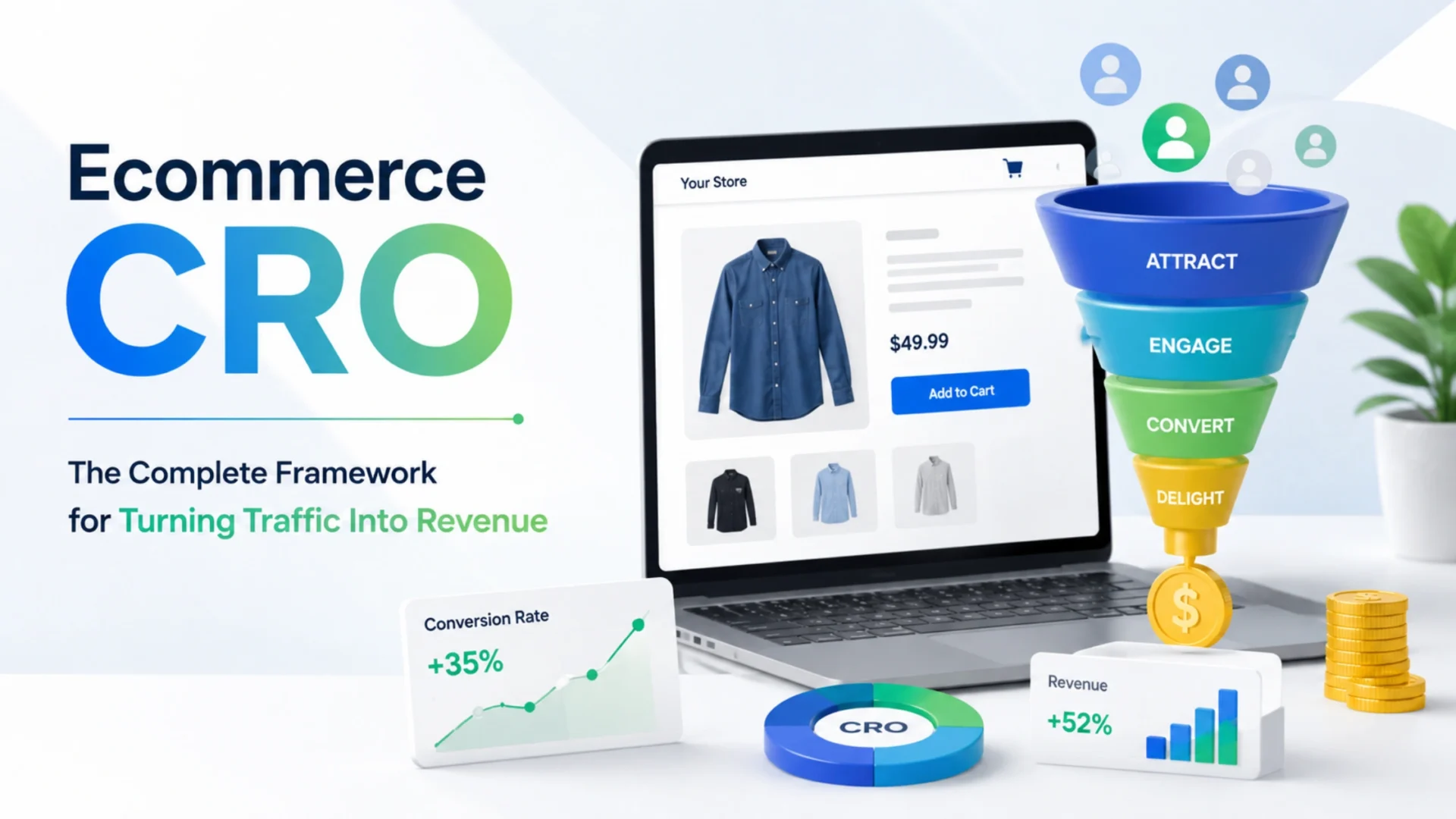
Ecommerce CRO is the structured process of increasing the percentage of website visitors who complete a purchase, through changes to site speed, product pages, checkout flow, trust signals, and personalization. It’s not a one-time redesign. It’s an ongoing cycle of auditing, testing, and iterating based on real user behavior. In 2026, the discipline has shifted from generic checklist tactics toward platform-specific execution and AI-assisted personalization, though the fundamentals from a decade of usability research still hold.
What is ecommerce CRO, exactly?
Ecommerce conversion rate optimization is the practice of increasing the share of site visitors who take a desired action, most commonly completing a purchase, without spending another dollar acquiring new traffic. It’s calculated with a simple formula: divide total conversions by total visitors, then multiply by 100. If 3,000 people visit your store in a week and 60 of them buy something, your conversion rate for that week is 2%.
That simple math hides a lot of complexity, though. A “conversion” doesn’t have to mean a completed sale. Adding an item to a cart, starting a checkout, signing up for a newsletter, or creating a wishlist are all micro-conversions that feed into the bigger picture. Most stores that treat CRO seriously track conversion rate at every funnel stage, not just the final one, because a healthy add-to-cart rate paired with a weak checkout completion rate points to a very different problem than low product-page engagement in the first place.
“Traffic acquisition answers how many people can we get to the store. Conversion rate optimization answers how many of the people already at the store actually buy.”
People often confuse CRO with UX design, and the two overlap heavily, but they aren’t identical. UX design asks whether an experience feels good to use. CRO asks a narrower, more commercial question: does this specific change move the number that matters, measured against a control, with actual data. A page can look beautiful and still convert worse than an ugly one if the ugly one removes more friction from the buying decision. That distinction is why CRO leans on testing rather than opinion, and why “we redesigned the homepage” is not the same claim as “we ran a controlled test and the new homepage converted 14% better.”
Why ecommerce CRO looks different in 2026
A few things have genuinely shifted this year, and it’s worth separating what’s real from what’s just recycled advice with a new date stamp on it. First, the baseline problem hasn’t gone anywhere. The Baymard Institute’s ongoing meta-analysis of 50 independent studies puts the global average cart abandonment rate at 70.22%, a figure that has held remarkably stable since roughly 2020, rising less than one percentage point in five years. Seven out of ten shoppers who add a product to their cart still walk away without buying it.
Second, mobile has quietly become the majority of traffic while still converting worse than desktop almost everywhere. That gap used to be explained away as “mobile shoppers are just browsing,” but the data suggests something more fixable: mobile checkout friction, not mobile shopping intent, is driving the difference. Third, personalization has moved from a nice-to-have marketing tactic to something close to a baseline expectation, which changes how product pages, search results, and recommendation modules need to behave.
70.22%
of shoppers who add a product to their cart still leave without buying, according to the Baymard Institute’s meta-analysis of 50 studies. The figure has barely moved in over a decade.
Pair that with a second, quieter number: 71% of consumers now expect a personalized shopping experience, and 76% report frustration when brands fail to deliver it, according to McKinsey’s ongoing personalization research. Most CRO effort still gets poured into surface-level fixes like button color and headline copy, while the actual leaks sit deeper in the funnel, checkout friction that costs real orders, and a growing expectation gap between what shoppers want and what most stores actually deliver. That’s the honest starting point for anyone serious about improving conversion this year, not another generic tips list.
The ecommerce CRO framework: six areas that actually move revenue
Skip one of these areas and it usually shows up downstream as a mysterious drop somewhere else in the funnel. Here’s what each area needs to accomplish, not just the generic advice attached to it everywhere else online.
Site speed and technical health:
Speed isn’t a nice-to-have anymore. Roughly 53% of mobile visitors abandon a page that takes longer than three seconds to load, and every additional second of delay compounds bounce rate on the device that now drives most ecommerce traffic. Compression, image optimization, lazy loading, and a proper CDN aren’t glamorous work, but they’re the foundation everything else in this framework sits on.
Navigation and product discovery:
If a shopper can’t find what they’re looking for in a few clicks, they leave, and it doesn’t matter how good the product page underneath is. Category labels that match real search language, a search bar that handles typos, and filters that mirror how customers actually shop all belong here. A well-structured ecommerce development foundation makes this far easier to execute cleanly than bolting search improvements onto a rigid theme later.
Product page persuasion is where browsing turns into buying intent. High-resolution images with real zoom, benefit-driven descriptions instead of spec dumps, visible star ratings with review counts, and honest stock or shipping information all reduce the hesitation that kills add-to-cart rates. Baymard’s usability research has repeatedly found that up to 95% of shoppers rely on reviews to evaluate a product before purchasing.
Checkout flow: (the single highest-leverage area in this framework)
Baymard’s checkout usability research has found that fixing documented checkout issues can lift conversion by as much as 35.26% on affected sites. Guest checkout, upfront cost transparency, fewer form fields, and inline validation all belong here, and most of them are fixable without a full replatform.
Round out the framework with two areas that compound the first four: trust and personalization, meaning security badges, transparent return policies, and social proof that reduce the anxiety stalling a purchase decision (companies that grow faster drive roughly 40% more of their revenue from personalization than slower-growing peers, per McKinsey), and testing and iteration, the discipline of treating every launched change as a hypothesis worth continuing to validate rather than a finished decision.
Worth saying directly: these six areas rarely get fixed in a straight line. A checkout fix often surfaces a trust problem nobody had noticed, and that’s a sign the process is working, not a sign it failed. Treating CRO as a rigid checklist to complete once is exactly the mistake that keeps the average abandonment rate stuck near 70% year after year.
Not sure which part of your funnel is actually leaking revenue?
Elsner can run a conversion audit that pinpoints exactly where visitors drop off, and what fixing it is realistically worth.
What’s a good ecommerce conversion rate in 2026?
Anyone quoting one flat number here is oversimplifying. Different benchmark trackers land in slightly different places depending on methodology, but most converge on a global average somewhere between 2.5% and 3%, with enormous variance by industry, device, and traffic source. A 2% rate might be strong for a considered $400 purchase and weak for a $20 impulse buy.
| Segment | Typical conversion rate | Why it lands there |
|---|---|---|
| Global average, all industries | 2.5% to 3.0% | Blended figure across device, traffic source, and industry; not meaningful on its own |
| Top-performing stores | 4.7% and above | Top 10% of stores by traffic and revenue, per multiple aggregated benchmark trackers |
| Food and beverage | 4.5% to 6.2% | Low consideration time, repeat and habitual purchasing behavior |
| Luxury and jewelry | 0.7% to 1.2% | High price point, long research cycle, comparison shopping across multiple retailers |
| Desktop traffic | 3.2% to 4.0% | Higher-intent visitors, larger screens, easier checkout completion |
| Mobile traffic | 1.8% to 2.8% | Drives 70%+ of traffic but lags on checkout friction and smaller form factors |
The more useful exercise isn’t chasing the “global average,” it’s benchmarking against your own category and your own historical baseline. A store improving from 1.4% to 2.1% has meaningfully outperformed a store sitting flat at 3.0%, even though the second number looks better on paper. Track the trend line, not the snapshot.
Where AI actually helps ecommerce CRO in 2026, and where it doesn’t
This is where most 2026 content gets vague or overhyped, so let’s be precise about it. AI’s clearest, most measurable win in CRO is personalization at a scale no human team could execute manually. McKinsey’s research shows AI-driven personalization can lift revenue by roughly 5% to 15% on average, with better-performing implementations pushing well past that, largely through more relevant product recommendations, smarter search ranking, and tailored on-site messaging.
Where AI is far less reliable is judgment about what should be tested in the first place. Recommendation engines are excellent at surfacing “customers who bought this also bought” patterns. They’re much weaker at telling you why your checkout abandons at a specific step, or whether a redesigned category page will actually resonate with your specific audience. That still requires human research, real user testing, and a strategist who can read behavioral data and ask the right follow-up question. Bolting an AI recommendation widget onto a store with a fundamentally broken checkout won’t fix the checkout, and teams that treat AI personalization as a patch over deeper structural friction usually see minimal lift, or worse, a slower page that quietly hurts the mobile conversion rate it was meant to help.
There’s a second dimension worth naming here, and it’s one most CRO guides skip entirely: how shoppers now discover products before they even reach your site. AI-driven search, AI Overviews, and conversational shopping assistants are changing the top of the funnel, meaning some visitors now arrive with a much narrower, more decided intent than a traditional organic click ever carried. A store that pairs solid CRO fundamentals with strong answer engine optimization is positioning itself to capture that higher-intent traffic before it even lands, rather than only optimizing what happens after the click.
Key ecommerce CRO trends for 2026
Some of these are genuinely new. Others are older ideas that finally have the data and tooling to work properly. None of this is a ranked list, just what’s actually shaping conversion strategy right now.
Platform-native checkout optimization is replacing generic advice: Magento, Shopify, and BigCommerce all handle checkout customization differently, and “reduce your form fields” means something very different depending on which platform’s checkout API you’re actually working within. Stores are getting more specific about implementation, not less. Alongside this, mobile-first checkout design is finally overtaking mobile-friendly as the standard: with mobile still converting well below desktop despite driving the majority of traffic, teams are designing checkout for thumbs and small screens as the primary case, treating desktop as the secondary layout instead of the other way around.
Real-time personalization is replacing batch segmentation: Static customer segments updated weekly are giving way to real-time behavioral triggers that adjust recommendations and messaging within the same session, since real-time personalization consistently outperforms batch approaches on conversion lift.
Illustrative scenario
Picture a mid-sized apparel store converting at 1.6% on mobile, well below its 3.1% desktop rate. An audit finds a five-step checkout with mandatory account creation. Cutting it to a two-step guest-first flow with saved payment options lifts mobile conversion into the low 2% range within two months. This is a representative pattern based on common checkout friction findings, not a specific client result.
Transparent pricing is moving earlier in the funnel: With unexpected costs at checkout remaining one of the biggest documented drivers of cart abandonment, more stores are surfacing shipping estimates, taxes, and total cost on the product page itself, well before the shopper reaches the cart. Reviews are following the same pattern, no longer confined to product pages: stores are surfacing rating snippets in category grids, search results, and cart summaries, since review visibility at every touchpoint reduces the hesitation that shows up later as abandonment.
CRO and SEO are finally working from the same playbook: Search intent alignment, meaning the page a shopper lands on actually matches what they searched for, has become a shared priority between SEO and CRO teams instead of two separate departments optimizing in isolation. That shift is easier to execute on composable or headless architecture, where stores can test and ship page-level changes without waiting on a full theme deployment cycle, compounding testing velocity over a full year.
B2B ecommerce is catching up on CRO fundamentals: Bulk pricing visibility, account-based checkout permissions, and quote request flows are finally getting the same testing rigor B2C brands have applied to product pages for years, a gap most CRO content still ignores entirely.
Common ecommerce CRO mistakes to avoid
These five show up constantly, and they’re rarely the result of laziness. They’re usually the byproduct of chasing visible wins over structural ones.
How to choose an ecommerce CRO partner
Most agency pitch decks look similar on the surface. What separates a partner who genuinely improves conversion from one who just runs surface-level tests shows up in a handful of direct questions worth asking before signing anything.
- Do they audit your specific platform’s checkout constraints, or do they hand you the same generic checklist regardless of whether you run Magento, Shopify, or BigCommerce?
- Can they show a documented before-and-after result with real statistical significance, not just a screenshot of a redesigned page?
- How do they prioritize fixes when there’s limited development budget, and can they explain that reasoning clearly?
- Do they treat CRO and SEO as connected disciplines, or as two teams that never talk to each other?
- Who actually implements the fixes: developers who understand your platform’s architecture, or a marketer handing off a spec and hoping for the best?
Be cautious of anyone promising a guaranteed conversion lift before running an actual audit of your store. That kind of confidence usually means they haven’t looked closely enough to know what’s actually broken yet. Businesses weighing this decision often start by comparing an in-house team against an agency partner before committing budget either way.
How Elsner approaches ecommerce CRO
Elsner runs CRO as a platform-native discipline, not a generic checklist applied identically to every store. That distinction matters because a checkout fix that works cleanly on Shopify’s native API can require a completely different implementation path on Magento or BigCommerce. Our teams build directly inside these platforms, which means conversion recommendations come with a real understanding of what’s actually feasible to ship, not just what looks good in a slide deck.
For stores ready to layer personalization on top of solid fundamentals, our conversion rate optimization services cover the full cycle: audit, prioritization, implementation, and ongoing testing, rather than a one-time redesign that quietly stops getting attention after launch. We also work with brands on the broader picture, since a strong CRO program compounds far better when it’s paired with the search and discovery work covered in our roundup of conversion rate optimization trends for 2026.
The bottom line
Ecommerce CRO in 2026 has more sophisticated tooling behind it than ever, and the same structural problem that’s shown up in the data for over a decade: seven out of ten shoppers still abandon their cart before buying. AI genuinely helps with personalization at scale, but it doesn’t replace the fundamentals of a fast site, a clear product page, and a checkout that doesn’t ask for more than it needs. The stores actually moving their conversion rate are the ones treating this as a continuous cycle instead of a one-time project, and platform-specific execution beats generic advice every time it’s been tested.
Ready to find out where your funnel is actually leaking?
Elsner audits, prioritizes, and implements conversion fixes for ecommerce brands who want platform-specific execution instead of another generic checklist. Book a consultation and let’s find out what your funnel actually needs first.
Key takeaways
✓ Ecommerce CRO is an ongoing cycle of auditing, testing, and iterating, not a one-time redesign project.
✓ The global average cart abandonment rate is 70.22%, according to Baymard Institute’s meta-analysis of 50 studies, and has stayed flat for over a decade.
✓ Checkout usability fixes can lift conversion by up to 35.26% on affected sites, making checkout the single highest-leverage area in most CRO programs.
✓ Personalization drives roughly 5% to 15% average revenue lift according to McKinsey, with faster-growing companies deriving about 40% more revenue from it than slower-growing peers.
✓ A “good” conversion rate depends entirely on industry, device, and traffic source; the 2.5% to 3% global average is a starting reference point, not a target.
✓ Elsner runs CRO as a platform-native discipline across Magento, Shopify, and BigCommerce, pairing audits with real implementation, not just recommendations.
Frequently Asked Questions
What is ecommerce CRO?
Ecommerce CRO, or conversion rate optimization, is the process of increasing the percentage of website visitors who complete a purchase through changes to site speed, product pages, checkout flow, and personalization. It’s calculated by dividing total conversions by total visitors and multiplying by 100.
What is a good ecommerce conversion rate?
Most benchmark trackers put the global average between 2.5% and 3%, though the figure varies enormously by industry, device, and traffic source. Food and beverage stores often exceed 4.5%, while luxury goods can sit under 1.2%. The top 10% of stores across industries convert above 4.7%.
How do I improve my ecommerce conversion rate?
Start with a full-funnel audit to identify where visitors actually drop off, then prioritize checkout friction and page speed first, since these areas carry the largest documented conversion impact. Layer in trust signals, personalization, and structured A/B testing once the fundamentals are solid.
Why do so many shoppers abandon their cart?
According to Baymard Institute research, the leading documented reasons include unexpected extra costs like shipping and taxes, forced account creation, and a checkout process that feels too long or complicated. The global average cart abandonment rate sits at 70.22% across 50 aggregated studies.
Does AI actually improve ecommerce conversion rates?
AI-driven personalization has a measurable impact, with McKinsey’s research pointing to an average revenue lift of roughly 5% to 15%. However, AI works best layered on top of solid fundamentals. It won’t compensate for a broken checkout or a slow-loading mobile site on its own.
What’s the difference between CRO and UX design?
UX design focuses on whether an experience feels intuitive and pleasant to use. CRO focuses specifically on whether a change measurably increases conversions, validated through testing rather than opinion. The two disciplines overlap heavily but aren’t identical.
Should I focus on desktop or mobile CRO first?
Mobile typically deserves priority since it now drives the majority of ecommerce traffic for most stores, even though it converts lower than desktop. Fixing mobile checkout friction usually delivers a bigger overall revenue impact than desktop-only improvements.
How long does it take to see results from ecommerce CRO?
A focused checkout or page-speed fix can show measurable movement within a few weeks, depending on traffic volume needed for statistical significance. Broader personalization and testing programs typically take two to four months to show their full compounding effect.