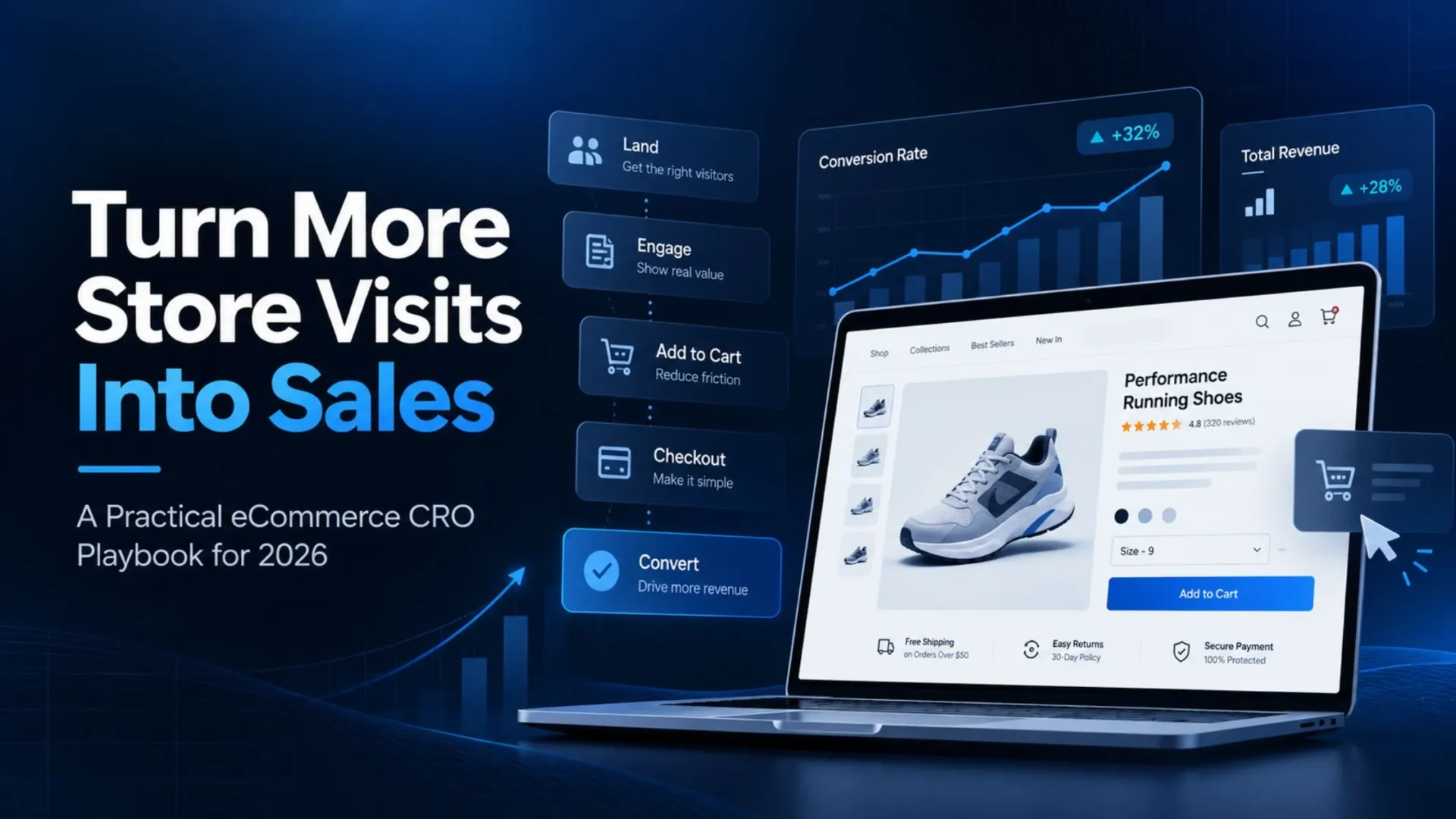





- Why Conversion Rate Optimization Matters More Than Ever in 2026?
- Top Conversion Rate Optimization Strategies That Work
- Optimize for User Intent, Not Just Traffic
- Improve Website Speed and Performance
- Simplify Navigation and User Experience
- Create High-Converting Landing Pages
- Use Clear and Compelling Call-to-Actions (CTAs)
- Build Trust with Social Proof and Credibility Signals
- Optimize Product or Service Pages
- Reduce Checkout Friction
- Leverage Personalization and AI
- Use Data and A/B Testing for Continuous Improvement
- Key Metrics to Measure CRO Success
- Common CRO Mistakes to Avoid
- Focusing Only on Traffic
- Ignoring Mobile Experience
- Lack of Clear Messaging
- Not Using Data for Decisions
- Quick CRO Checklist for 2026
- When to Consider Professional CRO Services?
- Want to turn your website traffic into real results?
- Conclusion
- Frequently Asked Questions (FAQ)
- What is conversion rate optimization (CRO)?
- What is a good conversion rate for a website?
- How can I improve my website conversion rate quickly?
- Does website speed affect conversions?
- What tools are used for CRO?
Let’s be honest for a second. You’ve spent real money getting people to your website. Maybe it’s Google Ads. Maybe it’s months of content work. Maybe it’s both. And still, most of those visitors leave without doing anything. That stings.Here’s the thing nobody talks about enough: traffic is just the beginning. What happens after someone lands on your page is where the actual money gets made or lost. A site that converts well is worth more than any ad campaign you’ll ever run, because it keeps working on every single visit.
That’s exactly why more businesses today are turning to a conversion rate optimization agency instead of just pouring more budget into acquisition. Because without fixing what happens on your site, more traffic simply means more wasted opportunity.
This guide focuses on the conversion rate optimization strategies that are producing actual results in 2026. Not a list of generic best practices. Real approaches, applied to real websites, that move the numbers.
Why Conversion Rate Optimization Matters More Than Ever in 2026?
Run any paid channel today and you’ll feel it immediately. Cost per click is up. Cost per acquisition is up. The easy era of cheap digital traffic is over and it’s not coming back. Every visitor hitting your site has a cost attached to them now, whether you’re paying directly or not.
Here’s a simple way to think about it. Say you’re converting at 2% right now. If you can push that to 4%, you’ve effectively doubled your revenue without touching your ad budget. No extra traffic. No new campaigns. Just the same people doing twice as much. That’s why CRO techniques deserve serious attention in 2026, not just a line item in the marketing plan.
The businesses pulling ahead aren’t necessarily outspending everyone else. They’re getting more out of what they already have. That gap compounds fast.
Top Conversion Rate Optimization Strategies That Work
Optimize for User Intent, Not Just Traffic
Here’s a scenario you’ve probably seen in your own data. Someone searches “affordable HR software for small teams,” clicks your ad, and lands on your homepage. Your homepage talks about enterprise solutions, Fortune 500 clients, and global scalability. That visitor is gone in eight seconds.
The mismatch between what someone searched and what they found is one of the most consistent conversion killers out there. It’s also one of the most fixable. Match the page to the query. Someone looking for a specific product should land on that product. Someone comparing options should land on a comparison. That’s the core of intent-based website conversion tips, and a key focus area for effective conversion rate optimization services.
When the page answers exactly what someone was thinking when they clicked, they don’t need convincing. They’re already halfway sold. That’s a very different conversation than trying to persuade someone who feels like they’re in the wrong place.
Improve Website Speed and Performance
Pull up your site on a cheap Android phone right now. Not your iPhone. Not your work laptop. Whatever a typical first-time visitor might actually be using. See how that feels. See how long it takes. That experience is your conversion rate’s ceiling.Speed is not a developer concern. It is a revenue concern. Industry data across dozens of studies has shown that load time directly affects how many people complete a purchase or submit a form. A page that loads in two seconds consistently converts better than the same page loading in five. The difference isn’t small.
Image compression, reducing render-blocking scripts, switching to faster hosting, using a CDN — none of this is exciting work. But it’s the kind of foundational fix that makes every other website conversion effort work better. Fast pages also rank better in search. That’s two wins from the same fix.
Simplify Navigation and User Experience
Ask someone who has never visited your site to find your pricing page. Watch them. Don’t help. Just watch. In most cases, what you’ll see will be uncomfortable. Menus that seemed obvious to your team are confusing to someone encountering them cold.
That’s the problem with navigation designed by insiders. It makes perfect sense to people who built the product. It often makes very little sense to someone who doesn’t yet know what any of the labels mean. The fix is not a redesign. It’s plain language and fewer layers, something every experienced conversion rate optimization company prioritizes when improving user journeys.
Every click a visitor needs to take before reaching what they want is a chance to lose them. The goal is to shorten that path. If someone has to go Homepage → Category → Sub-category → Product before they can buy, look hard at whether that middle is necessary.
Create High-Converting Landing Pages
A landing page that’s trying to appeal to everyone ends up connecting with no one. It’s a common mistake, especially in businesses that have multiple audience segments. The instinct is to put everything on the page so nobody feels left out. The result is a page that feels unfocused and converts poorly.
One offer. One clear reason why that offer matters. One action to take. That structure works because it removes the cognitive load of deciding. The visitor doesn’t have to sort through options. They read the page, understand the offer, and decide yes or no. In ecommerce conversion optimization, that clarity is worth more than any design upgrade.
Where the value proposition sits on the page matters too. If a visitor has to scroll to find out what you actually do, you’ve already lost a significant percentage of them. The most important sentence on your landing page should be visible the instant the page loads.
Use Clear and Compelling Call-to-Actions (CTAs)
“Submit.” Nobody is excited to submit anything. “Click Here” — click here for what? These button labels are relics from the early days of the web when forms were new and people clicked anything. That’s not the world your visitors live in now.A good CTA tells the visitor what they’re getting, not what they’re doing. “Get My Free Audit” works better than “Contact Us” because it says something specific is coming. “Start My Trial” works better than “Sign Up” because it frames the action as a beginning, not a commitment. Word choice here genuinely moves the needle.
One more thing: put the CTA where the visitor is already thinking about taking action. After a strong testimonial. After the pricing section. After an explanation of the benefit. Not just at the top and bottom of the page by default. Placement is half the job. Strong conversion optimization best practices treat the CTA as a placement decision as much as a copy decision.
Build Trust with Social Proof and Credibility Signals
Nobody wants to be the test case. When someone is considering buying from a brand they’ve never dealt with before, the first thing they’re looking for is evidence that other people have done it and it went fine. Reviews do that work. Case studies do that work. Even a simple “Trusted by 6,200 clients” does that work.
The placement of that proof matters as much as having it. A testimonial sitting at the bottom of the page, three scrolls from the CTA, is doing almost nothing. Put it near the moment of decision. Right above the buy button. Right next to the form. That positioning is a core part of any serious improve conversion rate effort.
Return policies, money-back guarantees, and security badges address a separate concern: what happens if this goes wrong? For first-time buyers especially, the fear of getting burned is real. A clearly stated guarantee doesn’t just look professional. It actively removes a reason not to buy.
Optimize Product or Service Pages
Here’s a quick test. Read your own product page description out loud. Count how many times you say what the product does versus how many times you say what the buyer gets out of it. Most product pages fail this test badly. They’re written from the product’s perspective, not the customer’s.“High-tensile stainless steel frame” is a feature. “Built to last a decade without rusting or warping” is a benefit. Same information. Completely different effect on the person reading it. Benefits answer the question the buyer is actually asking, which is not “what is this made of” but “what does this mean for me.”
An FAQ section built from real customer questions is one of the highest-value additions you can make to any product or service page. It handles objections in advance. It reduces back-and-forth support queries. And it demonstrates that you understand what your buyers are actually wondering before they ask. That’s ecommerce conversion optimization working at the content level.
Reduce Checkout Friction
The checkout stage has a specific and brutal dynamic: the buyer has already decided to purchase. Your job at that point is purely to not ruin it. And yet this is where enormous amounts of revenue disappear every single day.Forcing account creation before purchase turns away buyers who were genuinely ready to spend money. Adding unexpected fees at the last step destroys trust at the worst possible moment. A form that asks for twelve pieces of information when four would do it creates fatigue in people who are literally trying to give you money.
Guest checkout, transparent pricing with no late surprises, minimal required fields, and multiple payment options including buy-now-pay-later — these are the ecommerce conversion optimization fixes that cost almost nothing to implement and produce immediate results. Start there before touching anything else in the checkout flow.
Leverage Personalization and AI
If someone has visited your site four times, browsed the same product category twice, and added something to their cart without buying, they are not a cold lead. They’re a warm one who needed something to push them over the edge. Showing them the same homepage you show a stranger wastes that context completely.
Personalized product recommendations, emails triggered by specific browsing behavior, and targeted offers based on what someone almost bought — these are standard features of CRO strategies 2026. Most ecommerce platforms support some version of this natively. It does not require a big technical project to get started.
The underlying principle is simple. People respond to relevance. When a site surfaces exactly what a visitor has been thinking about, they engage more. They spend more. They come back more. Relevance is not just a UX nicety. It’s a revenue driver.
Use Data and A/B Testing for Continuous Improvement
Everyone on your team has an opinion about what will work better. The designer thinks the image should be bigger. The copywriter thinks the headline should be more direct. The CEO thinks the color scheme needs to change. All three might be wrong. That’s what testing is for.
A/B testing removes personal opinion from decisions that should be data-driven. You run two versions, you measure which one produces more of the behavior you want, and you go with the winner. You do it again. Over time, those incremental wins stack into meaningful improvements in your overall conversion rate optimization strategies.
Heatmaps and session recordings fill in a different kind of gap. They show you what’s happening on the page in a way that numbers alone cannot. You can see where people are clicking unexpectedly. You can watch someone scroll past your CTA without noticing it. That visual evidence tells you exactly where to focus next.
Key Metrics to Measure CRO Success
Track these four metrics consistently. They’re the difference between knowing your CRO work is paying off and just hoping it is.
|
Metric |
Description |
Why It Matters |
|
Conversion Rate |
Percentage of visitors who complete the desired action |
The primary number that tells you if the site is working |
|
Bounce Rate |
Visitors who exit after viewing just one page |
Usually points to a mismatch between ad and landing page |
|
Avg. Session Duration |
How long each visitor spends on the site per visit |
Longer visits indicate genuine interest before a decision |
|
Cart Abandonment Rate |
Checkouts started but not completed |
Directly reveals where checkout friction is losing you sales |
Common CRO Mistakes to Avoid
Focusing Only on Traffic
More traffic doesn’t fix a broken funnel. It amplifies it. If 97 out of every 100 visitors are leaving without converting, sending twice as many visitors just means twice as many people hitting the same wall. The problem is on-site, not in the traffic source.The instinct to run more ads when revenue is flat is understandable. It feels like action. But it’s expensive action that doesn’t address the actual problem. Figure out why the visitors you already have aren’t converting. That work will outlast any campaign.
Ignoring Mobile Experience
This one is still, somehow, a widespread problem in 2026. Sites with tiny text, misaligned buttons, forms that don’t resize, and carousels that break on touch screens. All of it on devices that account for more than half of web traffic.Test your site on actual phones. Not the browser’s device simulation mode. Real phones. The difference between how your site looks in a Chrome dev tools preview and how it looks on a mid-range Samsung is often significant.
Lack of Clear Messaging
Vague messaging feels safe. It doesn’t make bold claims that could be wrong. It doesn’t exclude any segment. The problem is it also doesn’t connect with anyone specifically. Generic copy produces generic results.The most damaging version of this is when the ad is specific and the landing page is not. Someone clicks a targeted message, arrives at a broad page, and the context vanishes. That disconnect is felt immediately, even if the visitor can’t articulate why they’re leaving.
Not Using Data for Decisions
Redesigning a page because it “feels outdated” or changing a headline because someone in a meeting didn’t like it — these decisions happen constantly. They’re also often wrong. Without a baseline measurement and a clear test structure, you have no way of knowing if the change helped or hurt.
Building a testing habit is more valuable than any individual CRO tactic. It’s the mechanism that lets you keep improving over time rather than just occasionally changing things and hoping for the best. CRO techniques done properly are systematic, not sporadic.
Quick CRO Checklist for 2026
Run through this before your next traffic campaign. These are the areas most likely hiding quiet conversion losses.
|
Area |
Checkpoint |
|
UX |
Can a new visitor find what they need in under five seconds? |
|
Speed |
Does the site load in under three seconds on a mid-range phone? |
|
Trust |
Are reviews, guarantees, and return policies easy to find? |
|
CTA |
Does every CTA say exactly what happens after the click? |
|
Content |
Is the core value proposition visible before scrolling? |
When to Consider Professional CRO Services?
At some point the internal team runs out of obvious things to try. The homepage has been redesigned. The checkout has been simplified. The CTAs have been rewritten. And conversions are still sitting in the same place. That is a plateau, and it is common. Here is when to bring in outside help:
- Traffic is steady but conversions are flat. The gap between visits and revenue is telling you something is broken on-site.
- No structured testing process exists. Individual fixes get made but nothing is measured against a control. Scattered changes produce scattered results.
- Funnel analysis and A/B data feel hard to act on. Heatmaps and session recordings sit unused because interpreting them takes expertise the team does not have.
- Technical implementation is creating bottlenecks. Good ideas are sitting in a backlog because there is no dev capacity to build and test them.
At Elsner, we bring 19 plus years of experience and a team of 250 plus developers to this work. Here is what we deliver:
- CRO / Conversion Optimization Services — full conversion audits that identify your highest-priority issues, backed by data not guesswork.
- UX/UI Design Services — removing the friction points and UX gaps that turn visitors away before they act.
- eCommerce Development Services — technical implementation that moves fast, across 9,500 plus projects delivered over 19 years.
- Structured testing programs — measurable, accountable A/B testing that produces results you can see in the numbers. Not guesswork. A system.
If traffic is healthy and revenue is not following, that gap is telling you something. Finding what it is telling you is where we start.
Want to turn your website traffic into real results?
Request a free CRO audit from Elsner. We’ll show you exactly where conversions are being lost.
Conclusion
Conversion rate optimization is one of those things that never really ends, and that’s actually a good thing. Every improvement opens up the next one. Every test teaches you something about how your specific audience thinks and behaves. That knowledge accumulates and becomes a genuine competitive advantage over time.
What works isn’t a mystery. Understand what your visitors are looking for, get out of their way, give them a reason to trust you, and make the next step obvious. Apply that thinking systematically across your site and the numbers will follow.
Start with one section. Make one change. Measure it properly. Then move to the next. That approach beats a big overhaul every time, because you learn as you go rather than gambling on a complete rebuild being better.
Frequently Asked Questions (FAQ)
What is conversion rate optimization (CRO)?
Conversion rate optimization is the work of getting more of your existing website visitors to take the action you want them to take. That might be buying a product, booking a call, signing up for a newsletter, or filling out a form. If your site gets 1,000 visitors and 30 of them buy something, your conversion rate is 3%. CRO is everything you do to move that number higher without necessarily increasing visitor volume.
What is a good conversion rate for a website?
The honest answer is that it depends. The commonly cited average across ecommerce sits between 1% and 3%. Lead generation pages in service businesses can run much higher, sometimes 5% to 10% on a well-optimized page. The number that actually matters is your own site’s current rate compared to where it was last month. That’s the benchmark worth obsessing over.
How can I improve my website conversion rate quickly?
Three things you can do this week with minimal technical work: rewrite your CTAs to say specifically what the visitor gets, check your page speed on a real mobile device and fix the obvious issues, and make sure your value proposition is visible before anyone has to scroll. Those three changes alone have produced measurable increase website conversion results for businesses across industries.
Does website speed affect conversions?
Yes. The data on this is consistent across industries and device types. Slow pages lose visitors before the content even loads. Every extra second of load time pushes bounce rates up and conversion rates down. Mobile users are more sensitive to this than desktop users because their connections are less consistent. Site speed improvements are one of the few website conversion tips that improve both conversions and search rankings at the same time.
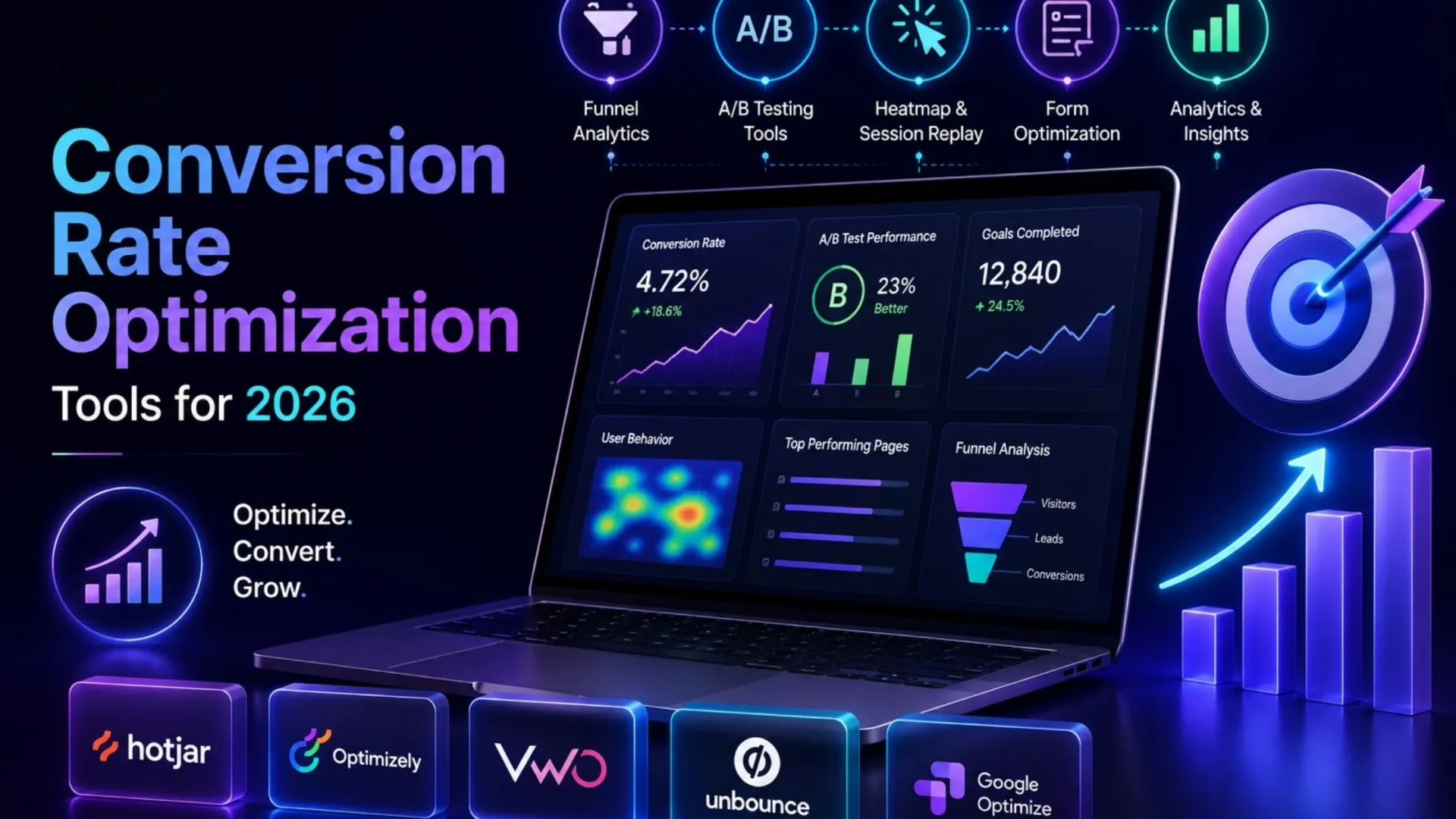
What tools are used for CRO?
Google Analytics for behavioral data and funnel tracking. Hotjar or Microsoft Clarity for heatmaps and session recordings. Optimizely or VWO for A/B testing. These three categories cover the foundation of any serious improve conversion rate program. You don’t need all of them on day one, but you’ll eventually want all three running together if you’re doing this properly.