



- What Is an LLM SEO Tool?
- Why Businesses Need LLM SEO Checking Tools in 2026
- Essential Features to Look for in the Best LLM SEO Tools
- Multi-model coverage
- Prompt-level tracking
- Citation analysis
- Competitor benchmarking
- Sentiment tracking
- Content recommendations
- Reporting and exports
- Integration depth
- Best LLM SEO Checking Tools for 2026
- Profound
- Scrunch AI
- Goodie AI
- Otterly.AI
- Semrush AI Toolkit
- Ahrefs AI Visibility Tools
- Surfer AI Optimization
- HubSpot AI SEO Tools
- Writesonic GEO Platform
- BrightEdge AI Search Tools
- Comparative Table of Top LLM SEO Tools
- Best LLM SEO Tools by Business Type
- Best for Agencies
- Best for Enterprise Brands
- Best for Small Businesses
- Best Budget-Friendly Option
- Best for Content Teams
- How to Choose the Right LLM SEO Tool
- Common Challenges in LLM SEO Optimization
- Future of LLM SEO Tools
- Final Verdict: Which Is the Best LLM SEO Tool for 2026?
- Conclusion
- CTA
- FAQs
Search has changed faster in the last 18 months than it did in the previous decade. People now ask ChatGPT, Gemini, Claude, and Perplexity the same questions they used to type into Google. Google itself is answering more queries directly through AI Overviews, often without sending users to a single website.
That shift has created a serious blind spot for most marketing teams.
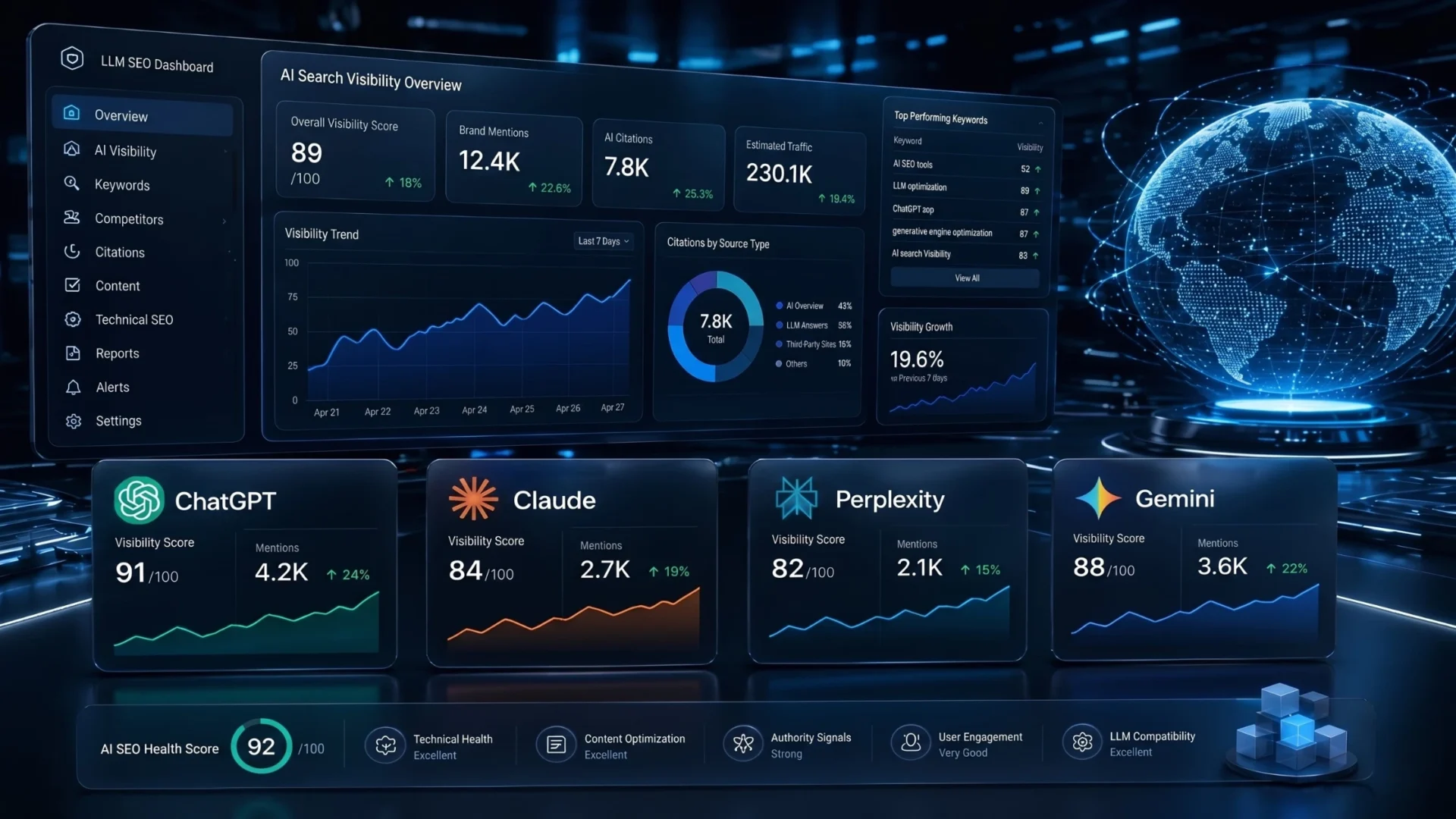
Traditional rank trackers can tell you where you sit on page one. They can’t tell you whether ChatGPT recommends your product when someone asks for the best CRM under $50 a month. That’s where the best LLM SEO checking tools come in. These platforms monitor brand visibility, citations, sentiment, and prompt-level performance across the AI engines that increasingly shape buyer decisions.
This guide breaks down the leading options for 2026, what each one does well, where it falls short, and how to pick the right fit for your team.
What Is an LLM SEO Tool?
An LLM SEO tool tracks how your brand, content, and competitors appear inside large language model outputs. Instead of monitoring keyword positions on Google, it monitors prompt responses on ChatGPT, Gemini, Claude, Perplexity, Copilot, and other AI surfaces.
The mechanics are different from classic SEO software. A traditional crawler checks which URL ranks for a keyword. An LLM SEO platform sends thousands of prompts to AI models, parses every response, and reports back on:
- Whether your brand is mentioned
- Which sources the model cites
- How competitors are positioned in the answer
- Sentiment and context around each mention
- Visibility share across models and topics
It’s a fundamentally different measurement layer. And honestly, most teams don’t realise how much they’re missing until they actually run their first scan.
For deeper context on the underlying shift, our breakdown of GEO vs AEO vs SEO covers how these disciplines overlap and where they differ.
Why Businesses Need LLM SEO Checking Tools in 2026
A few numbers tell the story. ChatGPT now serves more than 700 million weekly users. Perplexity’s query volume has grown more than 10x year over year. Google AI Overviews appear on a meaningful share of commercial searches in the US, UK, and India. Whatever the exact percentage in your category, the trend line is clear.
If a buyer asks an AI engine “what’s the best Magento partner for B2B” and your name doesn’t surface, you’ve effectively lost that lead. There’s no second page to rank on. There’s just one answer.
Here’s the practical difference between the two worlds:
| Traditional SEO | LLM SEO |
|---|---|
| SERP position tracking | AI answer visibility |
| Keyword traffic volume | Citation presence in LLM responses |
| Backlink authority | Entity authority across models |
| Click-through rate | Conversational discoverability |
| Featured snippet wins | Share of voice in generative answers |
The two disciplines are complementary, not opposing. You still need strong technical SEO, quality backlinks, and entity-rich content. But measurement now extends well beyond Google.
Essential Features to Look for in the Best LLM SEO Tools
Not every platform that calls itself an LLM SEO tool actually delivers. Some are dressed-up rank trackers. A few only support one model. Before you commit to a contract, check for the following.
Multi-model coverage
ChatGPT, Gemini, Claude, Perplexity, and Copilot at minimum. If a tool only watches one engine, it’s incomplete.
Prompt-level tracking
You want to see exactly which prompts your brand appears in, not just an aggregate score.
Citation analysis
When the LLM cites a source, which URL gets credited? Is it yours, a competitor, or a third-party listicle?
Competitor benchmarking
Share-of-voice comparisons across the same prompt set. This is where most decisions actually get made.
Sentiment tracking
A mention isn’t always good. Sometimes the AI says your product is overpriced. You want to know.
Content recommendations
Practical guidance on what to publish or update so models start citing you more often.
Reporting and exports
Clean dashboards for clients or internal stakeholders, plus raw data access.
Integration depth
Does it connect to your existing analytics, content stack, or CRM? Important for enterprise teams.
A quick filter: if a vendor can’t show you live competitor share-of-voice on a prompt of your choosing during the demo, walk away.
Best LLM SEO Checking Tools for 2026
Here’s the shortlist. Each platform has a different strength, and the right pick depends on your team size, budget, and how deep you need to go.
Profound
Profound is one of the platforms enterprise teams keep returning to. It tracks brand visibility across ChatGPT, Gemini, Claude, Perplexity, and Copilot at scale, with strong attention to citation analysis and competitive share-of-voice.
What stands out is the depth of its prompt library and the quality of its reporting. Marketing leaders running multi-brand portfolios use it to roll up performance across regions and product lines.
Pricing sits at the higher end. Enterprise plans typically start in the low five figures annually, which makes sense given the data volume involved. Smaller teams sometimes find it heavier than they need.
Best for: large brands and enterprise SEO teams that need defensible reporting.
Scrunch AI
Scrunch is built around brand intelligence inside generative search. It pulls structured data on how AI models describe your company, what attributes they associate with you, and where competitor narratives are winning.
Its sentiment layer is genuinely useful. Many tools report mentions; Scrunch tells you whether the mention helps or hurts. The dashboards are clean. Setup is fast.
One limitation: prompt customisation is narrower than Profound’s, so very specific niche tracking can feel boxed in.
Worth a serious look if brand reputation is part of your remit, not just rankings.
Goodie AI
Goodie focuses on actionability. The platform doesn’t just tell you what’s happening in AI search. It tells you what content to produce, which entities to strengthen, and which third-party sources to influence.
Teams that struggle to convert SEO data into editorial briefs find this approach refreshing. It’s particularly strong for content marketers who want a clear “do this next” workflow.
The trade-off is breadth. Coverage of niche models is thinner than the bigger platforms. For most B2B and B2C teams, that’s not a dealbreaker.
Otterly.AI
Otterly is the option people quietly recommend to friends. It’s affordable, well designed, and surprisingly thorough for the price.
Coverage spans the major LLMs and includes prompt monitoring, citation tracking, and competitor visibility. The interface is friendly enough that a small marketing team can be productive within a day.
It won’t replace Profound for a Fortune 500 brand. For a growing SaaS company spending under a few hundred dollars a month, it punches well above its weight.
Solid choice for startups and lean teams.
Semrush AI Toolkit
Semrush has moved aggressively into LLM tracking. The AI Toolkit sits inside the broader Semrush suite, which means existing customers get LLM visibility data alongside their keyword, backlink, and technical SEO reports.
For teams already paying for Semrush, the marginal cost is low and the workflow is familiar. The trade-off is that the AI-specific depth doesn’t quite match dedicated platforms yet. It’s improving fast though.
If your stack is already built on Semrush, this is the path of least resistance. If you’re choosing fresh, weigh it against the specialists.
Ahrefs AI Visibility Tools
Ahrefs has rolled out brand mentions tracking inside AI answers, citation analysis, and prompt-level reporting. The data quality is what you’d expect from Ahrefs, which is to say strong.
The AI feature set is newer than the company’s flagship modules. Some advanced reporting that competitors offer is still on the roadmap. That said, the integration with site audits and backlink data creates a useful unified picture for SEO leads who want everything in one place.
Good fit for teams that already trust Ahrefs as their primary tool.
Surfer AI Optimization
Surfer’s angle is content. It scans top-performing content in AI-cited sources and gives writers structured guidance on how to format, structure, and optimise pages so models are more likely to surface them.
Less a pure tracker, more an optimisation workbench. Pairs well with one of the dedicated visibility platforms above. Used together, they cover both measurement and execution.
Content teams tend to like it. SEO directors sometimes find it too focused on the writing layer.
HubSpot AI SEO Tools
HubSpot has folded AI search insights into its marketing hub. Reporting is straightforward and ties directly into campaign attribution.
It’s not the deepest LLM tool on the market. But for HubSpot-native teams who want a single dashboard covering email, CRM, content, and AI search visibility, the convenience matters. Reporting consolidation has real organisational value.
Expect this offering to deepen meaningfully through 2026.
Writesonic GEO Platform
Writesonic’s GEO module is interesting because it bridges the gap between AI content generation and AI visibility tracking. You can audit a page, identify gaps, generate optimised content, and then monitor whether LLMs start citing it.
The all-in-one approach appeals to small teams without dedicated SEO and content specialists. Larger teams sometimes prefer specialists for each layer.
Pricing is reasonable. Worth testing if you want to see the full content-to-visibility loop in one tool.
BrightEdge AI Search Tools
BrightEdge has been in enterprise SEO for years, and its AI search module reflects that maturity. It’s built for the kind of organisation that has multiple stakeholders, complex governance requirements, and significant content volume.
Custom dashboards, deep historical data, predictive analytics, and white-glove onboarding come standard. Pricing reflects the positioning.
If you’re running global SEO for a Fortune 1000 brand, this belongs on your shortlist alongside Profound.
Comparative Table of Top LLM SEO Tools
| Tool | AI Visibility Tracking | Citation Monitoring | Competitor Benchmarking | Pricing | Best For |
|---|---|---|---|---|---|
| Profound | Excellent | Excellent | Excellent | Enterprise | Large brands |
| Scrunch AI | Strong | Strong | Strong | Mid to enterprise | Brand-focused teams |
| Goodie AI | Good | Strong | Good | Mid-market | Content marketers |
| Otterly.AI | Good | Good | Good | Affordable | Startups, lean teams |
| Semrush AI | Good | Good | Strong | Mid-market | Existing Semrush users |
| Ahrefs AI | Good | Strong | Good | Mid-market | Existing Ahrefs users |
| Surfer AI | Limited | Limited | Limited | Affordable | Content optimisation |
| HubSpot AI SEO | Basic | Basic | Basic | Bundled | HubSpot users |
| Writesonic GEO | Good | Good | Basic | Affordable | All-in-one teams |
| BrightEdge | Excellent | Excellent | Excellent | Enterprise | Fortune 1000 |
Best LLM SEO Tools by Business Type
Best for Agencies
Agencies need multi-client management, white-label reporting, and predictable margins. Profound and Semrush AI Toolkit work well here. Profound for high-end clients, Semrush for broad portfolios where existing keyword data matters.
Best for Enterprise Brands
Profound and BrightEdge are the safer bets. Both handle scale, both deliver the kind of governance and data depth that procurement teams expect, and both have the support structures large organisations need.
Best for Small Businesses
Otterly.AI is hard to beat on price-to-value. For very small teams, even the entry tier gives you most of what you need to monitor visibility across the major models.
Best Budget-Friendly Option
Otterly.AI again, with Writesonic GEO as a close second if you want content generation in the same platform.
Best for Content Teams
Goodie AI for strategic direction, Surfer AI for execution. Many teams use both. The combination delivers more than the sum of its parts.
How to Choose the Right LLM SEO Tool
Don’t start with the tool. Start with the question.
Ask yourself what specific decision you’re trying to make better. Are you trying to prove ROI to leadership? Win competitive visibility in a specific category? Justify content investment? The honest answer narrows the field quickly.
Then check budget reality. A $50,000 annual platform is the wrong choice if you don’t have someone dedicated to working it. A $99-a-month tool is the wrong choice if you’re managing a portfolio of 12 brands.
After that, look at integrations. The tool needs to slot into your existing workflow, not replace it. A platform that doesn’t export to your reporting stack will quietly stop being used within a quarter.
Finally, run a real test. Most vendors offer trials or pilot periods. Use them. Track three or four prompts that genuinely matter to your business and see which platform gives you the clearest, most actionable picture.
Skip the demo theatre. Test the actual data.
Common Challenges in LLM SEO Optimization
A few things make this discipline harder than classic SEO.
Models update constantly. A response that mentions your brand today may not tomorrow, and the cause isn’t always something you did or didn’t do. That volatility frustrates teams used to predictable rank movements.
Data standardisation is still emerging. Two tools tracking the same prompt can return slightly different visibility scores depending on sampling frequency, geography, and model version. It’s not a flaw, just the nature of a young category.
Citation attribution can be inconsistent. Sometimes the LLM cites your URL. Sometimes it cites a third-party article that mentions you. Sometimes it doesn’t cite anyone at all. Building authority across all three patterns takes time.
Cost barriers are real for smaller teams. Enterprise platforms are priced for enterprise budgets. The middle market has decent options now, but it’s still a stretch for very small operations.
Platform fragmentation means you’re often stitching together insights from two or three tools rather than getting everything from one. That’ll consolidate over the next 12 to 18 months. For now, plan for some manual reporting overhead.
Future of LLM SEO Tools
The next generation of these platforms is starting to take shape, and a few directions are obvious.
Predictive analytics will move from “what happened” to “what will likely happen” if you publish, update, or restructure specific content. Some platforms are already piloting this.
Real-time GEO recommendations will get sharper. Instead of weekly reports, expect alerts when a competitor gains share on a high-value prompt, with clear suggestions on how to respond.
Cross-model optimisation will become standard. Right now most tools track each LLM separately. The winning platforms will surface unified strategies that move the needle across all major engines simultaneously.
Brand sentiment monitoring will deepen. Beyond mention counts, expect granular tracking of how your brand is described, by which sources, and in what tone.
Integration with enterprise SEO suites will accelerate. The line between traditional SEO platforms and LLM SEO platforms is already blurring. By late 2026, expect most major suites to offer competitive AI visibility modules.
Our piece on the future of SEO across LLM, GEO, and AEO goes deeper into where these trends are heading.
Final Verdict: Which Is the Best LLM SEO Tool for 2026?
Best overall:
Profound. The data depth, model coverage, and reporting quality justify the price for serious teams.
Best enterprise option: BrightEdge for organisations that need governance and white-glove support. Profound for those that prioritise pure AI search depth.
Best affordable solution: Otterly.AI. Genuinely strong product at a price that doesn’t require committee approval.
Best for agencies: Semrush AI Toolkit, especially if Semrush is already part of the stack.
Best innovation leader: Goodie AI for actionable intelligence, Scrunch AI for brand-led tracking. Both are pushing the category forward.
There isn’t a single winner for everyone. The right tool depends on your specific stage, budget, and goals. What matters more than the tool choice is actually doing the work, monitoring AI visibility weekly, and adapting content based on what the data shows.
Conclusion
The shift to AI-driven search isn’t coming. It’s already here. Buyers are asking generative engines for recommendations, and the brands that show up in those answers will own the next decade of digital growth.
The tools listed above are the most reliable way to track that visibility today. None of them are perfect. All of them are improving fast. The teams that start measuring now will have a meaningful head start over those waiting for the category to mature.
Pick a tool that fits your scale. Track the prompts that matter. Build content that earns citations. The fundamentals haven’t changed. The surfaces have.
CTA
Ready to see how your brand performs across ChatGPT, Gemini, Claude, and Perplexity? Elsner’s SEO and GEO specialists run dedicated LLM visibility audits, build optimisation roadmaps, and execute on content that wins citations in AI search. Book an AI SEO strategy consultation or explore our Generative Engine Optimization services to get started.
FAQs
1. What are the best LLM SEO checking tools in 2026?
The leading options are Profound, Scrunch AI, Goodie AI, Otterly.AI, Semrush AI Toolkit, Ahrefs AI tools, Surfer AI, HubSpot AI SEO, Writesonic GEO, and BrightEdge. The right pick depends on team size, budget, and whether you need pure tracking, content optimisation, or both.
2. How do LLM SEO tools differ from traditional SEO platforms?
Traditional SEO tools track keyword rankings and backlinks on Google. LLM SEO tools track brand mentions, citations, and visibility inside AI engines like ChatGPT, Gemini, Claude, and Perplexity. The two are complementary. You need both.
3. Which LLM SEO tool is best for enterprise businesses?
Profound and BrightEdge are the strongest enterprise choices. Both handle multi-brand reporting, complex governance, and the data depth that large organisations require. Pricing reflects that positioning.
4. Can LLM SEO tools improve visibility in ChatGPT and Google AI Overviews?
Yes. By identifying which prompts surface your brand, which sources LLMs cite, and where competitors win share of voice, these tools give you the inputs needed to update content, build entity authority, and earn more citations over time.
5. What features should I look for in an LLM SEO tracking tool?
Multi-model coverage, prompt-level tracking, citation analysis, competitor benchmarking, sentiment monitoring, content recommendations, clean reporting, and integration with your existing stack. If a platform misses two or more of these, keep looking.
6. Are LLM SEO optimization tools worth the investment for agencies?
For most agencies, yes. AI search visibility is becoming a core deliverable for clients, and proving ROI without dedicated tools is nearly impossible. Start with a mid-market platform that fits your client portfolio and scale up as demand grows.