



- What Brand Visibility in AI Search Actually Means
- Citation visibility
- Entity authority
- Surface presence
- Why It Matters Now, Not Later
- Traditional SEO vs AI Search Optimization
- The Ranking Factors Behind AI Search Visibility
- Proven Strategies to Improve Brand Visibility in AI Search
- Build a Real Entity SEO Foundation
- Create Content Worth Citing
- Optimize for AI Overviews and Generative Engines
- Strengthen Brand Authority Beyond Your Own Site
- Invest in Generative Engine Optimization
- Monitor What’s Actually Happening
- Common Mistakes Brands Keep Making
- Ignoring entity SEO entirely
- Publishing thin content at high volume
- Skipping schema
- Chasing every new AI platform without focus
- Forgetting the human reader
- Measuring ROI from AI Search Visibility
- What’s Coming Next
- Where to Start This Month
- Week one
- Week two
- Week three
- Week four
- FAQ’s
- Ready to get your brand cited inside AI answers?
Search has quietly changed. Most brands haven’t noticed yet.
A buyer used to type a query, scan ten blue links, and click two of them. That motion is fading. Today the same buyer asks ChatGPT, opens Gemini, pings Perplexity, or scrolls past a Google AI Overview before they ever see a ranking page. The answer arrives pre-chewed. Sometimes a brand gets named. Often it doesn’t.
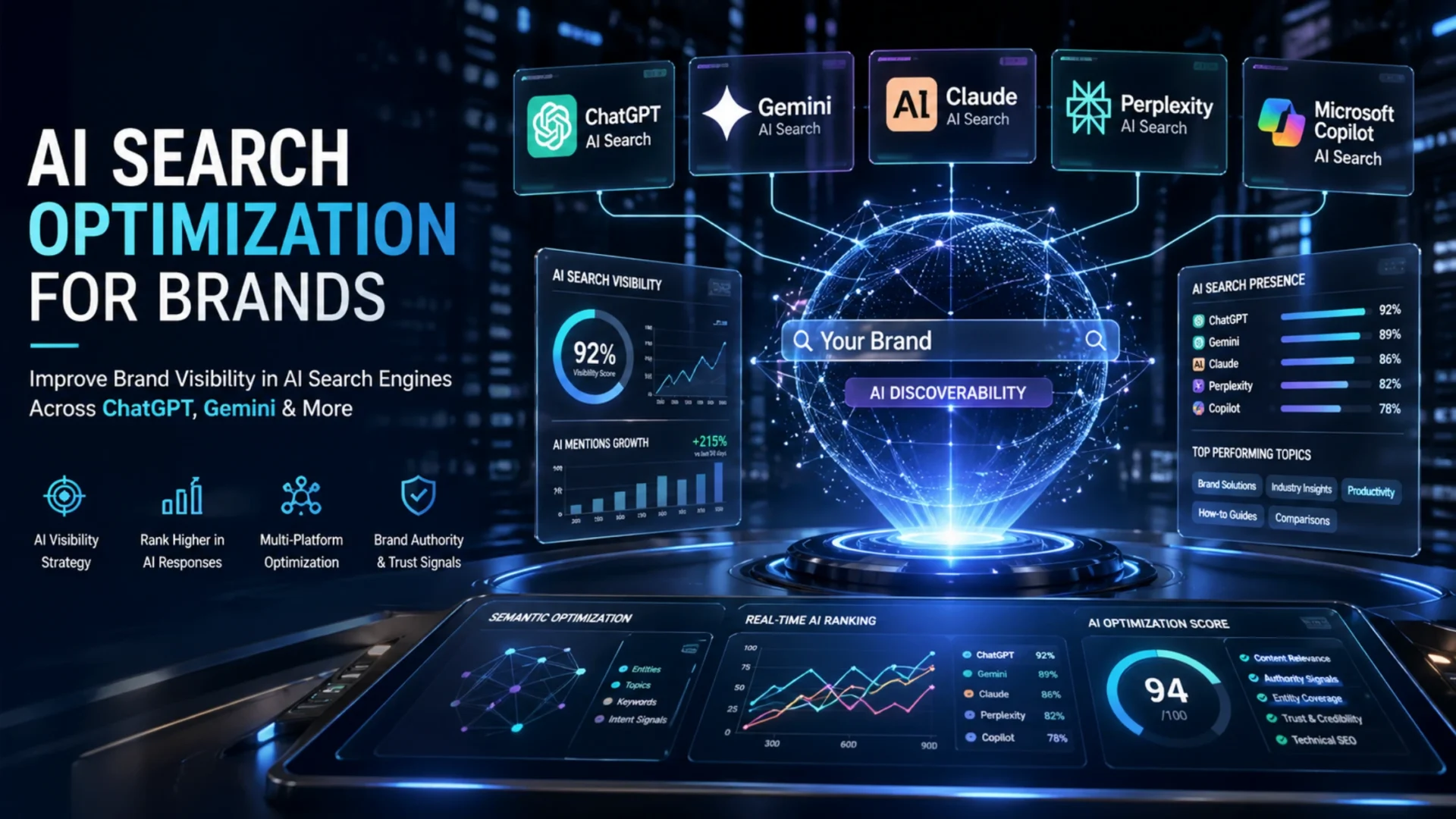
That’s the new battle. Improving brand visibility through AI-Powered SEO Services in AI search engines is no longer a nice extra for forward-thinking marketers. It’s becoming the difference between being part of the conversation and being invisible to it. This guide walks through what AI search visibility really means, the signals that drive it, and the practical moves your team can make starting this quarter.
What Brand Visibility in AI Search Actually Means
Traditional SEO chased rankings. You optimized a page, earned links, and watched it climb a SERP. AI search optimization is different. The goal isn’t a position. It’s a citation, a mention, a name-drop inside an answer the user never has to click away from.
A few practical definitions worth pinning down:
Citation visibility
How often a large language model references your brand or content inside its generated answer.
Entity authority
Whether the AI recognizes your brand as a distinct, trusted entity tied to specific topics.
Surface presence
Where your brand shows up across AI Overviews, ChatGPT browsing results, Perplexity sources, Gemini summaries, and Bing Copilot answers.
Honestly, this is closer to PR thinking than classic SEO thinking. You’re not chasing a slot. You’re earning a reputation the model trusts enough to repeat.
Why It Matters Now, Not Later
Click-through rates from organic listings have been sliding for two years. AI Overviews accelerated that drop. Studies from Pew Research and several major SEO platforms have shown organic CTR shrinking on queries where an AI summary appears at the top. The traffic doesn’t vanish. It moves. It now flows through the answer itself.
A few reasons brands can’t afford to wait:
The first-mover advantage is real. AI models build their associations slowly, and breaking into an established list of cited sources gets harder every quarter.
Buyers research differently. B2B procurement now starts with a conversational query like “what are the best ecommerce development partners for mid-market retailers” and goes downstream from there. If you’re not in that first answer, you’re not in the shortlist.
Brand mentions compound. Each citation reinforces the next, the same way backlinks used to.
Traditional SEO vs AI Search Optimization
| Traditional SEO | AI Search Optimization |
|---|---|
| Keyword rankings | Brand mentions inside answers |
| SERP positions | AI citations and source links |
| Backlinks | Entity trust and topical association |
| Click-through rate | Conversational discoverability |
| Page-level optimization | Brand-level optimization |
| Crawl-friendly HTML | LLM-friendly structure and clarity |
Both still matter. Skipping classic SEO doesn’t help anyone. But pretending the second column doesn’t exist? That’s the mistake most teams are making right now.
The Ranking Factors Behind AI Search Visibility
Nobody outside Anthropic, OpenAI, or Google fully knows the weighting. What we do know, from observing thousands of AI answers across industries, is which signals consistently show up in cited content.
Topical depth, not topical breadth. Models reward sources that go deep on a subject rather than skimming twenty adjacent ones. A page that genuinely answers a narrow question outperforms a 4,000-word everything-guide that says nothing specific.
Entity clarity. The model needs to know what your brand is, where it operates, what it does, and what topics it owns. Vague positioning kills citation rates.
Trust signals across the web. Reviews, third-party mentions, industry directories, podcast appearances, conference speaker pages. These compound into the kind of authority a model can verify.
Structured data done properly. Schema markup helps. Organization schema, Article schema, FAQ schema, HowTo schema, Product schema where relevant. Done sloppy, it gets ignored. Done well, it accelerates entity recognition.
Original data and research. Models love numbers they can quote. A page with proprietary research, a survey, or original benchmarks gets cited at a noticeably higher rate than a page rehashing what everyone else already published.
E-E-A-T fundamentals. Experience, Expertise, Authoritativeness, Trustworthiness. Old framework, still highly relevant. Author bios, named contributors, real credentials, real case work.
Proven Strategies to Improve Brand Visibility in AI Search
Here’s where most articles list ten generic tips. Skip those. The strategies below are the ones we’ve watched actually move the needle for B2B and ecommerce brands.
Build a Real Entity SEO Foundation
If a model can’t tell what your brand is, none of the rest matters. Start with the basics that most teams quietly neglect.
Get your Organization schema right. Include legal name, founding date, headquarters, founders, social profiles, and same-as references to Wikipedia, Crunchbase, LinkedIn, and authoritative industry sources. Run a knowledge panel claim through Google. Sort out your Wikipedia or Wikidata presence if your brand is large enough to qualify.
Then chase consistency. NAP details, tagline, descriptions, leadership names. Make sure the version on your About page matches LinkedIn, matches Crunchbase, matches your press releases. Conflicting data confuses models. Confused models pick someone else.
Create Content Worth Citing
There’s a useful test for any blog draft: would a model quote a sentence from this? If the answer is no, you’re producing wallpaper.
Citation-worthy content usually shows three traits. It says something specific. It backs claims with numbers or named sources. And it covers angles competitors skipped.
A few formats that consistently earn AI citations:
- Original research reports with downloadable data
- Comparison breakdowns with clear verdicts
- Industry benchmarks with year-over-year tracking
- Practitioner case studies with real metrics
- Definitive how-to guides written by named experts
Thin listicles? Generic explainers? Mostly invisible. The model has fifty of those to choose from. It picks the one with the strongest claim.
Optimize for AI Overviews and Generative Engines
Generative engines retrieve and summarize. Your content should make both jobs easy.
A few practical moves:
Lead with the answer. Don’t bury the conclusion under five paragraphs of throat-clearing. The first sentence under each H2 should answer the heading.
Write conversational headings. Real questions people ask, not keyword stuffing. “How does AI search visibility work” beats “AI Search Visibility Strategies and Methods.”
Use short, quotable sentences strategically. Mixed in with longer analysis. The short ones get pulled into answers. The longer ones build credibility.
Cluster related content. One pillar page on AI search visibility, supported by deeper pieces on entity SEO, schema, GEO, and answer engine optimization. Models pick up topical authority from clusters, not isolated articles.
Worth reading next: our GEO vs AEO vs SEO comparison guide goes deeper into the structural differences between these three optimization layers.
Strengthen Brand Authority Beyond Your Own Site
Your domain alone isn’t enough. AI models pull signals from across the web, and brands that show up in the right places earn citations even when their own page wouldn’t have ranked.
Where to invest:
Digital PR with real outlets. A mention in TechCrunch, Forbes, Search Engine Land, or a credible vertical publication carries weight that no amount of self-published content can replicate.
Industry directories that matter. Clutch, G2, Capterra, GoodFirms. Get profiles complete, get reviews moving, keep details fresh.
Podcast appearances. Models increasingly pick up transcripts. A founder on three relevant podcasts in six months builds named-entity recognition fast.
Author bylines. Get your subject experts contributing to industry publications under their own names. Author authority compounds.
Invest in Generative Engine Optimization
GEO is the discipline of structuring content specifically for retrieval by large language models. It overlaps with SEO but isn’t the same. The mechanics are technical: clean HTML, semantic structure, proper headings, fast loading, accessible markup, content chunking that makes sense to a retrieval system.
For most enterprise brands, this is the layer that needs the most catching up. Our generative engine optimization services page covers what a proper GEO audit actually looks at.
Monitor What’s Actually Happening
You can’t improve what you don’t measure. The catch is that most analytics platforms weren’t built for AI search.
Tools worth looking at:
- Profound: Tracks brand mentions across major LLMs.
- Semrush AI toolkit: Adds AI Overview tracking onto familiar SEO data.
- Otterly.AI: Focused specifically on AI search visibility monitoring.
- Scrunch AI: Strong on competitive benchmarking inside AI answers.
- Goodie AI: Useful for share-of-voice tracking inside generative engines.
- BrightEdge and Ahrefs: Both have rolled out AI visibility features worth testing.
Pick one. Set a baseline. Track monthly. The exact tool matters less than building the habit of looking.
Common Mistakes Brands Keep Making
A short list, because most of these are avoidable.
Ignoring entity SEO entirely
Treating it as a technical afterthought instead of a brand foundation.
Publishing thin content at high volume
Twenty mediocre posts a month doesn’t beat four genuinely useful ones.
Skipping schema
Or worse, implementing it wrong, with mismatched data that hurts more than helps.
Chasing every new AI platform without focus
Pick the two or three that matter for your buyers and go deep. ChatGPT and Google AI Overviews cover most B2B use cases right now.
Forgetting the human reader
AI optimization should never come at the cost of clarity, voice, or genuine helpfulness. The model is reading the same page your prospect is.
Measuring ROI from AI Search Visibility
Attribution gets messier here. Direct traffic from AI engines is often referrer-stripped, so dashboards can underreport the impact significantly.
What to track:
- AI mention frequency for branded and category queries
- Share of voice against named competitors inside generated answers
- Referral traffic from AI sources where attribution is captured
- Direct traffic spikes correlated with AI citation events
- Branded search lift over a 90-day window
- Demo requests and qualified leads referencing AI tools as their discovery channel
The lagging indicator matters most. When sales calls start with “we asked ChatGPT for the best [your category] partners and your name came up,” the strategy is working.
What’s Coming Next
A few shifts already in motion:
Multi-LLM optimization becomes the default. Brands stop optimizing for one model and start tracking presence across five or six.
Real-time content adaptation. Models will increasingly favor sources that update frequently and reflect current data.
AI authority scoring as a category. Expect tools and possibly platforms themselves to publish authority signals tied to AI citation worthiness.
Stronger emphasis on first-party data. Original research and proprietary insights become the most valuable currency in citation markets.
Brand governance inside AI. Bigger brands will start actively managing how they’re described by major models, similar to how they manage knowledge panels today.
Where to Start This Month
Don’t try everything at once. A 30-day starting point that actually works:
Week one
Audit your entity foundation. Schema, knowledge panel, Wikipedia or Wikidata, NAP consistency.
Week two
Pick three high-intent topics where being cited would matter, and rewrite or commission strong content for each one.
Week three
Set up tracking. Pick a tool. Capture baselines for your brand and three competitors.
Week four
Plan a digital PR push with one named author and three target publications.
That’s enough to move. Iterate from there.
FAQ’s
How can brands improve visibility in AI search engines?
Brands improve AI search visibility by combining strong entity SEO, citation-worthy content, structured data, third-party mentions, and active monitoring across major LLMs. Authority signals matter more than keyword volume.
What is the best strategy for ranking in AI-generated search results?
There’s no single ranking. The closest equivalent is being cited inside answers. The strategy is depth over breadth, original data, clear entity definition, and consistent presence across trusted external sources.
How does AI search optimization differ from traditional SEO?
Traditional SEO targets page rankings on a SERP. AI search optimization targets brand mentions and citations inside generated answers. Both rely on quality content, but AI search puts heavier weight on entity authority, structured data, and third-party trust signals.
Why is brand authority important for AI search visibility?
Large language models pull from sources they recognize as trusted on a given topic. Brand authority, built through reviews, PR mentions, expert content, and consistent web presence, signals that trust. Without it, citations rarely happen.
What tools help track brand mentions in AI search platforms?
Profound, Otterly.AI, Scrunch AI, Goodie AI, Semrush’s AI toolkit, BrightEdge, and Ahrefs all offer features for tracking AI search visibility. Most teams start with one platform and expand from there.
How do Google AI Overviews impact brand discoverability?
AI Overviews summarize answers at the top of search results, which often reduces clicks to ranking pages. Brands cited inside the Overview gain visibility even without a click. Brands not cited become harder to discover for users who stop scrolling after the summary.
Ready to get your brand cited inside AI answers?
Elsner’s GEO and AI search optimization team helps B2B brands, SaaS companies, and ecommerce leaders build the entity authority, content depth, and technical foundation needed to show up across ChatGPT, Gemini, and Google AI Overviews. Request an AI search visibility audit and see exactly where your brand stands today.
Get an AI Search Visibility Audit