




- What Makes Ecommerce “Enterprise” (and What Doesn’t)
- Why Enterprise Ecommerce Became a Priority
- Core Features That Define an Enterprise Ecommerce Solution
- Scalability and performance under load
- Deep integration with ERP, CRM, and OMS
- Advanced catalog and product information management
- B2B capabilities that match how companies actually buy
- Headless and API-first architecture
- Security, compliance, and reliability
- The Benefits That Justify the Investment
- The Challenges Teams Underestimate
- How Enterprise Ecommerce Platforms Are Built
- Enterprise Ecommerce Platforms Compared
- How to Choose the Right Platform
- Implementation Realities
- Trends Worth Watching
- A Pre-Investment Checklist
- Planning an Enterprise Ecommerce Build or Migration?
- Frequently Asked Questions
- What is enterprise ecommerce?
- How is enterprise ecommerce different from traditional ecommerce?
- How much does an enterprise ecommerce solution cost?
- Which enterprise ecommerce platform is best?
- What is headless enterprise ecommerce?
- Can enterprise ecommerce platforms support both B2B and B2C?
- What are the biggest enterprise ecommerce challenges?
- How long does an enterprise ecommerce implementation take?
Most enterprise ecommerce projects don’t fall apart because the platform was wrong. They fall apart because the team underestimated everything around it. The catalog that quietly grew to half a million SKUs. The four back-office systems that all need to agree on inventory in real time. The legacy order tool nobody wants to touch but everyone depends on. Picking an enterprise ecommerce platform is the visible decision. The hidden work, integration, data, and the way an organization actually operates, is where the money and the timeline really go.
This guide walks through what enterprise ecommerce actually means, the features that separate it from a standard storefront, the benefits that justify the spend, and the challenges that sink projects when they get waved away early. By the end you should be able to tell whether your business genuinely needs an enterprise ecommerce solution yet, and what to weigh before committing budget to one.
Quick answer: what is enterprise ecommerce?
Enterprise ecommerce is online selling built for high order volume, large or complex catalogs, multiple stores or regions, and deep integration with systems like ERP, CRM, and order management. It prioritizes scalability, security, customization, and unified data over the simplicity of an off-the-shelf store, and it is typically run by a team rather than a single owner.
What Makes Ecommerce “Enterprise” (and What Doesn’t)
There’s no membership card that turns a store into an enterprise operation. The label describes a level of complexity, not a revenue number on a slide. A business crosses into enterprise territory when its catalog, traffic, integrations, and team structure outgrow what a standard platform can comfortably handle.
A useful way to see the line is to compare what each tier is actually carrying day to day. Same store on the surface, very different machinery underneath.
Who actually lives in that right-hand column? Manufacturers and distributors managing huge B2B catalogs with contract pricing. Retailers selling across several brands and channels at once. Wholesalers handling tiered pricing and net terms. Healthcare and regulated sellers with compliance obligations baked into every transaction. If your operation looks like one of those, a standard store will start fighting you sooner than you’d like.
Why Enterprise Ecommerce Became a Priority
A decade ago, “having an online store” was the goal. Now the store is table stakes, and the pressure has moved to everything connected to it. Three shifts pushed enterprise ecommerce from a nice-to-have to a board-level conversation.
Buyers stopped tolerating friction. Whether someone is purchasing a $40 consumer product or signing a $400,000 supply contract, the expectation is the same fast, personalized, self-serve experience they get from the best apps they use daily. B2B buyers in particular now want to research, configure, and reorder without ever talking to a sales rep, and the businesses that make that easy win the repeat orders.
Channels multiplied. A single customer might discover a product on social, compare it on a marketplace, buy through the website, and return it in a store. Holding that experience together demands a commerce engine that treats inventory, pricing, and customer history as one shared source of truth instead of five disconnected ones. That unified view is also what turns raw activity into something you can act on, which is where strong business intelligence earns its keep.
Catalogs and operations got heavier. More SKUs, more variants, more regions, more rules. At small scale a spreadsheet and a couple of plugins cope. At enterprise scale, that approach quietly creates errors, stockouts, and pricing mistakes that cost real money before anyone notices. The platform has to carry the weight.
Core Features That Define an Enterprise Ecommerce Solution
Feature checklists for enterprise platforms run long, and most of them blur together. The features that actually matter cluster into a smaller set of capabilities. Get these right and the rest tends to follow.
1
Scalability and performance under load
The platform should hold its speed when traffic spikes during a promotion and when the catalog grows past anything a standard store would handle. This is the non-negotiable one. A site that buckles on the busiest day of the year fails at the exact moment it matters most.
2
Deep integration with ERP, CRM, and OMS
This is where enterprise commerce really separates from the pack. Orders, inventory, customers, and finance have to flow between systems automatically. When they don’t, staff spend their days re-keying data between tools, and that manual layer is both expensive and a steady source of errors.
3
Advanced catalog and product information management
Large catalogs need structured data, bulk editing, complex variants, and one place where product information stays consistent across every channel. A dedicated PIM, either built in or connected, stops the same product from showing three different descriptions in three different places.
4
B2B capabilities that match how companies actually buy
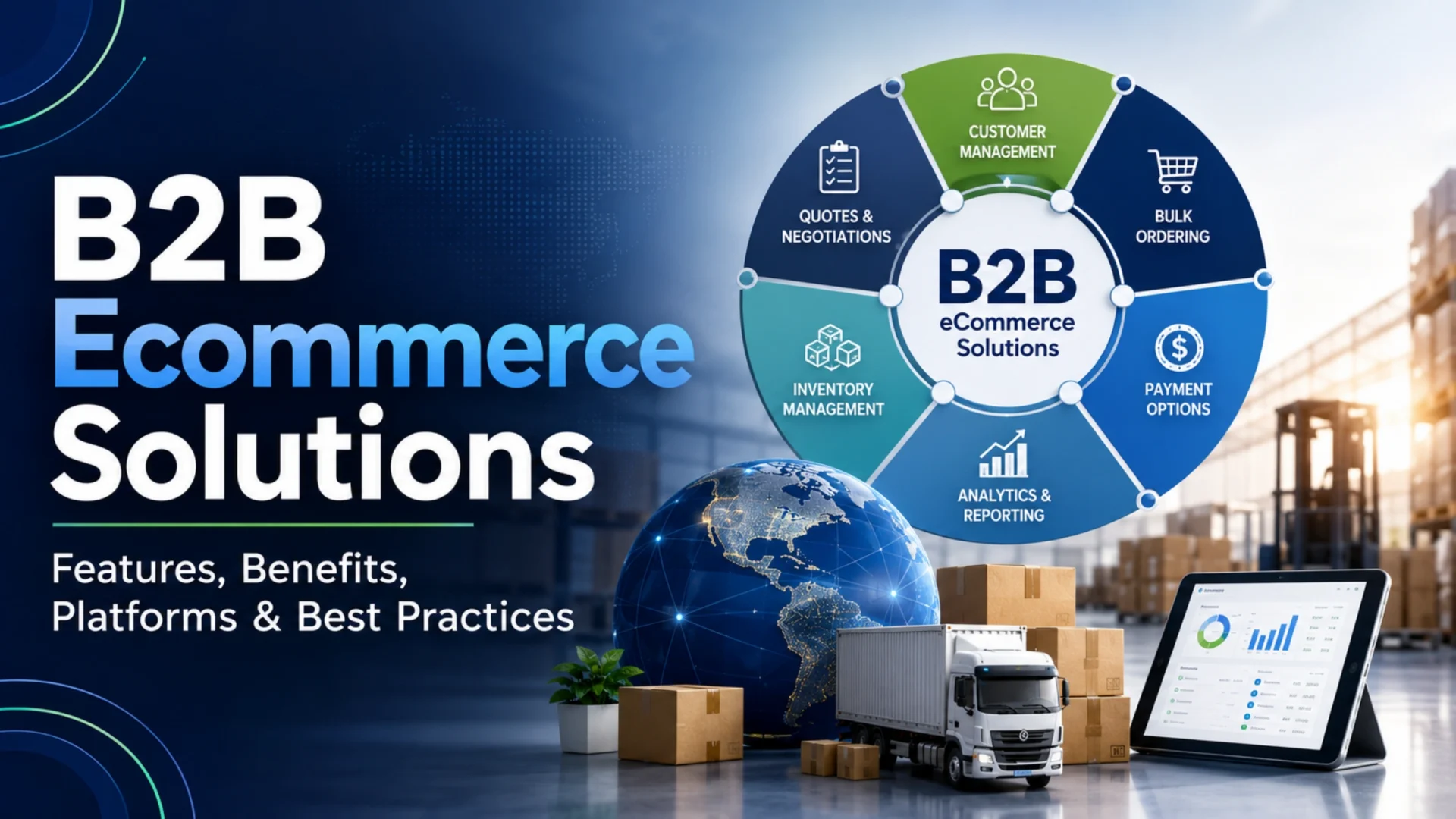
Quote requests, contract and tiered pricing, net payment terms, approval workflows, and account hierarchies for buyers with multiple sub-accounts. Consumer features alone won’t serve a wholesale or distribution buyer, and the platforms that handle this well open up serious revenue. If B2B is your world, the mechanics behind B2B ecommerce features deserve a close look before you commit.
5
Headless and API-first architecture
Separating the storefront from the commerce engine lets teams build fast, custom experiences and push content to web, mobile, and other surfaces from one back end. It adds engineering overhead, so it isn’t right for everyone, but for businesses that need a distinctive front end it’s transformative. A practical primer on headless ecommerce is worth reading before you decide.
6
Security, compliance, and reliability
PCI DSS for payment data, plus the access controls, audit trails, and uptime guarantees a serious business depends on. The PCI Security Standards Council sets the baseline here, and enterprise platforms are expected to meet it as a starting point, not a stretch goal.
Beyond those six, expect personalization, advanced on-site search, workflow automation, multi-currency and multi-language support, and analytics that tie back to revenue. Useful, yes. But they sit on top of the foundation above, not in place of it.
The Benefits That Justify the Investment
Enterprise platforms cost more, take longer, and demand more from the team. So the benefits have to be framed as business outcomes, not feature counts. Here’s where the return actually shows up.
- Revenue grows from the same demand. Faster pages, smoother checkout, and personalization lift conversion across every visitor you already have. That compounds. Worth chasing first.
- Operating costs drop as manual work disappears. Automated order, inventory, and pricing flows replace the re-keying that quietly eats payroll hours. The savings are real and they recur.
- One view of the customer sharpens every decision. When commerce, finance, and service share the same data, the guesswork leaves the room. Marketing spend, inventory bets, and pricing all get more accurate.
- Expansion stops being a rebuild. New region, new brand, new channel: an enterprise foundation absorbs growth instead of forcing a re-platform every couple of years. That headroom is part of what you’re paying for.
- The business gets more agile, not less. Counterintuitive, but a well-built modern stack ships changes faster than a tangle of plugins ever could.
One honest caveat on ROI
These benefits are real, but they don’t all arrive on day one. Conversion and automation wins can show up within the first quarter or two. The bigger structural payoffs, agility and clean data, build over time. Anyone promising instant transformation is selling, not advising. Results vary by scope and starting point.
The Challenges Teams Underestimate
This is the section most articles skip or soften, and it’s the one that decides whether a project succeeds. The platform is rarely the hard part. These are.
Integration debt is the silent budget killer. Every system you connect, ERP, CRM, tax, shipping, is a relationship that has to be built, tested, and maintained. Teams routinely budget for the platform and forget that the integrations can cost as much as the platform itself, sometimes more. Map every system before you sign anything.
Data migration is messier than it looks on paper. Years of orders, customers, and product data carry inconsistencies, duplicates, and gaps. Moving it cleanly takes longer than anyone expects, and skipping the cleanup just imports the mess into the shiny new system. Budget time for it specifically.
Total cost of ownership runs well past the license fee. The sticker price is the beginning. Add hosting, integrations, custom development, ongoing maintenance, and the internal team time to run it all. A platform that looks cheap on licensing can cost more in total than one with a higher headline price. Model the full picture, not the line item.
Vendor lock-in versus flexibility is a genuine tradeoff. An all-in-one suite is simpler to run but harder to change. A composable, best-of-breed stack offers flexibility but demands real engineering discipline to keep it coherent. Neither is wrong. Choosing without understanding the tradeoff is.
The mistake that sinks projects
Treating enterprise ecommerce as an IT project. It isn’t. It touches sales, marketing, operations, finance, and customer service, and if those teams aren’t aligned and involved from the start, the platform launches into an organization that wasn’t ready for it. The technology rarely fails. The change management around it does.
How Enterprise Ecommerce Platforms Are Built
You don’t need to be an architect to make a smart decision, but understanding the layers helps you ask better questions and spot weak proposals. An enterprise commerce stack is essentially four layers working together.
When a project gets expensive or slow, the integration layer is usually the reason. It’s the least visible part of the stack and the most underestimated in planning. If you’re weighing a heavily customized build, the discipline behind solid custom software development is what keeps that layer maintainable instead of becoming a liability two years in.
Enterprise Ecommerce Platforms Compared
No platform wins every scenario, and any vendor who claims otherwise should make you cautious. The right choice depends on your catalog, your B2B versus B2C mix, your integration load, and how much engineering capacity you have in-house. Here’s how the major options generally line up.
Cost tiers are relative, not exact pricing. Actual cost depends on traffic, integrations, and customization. Confirm current pricing directly with each vendor.
If you’re still deciding between a packaged platform and something built around your exact workflows, the tradeoffs in SaaS versus custom ecommerce are worth thinking through, since that single decision shapes almost everything downstream.
How to Choose the Right Platform
Skip the feature-comparison spreadsheet for a minute. The better starting point is a short set of questions about your own business. Your honest answers narrow the field faster than any vendor demo.
- How complex is the catalog, really? Variant depth, pricing rules, and SKU count matter more than the raw number of products.
- Is this B2B, B2C, or both? The answer rules certain platforms in and out immediately.
- How many systems need to connect? Count them now. This is the line item most teams get wrong.
- What engineering capacity do you have in-house? Composable flexibility is a gift to teams that can support it and a burden to teams that can’t.
- Where do you expect to be in three years? Choose for the growth horizon, not just today’s needs.
- What does total cost look like across three years? License plus hosting plus integrations plus maintenance plus team time.
Implementation Realities
Enterprise ecommerce projects move through recognizable phases, and knowing the shape of them keeps expectations grounded. Timelines vary widely with scope, so treat these as a frame rather than a promise.
Discovery and planning come first, where requirements, integrations, and data are mapped in detail. Rushing this phase is the most common and most expensive mistake, because every gap here surfaces later at ten times the cost. Then comes the build, including the storefront, the commerce configuration, and the integration work that usually dominates the timeline. Data migration runs alongside or just after, and it deserves its own attention rather than being treated as a quick export and import.
Testing follows, and it should be thorough across devices, payment scenarios, and every connected system, not a quick click-through before launch. Launch itself is best done in stages where possible, rather than flipping a single switch and hoping. And the work doesn’t end at go-live. Enterprise commerce is something you operate and improve continuously, which is why ongoing ecommerce maintenance belongs in the plan and the budget from the start.
Trends Worth Watching
A few shifts are actively reshaping how enterprise commerce gets built, and they’re worth factoring into a platform decision you’ll live with for years.
Composable commerce is the move away from monolithic suites toward best-of-breed components connected through APIs. The approach is championed by groups like the MACH Alliance, and it offers real flexibility, though it asks more of your engineering team in return. AI-driven personalization and search are becoming standard rather than premium, with recommendations and on-site search tuned to individual behavior. Unified commerce pushes past omnichannel toward a single real-time view of inventory, customers, and orders across every touchpoint. And first-party data strategies are gaining urgency as third-party tracking fades, making the customer data your own platform collects more valuable than ever.
A Pre-Investment Checklist
Before committing budget, run an honest pass through these. If you’re answering “not yet” to several, the groundwork needs attention before the platform decision does.
✓ Growth goals are defined in numbers, not adjectives
✓ Every system that needs to integrate has been listed and counted
✓ Existing data has been assessed for quality, not just volume
✓ Security and compliance requirements are documented up front
✓ A three-year total cost of ownership has been modeled
✓ The non-IT teams who’ll use the platform are part of the decision
✓ There’s a plan for who operates and improves the platform after launch
Enterprise ecommerce rewards the businesses that treat it as an operating decision, not just a software purchase. The platform matters, but the planning around it, integrations, data, team alignment, and a realistic view of total cost, is what separates the implementations that pay off from the ones that stall. Get those right, and the technology does exactly what it’s supposed to: carry growth instead of capping it.
Planning an Enterprise Ecommerce Build or Migration?
From platform selection and integration architecture to data migration and post-launch optimization, the right partner reduces risk and gets you to value faster. Let’s map your requirements, your integration load, and the platform that actually fits how your business operates.
Frequently Asked Questions
What is enterprise ecommerce?
Enterprise ecommerce is online selling built for high order volume, large or complex catalogs, and deep integration with systems like ERP, CRM, and order management. It emphasizes scalability, security, and customization over the simplicity of a standard store, and it is usually run by a cross-functional team rather than a single owner.
How is enterprise ecommerce different from traditional ecommerce?
The difference is complexity, not just size. Traditional ecommerce runs on themes, plugins, and a handful of integrations. Enterprise ecommerce handles massive catalogs, multiple stores and regions, custom workflows, and connections to several back-office systems at once, with the performance and security to match.
How much does an enterprise ecommerce solution cost?
It varies widely with scope, so any single figure would mislead. Total cost includes licensing, hosting, integrations, custom development, ongoing maintenance, and internal team time. The integration and customization work often costs as much as the platform itself, so model total cost of ownership across at least three years rather than focusing on the license fee.
Which enterprise ecommerce platform is best?
There’s no single best platform. The right choice depends on catalog complexity, your B2B versus B2C mix, how many systems need to integrate, and your in-house engineering capacity. Shopify Plus suits speed-focused brands, Adobe Commerce handles complex customization, BigCommerce balances flexibility with lower operational load, and Salesforce, SAP, and commercetools serve large or composable enterprise needs.
What is headless enterprise ecommerce?
Headless ecommerce separates the customer-facing front end from the commerce engine, connecting them through APIs. This lets teams build fast, fully custom experiences and deliver content across web, mobile, and other channels from one back end. It adds engineering overhead, so it fits businesses that need a distinctive front end and have the technical capacity to support it.
Can enterprise ecommerce platforms support both B2B and B2C?
Yes. Most leading enterprise platforms support hybrid B2B and B2C selling, with B2B features like contract pricing, quote requests, net terms, and account hierarchies running alongside standard consumer functionality. If both models matter to your business, confirm the platform handles them natively rather than through workarounds.
What are the biggest enterprise ecommerce challenges?
The hardest parts are rarely the platform. Integration complexity, data migration, total cost of ownership beyond the license, and the vendor lock-in versus flexibility tradeoff cause the most trouble. The single biggest risk is treating the project as IT-only instead of aligning sales, operations, finance, and marketing from the start.
How long does an enterprise ecommerce implementation take?
Timelines depend heavily on scope, integration count, and data complexity, so ranges vary a lot. Discovery, build, migration, testing, and a staged launch all take real time, with integration work usually dominating. Rushing discovery is the most common way to blow the timeline later, so plan that phase carefully rather than compressing it.