



- What is an AI-ready ecommerce website, and why it matters in 2026
- How ChatGPT and Google AI actually choose which products to recommend
- Seven steps to build an AI-ready ecommerce website
- Platform notes: Shopify, WooCommerce, BigCommerce, Magento
- Common mistakes that keep you invisible to AI
- How Elsner builds AI-ready ecommerce websites
- Quick reference checklist
- Final thoughts
- Want to know exactly where your store stands with AI search?
- Frequently Asked Questions
- What is an AI-ready ecommerce website?
- How do I get my products recommended by ChatGPT?
- Do I need Google Merchant Center to appear in AI shopping results?
- Does this work on Shopify and WooCommerce?
- How long does it take to see AI visibility results?
- Is GEO different from SEO?
- Should I block AI crawlers to protect my content?
Something shifted in the last year, and most ecommerce brands haven’t noticed yet. Earlier, shoppers typed “best waterproof laptop backpack” into Google, scrolled through ten blue links, and picked one. Now they just ask ChatGPT. Or they glance at Google’s AI Overview. They get a targeted answer, three or four product names, and a short reason why each one made the cut. No browser tabs. No scrolling. Just an answer.
Here’s the number that should worry every store owner reading this: in early 2026, 68 percent of US Google searches. ended without a single click Further, generative AI traffic to US retail sites has grown 4,700 percent year over year. That’s not a typo. That’s a genuine behavior shift.
So the real question isn’t “should I care about AI search?” It’s “does ChatGPT even know my products exist? Would it actually recommend them?” This guide walks through exactly what it takes to build an AI-ready ecommerce website so generative engines can read, trust, and recommend your products. No fluff. Just steps you can actually implement.
Quick Answer
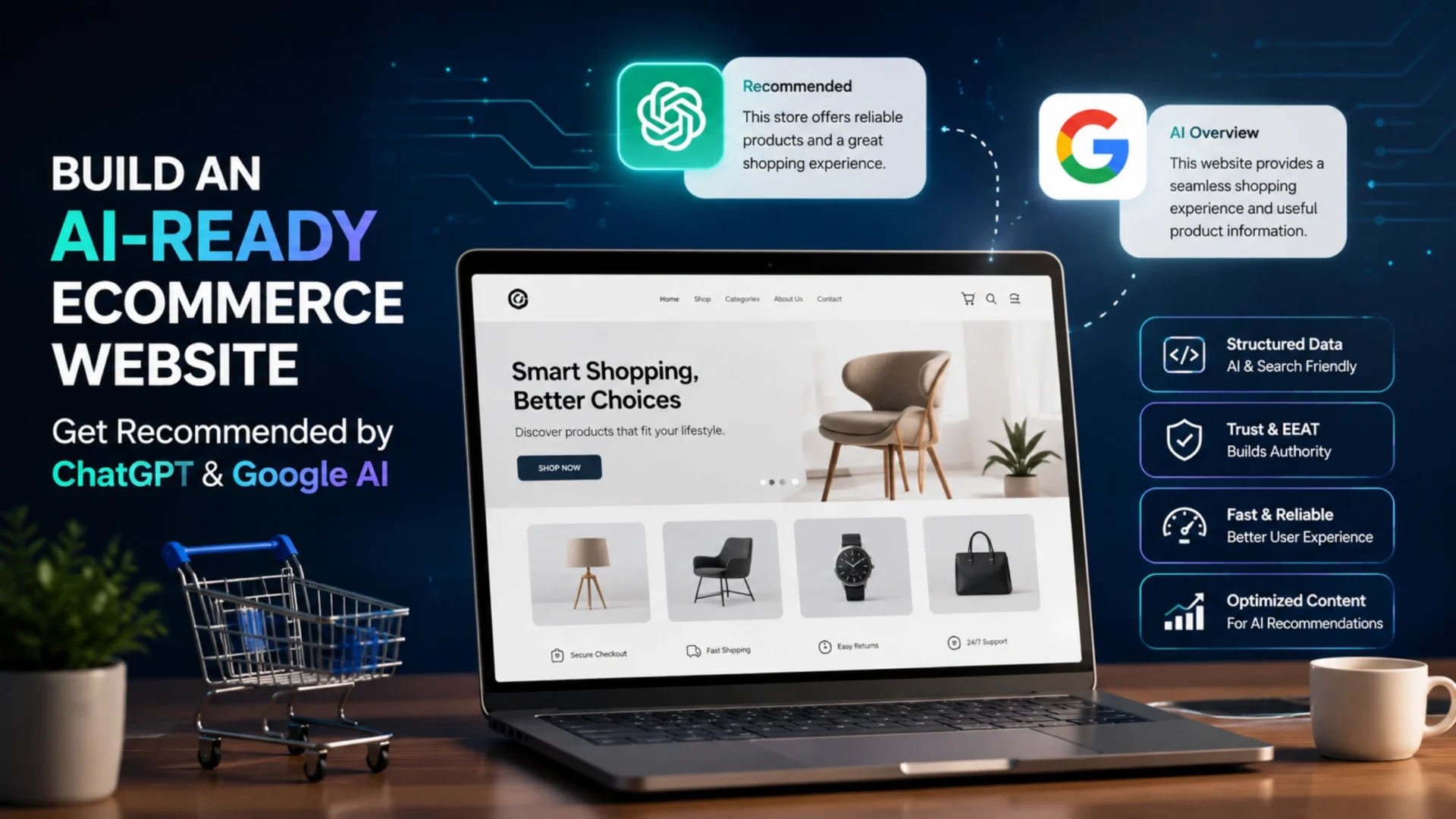
An AI-ready ecommerce website is a store built for machine reading, not just human browsing. That means complete JSON-LD Product and FAQ schema, server-side rendering so crawlers can actually see your prices and descriptions, an accurate Google Merchant Center feed, crawler access for OAI-SearchBot and PerplexityBot, and content written in plain, use-case language that AI engines can lift and cite directly. Get those five things right and ChatGPT, Google AI Mode, and Perplexity have a real reason to recommend you.
What is an AI-ready ecommerce website, and why it matters in 2026
An AI-ready ecommerce website is a structured website. It allows generative engines like ChatGPT, Google AI Mode, and Perplexity to actually read your product data, understand what you sell, and cite you as an answer. It isn’t about ranking in the classic sense. It’s about being legible to a machine that reads meaning instead of counting keywords.
In simple terms, your store isn’t built just for humans or Google rankings anymore. It’s built for AI decision-making too. Two terms come up constantly here:
- GEO (Generative Engine Optimization): optimizing your store to be picked up and surfaced by AI engines.
- AEO (Answer Engine Optimization): structuring content so it directly answers a user’s question, no digging required.
We’ve gone deeper into how these two differ from traditional SEO in our GEO vs AEO vs SEO comparison guide, so we won’t repeat all of that here. Why does this matter so much right now? According to Gartner 25 percent, of search volume is expected to shift to AI-driven experiences by 2026. That’s not small.
Even more interesting, data shows that AI-referred ecommerce visitors convert at 2.47 percent, compared to 1.82 percent from Google Ads. That means fewer clicks, but better buyers. Traffic might shrink a little. The quality of it, though, is going up.
How ChatGPT and Google AI actually choose which products to recommend
This is where most guides get vague, so let’s actually get into the mechanics. AI engines don’t rank pages the way Google’s classic algorithm does. There’s no backlink count being tallied, no keyword density check. Instead, these systems use retrieval and semantic matching. They pull chunks of information that seem to directly answer the query, then generate a response from what they’ve retrieved.
Structured data plays a much bigger role here than most people realize. Findings show that 71 percent of pages cited by ChatGPT and 65 percent of pages cited by Google AI Mode include structured data. That’s not a coincidence. Clean, machine-readable markup is basically what gets your product shown instead of leaving it guessable.
There’s also a detail a lot of brands miss entirely: ChatGPT pulls around 75 percent of its product data from Google Shopping. Which means your Google Merchant Center feed isn’t just a Google Ads thing anymore. It’s quietly become one of the core inputs powering ChatGPT’s product recommendations too.
Broadly, three signal groups do the heavy lifting: on-site data quality, meaning your schema, your content, and how clean your structure actually is; off-site authority and citations, meaning mentions, reviews, and being talked about elsewhere; and review signals, meaning specific, verifiable, detailed reviews rather than a pile of star ratings.
Each engine leans differently, too. ChatGPT rewards comprehensive, well-organized content. Google AI Overviews depend heavily on Google’s own index plus Merchant Center data. Perplexity prefers freshness and how easily its crawler can access your site. Claude tends to favor depth and factual accuracy over surface-level polish.
Seven steps to build an AI-ready ecommerce website
These are the steps that actually get a store considered and cited by AI platforms, in the order they should happen.
1
Audit your current AI visibility
Before fixing anything, find out where you actually stand. Open ChatGPT, Google AI Mode, Perplexity, and Claude, then run real buyer-style questions, the kind an actual customer would type. Not generic searches like “brand name products.” Try “best noise-cancelling headphones for flights under $200.” Note down where you show up, where competitors appear, and where you’re invisible. Brands are frequently shocked at how absent they are. Build a bank of 50 to 100 test queries so you can track movement over months, and segment your AI referral traffic in GA4, watching for sources like chatgpt.com and perplexity.ai in your referral data.
2
Make your store technically readable by AI crawlers
Check your robots.txt file. A lot of stores accidentally block the very crawlers that would make them visible in AI search. Allow OAI-SearchBot and PerplexityBot, since these actually power AI search visibility. You can still block GPTBot, used for model training, without hurting your search visibility at all. Next, check how your product data loads. If prices, descriptions, and schema only appear after JavaScript runs, a lot of AI crawlers simply won’t see them. Server-side rendering fixes this. An easy test: disable JavaScript in your browser and reload a product page. If the product info disappears, that’s a problem. It’s also worth adding an llms.txt file, since it gives AI systems a clean, direct map of your most important content.
3
Structure product data with schema AI can trust
Implement complete JSON-LD Product schema on every important page, including price, availability, GTIN or another identifier, brand, and review data. Don’t leave gaps. An incomplete schema is worse than none at all, because it signals unreliable data. Add FAQPage schema too, not just on product pages but on category pages and buying guides. Sites that combined structured data with FAQ blocks saw a 44 percent increase in AI citations. If you’re prioritizing, start with your top-revenue SKUs and get those to full attribute completion before working outward.
4
Optimize your Google Merchant Center feed
This is something many brands still miss. ChatGPT pulls a large portion of product data from Google Shopping, which makes your Merchant Center feed genuinely critical. Keep pricing, availability, and identifiers accurate, and make sure your on-page schema matches what’s in the feed. Mismatches between the two confuse AI systems and can hurt visibility. Here’s a thing that makes a real difference: write feed descriptions and product copy in natural, use-case language instead of a spec dump. Compare “600D nylon backpack, 20L capacity” against “ideal for long-distance commuters who need a waterproof laptop backpack that survives daily transit.” AI understands use cases better than specs alone, and this improves both Shopping and AI visibility at once.
5
Create content AI engines actually cite
Write conversational, use-case-led content that mirrors how people actually talk to AI. Category buying guides and comparison pages work particularly well here, especially in an answer-first format: start with a direct answer, then support it. Real facts matter more than persuasive language. A Princeton-led study on generative engine optimization found that adding citations, quotations, and statistics to content can lift visibility in generative engines by up to 40 percent. Add genuine FAQ sections too, 3 to 4 real purchase questions per page, not filler questions nobody actually asks. Think about what a hesitant buyer would want answered before checkout.
6
Build off-site authority and review signals
None of this works in isolation. AI engines cross-reference what you say about yourself against what the rest of the internet says about you. Brand mentions across the web are one of the strongest predictors of AI citation, carrying around 35 percent of the weight in these models. Somewhat surprisingly, a strong Reddit presence tends to act as a real citation multiplier, since AI systems seem to treat Reddit discussions as a trust signal, probably because they read as unfiltered and genuine. Work on earning mentions through review sites, comparison articles, and reputable publications, and encourage customers to leave detailed reviews rather than just star ratings. Keep your brand and entity definitions consistent everywhere too. Same name, same description, same core facts, across your site, your social profiles, and any directory listings.
7
Measure and maintain AI visibility
This isn’t a one-time step. Track your AI referral traffic in GA4, keep an eye on brand citation mentions, and monitor your share of voice across the different engines. Re-run the test-query bank you built in step one and watch the trend line, not any single data point, since these systems change output from week to week even without you changing anything. Worth knowing: ChatGPT drove roughly 77 percent of AI assistant referral traffic as of April 2026, with Gemini and Perplexity both growing steadily. That mix is very likely to keep shifting, so don’t build your entire strategy around one engine’s current behavior.
Here’s a simplified before-and-after look at what “complete” schema actually means, since that word gets thrown around a lot without specifics.
| Element | Thin schema (before) | Complete schema (after) |
|---|---|---|
| Price | Listed | Listed, with currency and validity date |
| Availability | Missing | InStock or OutOfStock explicitly marked |
| Identifiers | None | GTIN, MPN, or SKU included |
| Reviews | Missing | aggregateRating with review count |
| Brand | Missing | Explicitly defined entity |
Small gaps like these are often the difference between a page that gets cited and one that gets skipped entirely. Getting the technical build right from the start is exactly what our AI-driven ecommerce development guide covers in more depth, including what a properly engineered, AI-friendly build looks like end to end.
Platform notes: Shopify, WooCommerce, BigCommerce, Magento
Good news. These strategies work across all major platforms. Implementation just differs slightly depending on where your store lives.
| Platform | What typically needs attention |
|---|---|
| Shopify | Often needs a theme-level fix or app for full schema control, since default themes tend to ship with incomplete markup |
| WooCommerce | Usually needs a dedicated schema plugin, since built-in WordPress SEO plugins vary widely in Product schema completeness |
| BigCommerce | Handles most of this natively but still needs manual FAQ schema work |
| Magento (Adobe Commerce) | Needs more developer attention for server-side rendering, since many Magento storefronts still lean on client-side JavaScript for product data |
If you want a deeper platform-specific breakdown, our ecommerce development team at Elsner handles this kind of build work across all four platforms regularly.
Common mistakes that keep you invisible to AI
A few of these show up over and over, and they’re usually easy fixes once you know to look for them.
- Blocking OAI-SearchBot in robots.txt. This is the big one. It makes your entire store invisible to ChatGPT search.
- Client-side-only rendering of product data and schema, since a lot of crawlers simply can’t execute JavaScript to see it.
- Thin or missing Product and FAQ schema across key pages.
- Incomplete or mismatched Merchant Center feeds, where your feed data and on-page schema tell two different stories.
- Persuasive copy with no real facts behind it, nothing an AI can actually cite.
- Treating this as a one-time project instead of ongoing maintenance.
Honestly, most stores are making at least two or three of these mistakes right now without realizing it.
How Elsner builds AI-ready ecommerce websites
At Elsner, this isn’t treated as just SEO or just development. It’s a combined approach. We audit your current AI visibility, fix technical gaps, implement structured data, optimize your product feeds, and build content that AI engines actually trust. And importantly, we track performance continuously, because this space is moving fast and staying visible requires ongoing work, not a one-time fix.
If you’re unsure where your store stands right now, reach out to our development team for an audit, or check our GEO and AEO service pages to see how we approach this work.
Quick reference checklist
- Run 50 to 100 real buyer-style queries across ChatGPT, Google AI Mode, Perplexity, and Claude to baseline your visibility
- Allow OAI-SearchBot and PerplexityBot in robots.txt, and confirm product data survives with JavaScript disabled
- Add complete JSON-LD Product schema, including price, availability, identifiers, brand, and review data on every key page
- Add FAQPage schema on product, category, and buying guide pages, not just product pages
- Match your Google Merchant Center feed exactly to your on-page schema, and write descriptions in use-case language
- Publish answer-first content with real citations, statistics, and genuine FAQ sections
- Earn off-site mentions, detailed reviews, and consistent brand entity information across the web
- Track AI referral traffic in GA4 and re-run your test-query bank monthly, not just once
Final thoughts
AI product discovery rewards data quality and genuine authority over ad spend. You don’t need the biggest budget to win here. You need a clean schema, an accurate feed, honest content, and a bit of patience. Run through the seven steps in order: audit your current visibility, fix crawler access, complete your schema, clean up your feed, write content worth citing, build off-site authority, then measure and keep going.
This space moves fast, and the early movers are the ones showing up in AI answers six months from now.
Want to know exactly where your store stands with AI search?
Have a team handle the technical side while you focus on the business. Reach out for an AI-visibility audit and we’ll show you exactly where your AI-ready ecommerce website stands today.
Frequently Asked Questions
What is an AI-ready ecommerce website?
A store built so AI tools like ChatGPT and Google AI can read it, understand it, and recommend its products. That means clean schema, content that loads properly, an accurate product feed, and copy people, and AI, can actually trust.
How do I get my products recommended by ChatGPT?
Start with your Merchant Center feed, since ChatGPT pulls a lot of its product data from Google Shopping. Add complete schema, allow OAI-SearchBot in robots.txt, and write content that actually answers what buyers are asking.
Do I need Google Merchant Center to appear in AI shopping results?
Yes, in most cases. Many AI engines rely on Google Shopping data, so an optimized Merchant Center feed significantly improves your chances of being recommended.
Does this work on Shopify and WooCommerce?
Yes. The core steps are the same everywhere. Each platform just needs a few small tweaks for schema and rendering, which are platform specific.
How long does it take to see AI visibility results?
Most stores see early movement in 6 to 10 weeks after fixing schema, feed, and content. Building real authority through reviews and mentions takes a bit longer, usually a few months.
Is GEO different from SEO?
Yes, though they overlap. SEO optimizes for ranked links in traditional search. GEO optimizes for being retrieved and cited inside AI-generated answers. Many of the same fundamentals, good content, technical cleanliness, trust, matter for both, but the mechanics of what gets rewarded differ.
Should I block AI crawlers to protect my content?
Blocking GPTBot, used for training, is fine and won’t hurt you. But blocking OAI-SearchBot or PerplexityBot will make you invisible in AI search, so know which one you’re actually blocking before you do.