



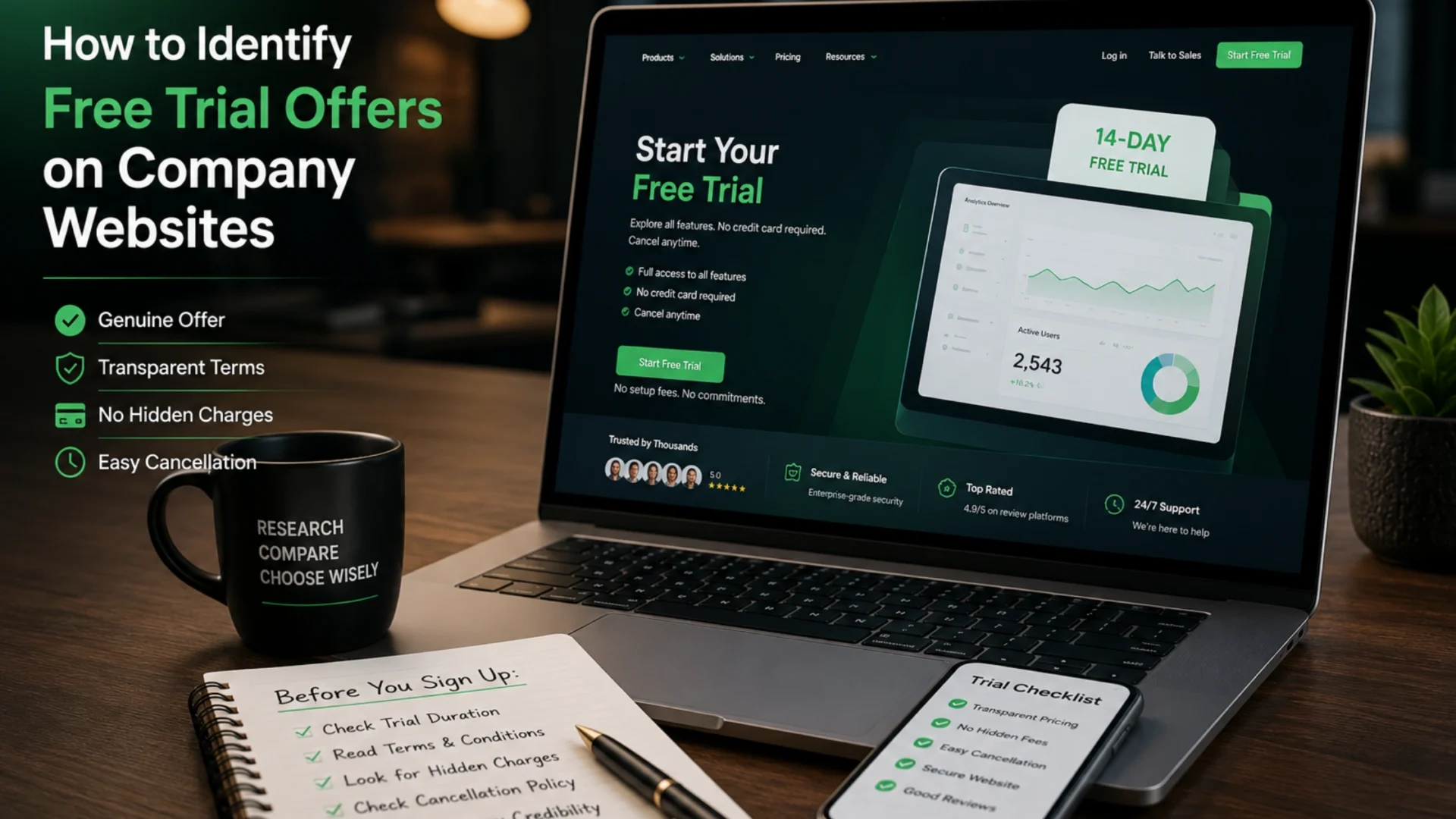
- What Is a Free Trial Offer?
- The Common Types You’ll Run Into
- Why Companies Bother Offering Free Trials
- Signs You’re Looking at a Legitimate Free Trial Offer
- Clear Pricing Transparency
- Easy to Find Terms and Conditions
- Professional Website and Real Security
- Real Reviews From Real Humans
- Transparent Contact Information
- Red Flags That Should Make You Close the Tab
- How to Evaluate a Company Before Starting the Trial
- Research the Brand Reputation
- Check Documentation and Support Quality
- Analyze the Pricing Structure
- Compare Two or Three Competitor Trials Side by Side
- Where to Find Genuine Free Trial Offers
- Free Trial Best Practices Every User Should Follow
- How Businesses Use Free Trials as a Marketing Strategy
- Common Myths About Free Trial Offers
- Myth 1. All free trials are scams.
- Myth 2. Free means no strings attached.
- Myth 3. Longer trials are always better.
- The Bottom Line
- FAQs
- Need a Product That Earns Trust From Day One?
A marketer I know signed up for an SEO tool’s “14 day free trial” last spring. She put her card in, set a calendar reminder for day 13, and assumed she was safe.
The tool charged her on day 8.
Turns out the “trial” wasn’t really a trial. It was a paid plan with a 7 day refund window, dressed up in trial language. The pricing page said one thing. The checkout said another. The terms of service, buried four clicks deep, said the actual truth.
She got her money back eventually. Took three emails and a chargeback threat. Plenty of people don’t bother and just eat the charge.
That’s the world of free trial offers in 2026. Most are honest. A meaningful chunk are not. And telling them apart before you hand over a card number is a skill worth learning, whether you’re picking software for your team or just trying out a streaming service. So here’s how to actually do it.
What Is a Free Trial Offer?
A free trial gives you temporary access to a product or service without paying upfront. That’s the textbook answer. The reality is messier because the word “free” gets stretched in some pretty creative directions by marketing teams.
The Common Types You’ll Run Into
Not all free trials work the same way. Some are genuinely free for a fixed period. Others quietly ask for billing info on day one and start charging the second the clock runs out. A few are basically demos in disguise.
Here’s how the four main types compare in practice.
| Trial Type | What You Get | Risk Level |
|---|---|---|
| Time based, no card | Full access for 7 to 30 days, no billing info collected | Lowest |
| Time based, card required | Full access, but auto bills after trial ends unless you cancel | Medium |
| Feature limited (freemium) | Free forever on a stripped down plan, paid for premium features | Low |
| Reverse trial | Premium access first, then downgrades to a free plan if you don’t pay | Low to medium |
Notion uses reverse trials. So does Loom. Most B2B SaaS companies favor card required trials because they convert better. Consumer tools lean toward freemium. None of these are inherently bad. They just have different rules you should know going in.
Why Companies Bother Offering Free Trials
Free trials aren’t charity. Companies offer them because they work. Roughly 60 percent of SaaS firms use some form of trial in their funnel, and a well designed trial can lift conversions by double digits.
The honest version is simple. Companies want you to feel the product so you stick around. The dishonest version is also simple. Some companies want your card before you realize what you signed up for.
Knowing which is which is the whole game.
Signs You’re Looking at a Legitimate Free Trial Offer
Real trials almost always share the same handful of traits. Once you’ve spotted these on a few clean websites, the sketchy ones start to stick out fast.
Clear Pricing Transparency
A legitimate company tells you the price before you sign up. Not in the footer. Not on a separate page you have to hunt for. Right there, near the trial signup.
If the pricing page is missing, hidden behind a “contact sales” wall for a $19 a month tool, or only appears after you’ve handed over your email, that’s worth a pause. Honest pricing builds trust. Companies that hide pricing usually have a reason.
Easy to Find Terms and Conditions
Trial length, what happens at the end, how cancellation works. These three things should be findable in under 30 seconds. If you’re digging through legal pages to figure out when you’ll get billed, that’s already a yellow flag.
Honest companies say things like “Your card won’t be charged until day 15. Cancel anytime from your account settings.” Sneaky ones say things like “Subscription will continue at the prevailing rate.” Read the difference. It matters.
Professional Website and Real Security
HTTPS in the URL. A real privacy policy. A footer with actual company information, not just a Gmail address. PCI compliance badges if they’re collecting card info.
Honestly, design polish alone isn’t proof of legitimacy. Scammy companies can buy templates too. But the absence of these basics is almost always a sign to walk away. A serious company invests in proper web development, and that investment shows up in the small details. Page load speed, broken links, mobile responsiveness, accessibility. Companies that cut corners on the basics usually cut corners elsewhere too.
Real Reviews From Real Humans
Check G2, Capterra, Trustpilot, or the App Store before you sign up. Look for reviews with specific details about features, support response times, billing experiences. Generic five star reviews that all sound the same are usually paid.
Pay extra attention to the three star reviews. People who liked a product but had a complaint tend to write the most useful, honest feedback you’ll find anywhere.
Transparent Contact Information
A real business email. A working support channel, whether that’s chat, ticketing, or phone. A company address. LinkedIn profiles of the leadership team.
You don’t need all of these. You should be able to find at least two without effort. If contact info is just a generic web form and nothing else, ask yourself who you’d actually call if billing went sideways.
Red Flags That Should Make You Close the Tab
Now the warning list. Any one of these on its own might be fixable. Two or more in combination, especially when paired with pressure tactics, and you’re almost certainly looking at a setup designed to extract money from people who don’t read carefully.
Hidden charges buried in fine print. Watch for phrases like “you’ll be enrolled in our premium plan,” “automatic upgrade after trial,” or “service fee may apply.” These are landmines. Honest companies state pricing in plain language above the signup button.
Card collection with no clear billing date. If a company asks for your credit card but won’t tell you exactly when charges begin, that’s not a trial. That’s a trap. The good ones email you 3 to 5 days before the first charge. The bad ones email you the receipt after.
Unrealistic claims. “Unlimited everything forever.” “Guaranteed 10x results.” “Replace your entire marketing team.” If it sounds too good for the price, something else is paying the bill. Sometimes that something is you, later.
No clear cancellation path. The FTC’s Click to Cancel rule, finalized in 2024 and partially vacated by a federal appeals court in mid 2025, was designed to fix exactly this problem. The legal landscape is still moving, but the principle holds. If a company makes it dramatically harder to cancel than to sign up, that’s intentional. Walk away.
Fake countdown timers and pressure tactics. “This offer expires in 4:59.” “Only 3 trial spots left today.” Real software companies don’t run out of trial spots. These are dark patterns, designed to short circuit your judgment. Close the tab.
No company history or unfindable founders. Search the company name plus the word “scam” or “complaints.” Check LinkedIn for the leadership team. If a B2B tool has no visible humans behind it, no press mentions, no funding history, and a domain registered three months ago, the trial is the least of your worries.
How to Evaluate a Company Before Starting the Trial
Spotting red flags is the defensive half. The offensive half is doing actual research before you click signup. Five minutes here saves hours of headache later.
Step 1
Research the Brand Reputation
Google the company name. Read the first two pages of results, not just the top three. Check Reddit (search “site:reddit.com [company name]” for unfiltered opinions). Look at Trustpilot and the Better Business Bureau if it’s a US company.
Pay attention to recent complaints. A company with 4,000 happy reviews and 300 angry ones about billing is telling you something specific. Believe them.
Step 2
Check Documentation and Support Quality
A real product has a real help center. Browse it for 90 seconds. Are articles well written, recently updated, and actually helpful? Or is it three pages of placeholder text?
Bonus tip. Send their support a question before signing up. Ask about cancellation specifically. The speed and clarity of the reply tells you exactly what to expect if billing goes wrong later.
Step 3
Analyze the Pricing Structure
Monthly versus annual. Per seat versus flat rate. What gets paywalled on the cheap tier. What add ons cost extra. Companies that bury this stuff are setting you up for sticker shock at the moment of renewal.
Map out what your actual usage will look like and price it out at full retail. If the math gets ugly, the trial is showing you a version of the product you won’t be able to afford anyway.
Step 4
Compare Two or Three Competitor Trials Side by Side
Most software categories have at least three legitimate players. Look at all of them. Compare trial length, feature access, cancellation rules, and whether they collect a card upfront.
The company offering the most generous, transparent trial isn’t always the best product. But it’s usually the most confident one. That signal is worth weighing.
Where to Find Genuine Free Trial Offers
Source matters as much as the trial itself. The same product can look very different on the company’s own site versus a third party affiliate landing page.
Always start on the official company website. Type the URL yourself, or click through from a search engine result. Affiliate links sometimes route through promotional pages with different terms than the main site.
Use trusted SaaS review platforms as discovery tools. G2, Capterra, Product Hunt, and GetApp let you compare alternatives, filter by category, and read real verified reviews. They won’t replace your own research, but they shortlist a category fast.
Be careful with “best of” blog roundups. Most are affiliate driven, which isn’t automatically bad but worth knowing. The author often gets paid when you sign up. That doesn’t make the recommendation wrong. It does mean the ranking might reflect commission rates more than product quality.
Free Trial Best Practices Every User Should Follow
Even with a perfectly legitimate company, a few habits save you from your own forgetfulness.
- Read the terms before clicking signup. Specifically the section on billing triggers and cancellation. Yes, it’s boring. Yes, it’s the part that determines whether you get charged.
- Set a calendar reminder for 2 days before the trial ends. Not day of. People forget. Buffer time saves money.
- Actually test the core features. A trial you don’t use is just a paid subscription waiting to happen. Block time on your calendar to evaluate the thing properly within the first 4 days.
- Use a virtual card or single use card number when you can. Privacy.com, Apple Card, and many banks now offer one time card numbers. If the company tries to recharge after cancellation (it happens), they can’t.
- Screenshot the cancellation confirmation. Always. If a company ever tries to bill you after cancellation, that screenshot is your fastest path to a chargeback.
One more thing on chargebacks. If a company charges you after a cancellation or refuses to honor their own trial terms, US cardholders have 60 days from the statement date to dispute the charge under the Fair Credit Billing Act. EU and UK customers have similar protections. Know your rights. Use them when needed.
How Businesses Use Free Trials as a Marketing Strategy
Worth understanding the other side of the table for a minute. Free trials are a product led growth tool. Companies that do it well, like Slack, Calendly, and Figma, use trials to let the product sell itself. No pushy sales calls. Just access.
The conversion math is interesting. SaaS companies typically see free trial to paid conversion rates between 15 and 25 percent for credit card required trials, and 5 to 10 percent for no card trials. That’s why card upfront is more common in B2B. Higher friction, higher conversion.
The good companies treat the trial as a relationship starter. The bad ones treat it as a billing trick. Telling the two apart is the entire point of this article.
For founders or product leaders thinking about trial design, our team’s covered the build side of this in our SaaS development services page. Worth a read if you’re shipping a product and weighing trial mechanics.
Common Myths About Free Trial Offers
Myth 1. All free trials are scams.
They aren’t. Most are legitimate marketing tools from real companies. The bad actors get loud because they cause damage, but they’re a minority of the market. A little research separates them from the real options every time.
Myth 2. Free means no strings attached.
It rarely does. The string is usually time (a deadline you’ll forget), data (you’re handing over usage information), or a billing relationship that activates if you don’t cancel. None of these are inherently wrong. Just know what you’re trading.
Myth 3. Longer trials are always better.
Sometimes yes. Often no. A focused 7 day trial where you actually use the product beats a 30 day trial that drifts into the background. The length is less important than whether you’ll use it.
The Bottom Line
Identifying legitimate free trial offers isn’t complicated. It just takes a habit of pausing before clicking.
Check pricing transparency. Read the cancellation rules. Look up the company. Read three star reviews. Set a calendar reminder. Use a virtual card when you can. Screenshot the cancellation confirmation. That’s the whole playbook.
Do this consistently and you’ll never get burned by a trial again. Skip it, and the next $480 surprise charge is just a question of when.
If you’re a business building a SaaS product or evaluating tools at scale, trial mechanics deserve real thought. Our team has helped dozens of founders design trial flows that build trust instead of breaking it. Have a look at our product development and conversion rate optimization work if that’s the kind of conversation you’re having internally.
FAQs
How can I tell if a free trial is legitimate?
Look for transparent pricing, clear cancellation terms, real customer reviews on independent platforms like G2 or Trustpilot, secure HTTPS checkout, and findable contact information. If any of those are missing or buried, that’s your signal to research further before handing over a card.
Do all free trials require a credit card?
No. Many companies offer no card trials, especially in consumer software and freemium SaaS. B2B tools tend to require cards because it improves conversion rates. Neither approach is automatically better or worse, but no card trials are lower risk if you’re just exploring.
What should I check before signing up for a free trial?
Five things. Pricing after the trial ends. Exact billing date. How cancellation actually works. Recent reviews from real users. The company’s basic legitimacy (real address, real team, real history). Ninety seconds of checking saves a lot of cleanup later.
How do companies make money from free trials?
Trials convert users into paying customers. Industry conversion rates run roughly 15 to 25 percent for card required trials and 5 to 10 percent for no card versions. Companies bet that letting you experience the product builds enough value to justify the price.
Can I cancel a free trial before being charged?
Yes, on any legitimate trial. The cancellation path should be findable from your account settings within a couple of clicks. If a company forces you to call, email, or jump through hoops to cancel, that’s a red flag and possibly a violation of consumer protection rules depending on your country.
What are the warning signs of a fake free trial offer?
Hidden pricing, no clear billing date, fake urgency timers, unrealistic claims, buried cancellation paths, missing company information, and aggressive upsells before you’ve even tried the product. Any two of these together is a strong signal to walk away.
Are no credit card free trials safer?
Generally yes, in the sense that you can’t be charged if no card is on file. But “safer” doesn’t mean “better.” Some legitimate, valuable products require cards because that’s how their funnel works. Use the right judgment for the risk profile you’re comfortable with.
Where can I find trustworthy software free trials?
Start with the official company website. Use review platforms like G2, Capterra, Trustpilot, and Product Hunt for discovery and verified reviews. Be a little cautious with affiliate driven “best of” blog posts. They’re often legitimate but their rankings can reflect commission rates as much as product quality.
Need a Product That Earns Trust From Day One?
Whether you’re evaluating tools for your team or building a SaaS product that needs a trial flow customers actually trust, the same principles apply. Transparency wins. Hidden tricks lose. Always.
Elsner has built and optimized trial experiences for SaaS founders across ecommerce, B2B, and fintech. If you want a product that converts honestly and keeps users around, talk to our team or explore our SaaS development work.