



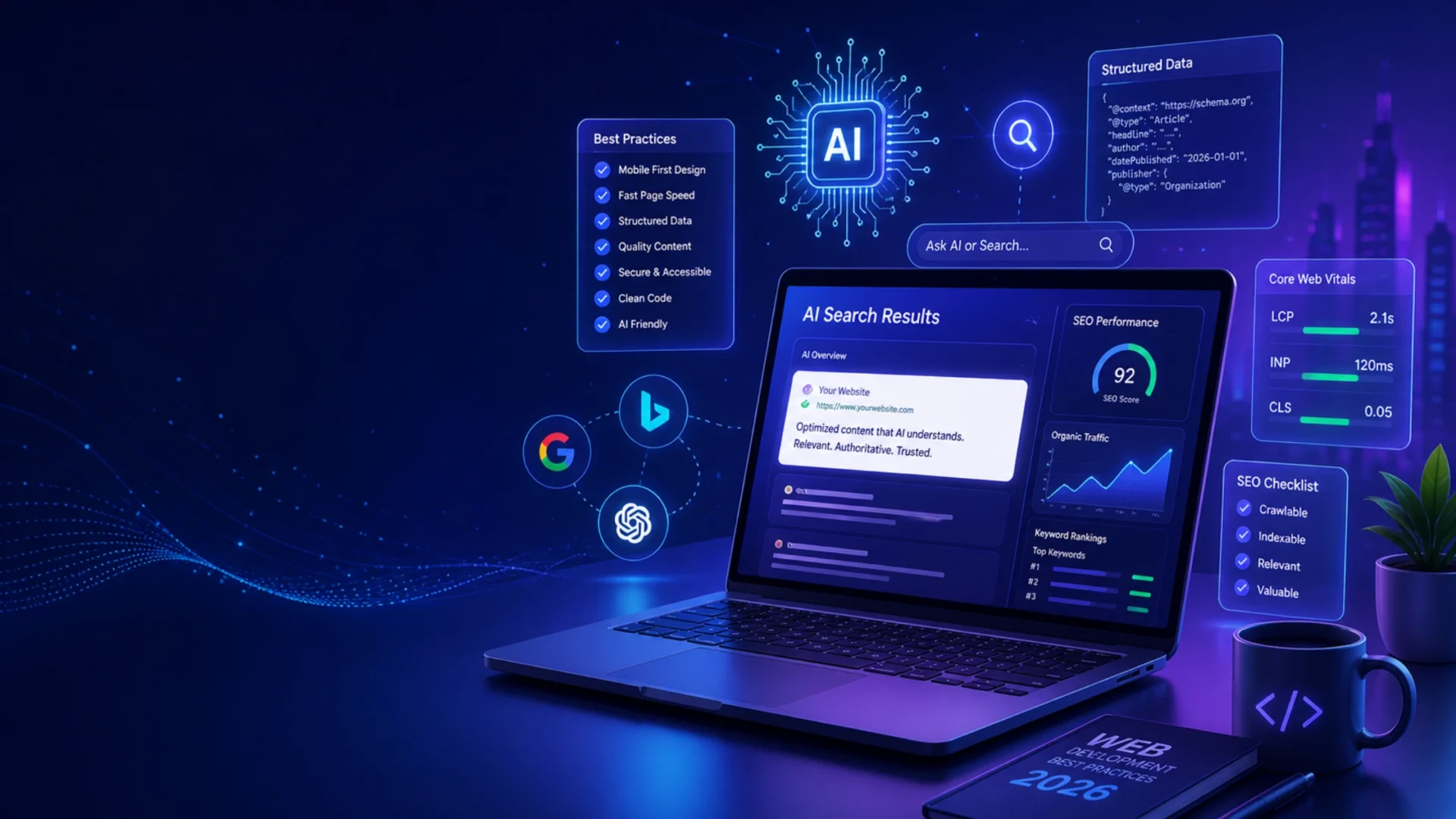
- The New Era of Web Development in 2026
- Rise of AI Powered Search Engines
- User Behavior Has Shifted
- Core Web Development Best Practices for Modern SEO
- Website Architecture
- Performance Optimization
- Technical SEO
- Building Websites for AI Search Optimization
- Answer Engine Optimization
- Generative Engine Optimization
- Semantic HTML and Entity Optimization
- Voice Search Compatibility
- Security Best Practices That Influence SEO
- HTTPS and Secure Coding
- US Specific Compliance
- User Experience and Conversion Focused Development
- Mobile Responsiveness
- Accessibility
- Conversion Optimization
- AI Powered Web Development Tools and Automation
- AI Coding Assistants
- Automated Testing and Monitoring
- Ethical AI Implementation
- Content Management and Scalability Best Practices
- Headless and API First Architecture
- Cloud Hosting and Modular Development
- Common Web Development Mistakes to Avoid in 2026
- 2026 Web Development Best Practices Checklist
- SEO Readiness
- AI Search Readiness
- Performance
- Security
- Accessibility
- Conversion
- Why Businesses Need Expert Web Development Services for Future Growth
- Build a Website That Wins in AI Search
- Frequently Asked Questions
- What are the most important web development best practices in 2026?
- How does AI search impact website development?
- What is Generative Engine Optimization in web development?
- Why are Core Web Vitals important for SEO success?
- How can web development improve Google AI Overview visibility?
- What security practices are essential for SEO friendly websites?
- How does mobile first web development affect rankings?
- What are the best frameworks for SEO optimized web development?
- How can businesses future proof their websites for AI search?
- Why should businesses invest in professional web development services?
Search has changed. Most teams noticed it sometime in 2024 when Google AI Overviews started cutting into traditional click-through rates. By mid-2025, click data from Ahrefs and SimilarWeb showed informational queries losing roughly 18 to 34 percent of organic clicks to AI-generated answers. That’s not a blip. It’s a structural shift.
For US business owners, ecommerce brands, and enterprise teams, this means the old playbook doesn’t hold up. You can build a fast website, write decent content, get some backlinks, and still lose visibility because the answer engine pulled your competitor’s structured data instead of yours.
This guide walks through what actually works now. Not theory. Real practices we’ve used on Elsner client projects across Shopify Plus stores, Magento builds, custom enterprise applications, and headless WordPress setups. Some of it will sound familiar. Some won’t.
If you’re planning a build or a major upgrade, read carefully.
The New Era of Web Development in 2026
Let me be blunt about something. A website is no longer a destination. It’s a data source.
Google’s AI search experience, ChatGPT browse mode, Perplexity, Claude, and Gemini all pull from web content to construct answers. They scrape, summarize, attribute (sometimes), and serve. Your site has to be readable by these systems first, then attractive to humans second.
That sounds harsh, but it’s the practical reality.
Important: Sites built for keyword-stuffed blog rankings won’t survive the transition. Sites built for entity recognition, structured answers, and topical depth will thrive.
Rise of AI Powered Search Engines
Three things happened almost simultaneously between 2023 and 2025:
- Google rolled out AI Overviews to the US first, then global markets
- OpenAI launched SearchGPT and integrated browsing into ChatGPT
- Perplexity went mainstream, hitting roughly 100 million monthly queries by Q2 2025
Each system reads HTML differently. None of them care about your hero animation. They care about clean structure, schema, and authoritative content blocks they can quote.
User Behavior Has Shifted
Honestly, this part still surprises clients. Younger users skip the search box entirely. Pew Research data from late 2025 showed that 41 percent of US adults under 30 use AI chatbots as their primary information source for at least some daily queries.
That’s not the future. That’s now.
Sites built for keyword-stuffed blog rankings won’t survive the transition. Sites built for entity recognition, structured answers, and topical depth will thrive.
Core Web Development Best Practices for Modern SEO
The fundamentals still matter. They just have to be sharper.
Website Architecture
Clean structure isn’t optional anymore. AI crawlers parse hierarchy faster than they parse flowery prose.
A few non-negotiables we apply on every Elsner project:
- URL paths should describe content, not session IDs. /services/web-development beats /page?id=2417 every single time.
- One H1 per page. Multiple H1s confuse both Googlebot and language models doing chunk extraction.
- Internal linking should flow logically from pillar pages down to supporting articles. Hubs and spokes.
- XML sitemaps must update automatically whenever new content publishes.
- Mobile-first frameworks like Next.js, Astro, and Remix handle this natively. WordPress and Magento can be configured to follow the same rules with proper theme work.
If you’re running a multi-region site, hreflang tags and country-specific subdirectories matter even more now. AI systems use these signals to decide which version to show in answers.
Performance Optimization
Core Web Vitals stopped being a nice-to-have around 2022. By 2026, they’re a survival metric.
Google’s recent threshold updates pushed the LCP target down to 2.5 seconds and tightened INP (Interaction to Next Paint) requirements. We’ve seen real client data where dropping LCP from 3.8 seconds to 1.9 seconds correlated with a 27 percent organic traffic lift over 90 days.
Practical performance moves that pay off:
- Lazy load images below the fold using native loading=”lazy”
- Serve images in WebP or AVIF, not JPEG, with proper srcset for responsive delivery
- Use a CDN that supports edge caching. Cloudflare, Fastly, and BunnyCDN all work well depending on your traffic profile
- Server-side rendering for content-heavy pages, especially product pages and blog articles
- Edge computing for personalization without sacrificing speed
- Compress and minify CSS, JavaScript, and HTML
Skip vanity benchmarks. Run real-device testing on a mid-range Android phone with a throttled 4G connection. That’s where most of your US traffic actually comes from.
For a deeper checklist, our Core Web Vitals optimization guide walks through the audit process step by step.
Technical SEO
Schema markup used to be a suggestion. It’s now the primary way AI systems understand what your page is about.
The schema types that earn the most pickup in AI Overviews:
- Article and BlogPosting for editorial content
- Product with detailed offers, reviews, and pricing
- FAQPage when questions are genuinely useful, not stuffed for SEO
- HowTo for tutorial content
- Organization and LocalBusiness for entity recognition
- Person for author credibility, which feeds EEAT signals
Beyond schema, the basics still apply: canonical tags on every indexable page, robots.txt that doesn’t accidentally block CSS or JS, HTTPS everywhere with valid certificates, and JavaScript SEO done right.
A note on JavaScript. If your site relies heavily on client-side rendering, Google can usually handle it, but AI crawlers like ChatGPT’s GPTBot often can’t render JS at all. Static rendering or hybrid approaches win in this environment.
Building Websites for AI Search Optimization
This section is where most teams fall behind. Traditional SEO still gets attention. AI search optimization gets ignored, or worse, treated as an afterthought.
Answer Engine Optimization
AEO is about giving AI systems extractable, citable content blocks. Think of it as writing for the snippet first, the page second.
What works:
- Direct, declarative answers in the first sentence of any FAQ or definition
- Question-formatted H2 and H3 headings
- Numbered or bulleted steps when the topic is procedural
- Clear definitions tagged with appropriate schema
- Tables that summarize comparisons, pricing, or feature differences
Our Answer Engine Optimization services page details how we structure content for citation-worthiness across major AI platforms.
Generative Engine Optimization
GEO is the broader strategy. It’s about earning mentions in AI-generated responses across ChatGPT, Gemini, Claude, and Perplexity.
GEO works differently than traditional SEO because:
|
1
|
Backlinks Matter LessTopical authority and entity recognition matter more. |
|
2
|
Mentions in Trusted PublicationsCreate training-data signals, even without links. |
|
3
|
Structured Data Builds Knowledge Graph EntriesThat AI systems pull from. |
|
4
|
Content Freshness Matters DisproportionatelyStale content gets ignored. |
A good GEO strategy combines content depth with strategic PR. Getting cited in industry publications, contributing to authoritative guides, and maintaining consistent entity information across the web all feed the model.
If you want the full breakdown, our GEO services page covers the methodology.
Semantic HTML and Entity Optimization
This part is technical but important.
Use semantic HTML elements properly. <article>, <section>, <header>, <nav>, <main>, and <aside> tell AI parsers what each chunk represents. Generic <div> soup tells them nothing.
Entity optimization means ensuring your brand, products, services, and key concepts are tagged and linked consistently. Wikipedia entries, Wikidata records, Google Business profiles, and consistent NAP (Name, Address, Phone) data across the web all reinforce entity recognition.
For US businesses targeting local markets, this is especially critical. Yelp, Google Business, Apple Maps, Bing Places, and industry-specific directories should all carry matching entity data.
Voice Search Compatibility
Voice queries skew conversational and longer. “What’s the best ecommerce platform for a small jewelry brand in Texas” rather than “best ecommerce platform jewelry.”
Optimizing for voice means:
- Long-tail question phrases in headings
- Natural language in content body
- Concise answers (typically under 30 words for the snippet portion)
- Local relevance for “near me” intent
Security Best Practices That Influence SEO
Security isn’t separate from SEO anymore. Google explicitly factors HTTPS, malware status, and data protection into rankings. AI systems factor trustworthiness signals into citation decisions.
HTTPS and Secure Coding
Every page needs HTTPS. Not just login pages. Every single one. Browsers now flag HTTP sites as “Not Secure,” which tanks both rankings and conversion rates.
Beyond the basics:
- Implement HSTS headers to force HTTPS connections
- Use TLS 1.3 minimum
- Renew certificates automatically with Let’s Encrypt or your CDN provider
- Audit third-party scripts. They’re often the weakest security link.
OWASP Top 10 compliance is the baseline for serious projects. Cross-site scripting, SQL injection, broken authentication, and security misconfiguration still account for the majority of breaches we see during audits.
US Specific Compliance
CCPA and CPRA apply to California users. Other states have rolled out similar laws. Texas, Virginia, Colorado, Connecticut, and Utah all have active privacy frameworks as of 2026.
What businesses need:
- Clear cookie consent that actually respects user choices, not the dark-pattern kind
- Privacy policy that’s readable, not legalese
- Data deletion request workflows that work
- Disclosure of any AI processing involving user data
Accessibility compliance ties into this too. The DOJ has been more aggressive on ADA web accessibility lawsuits. WCAG 2.2 AA compliance is the practical standard. Tools like axe DevTools and Lighthouse catch most violations, but manual testing catches the rest.
Trust signals matter. Visible security badges, clear company information, About pages with real team members, and verified business addresses all reinforce trust for both users and AI evaluators.
User Experience and Conversion Focused Development
Rankings without conversions are just expensive vanity metrics. UX is where development meets revenue.
Mobile Responsiveness
Mobile traffic crossed 60 percent of US ecommerce sessions in early 2025 according to Statista. Mobile-first isn’t a strategy anymore. It’s the default. Desktop is the secondary view.
Key considerations:
- Tap targets at least 48px square, with proper spacing
- Forms that auto-format and use the right input types
- Sticky CTAs that don’t block content
- Image dimensions that don’t cause layout shifts
Accessibility
Accessible sites rank better, convert better, and avoid lawsuits. Triple win.
Practical accessibility wins:
- Alt text on every meaningful image
- Proper heading hierarchy (H1, then H2, then H3, no skipping)
- Sufficient color contrast (4.5:1 minimum for body text)
- Keyboard navigation that actually works
- Form labels associated with inputs
- Skip links for screen readers
- ARIA attributes where semantic HTML isn’t enough
Conversion Optimization
This is where development decisions become business decisions.
A few patterns that consistently lift conversions on Elsner client projects:
- Single-column checkout flows for ecommerce
- Guest checkout option (forced account creation kills conversion)
- Social proof near CTAs, not buried at the bottom
- Trust signals on payment pages
- Loading states that show progress, not blank screens
- Personalization that uses behavioral data, not creepy demographic guesses
If conversion lift is the goal, our Conversion Rate Optimization services team runs structured A/B testing programs that typically deliver 18 to 34 percent improvements over six months.
AI Powered Web Development Tools and Automation
The tools have gotten remarkably good. Used well, they ship faster code with fewer bugs. Used poorly, they ship faster bugs.
AI Coding Assistants
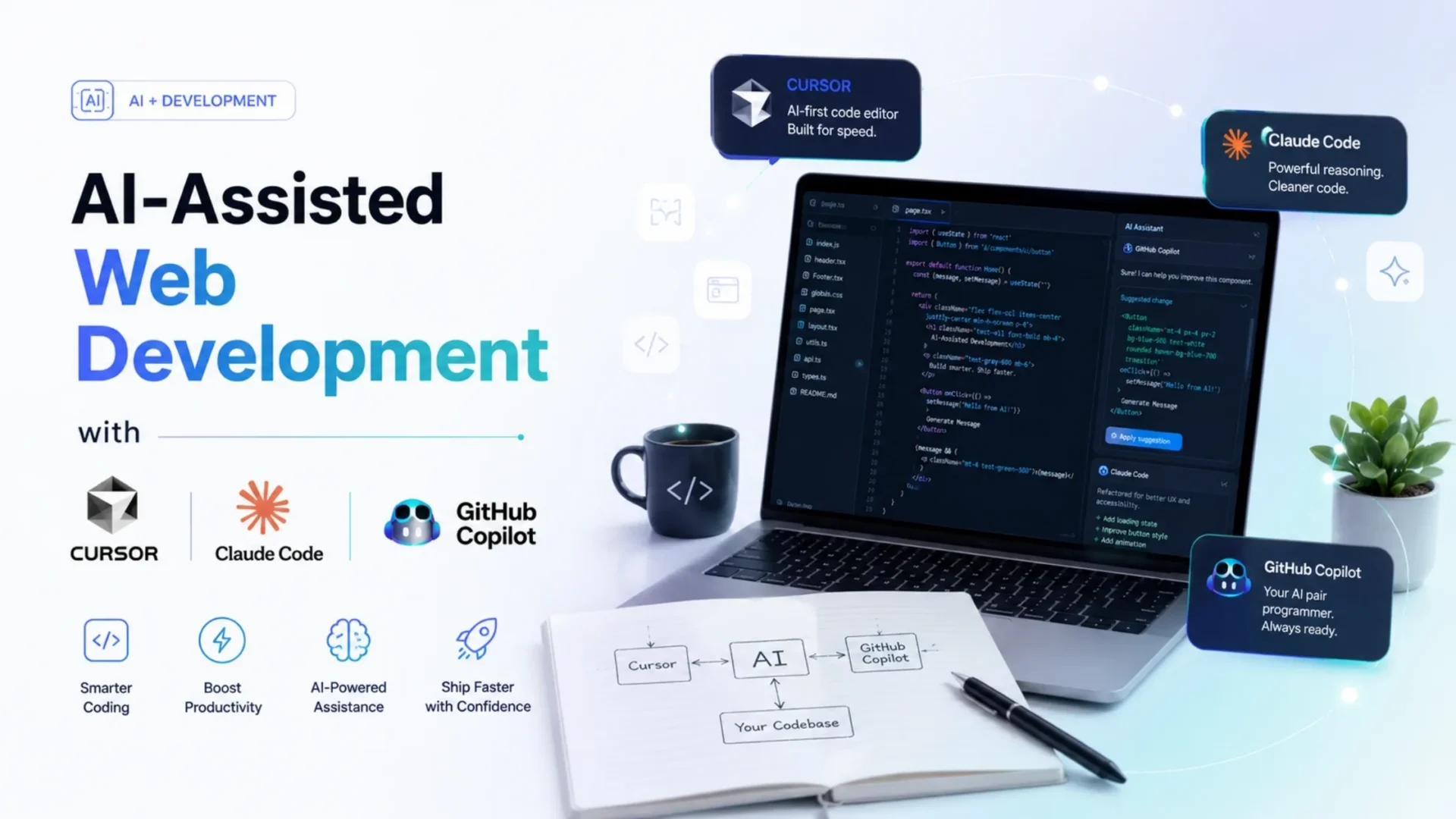
GitHub Copilot, Cursor, and Claude Code workflows have become standard for production teams. We use them daily on Elsner builds.
The senior engineer review still matters. AI-generated code without expert review is a maintenance nightmare waiting to happen.
Automated Testing and Monitoring
Playwright, Cypress, and Vitest cover most front-end testing needs. For SEO and performance monitoring, tools like Ahrefs, Semrush, ContentKing, and Sitebulb catch issues before they tank rankings.
Real-user monitoring through New Relic, Datadog, or Sentry tells you what’s actually happening in production, not what your local environment thinks is happening.
Ethical AI Implementation
If your site uses AI for personalization, content generation, or chatbots, transparency is non-negotiable.
Disclose AI usage. Give users control over what AI processes their data. Audit AI outputs for bias and accuracy. The reputational risk of an AI feature behaving badly outweighs almost any short-term benefit.
For businesses planning AI integrations into their stack, our AI strategy consulting team helps map out responsible implementation roadmaps.
Content Management and Scalability Best Practices
Pick the wrong CMS and you’ll fight it for years. Pick the right one and it disappears into the background.
Headless and API First Architecture
Headless CMS adoption has accelerated significantly. Strapi, Sanity, Contentful, and Storyblok all power production sites at scale.
The advantages:
- Content reuse across web, mobile, and emerging channels
- Faster front-end performance with static site generators
- Better security through reduced attack surface
- Independent scaling of content delivery and content management
The trade-off is complexity. Headless setups require more developer resources than traditional WordPress or Magento installs. For a brand publishing weekly blog posts and running a few landing pages, traditional CMS still makes sense. For a company managing thousands of products across multiple channels, headless wins.
Cloud Hosting and Modular Development
AWS, Google Cloud, and Azure dominate enterprise hosting. For mid-market businesses, Vercel, Netlify, and Cloudflare Pages handle most front-end deployments at lower cost and complexity.
Modular development means building features as composable units. React component libraries, Vue’s composition API, Web Components, and design systems like Storybook all support this approach. The payoff is faster iteration and easier maintenance.
For ecommerce specifically, our ecommerce development services include architecture consulting to help businesses choose between traditional, headless, and composable approaches based on actual requirements.
Common Web Development Mistakes to Avoid in 2026
After auditing dozens of websites this year, the same issues keep showing up. Honestly, most are preventable.
The expensive ones:
- Heavy reliance on client-side JavaScript without server-side rendering. AI crawlers can’t see your content.
- Skipped accessibility testing. Lawsuit risk plus ranking penalties.
- Ignored schema markup. Missing free visibility in AI Overviews.
- Outdated security patches. Especially WordPress sites running plugins from 2021.
- Bloated themes. Some Magento Luma installations weigh 8MB on first load. That’s catastrophic.
- Generic content built for keywords instead of users. Google’s helpful content system flags this fast.
- Slow third-party scripts. Marketing tags often add 2 to 5 seconds of load time.
- No structured author or organization data. EEAT signals matter more every year.
The fix for most of these isn’t expensive. It’s just attention to detail during development and ongoing maintenance.
2026 Web Development Best Practices Checklist
Quick reference for teams planning a new build or audit:
SEO Readiness
- Clean URL structure with descriptive paths
- Schema markup for all major content types
- Optimized title tags and meta descriptions
- Canonical tags on every indexable page
- XML sitemap with automatic updates
- Internal linking from pillar to supporting pages
AI Search Readiness
- Semantic HTML throughout
- FAQ blocks with FAQPage schema
- Direct answers in first sentences
- Entity rich content with proper tagging
- Author bios with Person schema
- Knowledge graph alignment
Performance
- LCP under 2.5 seconds
- INP under 200ms
- CLS under 0.1
- WebP/AVIF images with proper srcset
- Lazy loading below the fold
- Critical CSS inlined
Security
- HTTPS with HSTS
- TLS 1.3 minimum
- OWASP Top 10 compliance
- Regular dependency audits
- Privacy policy and cookie consent
- Data deletion workflows
Accessibility
- WCAG 2.2 AA compliance
- Keyboard navigation
- Proper heading hierarchy
- Color contrast 4.5:1 minimum
- Alt text on meaningful images
- Form labels and ARIA where needed
Conversion
- Single-column checkout
- Guest checkout option
- Visible trust signals
- Mobile-optimized forms
- Clear CTAs with action verbs
- A/B testing program
Print this. Or save it. It’s the operational checklist we use during Elsner client kickoffs.
Why Businesses Need Expert Web Development Services for Future Growth
Here’s the honest part. Most businesses can’t build all of this in-house. The skill set required spans development, SEO, security, accessibility, content strategy, and increasingly, AI optimization. Hiring all of that is expensive. Training existing staff takes years.
That’s where partnering with an experienced agency pays off.
A good development partner brings:
- Cross-functional expertise without the hiring overhead
- Proven processes refined across hundreds of projects
- Senior level judgment on architectural decisions
- Industry connections for tools, integrations, and platforms
- Ongoing maintenance and optimization beyond launch
Elsner Technologies has spent the last 15+ years building websites and ecommerce platforms for US businesses across jewelry, furniture, fashion, tile, and B2B sectors. Our web development services span Shopify Plus, Magento Adobe Commerce, WordPress, BigCommerce, Pimcore, and custom MERN/Laravel builds.
The shift to AI-driven search isn’t slowing down. Sites built today with AEO, GEO, Core Web Vitals, accessibility, and security baked in will dominate the next decade. Sites built without these will struggle.
Build a Website That Wins in AI Search
Planning a new build or considering an upgrade? Talk to our team. We’ll review your current setup, identify the gaps that matter most, and build a roadmap aligned with your actual goals and budget.
Frequently Asked Questions
What are the most important web development best practices in 2026?
The most important practices include AI search optimization, Core Web Vitals compliance, mobile-first responsive design, semantic HTML structure, schema markup, HTTPS security, WCAG 2.2 accessibility, and clean technical SEO. Sites that combine all of these consistently outperform those that focus on just one or two areas.
How does AI search impact website development?
AI search engines like Google AI Overviews, ChatGPT, and Perplexity pull content directly from websites to construct answers. This means sites need to be readable by AI crawlers, structured with semantic HTML and schema, and authoritative on their topics. Sites built only for traditional keyword rankings lose visibility in AI-generated answers.
What is Generative Engine Optimization in web development?
Generative Engine Optimization (GEO) is the practice of structuring websites and content to earn mentions and citations in AI-generated responses across platforms like ChatGPT, Gemini, and Perplexity. It combines technical SEO, structured data, topical authority, and strategic PR to build entity recognition that AI systems can pull from.
Why are Core Web Vitals important for SEO success?
Core Web Vitals measure real user experience through loading speed (LCP), interactivity (INP), and visual stability (CLS). Google uses these as ranking signals, and sites that fail Core Web Vitals thresholds typically see lower rankings, higher bounce rates, and reduced conversions. Hitting the recommended thresholds correlates with measurable traffic and revenue gains.
How can web development improve Google AI Overview visibility?
Improving AI Overview visibility requires direct answers in content, FAQPage schema, semantic HTML structure, author credibility through Person schema, topical depth, and consistent entity information across the web. Sites that AI systems can easily parse and trust earn more citations.
What security practices are essential for SEO friendly websites?
Essential security practices include HTTPS with HSTS headers, TLS 1.3 minimum, regular dependency audits, OWASP Top 10 compliance, secure coding standards, and proper privacy compliance under CCPA and similar US state laws. Search engines penalize insecure sites, and AI systems factor trustworthiness into citation decisions.
How does mobile first web development affect rankings?
Google indexes the mobile version of websites as the primary version, so mobile experience directly determines rankings. Sites with poor mobile performance, broken layouts, or slow mobile loading lose visibility in both traditional search and AI-generated answers.
What are the best frameworks for SEO optimized web development?
Next.js, Astro, Remix, Nuxt, and SvelteKit all support server-side rendering and static generation, which work well for SEO. For traditional CMS approaches, WordPress with proper optimization or headless setups using Strapi, Sanity, or Contentful deliver strong results. Framework choice depends on team expertise, content workflow, and scaling requirements.
How can businesses future proof their websites for AI search?
Future-proofing requires investing in semantic HTML, comprehensive schema markup, topical content depth, entity optimization, author credibility signals, and regular content updates. Building on flexible architectures that support new schema types, structured data formats, and AI-related features as they emerge also helps.
Why should businesses invest in professional web development services?
Professional development services provide cross-functional expertise across development, SEO, security, accessibility, and AI optimization without the cost of hiring a full in-house team. Experienced agencies bring proven processes, industry connections, and senior judgment that typically deliver faster, more reliable results than DIY approaches.