




- Site search is now a revenue channel, not a feature
- What Is an Ecommerce Search Engine?
- What Does a Modern Ecommerce Search Engine Actually Do?
- Query Understanding and Natural Language Processing
- Autocomplete and Predictive Search
- Faceted Navigation and Smart Filtering
- Personalization Based on Shopper Behavior
- Visual and Voice Search
- Merchandising Rules and Search Analytics
- Built-In vs Headless vs Dedicated Search Platforms
- How Much Does an Ecommerce Search Engine Cost in 2026?
- Want pricing tailored to your catalog and traffic?
- When Should You Upgrade Your Ecommerce Search Engine?
- Upgrade Now When
- Wait When
- Custom Build When
- Hybrid Approach When
- Best Practices Checklist for Better Product Discovery
- Common Mistakes That Kill Product Discovery
- Real Results: What a Good Ecommerce Search Engine Delivers
- Fashion Retailer With 18,000 SKUs
- B2B Industrial Parts Distributor
- Beauty Brand With a Subscription Model
- KPIs to Measure Your Ecommerce Search Engine
- Ready to Audit Your Ecommerce Search Engine?
- Frequently Asked Questions
- Final Word on Ecommerce Search Engines
- Search is the highest-impact UX investment most brands are quietly ignoring
Most ecommerce teams underestimate one thing more than anything else on their site. The search bar. That little input field at the top of the page handles roughly 30 to 40 percent of all on-site purchase intent, yet most stores still ship with default search that returns junk results, ignores typos, and bounces shoppers within seconds.
This guide walks through what a modern ecommerce search engine actually needs to do in 2026, what the best practices look like, and where most brands quietly leak revenue without realizing it. We’ve worked on search implementations across Shopify Plus, Adobe Commerce, BigCommerce, and custom headless builds since the early days of Elasticsearch on retail.
Site search is now a revenue channel, not a feature
An ecommerce search engine is the system that powers product discovery on an online store. Baymard Institute research suggests roughly 12 to 15 percent of ecommerce revenue flows through on-site search users, who convert at two to three times the rate of non-search visitors. Salesforce’s State of Commerce data backs this up year after year. Yet most stores still run basic keyword matching that hasn’t been touched since 2019. This piece covers what an ecommerce search engine actually does, how AI and semantic search have reshaped product discovery, real 2026 pricing, the build versus buy decision, and the KPIs that tell you whether your current setup is making money or quietly losing it.
What Is an Ecommerce Search Engine?
An ecommerce search engine is the software layer that handles product discovery on an online store. It takes a shopper’s query, whether typed, spoken, or uploaded as an image, indexes the product catalog, and returns a ranked list of results matching the intent.
Behind that simple-looking search bar sit several moving parts. Indexing, query parsing, natural language understanding, ranking models, personalization signals, merchandising rules, and analytics. The default search engine that ships with Shopify, WooCommerce, or BigCommerce works fine for stores with fewer than 500 SKUs. Once you cross that line, things break. Bigger catalogs, more attributes, seasonal collections, and varied shopper intent all start exposing the gaps.
That’s where dedicated ecommerce search engine platforms come in. Players like Algolia, Klevu, Bloomreach, Searchspring, Constructor, Coveo, and open source options like Typesense and Elasticsearch dominate this space in 2026.
What Does a Modern Ecommerce Search Engine Actually Do?
Most search vendors describe their feature lists in marketing language. Stripping the jargon, six core capabilities define what a modern ecommerce search engine should deliver. Each one quietly affects conversion in measurable ways.
Query Understanding and Natural Language Processing
A real search engine reads intent, not just words. Someone typing “red running shoes under $80” should see filtered results without needing to click filters manually. NLP handles plurals, synonyms, brand-product splits, and attribute extraction. Without it, shoppers see zero-result pages on perfectly findable products.
Autocomplete and Predictive Search
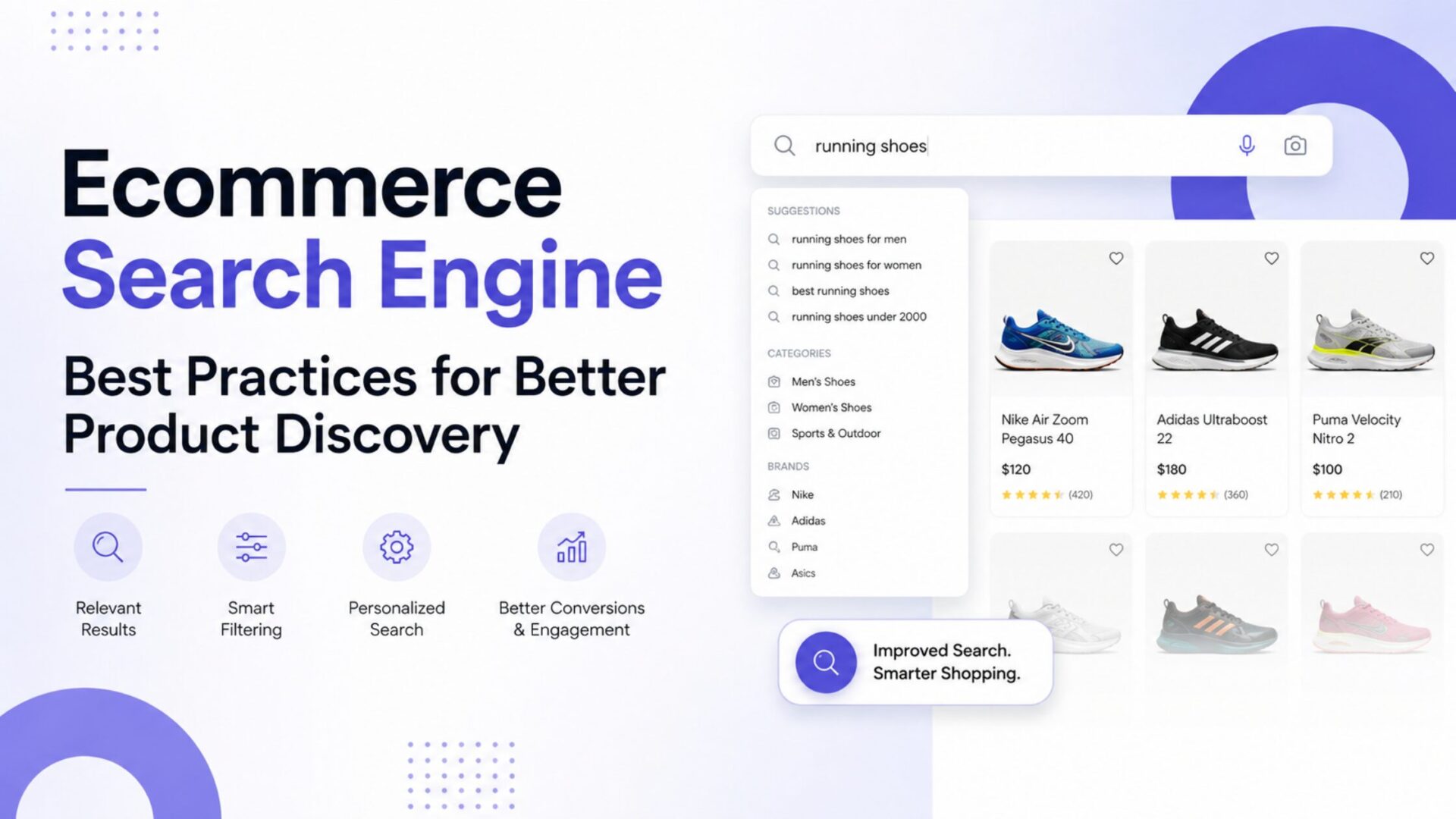
Suggestions that appear as someone types reduce friction by 30 to 50 percent on average. Strong autocomplete shows products, categories, and popular queries together. Shopify Plus stores using Klevu or Searchspring typically see autocomplete sessions convert at significantly higher rates than blind keyword searches.
Faceted Navigation and Smart Filtering
Filtering by price, brand, color, size, material, and rating is table stakes. Smart faceting goes further. It hides filters with zero matching products, surfaces the most relevant attributes for each query, and adapts as users refine. A jewelry brand might prioritize metal type and stone. A furniture store might lead with room and dimensions.
Personalization Based on Shopper Behavior
Two shoppers searching “running shoes” shouldn’t see identical results. Personalization layers in past browsing, purchase history, location, and even time of day. Stores running personalized search consistently report 8 to 15 percent revenue lift over generic ranking. Our work on AI driven ecommerce development covers how this technology actually moves the needle.
Visual and Voice Search
Image-based search has gone from novelty to expected in fashion, beauty, jewelry, and home decor. Voice queries are growing slowly but steadily, especially on mobile and in reorder behavior. Both rely on vector embeddings and multimodal models that mainstream platforms started shipping in 2024 and 2025.
Merchandising Rules and Search Analytics
A search engine should let merchandisers boost new arrivals, bury out-of-stock items, promote seasonal collections, and lock specific products to the top of relevant queries. Without merchandising controls, you’re running on autopilot. Analytics on zero-result searches, top queries, and exit rates is where the real ROI insights live.
Built-In vs Headless vs Dedicated Search Platforms
Picking the right ecommerce search engine sometimes matters more than picking the right ecommerce platform. Four broad options exist in 2026, and the right choice depends on catalog size, traffic volume, and team capacity.
For mid-market brands in 2026, the decision usually comes down to mid-tier SaaS versus enterprise SaaS. The mid-tier wins on speed of implementation and total cost. The enterprise tier wins when personalization depth, multi-locale support, and advanced merchandising matter. Open source still has a place for teams who want full control and have the engineering bandwidth, but the trend is clearly shifting toward managed services.
The honest pattern we see across retail audits in 2026 is that most brands spend less than 2 percent of their tech budget on ecommerce search, even though search drives 12 to 15 percent of revenue. That math should make merchandising directors uncomfortable, but it rarely does. Search is invisible when it works. Nobody schedules a meeting because the search bar is fine. Yet a single relevance upgrade can outperform six months of paid ads on revenue impact. The ROI isn’t subtle.
How Much Does an Ecommerce Search Engine Cost in 2026?
Pricing varies wildly depending on traffic volume, catalog size, and feature depth. Here are the real numbers we see across mid-market and enterprise brands. Token-based pricing has started showing up for AI-heavy search products, which can swing monthly costs more than the published rate cards suggest.
What most vendors don’t volunteer up front: taxonomy cleanup is usually 20 to 30 percent of the total project cost when migrating to a new ecommerce search engine. Product data quality matters more than the search engine itself. Garbage in, garbage out applies harder here than almost anywhere else in retail tech. Our work on product information management covers the foundational data layer that makes search actually work.
Want pricing tailored to your catalog and traffic?
Our team scopes ecommerce search engine projects in the first 30 minutes, no obligation, and gives you a real number to budget against.
When Should You Upgrade Your Ecommerce Search Engine?
Not every store needs a new search platform. Some need a tune-up of what’s already there. Four scenarios cover most decision points in 2026.
Upgrade Now When
Your zero-result search rate sits above 8 percent. Search users convert at less than 1.5x the non-search rate. Mobile search bounce is above 60 percent. Catalog has grown past 2,000 SKUs and basic search clearly can’t keep up.
Wait When
Your catalog stays under 500 SKUs. Search usage is below 15 percent of sessions. The conversion gap from search is small. Bigger fundamentals like checkout flow or PDP quality need fixing first.
Custom Build When
You have a uniquely complex catalog (B2B punchout, configurable products, regulated goods). Search depth requires proprietary logic that no SaaS handles. You have an engineering team capable of long-term ownership.
Hybrid Approach When
You want SaaS for the search index but need custom merchandising and UI control. The done-with-vendor model is gaining traction in 2026 as platforms open up APIs further.
Best Practices Checklist for Better Product Discovery
The single biggest pattern in successful ecommerce search projects: small, well-executed fundamentals beat fancy AI features that nobody uses. Here are the practices that consistently move the conversion needle.
- Show autocomplete suggestions within 150 milliseconds of keystroke
- Index products, categories, brands, and content in a single federated search
- Handle typos and plurals automatically with spell tolerance
- Display product images and prices inside autocomplete dropdowns
- Track every zero-result search and review it weekly
- Build synonym dictionaries based on real customer queries, not internal jargon
- Add visual search for fashion, beauty, jewelry, and home decor stores
- Personalize results once a user has 3 or more interactions in a session
- Optimize the “no results” page with popular products and search tips
- A/B test ranking algorithms regularly, not just front-end design changes
The brands seeing the strongest results in 2026 obsess over zero-result searches. That’s where the gold sits. Every empty result page is either a missing synonym, a misspelled product attribute, or a genuine gap in the catalog. Fix those weekly and conversion compounds quietly.
Common Mistakes That Kill Product Discovery
Picking a strong vendor means nothing if execution fundamentals get skipped. Six mistakes show up across nearly every search audit we’ve run since 2022. They look obvious in writing. Yet they keep happening.
Defaulting to relevance ranking without merchandising rules. The default ranking from any search vendor optimizes for relevance, not revenue. Without boost rules for margin, stock levels, and seasonal priorities, your bestsellers get buried.
Ignoring zero-result searches entirely. Most teams never look at what shoppers search for and find nothing. That single report is usually worth thousands in recovered revenue once you start acting on it.
Treating search like a once-and-done implementation. Search needs ongoing tuning. Synonyms change. Catalogs grow. New seasonal terms appear. Brands treating it as a launch-and-forget project see results degrade within months.
Skipping mobile-first search testing. Mobile drives most ecommerce traffic, yet many search experiences are tested only on desktop. Search bar placement, dropdown sizing, and thumb-friendly filters matter more than on desktop.
Picking a platform based on vendor pitch decks. Most vendor demos run on cherry-picked datasets. Always test with your actual catalog before signing. Performance on 50,000 SKUs looks nothing like performance on 500.
Forgetting the analytics layer. A search engine without good analytics is a black box. You need dashboards on top queries, zero results, click-through rates, and search-to-purchase paths. Without these, you’re tuning blind.
Real Results: What a Good Ecommerce Search Engine Delivers
Three projects from our portfolio that show what proper implementation actually moves. Numbers are real, client names anonymized.
Fashion Retailer With 18,000 SKUs
Challenge: zero-result search rate sat at 14 percent and mobile bounce on search results pages was over 70 percent.
Build: migrated from default Magento search to Klevu, rebuilt synonyms from 6 months of real query data, added visual search and merchandising rules.
Outcome: zero-result rate dropped to 3.2 percent, mobile search conversion rose 41 percent, and average order value from search users climbed 12 percent over the first quarter.
B2B Industrial Parts Distributor
Challenge: 220,000 SKUs with complex part numbers, technical attributes, and customer-specific pricing. Default Adobe Commerce search couldn’t handle attribute-based queries.
Build: deployed Elasticsearch with custom relevance scoring, mapped customer hierarchies for personalization, added punchout-compatible search APIs.
Outcome: time-to-product dropped from 4 minutes to 38 seconds. Search-driven revenue share went from 22 percent to 47 percent within 5 months.
Beauty Brand With a Subscription Model
Challenge: high-intent shoppers landing from paid ads kept churning before finding the right product, especially for skin and hair concerns.
Build: implemented Algolia with NLP-driven concern-to-product mapping, added quiz-style guided search, layered personalization for returning subscribers.
Outcome: search-driven add-to-cart rate doubled. Subscription conversion from first-session search improved 28 percent within 90 days.
What separates brands that win at ecommerce search from the ones that don’t isn’t the vendor they pick. It’s the discipline they bring after launch. Every successful implementation we’ve shipped had a merchandiser or growth lead reviewing search analytics weekly within the first six months. Every disappointing one had a beautiful new search tool that nobody opened the dashboard for. Tools don’t fix neglect. Process does.
KPIs to Measure Your Ecommerce Search Engine
Most search vendors report on vanity metrics. Real ROI lives in a different set of numbers. Here are the KPIs worth tracking in 2026, with realistic benchmarks based on production retail data.
A quick note on measurement. Vendors love to show search session metrics in isolation. The number that matters most is search-driven revenue as a share of total revenue, tracked month over month. Anything else is noise. Our breakdown on ecommerce metrics that actually predict growth goes deeper on the broader measurement framework.
Ready to Audit Your Ecommerce Search Engine?
Our team has scoped and shipped search implementations for fashion, B2B, beauty, jewelry, and home decor brands. The first 30-minute conversation walks through your zero-result data, mobile experience, and whether your current setup is worth keeping or worth replacing.
Frequently Asked Questions
What is an ecommerce search engine?
An ecommerce search engine is the software layer that powers product discovery on an online store. It takes shopper queries, indexes product data, applies ranking and personalization, and returns relevant results. Modern systems handle natural language, autocomplete, faceted filtering, visual search, and merchandising rules.
What is the best ecommerce search engine in 2026?
There’s no single best option. For mid-market brands, Klevu, Searchspring, and Findify deliver strong out-of-box AI at reasonable pricing. For enterprise, Algolia, Bloomreach Discovery, Constructor, and Coveo lead on personalization and advanced merchandising. Native platform search works well only for stores under 500 SKUs.
How much does an ecommerce search engine cost?
Pricing ranges from $500 per month for mid-tier SaaS like Klevu to over $25,000 monthly for enterprise platforms like Bloomreach or Constructor. Implementation typically runs $5,000 to $75,000 one-time, depending on catalog complexity and integration scope.
How does AI improve ecommerce search?
AI improves ecommerce search through natural language understanding, semantic vector matching, personalization, and predictive autocomplete. Modern AI-driven search interprets intent rather than just matching keywords, which significantly reduces zero-result searches and improves conversion from high-intent queries.
What is semantic search in ecommerce?
Semantic search interprets the meaning behind a query rather than matching exact keywords. A shopper searching “warm jacket for skiing” gets ski-appropriate insulated jackets even if the product titles don’t include those exact words. It uses vector embeddings and language models to map queries to products by intent.
Should I build or buy an ecommerce search engine?
Buy when speed-to-value matters and your catalog fits standard SaaS capabilities. Build with open source like Elasticsearch when you need deep customization, have engineering bandwidth, and want full control over relevance logic. Custom builds usually only make sense for highly complex B2B or specialized industries.
How do I know if my current ecommerce search engine is underperforming?
Three quick signals: a zero-result search rate above 8 percent, search-to-purchase conversion under 2x your overall site conversion, and mobile search bounce above 60 percent. If any two apply, your current setup is leaving revenue on the table.
Final Word on Ecommerce Search Engines
Picking and tuning an ecommerce search engine in 2026 is less about chasing the latest AI buzzword and more about respecting the fundamentals. Catalog data hygiene. Synonym dictionaries built from real queries. Weekly review of zero-result searches. Merchandising rules that match business priorities. Mobile-first testing.
The brands quietly winning at product discovery this year aren’t the ones with the biggest search budgets. They’re the ones with a process, a clear ownership model, and a willingness to look at the unflattering numbers in their search analytics. That mindset turns search from a cost center into one of the most profitable revenue channels on the site.
If you’re evaluating platforms or auditing your current setup, talk to our team. We’ve shipped search implementations across Shopify Plus, Adobe Commerce, BigCommerce, and custom headless builds for brands across fashion, jewelry, beauty, furniture, and B2B distribution.
Search is the highest-impact UX investment most brands are quietly ignoring
The fastest ROI in ecommerce in 2026 rarely comes from another ad campaign or a redesign. It comes from fixing the search bar most teams stopped thinking about. A well-tuned ecommerce search engine drives 12 to 25 percent of revenue at conversion rates 3 to 6 times higher than browse traffic. Skip the moonshot AI features. Start with clean data, real synonyms, weekly analytics review, and merchandising rules that match what you’re actually trying to sell. The rest follows.
And if you want a fresh audit of your search engine performance before scoping anything new, talk to our ecommerce development team. The first conversation is free and you’ll walk away with a clearer picture either way.