




- How BigCommerce Pricing Actually Works
- The Plans at a Glance
- Core Plan (formerly Standard)
- Growth Plan (formerly Plus)
- Scale Plan (formerly Pro)
- Performance (formerly Enterprise): The Custom Quote Reality
- The Costs People Forget
- BigCommerce vs Shopify on Cost
- Which Plan Should You Choose
- A Total Cost of Ownership Example
- FAQs
- How much does BigCommerce cost per month?
- Does BigCommerce charge transaction fees?
- What happens when I hit my sales limit?
- How much is BigCommerce Enterprise (now Performance)?
- Is BigCommerce cheaper than Shopify?
- Final Thoughts
- Not Sure Which BigCommerce Plan Fits Your Numbers?
When people search for BigCommerce pricing, what they actually want is one honest number: what will this cost me every month, once everything is added up? The monthly plan fee is just the entry point. Real cost depends on your sales volume, the apps you’ll need, your theme, your payment processor’s rate, and any development work along the way.
This guide walks through what each BigCommerce plan includes, who it fits, and where the extra costs tend to hide.
Important: BigCommerce restructured its entire plan lineup on June 1, 2026. New names, new sales thresholds, and a fee that didn’t exist before. If you’ve read a pricing guide from earlier this year, or even last month, some of it is already out of date.
Everything below was checked against BigCommerce’s official pricing page. We’d recommend reconfirming before you commit to BigCommerce development services, since the platform has already changed its structure once this year.
How BigCommerce Pricing Actually Works
BigCommerce sells its plans on a monthly or annual basis. Pay annually and you save a decent amount, usually somewhere around 25 percent off the monthly rate. Most stores planning to stick around end up going annual once they’re confident in the platform.
Here’s the part that confuses people. BigCommerce doesn’t charge based on features alone. It also caps how much revenue you can process on each plan before it bumps you up a tier, automatically. This is measured on a trailing twelve-month basis, using what BigCommerce calls Inclusive GMV, basically your Gross Merchandise Value, adjusted slightly to account for typical discounts and returns.
Say your trailing twelve-month sales cross the threshold on your current plan. You’ll get a notification, and your account moves up to the next plan and its pricing, whether you were planning for it or not. It isn’t a penalty. It’s built into how the platform scales with you. But if you’re budgeting a year out, you want to know this is coming, not find out about it on an invoice.
There’s also a fee that’s new for 2026. BigCommerce used to advertise no platform transaction fees as a selling point over Shopify. That’s still mostly true, but with a catch. As of June 2026, orders processed through a payment gateway that isn’t on BigCommerce’s approved list (Stripe, PayPal, or Braintree, Adyen, Checkout.com, and a handful of others) carry what’s called an Open Payment Provider Fee. It runs higher on cheaper plans and lower on pricier ones, which in effect nudges everyone toward staying on an approved gateway rather than shopping around for the best processing rate.
We’ll walk through the actual numbers, plan by plan, below.
One more thing worth a mention: if you’re pricing this out for a store selling outside the US, keep an eye on currency. BigCommerce quotes in US dollars by default, and the figures below reflect that. Actual billing can vary a little depending on your region and card processor.
A Quick Update on Plan Names
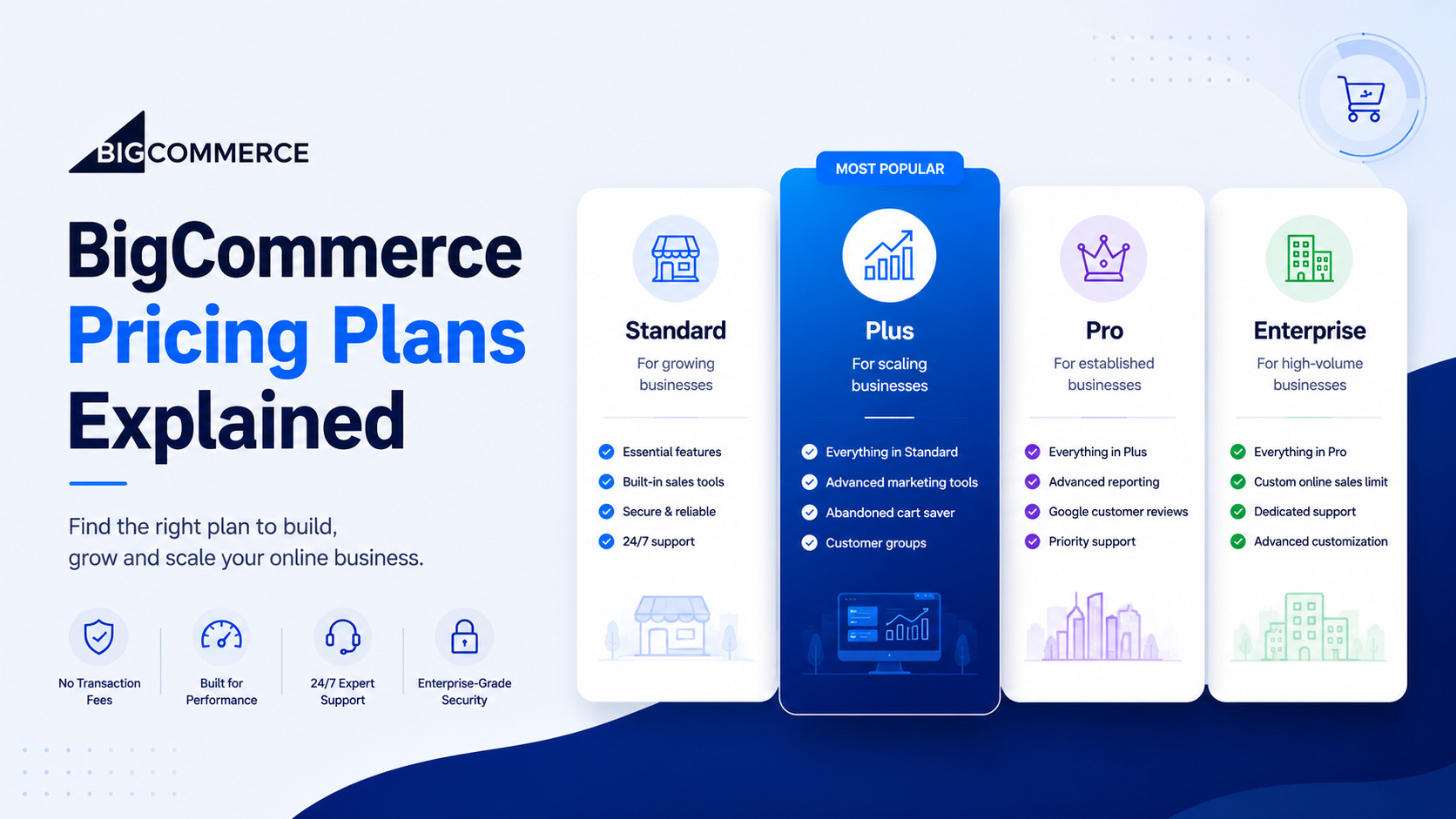
If you’ve shopped BigCommerce before, or read about it anywhere online, you probably know the plans as Standard, Plus, Pro, and Enterprise. On June 1, 2026, BigCommerce has renamed all the plans. Standard became Core, Plus became Growth, Pro became Scale, and Enterprise became Performance. The base monthly prices didn’t move much, but the sales thresholds tied to each plan dropped, in some cases by close to half. We’ll use the current names throughout, with the old ones noted alongside so nothing gets lost in translation.
The Plans at a Glance
Note: Prices exclude tax and were checked against BigCommerce’s official pricing page on July 23, 2026. Reconfirm current figures. BigCommerce has changed its structure once already this year, and it may again.
Core Plan (formerly Standard)
Core is where most new stores start, and honestly, it’s a strong starting point. For $39 a month, or $29 if you commit annually, you get unlimited products, unlimited staff accounts, and unlimited bandwidth, along with a real storefront, point of sale, and selling across channels like Amazon, eBay, and Facebook or Instagram.
You also get things some competitors charge extra for: real-time shipping quotes, a built-in blog, product reviews, and reporting that’s genuinely useful once you’re making decisions off your numbers instead of guessing.
Where Core starts to feel tight is the $30,000 trailing twelve-month sales cap. That number sounds generous until you’re actually running a store; a single good holiday season can get you there faster than you’d think.
Orders processed outside BigCommerce’s approved gateway list also carry the steepest Open Payment Provider Fee of the four plans, at 2 percent. If you’re planning to grow past hobby-store sales, it’s worth mapping out roughly when you’ll outgrow this tier. For a closer look at getting a Core-tier store set up properly, our BigCommerce development guide covers the setup side in more detail.
Growth Plan (formerly Plus)
Growth runs $105 a month, or $79 billed annually, and it’s built for stores that are past the early stage and need to convert more of the traffic they’re already getting.
The features that justify the step up are mostly about customers who don’t check out on the first visit. Abandoned cart recovery, customer segmentation, and persistent carts, meaning a shopper’s cart follows them across devices, all live here. If you’re running any kind of email flow off cart abandonment, this plan tends to pay for itself fairly quickly.
The sales cap moves up to $100,000 in trailing twelve-month GMV, and the Open Payment Provider Fee drops to 1 percent. Most stores doing consistent five or low-six-figure annual revenue land comfortably here.
If that’s roughly your profile and you’re weighing how much more to invest in the storefront itself, it’s worth reading up on what it takes to build a high-performing BigCommerce store before you lock in a plan.
Scale Plan (formerly Pro)
Scale is $399 a month, or $299 with annual billing, and it’s aimed at stores doing real volume or needing more technical headroom.
This is where you get a meaningfully higher API rate limit, useful if you’re running integrations that make a lot of calls, plus more advanced merchandising and customization tools. The sales limit mechanic also works differently here. Instead of a hard annual cap, Scale uses a monthly GMV threshold of $33,333. Cross it, and you’re charged a 0.9 percent overage on the GMV above that line, rather than being pushed to the next tier outright. It’s a gentler way to scale than the old block based model that ran under the Pro name.
The Open Payment Provider Fee drops further here too, to 0.6 percent, which is one more reason higher-volume stores tend to consolidate onto an approved gateway instead of splitting payment processing across providers.
Performance (formerly Enterprise): The Custom Quote Reality
Performance doesn’t have a public price list, and there’s a reason for that. BigCommerce publishes a starting point, currently around $1,499 a month billed annually, but what you actually pay depends on your sales volume, the complexity of your catalog, how many storefronts you’re running, whether you need B2B functionality, and the level of support and account management you want.
What you’re really paying for at this level is dedicated account management, priority support, higher and often negotiable API limits, and terms shaped around your business rather than a fixed contract.
Tip: If you’re evaluating Performance, come to the conversation with your actual numbers ready, current GMV, growth projections, integration needs, and anything compliance-related. Vague requirements tend to get vague quotes. Specific ones get you a number that actually reflects what you’ll use.
The Costs People Forget
The plan price is the headline. Here’s what tends to get left out of the budget.
✅ Paid Apps
Most stores end up needing a handful for things like advanced SEO, loyalty programs, or subscriptions. Budget somewhere in the range of $75 to $300 a month for a typical stack, more if you’re running specialized functionality.
✅ Premium Themes
Free themes work fine for plenty of stores, but a premium Stencil theme with more built-in customization can run $150 to $300 or more, as a one-time cost.
✅ Payment Processing
Your plan’s monthly fee is separate from what your processor charges per transaction, typically 2.5 to 3 percent, on top of any Open Payment Provider Fee if you’re not on an approved gateway.
✅ Design, Development, and Maintenance
Whether you build in-house or bring in a partner, ongoing work like updates, new features, and troubleshooting has its own cost, and it’s usually the line item people underestimate the most.
✅ Migration
If you’re moving from another platform, factor in the cost of transferring products, customer data, and order history, plus rebuilding any custom functionality you had elsewhere.
Our piece on BigCommerce checkout strategies is a good next read if checkout conversion is part of what’s driving the move.
BigCommerce vs Shopify on Cost
This comparison comes up a lot, and the honest answer has gotten a bit more nuanced this year.
For years, BigCommerce’s pitch was straightforward: no transaction fees. That’s softer now. Stick to an approved payment gateway, and you’re still fee-free at the platform level. Don’t, and the math starts to look closer to Shopify’s than it used to.
The structural difference that still holds up is app reliance: BigCommerce ships more functionality out of the box, which tends to mean fewer subscriptions stacking up over time.
For a broader view across platforms, our ecommerce platform comparison lines up BigCommerce against Shopify, Magento, WooCommerce, and OpenCart side by side.
Which Plan Should You Choose
A few questions worth answering honestly before you pick a tier.
- What’s your realistic trailing annual sales number, not your best case projection?
- Do you actually need Growth plan’s conversion features (cart recovery, segmentation), or would Core’s built-in tools work fine for now?
- Are you running enough order volume that Scale’s API limits and overage model make more sense than a hard tier upgrade?
- Would a higher tier save you money once you account for the apps you’d otherwise need to buy separately?
That last point matters more than it looks. Paying more for a plan that includes features natively, instead of stacking three or four paid apps to get the same result, often works out cheaper overall. The lowest sticker price isn’t always the lowest total cost.
A Total Cost of Ownership Example
Here’s an illustrative monthly total for a mid-sized store on Growth. This is an example only; your actual numbers will depend on your store’s specifics.
Add those up for a store doing modest monthly sales, and you land closer to $450 to $600 a month, before processing fees on actual transaction volume. That’s the number worth budgeting against, not just the plan price on its own.
FAQs
How much does BigCommerce cost per month?
Plans start at $39 a month for Core, or $29 with annual billing, and run through $399 for Scale. Performance is available as a custom quote, starting around $1,499 a month.
Does BigCommerce charge transaction fees?
Not at the platform level, as long as you’re using an approved Embedded Payment Provider. Orders processed through other gateways carry an Open Payment Provider Fee ranging from 0.6 to 2 percent, depending on your plan.
What happens when I hit my sales limit?
On Core and Growth, crossing your trailing twelve-month GMV threshold triggers an automatic upgrade to the next plan. On Scale, you’re charged a 0.9 percent overage on GMV above the monthly threshold instead of being moved up automatically.
How much is BigCommerce Enterprise (now Performance)?
There’s no fixed number. BigCommerce quotes Performance based on your sales volume, catalog complexity, and support needs, with a published starting point of around $1,499 a month billed annually.
Is BigCommerce cheaper than Shopify?
It depends on your payment gateway and app usage. BigCommerce’s built-in features can mean fewer paid apps, but its new payment provider fee narrows the cost gap that used to exist around transaction fees.
Final Thoughts
The cheapest plan on paper is rarely the cheapest plan in practice. Once you factor in apps, theme costs, payment processing, and the development work that keeps a store running well, the plan price turns out to be just the starting line. Match your plan to where your sales volume and feature needs actually are, not where they might be someday, and revisit that match every year or so, since BigCommerce’s own structure has already shown it can change.
If you’re weighing a BigCommerce build, a migration from another platform, or just want a second opinion on which plan fits your numbers, Elsner’s team works through this with clients regularly. We can help map out your actual costs before you commit to a tier. Reach out, or take a look at what it takes to hire a BigCommerce developer who already knows the platform inside out.
Not Sure Which BigCommerce Plan Fits Your Numbers?
Elsner’s team can map out your true monthly cost — plan, apps, processing, and development — before you commit to a tier or plan a migration.