




- CRO is a Process, Not a Hack
- Start With Research, Not Guesses
- Building Strong Hypotheses
- Prioritization Frameworks
- A/B Testing Done Right
- High-Impact Areas to Optimize in 2026
- CRO in the Age of AI and Privacy
- Common CRO Mistakes
- When Not to Run an A/B Test
- A Simple CRO Workflow to Adopt
- FAQs
- What are the most important CRO best practices?
- What is a good conversion rate in 2026?
- How long should an A/B test run?
- How has AI changed CRO in 2026?
- Where should I start with CRO?
- Conclusion
- Ready to Move From Scattered Tests to a Structured CRO Program?
Most teams treat CRO the way they treat fixing a leaky faucet. You change a few things, run one test, and hope the numbers shift. When they don’t, the whole effort gets wasted.
Real CRO is not about quick fixes. It’s a process you run over and over. You observe, you test, you learn, and you do it again. In 2026, that loop also has to work alongside AI tools, first-party data, mobile-first behavior, and a zero-click discovery that keeps shifting who lands on your pages and why.
This guide covers the full process, from research to test analysis, including when not to test at all. Let’s take a look at some conversion rate optimization best practices.
CRO is a Process, Not a Hack
There’s a version of CRO advice that never really goes away: change your button color, add urgency text, write “limited offer” somewhere on the page. Some of it works occasionally. None of it stacks.
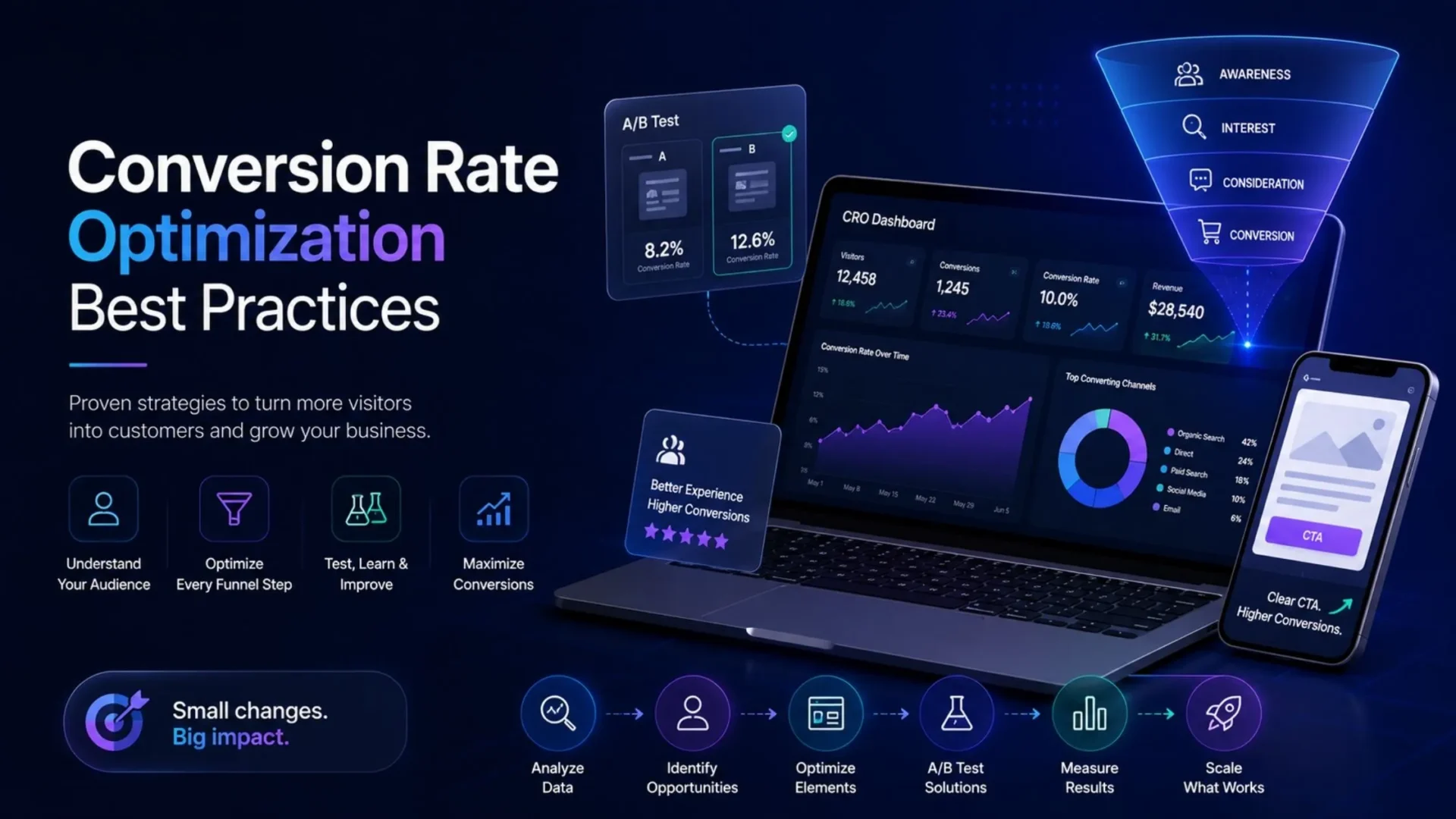
What makes a proper CRO program different is the loop. You research to understand what’s happening. You form a hypothesis about why. You prioritize what’s worth testing. You run the test properly. You analyze the results. Then you go again, this time with more context than you had before.
That’s how insights compound. One test teaches you something about your audience. That shapes the next hypothesis. Six months in, you have a real body of knowledge about what works for your specific users on your specific site.
One-off tweaks break that chain. Even when they win, you don’t know why, and you can’t build on them.
If you want to scale conversions, you need a system. That’s the actual difference between teams that improve consistently and teams that are still debating button colors.
Start With Research, Not Guesses
The Conversion Rate Optimization best practices don’t start with a test. They start with a question: where are users dropping off, and why?
Answering that takes two kinds of data.
However, the best hypotheses come from pairing both. Quantitative data tells you a product page has a 65% bounce rate. Qualitative data tells you users are looking for delivery information they can’t find. Now you have something real to test.
Programs that rely on only one of these sources end up optimizing with half the picture.
Building Strong Hypotheses
A good hypothesis is not “let’s try a different headline.” It’s a structured prediction tied to real evidence. For example, a simple format like: “because of this evidence, we expect this change to produce this result, measured by this metric” works.
A real example: Session replays show users stopping at step three of checkout, right when delivery costs appear for the first time. So the hypothesis is: if we show delivery costs on the product page instead, fewer people will drop off at checkout. You measure it by tracking how many users complete step three.
That’s testable, specific, and grounded in something you actually observed.
Weak hypotheses skip the evidence entirely. They go straight from idea to test. Even when those tests win, you don’t really learn anything. You never knew what the problem was to begin with.
Prioritization Frameworks
Once you have listed down too many hypotheses, you need to decide which one to test first. Testing everything at once splits traffic and drags out timelines.
Two frameworks work well here:
ICE is quick. You rate each idea on its potential impact, how confident you are in the evidence behind it, and how easy it is to build. Average the scores and rank from there.
PIE frames the criteria around pages and opportunities instead of effort. It works well when you’re deciding which section of the site deserves attention first.
Neither is perfect, and no scoring method replaces judgment. But some prioritization is better than no prioritization at all. The goal is to be specific about where you spend testing cycles, not to be overly scientific about the scores themselves.
A/B Testing Done Right
A/B testing is the core of most CRO programs, and also where most of the mistakes happen.
The most common one: you see promising numbers after a few days and call it a win. This is called peeking. It makes results look significant before they actually are. You end up rolling out changes that do nothing.
A few things to lock in before any test goes live:
✅ Calculate Sample Size Upfront
Free tools handle this. You enter your current conversion rate, the minimum lift you want to detect, and your desired significance level. The output tells you how many visitors each variant needs before results are meaningful.
✅ Set a Minimum Test Duration Before You Start
At least one full weekly cycle, or maybe two. People behave differently on different days. For example, a test that misses weekends will give you skewed results.
✅ Test One Variable at a Time When You Can
Multivariate testing has its place, but for programs with limited traffic, testing a single variant at a time makes results much easier to read.
⚠️ Do Not Stop Early When Results Look Good
Pre-commit to your sample size and duration before the test launches, write it down, and hold to it. Some teams stop a test early because the numbers look good. This is how most teams end up making changes that don’t actually work.
High-Impact Areas to Optimize in 2026
Not every page deserves the same testing attention. Some areas return more consistently than others.
|
1
|
Page Speed and Core Web VitalsThey still matter, both for rankings and for user behavior. A one-second delay in load time can meaningfully affect conversions, particularly on mobile. This is often a development task before it becomes a testing task. |
|
2
|
Mobile ExperienceMobile is where most e-commerce traffic can be found these days. But a lot of sites still operate under desktop assumptions. You’ll often find tiny buttons so close together they’re almost impossible to press separately, forms that are hard to complete on a small screen, and navigation that simply mirrors desktop. There’s a detailed breakdown of UX mistakes that kill conversions, which covers where this goes wrong most often. |
|
3
|
Checkout and Form FrictionThis probably deserves its own testing program. Every unnecessary field, every extra step, every unclear error message costs completed orders. Autofill support, guest checkout options, and real-time field validation all fall under this umbrella. This guide on Magento 2 checkout strategies that boost conversions is a practical starting point for this work. |
|
4
|
Value Proposition ClarityHere, most sites quietly lose users. If someone lands on a page and can’t immediately understand what you offer and why it matters to them, they leave. Not because they decided against you, but because they never understood your point. |
|
5
|
Trust SignalsThey reduce friction in the decision stage. Reviews, clear return policies, security badges, and social proof all help. These are often quick wins that don’t even need a test. They just need the discipline to be surfaced clearly. |
CRO in the Age of AI and Privacy
Two things have meaningfully changed how CRO programs operate in 2026.
AI tools can now spot patterns in user behavior, flag unusual test results, and suggest hypothesis ideas much faster than before. Work that took days now takes hours. But you still need human judgment to make sense of it all. AI finds the signals. You decide what to do next.
Personalization has changed too. Third-party cookies are mostly gone. Now, first-party data drives testing and targeting. Teams that relied on outside data are starting over. If you’re using AI tools for this, AI conversion optimization for Shopify is a useful read.
Privacy and consent go beyond being mere compliance tasks. These days, they’re an integral part of the way you run tests. If you are running experiments with logged-in users, or a multinational project, or using session replay tools, then it’s essential to plan how user data will be collected, rather than adding these later as an afterthought.
Zero-click discovery is another shift worth paying attention to. More users are landing on pages after an AI Overview or featured snippet already answered their top-level question. Those visitors are often ahead in their decision process than a typical organic visitor. Your landing pages need to meet them there.
Pairing CRO work with strong ecommerce SEO services is increasingly how teams maintain visibility in this environment.
For a broader look at how these shifts are playing out across the industry, the CRO trends for 2026 overview has more detail on what’s changing and how programs are adapting.
Common CRO Mistakes
Even experienced teams make these consistently.
|
1
|
Calling Tests Before Statistical SignificanceThe big one. Results look promising, and there’s pressure to move. The fix is pre-committing to a sample size before the test launches, not after results start coming in. |
|
2
|
Testing Trivial ElementsBurns testing cycles. Whether a subheading is a slightly different size doesn’t move conversions in any meaningful way. Save tests for elements that actually affect how users make decisions. |
|
3
|
Ignoring SegmentsHides real patterns in the data. Aggregate results can look flat while mobile and desktop users are responding in completely different ways. Always look at results by segment before concluding. |
|
4
|
Optimizing Into a Local MaximumMore subtle and harder to catch. You keep improving the current version of a page until it’s about as good as that version can get. And in doing that, you miss the question of whether a fundamentally different approach might work much better. |
When Not to Run an A/B Test
A/B testing is a tool, not a default answer.
- Not enough traffic: if your site doesn’t get enough traffic, tests take months to finish, and the results still may not mean much. User research and fixing known issues will get you further than waiting on data that can’t give you a clear answer.
- Obvious usability problems: if session replays show users repeatedly clicking a non-clickable element, fix it. If your checkout form has no validation and users are submitting errors on loop, fix that too. Running a test on obvious problems just delays fixing them.
- No clear hypothesis: sometimes the right step is more research, not a test. If you don’t have a clear hypothesis grounded in real evidence, running a test produces noise, not insight.
A Simple CRO Workflow to Adopt
This isn’t complicated, but it does require consistency.
|
1
|
Start Each Cycle With ResearchPull quantitative data, review session replays, run a user survey if it’s been a while. Look for friction. |
|
2
|
Prioritize Your Hypothesis BacklogUse ICE or PIE. Pick the highest-scoring items that you have the traffic and resources to test properly. |
|
3
|
Build the Test CarefullyOne variable, a clear success metric, sample size calculated, and duration set before launch. |
|
4
|
Read the Results for What They Actually ShowIf the test isn’t significant, don’t call it a win. If a specific segment responds differently from the aggregate, dig into that. |
|
5
|
Document EverythingA learning log that captures what you tested, what happened, and what you learned is one of the most underrated assets in any CRO program. Individual test results fade. A library of documented insights compounds. Then repeat. |
The website optimization guide covers how this connects to the broader user experience picture.
And if you’re figuring out whether to build this in-house or work with a specialist team, the in-house vs agency CRO comparison is worth reading before you make that call.
FAQs
What are the most important CRO best practices?
Start with research before you form any hypothesis. Run tests with proper sample sizes and do not stop early. Document what you learn, so insights carry forward. These three habits separate programs that improve consistently from programs that run in loop.
What is a good conversion rate in 2026?
A good conversion rate varies based on the industry, type of traffic, and how exactly a conversion is defined. The typical average rate for online stores is around 1 – 4%, with the variance for different businesses being huge. A more relevant benchmark would be comparing your previous performance and if you are improving it consistently or not.
How long should an A/B test run?
At minimum, one full weekly cycle, usually two to account for day-of-week variation in user behavior. The more accurate answer is: until you’ve reached the sample size you calculated before launching, however long that takes.
How has AI changed CRO in 2026?
AI has made analysis faster and pattern detection more accessible, and it’s enabled more nuanced personalization through first-party data. What hasn’t changed is the need for structured hypotheses, real statistical rigor, and human judgment about what the data actually means for your users.
Where should I start with CRO?
Pick your highest-traffic page with the biggest measurable drop-off rate. Run quantitative and qualitative research on it. Form one hypothesis grounded in that research. Run one test properly. Learn from it. That’s the full playbook, just repeated.
Conclusion
Real CRO is not about tricks. It’s about knowing your users well and testing that knowledge in a consistent, repeatable way.
The programs that produce consistent results are the ones that start with research, build evidence-backed hypotheses, test with proper statistical rigor, and treat every cycle as a chance to learn something useful.
If your team is ready to move from scattered experiments to a structured program, Elsner’s conversion rate optimization services are built for exactly that. We help ecommerce teams and growth-focused businesses build testing programs that compound over time. If a structured approach sounds right for where you are, let’s talk about what that looks like for your site.
Ready to Move From Scattered Tests to a Structured CRO Program?
Elsner helps ecommerce and growth-focused teams build testing programs that compound over time — research-led, evidence-backed, and built to last.