
 Zoho
Solutions
Zoho
Solutions
 Ecommerce
Development
Ecommerce
Development
 Web
Development
Web
Development
 AI
Solutions
AI
Solutions



- What is Enterprise Answer Engine Optimization?
- Why enterprise AEO is a different discipline than standard AEO
- The business case: what AI search is doing to enterprise pipeline
- Why AEO traffic is later-stage, higher-intent traffic, not lower-quality traffic
- Not sure how visible your brand already is in AI answers?
- The enterprise AEO strategy framework
- Technical AEO implementation at enterprise scale
- Building answer-first content your AI engines will cite
- Measuring enterprise AEO and reporting to leadership
- Governance, compliance, and build vs buy
- A phased enterprise AEO roadmap (first 6 months)
- How Elsner helps enterprises win AI search
- The bottom line
- Ready to build a defensible enterprise AEO strategy?
- Frequently Asked Questions
- What is enterprise answer engine optimization?
- How is enterprise AEO different from regular AEO?
- How do you measure AEO at the enterprise level?
- How long does enterprise AEO take to show results?
- Does AEO replace SEO?
- Who owns AEO inside a large organization?
Buyers these days have stopped starting their research on search engines. They ask ChatGPT, Gemini, or Google’s AI Overviews a question and get the required answers even before they visit a website. For enterprise brands, this is already showing up in traffic numbers. The research stage queries that used to be at the top of the funnel are now getting quietly absorbed by AI answers.
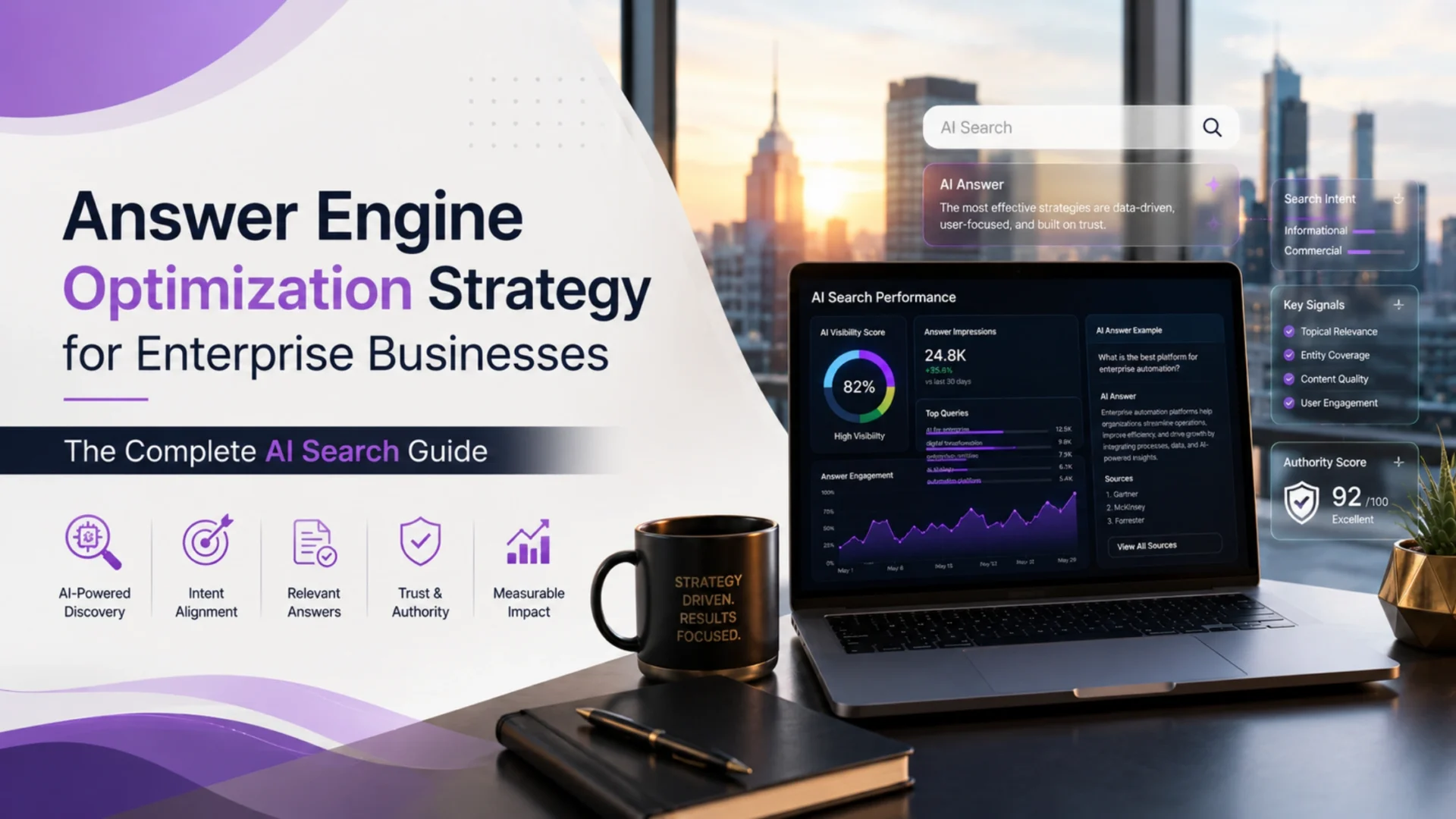
This guide gives you a comprehensive strategy for enterprise answer engine optimization (AEO): how it differs from standard AEO, the framework to run it at scale, the technical build, and how to report the results. Several industry studies already put AI-assisted search sessions in the double digits as a share of total search volume, and that share keeps growing.
Quick Answer
Enterprise answer engine optimization is the practice of structuring a large organization’s content, technical infrastructure, and governance so that AI systems like ChatGPT, Google AI Overviews, Gemini, Perplexity, and Copilot can find, understand, and cite that organization’s information accurately, across every brand, product line, and region it operates in. It builds on SEO, but where standard AEO focuses on individual pages earning citations, enterprise AEO focuses on an entire portfolio doing that consistently, at once, without brands stepping on each other.
What is Enterprise Answer Engine Optimization?
Enterprise AEO builds directly on SEO and shares ground with generative engine optimization, but it is not a rebrand of either one. Where standard AEO focuses on individual pages earning citations, enterprise AEO focuses on an entire portfolio doing that consistently, at once, without brands stepping on each other.
If you want the fuller breakdown of how AEO, GEO, and traditional SEO relate, we have covered AEO vs GEO vs SEO here. This piece stays focused on what changes once you are operating at enterprise scale.
Why enterprise AEO is a different discipline than standard AEO
Enterprise AEO is a different discipline because the scale changes everything. You are not optimizing a single page or a website. You are managing thousands of pages, several brands, multiple regions, and teams across marketing, IT, product, legal, and communications, all of whom need to agree on how the brand shows up in AI answers.
A mid-market company might have one content team and one CMS. An enterprise has product marketing teams that do not talk to regional marketing teams, a legal function that needs sign-off on claims, and a procurement process before any vendor touches the CMS. None of that is optional context. It is the actual environment AEO has to work inside.
The risk of doing AEO “page by page” at enterprise scale
Treating enterprise AEO as a page-by-page exercise creates inconsistency. One team optimizes a product page one way, while another team optimizes a similar page in a completely different way, and AI models end up pulling conflicting information about the same company. It does not just look messy, it actively reduces citations, because AI models treat consistency as a trust signal.
Why portfolio-level strategy prevents cross-brand cannibalization
A portfolio-level strategy matters because without it, brands under the same enterprise umbrella end up competing for the same AI citation. If your enterprise owns three brands that publish close to the same content on the same topic, you are not increasing your chances of getting cited, you are diluting your own signal and confusing the AI model about which source to trust. A shared strategy assigns topical ownership across the portfolio, the same way a smart internal linking structure prevents keyword cannibalization in classic SEO.
The business case: what AI search is doing to enterprise pipeline
AI search is already reshaping the enterprise pipeline because a meaningful share of top-of-funnel research queries get answered without a click, and B2B marketers who are not tracking AI visibility are losing that traffic without knowing it. Zero-click search behavior has been climbing for years, and generative answers accelerate it further.
58.5%
Of Google searches in the US now end without a click, according to SparkToro’s zero-click search study.
~22%
Of B2B marketing teams currently track what AI tools are actually saying about their brand, per a multi-source B2B buyer analysis.
Here is the part that should create urgency, not panic: most brands are not measuring this yet, which means the ones who start now get a head start most competitors will not have for another year or two.
Why AEO traffic is later-stage, higher-intent traffic, not lower-quality traffic
AEO-driven traffic tends to be later-stage and higher-intent, not a lower-quality substitute for organic clicks. When someone clicks through from an AI Overview or a ChatGPT citation, they have already had their basic question answered. They are clicking because they want to go deeper, evaluate a vendor, or take action. That is a warmer visitor than someone landing on a generic “what is X” page from a standard search result. Enterprises that treat AI-referred visits as a lesser channel are underselling a segment that is often closer to a buying decision.
Not sure how visible your brand already is in AI answers?
Most enterprise teams have never checked. Elsner can run a citation and visibility audit across your brand portfolio before you commit to a full AEO program.
The enterprise AEO strategy framework
The strategy that works at enterprise scale is layered, not linear. Crawl access, technical foundation, content, authority, measurement, and governance all need to work together. A weak layer anywhere drags down everything built on top of it. Here is the framework we use with clients, divided into six layers.
Layer 1: Crawl access
Can AI crawlers actually reach your content? Enterprises with aggressive bot-blocking rules, paywalls, or heavy JavaScript often lock them out without anyone noticing. This is a quick audit, and it is the most overlooked layer.
Layer 2: Technical foundation and schema at scale
Structured data, entity clarity, and site architecture, applied consistently across thousands of pages instead of as one-off fixes. Headless CMS setups add extra complexity here, which we cover further below.
Layer 3: Answer-first content
Content structured so the direct answer comes first, followed by supporting depth. This means mapping real user questions to content, backed by original data and genuine expert input rather than recycled summaries.
Layer 4: Authority and entity signals
Third-party citations, consistent brand information throughout, and genuine E-E-A-T signals. AI models cross-check sources, so what other credible sites say about your brand matters as much as what your own site says.
Layer 5: Measurement
Citation rate, mention rate, share of voice inside AI answers, and AI-sourced sessions. Traditional rank tracking does not capture any of this, so this layer requires its own tooling and reporting approach.
Layer 6: Governance
Clear ownership, brand safety checks, hallucination monitoring (catching when an AI system misrepresents your brand), and compliance sign-off built into the process from the start.
| Layer | What it covers | Why it fails without the others |
|---|---|---|
| Crawl Access | Bot permissions, rendering, indexability | Nothing downstream matters if AI can’t reach the content |
| Technical Foundation | Schema, entity clarity, architecture | Weak structure means AI can’t parse what it does reach |
| Answer-First Content | Direct answers, original data, Q&A mapping | Great technical setup with weak content still won’t get cited |
| Authority Signals | Third-party citations, E-E-A-T | Content without external trust signals gets deprioritized |
| Measurement | Citation rate, share of voice, AI sessions | Without this, none of the above can be proven or improved |
| Governance | Ownership, brand safety, compliance | Without it, the whole program stalls at the first legal or procurement review |
Technical AEO implementation at enterprise scale
Technical AEO implementation at the enterprise level means coordinating crawlability, schema, site speed, and CMS architecture across thousands of pages and multiple teams, not fixing one page at a time. This is where a lot of enterprise AEO efforts quietly drop, because the technical work is actually bigger than what most content teams expect.
For example, schema markup is not a one-time tag that you add and forget. At the enterprise level, it needs a templated approach so that new pages inherit correct structured data automatically, instead of relying on someone to add it manually. Site speed and rendering also matter. If AI crawlers hit a slow, heavy JavaScript page and time out before the content loads, the page becomes non-existent to them.
Headless CMS setups deserve their own mention, because they are increasingly common in enterprise environments and they introduce real AEO complications, particularly around how content gets rendered and how schema gets injected. We go deeper on that specific challenge in our guide to SEO for headless CMS platforms. None of this technical work happens in isolation either. It requires ongoing coordination between SEO, content, and engineering teams, which is exactly where governance (Layer 6) starts to matter well before you get anywhere near a launch.
Building answer-first content your AI engines will cite
Content earns AI citations when it leads with a direct, factual answer and backs it up with original data, expert input, and clear question-to-content mapping, not when it buries the answer under three paragraphs of preamble. AI systems are, at their core, looking for extractable, confident, well-sourced statements. Give them exactly that, early in the piece. A few things matter more than people expect:
- Clear Q&A-style headings that mirror how people actually phrase questions to a chatbot, not how a marketer might phrase a headline.
- Factual density. Specific numbers, named studies, and dated statistics outperform vague claims every time.
- Original research or proprietary data, even something as simple as an internal survey of your own customers, since AI models weigh original sources heavily.
- Expert quotes attributed to a real, named person with credible experience.
- A refresh schedule. Recent content gets cited more often for commercial and comparison queries. SE Ranking’s study found that content updated within the last two months earns 5.0 citations on average, compared to 3.9 for pages older than two years.
One accuracy note worth highlighting: FAQ structure still helps AI engines extract answers cleanly, but as of a rollback earlier this year, Google no longer grants rich snippet treatment for FAQ schema on most non-government, non-healthcare sites. So format your FAQs for clarity and extraction, not because you are expecting the old rich-result visual in classic search.
For a broader look at how this connects to topic architecture, our blog on how topic clusters turn the tables for SEO is a useful companion read, and our content marketing services team handles this exact kind of production at scale.
Measuring enterprise AEO and reporting to leadership
Measuring enterprise AEO requires new metrics that traditional SEO dashboards do not capture, and translating them into a board-ready view that ties back to pipeline and revenue, not just visibility. Citation rate, mention rate, share of voice inside AI answers relative to competitors, and AI-sourced sessions are the core numbers to track.
| Metric | What it tells you | Traditional SEO equivalent |
|---|---|---|
| Citation Rate | How often AI engines cite your content for target queries | Organic ranking position |
| Mention Rate | How often your brand is mentioned, even without a direct link | Brand search volume |
| Share of Voice | Your citation frequency relative to named competitors | Market share of clicks |
| AI-Sourced Sessions | Traffic arriving via AI platform citations | Organic sessions |
| Attributed Pipeline | Revenue-stage activity traceable to AI-sourced visits | Organic-to-lead conversion |
The step that actually gets the budget approved is connecting these numbers to the pipeline. A citation rate improving month over month is interesting to a marketing team. An AI visibility score tied to attributed pipeline and revenue is what gets a CMO to keep funding the program at the next budget cycle.
Governance, compliance, and build vs buy
Governance for enterprise AEO means clear cross-functional ownership, brand safety monitoring, and hallucination checks, all while still meeting the procurement and compliance bar that large organizations already apply to every other vendor. Someone needs to own AEO the way SEO is owned today, with the authority to approve claims, check AI-generated summaries of your brand for accuracy, and escalate when something goes wrong about a product or policy.
The procurement team will ask the same questions they ask about any other technology partner, like SOC 2 compliance, single sign-on, and role-based access control if you are working with external tools. It is better to have the answers ready before the conversation comes up.
On build versus buy, here is the honest take. If you already have SEO, content, and engineering talent free, you can build it in-house. Most enterprises do not have that bandwidth, and a partner who already understands both the technical and content sides of AEO moves faster and skips the early mistakes.
A phased enterprise AEO roadmap (first 6 months)
A realistic enterprise AEO rollout starts with a single pilot brand or region, then expands based on what that pilot proves. Early citation movements usually start appearing within 30 to 60 days, and meaningful visibility follows in around 4 to 6 months. The most common way enterprise AEO programs stall out is when they try to launch across every brand and region simultaneously.
Weeks 1 to 4: Crawl access audit, technical foundation review, and governance ownership assigned. Pick one pilot brand or region.
Weeks 4 to 8: Schema and structural fixes deployed on the pilot. First batch of answer-first content published or refreshed.
Weeks 8 to 12: Early citation and mention tracking begins. Expect the first small signals of AI citation activity here.
Months 3 to 4: Expand the framework to a second brand or region based on pilot learnings. Refine the content and technical playbook.
Months 4 to 6: Full measurement dashboard in place, first leadership report delivered, and a scaling plan built for the remaining portfolio.
This timeline matters a lot, because setting the wrong expectation internally, such as promising results in two weeks, is one of the fastest ways to lose leadership buy-in for a program that actually needs a couple of months to show its full potential.
How Elsner helps enterprises win AI search
Elsner works with enterprise teams on exactly this combination: technical implementation and content strategy under one roof, not split across a dev vendor and a separate content agency. That matters because the layers in this framework are not independent. Schema work that does not match the content structure, or content that ships faster than the technical foundation can support, creates gaps that show up later as inconsistent AI citations.
Our team has followed this exact process for multi-brand and multi-region clients, building the crawl access audits, schema templates, and answer-first content pipelines covered above, along with the governance process that gets approval from legal and procurement rather than just sticking to reviews. We also handle the ongoing measurement piece, so leadership gets a dashboard that speaks in pipeline and revenue terms, not just visibility scores that nobody outside the marketing team understands.
If your organization is weighing whether to build this capability internally or bring in a partner who has already worked on it, our enterprise AEO services team can help you figure out where to start.
The bottom line
AI search is no longer a future consideration for enterprise brands. It is already taking away research stage traffic from traditional organic results. Enterprises that start acting now with a real framework, instead of scattered page-level fixes, are taking the lead. Start with one pilot, prove the framework, then scale.
Ready to build a defensible enterprise AEO strategy?
Elsner handles both the technical and content sides of enterprise AEO under one roof. Book a consultation and let’s map out what a pilot would look like for your organization.
Frequently Asked Questions
What is enterprise answer engine optimization?
Enterprise answer engine optimization is the practice of structuring a large organization’s content, technical setup, and governance so that AI systems like ChatGPT and Google AI Overviews can find, understand, and accurately cite that organization across every brand and region it operates in.
How is enterprise AEO different from regular AEO?
Enterprise AEO differs from regular AEO in terms of scale. It manages a whole portfolio of brands, regions, and teams instead of a single site, and involves cross-functional governance, portfolio-level content strategy, and technical work across thousands of pages, not just isolated page fixes.
How do you measure AEO at the enterprise level?
Enterprise AEO is measured through citation rate, mention rate, share of voice inside AI answers, AI-sourced sessions, and attributed pipeline, reported in a way that ties directly back to revenue for leadership.
How long does enterprise AEO take to show results?
Most enterprise AEO programs show early citation movement within 30 to 60 days, with meaningful, measurable visibility gains typically appearing around 4 to 6 months after a well-run pilot phase.
Does AEO replace SEO?
No. AEO builds on top of SEO fundamentals like crawlability, technical health, and authority signals. It adds a layer focused specifically on how AI systems extract, trust, and cite content.
Who owns AEO inside a large organization?
There is no universal answer yet, but the programs that work best assign clear ownership, usually within SEO or content leadership, with defined authority to coordinate across marketing, IT, legal, and communications.