


- What Are AI Visibility Tools?
- Traditional SEO Tracking
- AI Visibility Tracking
- Why AI Visibility Tracking Matters for SEO Teams
- 1. AI Answers Can Summarize Information Before a Click
- 2. AI Systems May Mention Only a Small Number of Brands
- 3. Ranking Does Not Guarantee AI Visibility
- 4. Competitor Visibility Becomes Easier to Diagnose
- 5. AI Visibility Is Becoming Measurable
- How AI Visibility Tools Work
- Step 1: Build a Prompt Set
- Step 2: Run Prompts Across AI Platforms
- Step 3: Analyze Responses
- Step 4: Benchmark
- Step 5: Identify Gaps
- Step 6: Turn Findings Into Actions
- What Should You Track With an AI Visibility Tool?
- Important Clarification
- AI Mentions vs AI Citations: What’s the Difference?
- Mention
- Citation
- AI Visibility vs Traditional SEO Visibility
- How to Choose the Right AI Visibility Tool
- 1. AI Platform Coverage
- 2. Prompt Coverage
- 3. Citation Tracking
- 4. Competitor Tracking
- 5. Historical Data
- 6. Geographic Tracking
- 7. Platform-Level Reporting
- 8. Integration With SEO Data
- 9. Reporting
- 10. Data Methodology
- How a Few Representative Tools Compare
- AI Visibility Tools vs Manual Tracking
- Manual Tracking Works For
- Dedicated Tools Become Useful When
- How to Build an AI Visibility Tracking Workflow
- How to Turn AI Visibility Data Into SEO Actions
- A Made-Up Example (Not a Case Study)
- Common Mistakes When Using AI Visibility Tools
- Mistake 1: Treating One AI Response as a Ranking
- Mistake 2: Tracking Only Brand Mentions
- Mistake 3: Looking Only at Your Own Brand
- Mistake 4: Obsessing Over One Visibility Score
- Mistake 5: Tracking Random Prompts
- Mistake 6: Ignoring Source Domains
- Mistake 7: Optimizing Only Your Website
- Mistake 8: Expecting Instant Results
- How Much Does an AI Visibility Tool Cost?
- Are AI Visibility Tools Worth It?
- More Useful For
- Less Necessary For
- AI Visibility Tools: A Practical Evaluation Checklist
- Key Takeaways
- Frequently Asked Questions
Your pages rank well. Your traffic looks good. Your site audit is clean. Then a buyer asks ChatGPT for the best vendors in your field, and your brand isn’t the answer.
Search habits are changing. Google shared numbers in May 2026 showing that AI Overviews reach about 2.5 billion people a month, and AI Mode has passed 1 billion. Ranking on page one is no longer the only way to be seen. A brand can rank well, get strong organic traffic, and have clean technical pages, and still be missing when a customer asks an AI for recommendations.
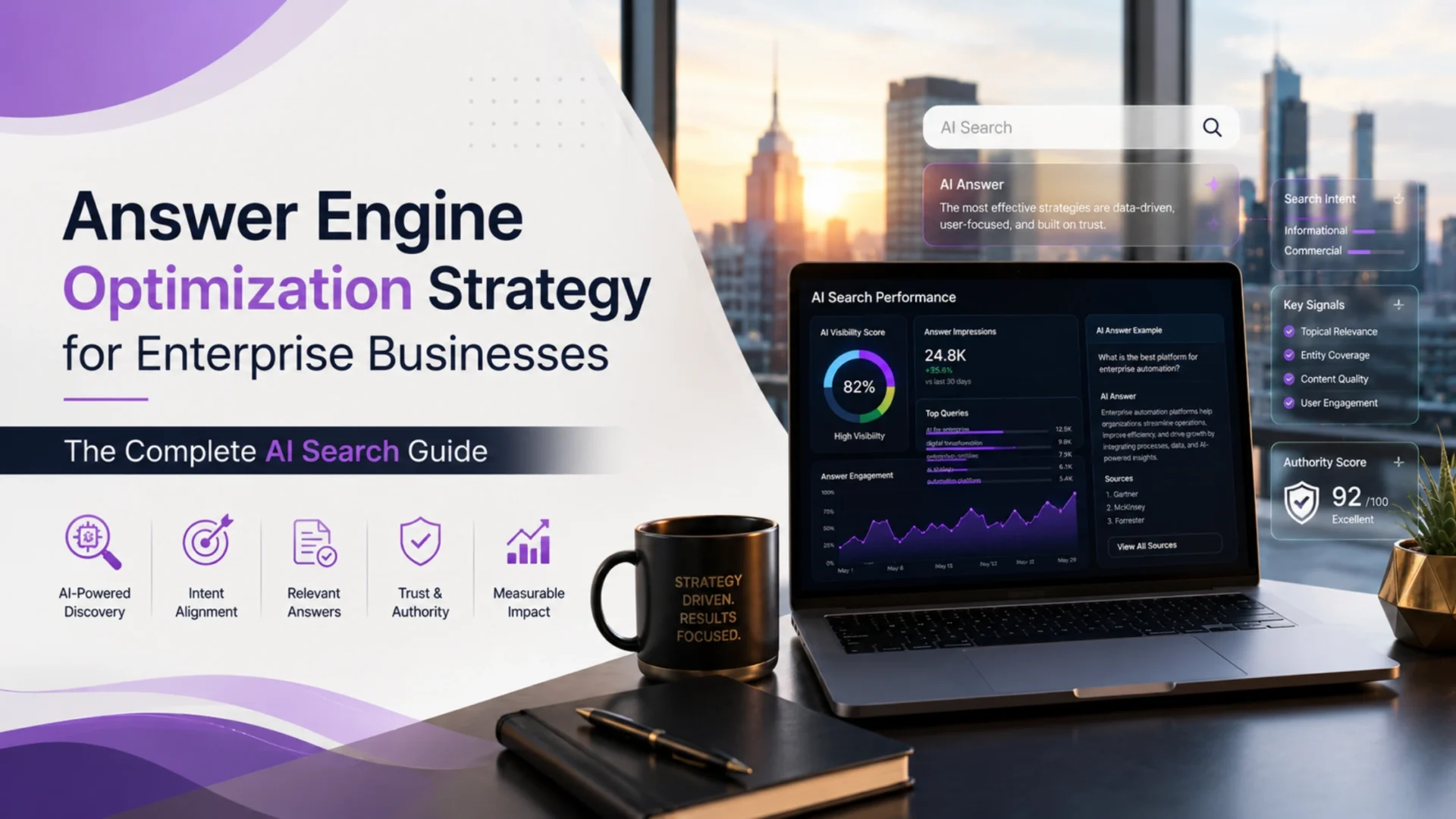
AI visibility tools try to measure that new layer. This guide covers what these tools track, which metrics matter, how they work, what to compare, and how to build a monitoring routine your team can repeat. It skips the AEO and GEO basics, since you’ve likely read those already. Instead, it focuses on measuring, comparing tools, and acting on the data. Rankings still count. They just don’t tell you if an AI names, recommends, or cites your brand.
Quick Answer
AI visibility tools run a fixed set of prompts across AI platforms, then record whether your brand is mentioned, which sources are cited, and which competitors appear instead. Track mentions, citations, share of voice, and competitor presence first. Compare tools by platform coverage, methodology, and history, and read the data next to your SEO and analytics reports. No tool can guarantee a citation, so judge results by patterns across repeated runs, not by one answer.
What Are AI Visibility Tools?
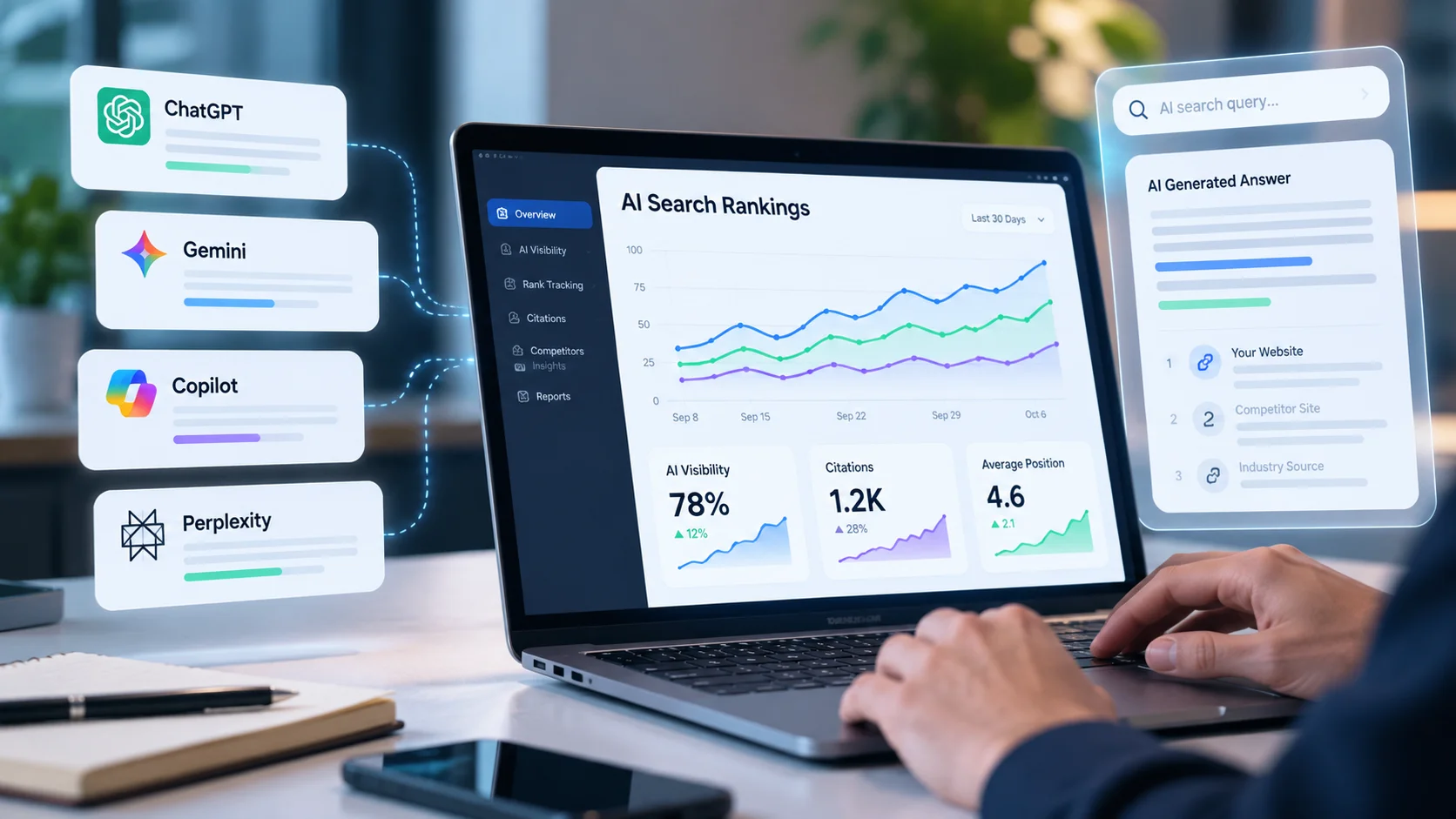
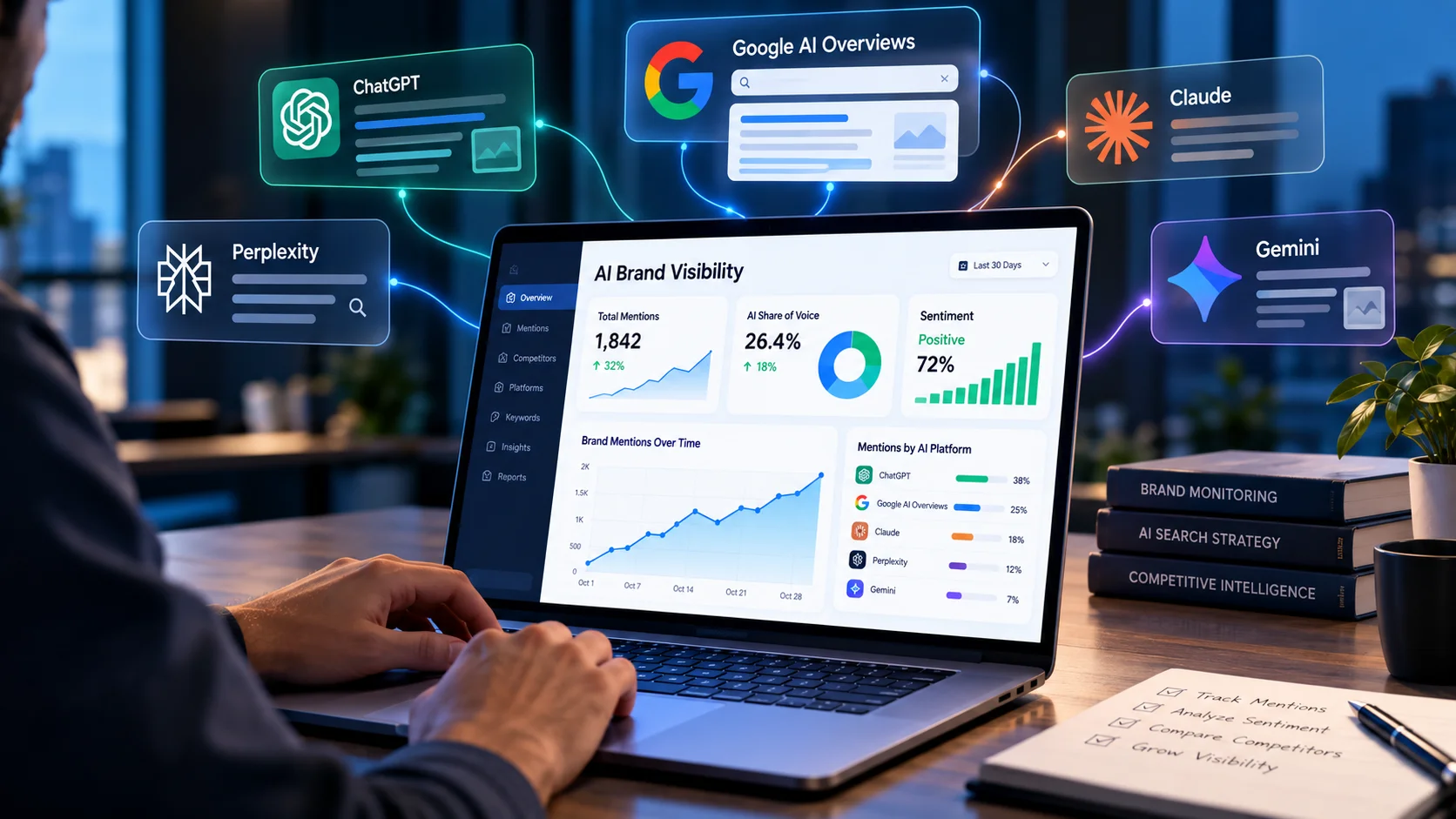
AI visibility tools are software that checks how your brand appears in AI-generated answers. They run prompts on AI platforms. Then they record if your brand is mentioned, which sources are cited, and which competitors show up instead.
Depending on the tool, you may see brand mentions, citations, source URLs, prompt level visibility, competitor mentions, share of voice, sentiment, topics, platforms, trends, cited pages, and citation domains.
Here’s a simple way to see the difference between the two kinds of tracking.
Traditional SEO Tracking
It measures:
- Rankings
- Impressions
- Clicks
- CTR
- Organic traffic
AI Visibility Tracking
It can measure:
- Brand mentions
- AI citations
- Prompt visibility
- Competitor presence
- AI share of voice
- Source and citation patterns
- Platform level visibility
The two systems work together. SEO tracking shows where your pages rank and what happens after a click. AI tracking shows if the answer included you at all. Neither one replaces the other, and you’ll get the clearest view when you read them side by side.
Why AI Visibility Tracking Matters for SEO Teams
Your usual SEO dashboard doesn’t show the full picture. Here’s why.
1. AI Answers Can Summarize Information Before a Click
A user may get an answer without visiting several sites. Your page can help build that answer and still get no visit. That means clicks alone can understate how often people see your brand.
2. AI Systems May Mention Only a Small Number of Brands
That changes how competition works. You may not be fighting for ten blue links. You may be fighting for two or three names in one answer. Being the fourth best option can mean being left out.
3. Ranking Does Not Guarantee AI Visibility
A page can rank high on Google and still not appear in a given AI answer. An Ahrefs study of 15,000 prompts found that only 12% of links cited by ChatGPT, Gemini, and Copilot were in Google’s top 10 for the same prompt. Semrush also notes that AI visibility is spread across platforms, and that traffic numbers alone don’t fully capture it. So a strong rank is a good sign, not proof.
4. Competitor Visibility Becomes Easier to Diagnose
You can find the prompts where a rival shows up and you don’t. Then you can ask why. Maybe a rival has stronger sources, clearer pages, or more mentions on other sites.
5. AI Visibility Is Becoming Measurable
Teams used to test chatbots by hand. Now there are tools built for steady monitoring. Google and Microsoft also share some AI data with site owners, and ChatGPT tags its referral traffic. The category is moving from guesswork to real monitoring.
None of this means SEO no longer matters. Google says that SEO basics still matter for AI Overviews and AI Mode. If you also want to work on the content side, Elsner’s guide to AI search optimization goes deeper.
How AI Visibility Tools Work
Most tools follow the same flow. They run prompts, read the answers, and turn the results into trends. Here’s the flow, which also fits a simple pattern: discover, track, compare, diagnose, act, measure.
Step 1: Build a Prompt Set
The tool finds prompts, or you add your own. A few examples, just for illustration:
- Best ecommerce development companies
- Best Shopify development agencies
- Shopify experts for enterprise stores
- Magento migration companies
- Best ecommerce platforms for B2B
Step 2: Run Prompts Across AI Platforms
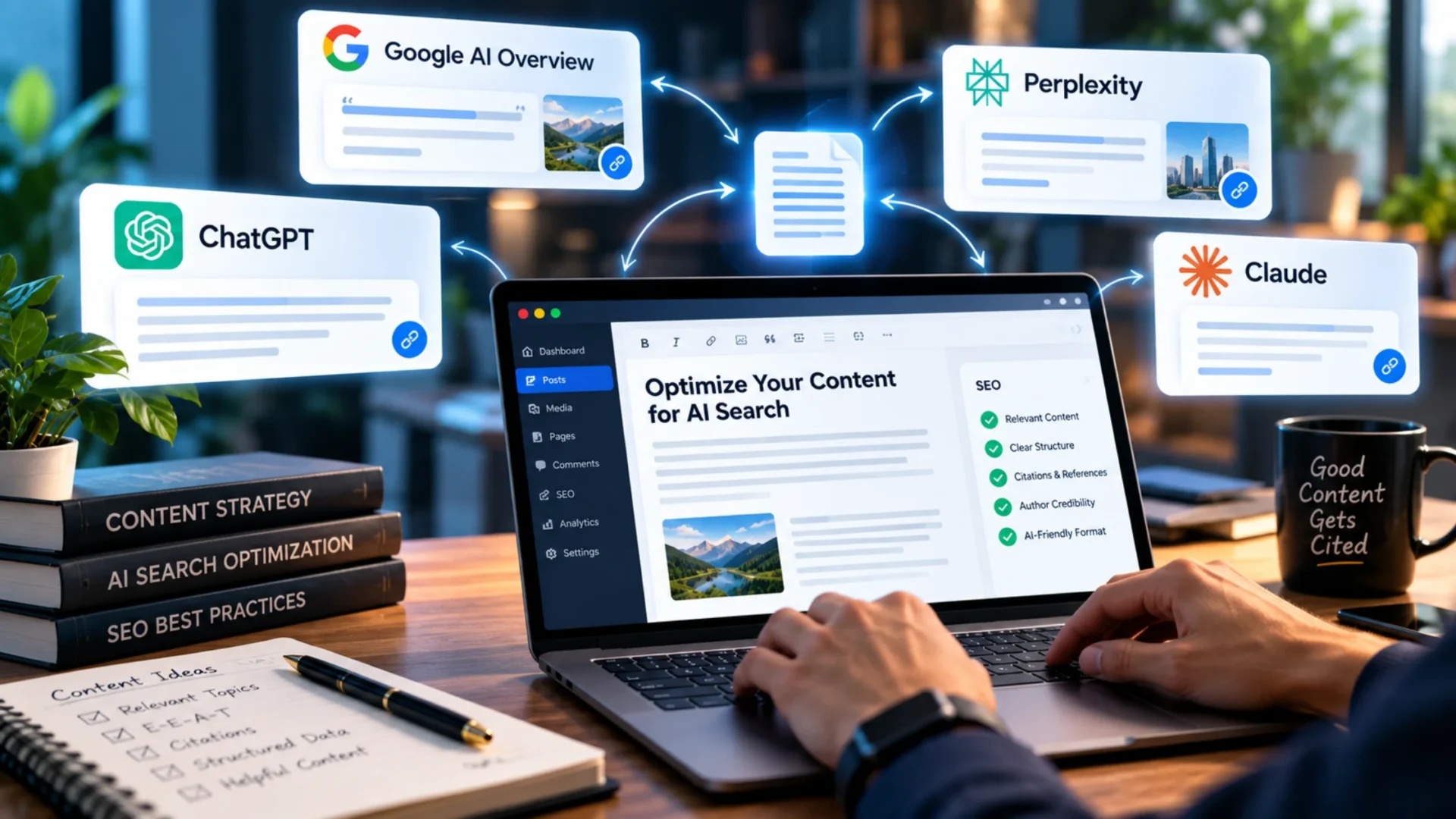
Possible platforms include ChatGPT, Google AI Overviews, Google AI Mode, Gemini, Perplexity, Microsoft Copilot, and Claude. Support changes by tool and plan, so check before you buy. Some tools cover only a few engines on their base plans, with more on higher plans. Semrush’s help pages, for example, list prompt tracking for Google AI Mode, AI Overviews, Gemini, and ChatGPT Search.
Step 3: Analyze Responses
The tool finds brand mentions, the order of mentions, citations, cited domains, competitors, topics, and sentiment. This is where raw answers turn into numbers you can chart.
Step 4: Benchmark
You compare your brand against competitors, one platform against another, one topic against another, and this month against last month.
Step 5: Identify Gaps
Look for prompts where competitors appear, topics where you’re missing, sources your rivals get cited from, pages that are cited, and content you haven’t made yet.
Step 6: Turn Findings Into Actions
Use the data for content updates, new content, entity fixes, digital PR, third party authority building, technical fixes, internal linking, and structured data. This step is where most of the value is.
One Caution
AI answers change with prompt wording, location, platform, model version, sources, freshness, and the time you check. So AI visibility isn’t a fixed rank like a Google position. It’s a pattern across a set list of prompts and repeated runs.
What Should You Track With an AI Visibility Tool?
This is the core of any tracking plan. Start with these ten metrics. No tool reports all of them, and that tells you something too.
| Metric | What It Tells You | Why It Matters |
|---|---|---|
| Brand Mentions | Whether AI answers mention you | Basic visibility |
| Citation Rate | How often your sources are cited | Source authority |
| Share of Voice | Your presence vs competitors | Competitive visibility |
| Prompt Visibility | Which queries trigger your presence | Query level performance |
| AI Visibility Score | A tool specific visibility indicator | Trend tracking |
| Citation Sources | Which domains AI systems use | Authority opportunities |
| Cited Pages | Which pages earn citations | Content performance |
| Sentiment/Context | How the brand is described | Brand perception |
| Competitor Mentions | Who appears instead of you | Competitive gap |
| Platform Visibility | Where you appear | Platform specific strategy |
Important Clarification
An AI visibility score isn’t an industry standard. Each tool works it out in its own way. Semrush builds a 0 to 100 score from topic coverage and how steadily your brand is mentioned. Peec defines visibility as the share of answers that mention your brand. Same name, different math.
A score is useful for tracking change inside the same tool. Scores from two different vendors shouldn’t be treated as directly comparable.
Short on time? Start with mentions, citations, share of voice, and competitor mentions. Add sentiment later, and treat it as a hint, not a verdict. One cold description in one answer means little. A pattern across many prompts means something.
Also pair tool data with your own analytics. AI referral traffic, branded search in Search Console, and assisted sales show if visibility turns into business. Tools show exposure. Your analytics show results. Many AI answers never lead to a click you can trace, so neither can replace the other.
AI Mentions vs AI Citations: What’s the Difference?
A mention is not the same as a citation. Both matter, and they tell different stories.
Mention
The AI response names your brand. For example: “Company X offers Shopify development services.”
Citation
The AI response links to, or names, a source that supports the answer. For example, a footnote pointing to Company X’s service page.
A brand can be mentioned without a direct citation. A source can also be cited without the brand being clearly mentioned. Peec’s help pages draw the same line between brand visibility and source visibility.
Why both matter: a brand that’s mentioned but rarely cited may be linked to a topic, but AI doesn’t treat its content as the source. A page that’s cited but not named does the work while someone else gets the credit. If you see the first pattern, answer engine optimization work often starts with the pages AI could cite.
Here’s a quick scenario. A buyer asks for the best B2B ecommerce platform. The answer names two vendors and links to a comparison article that lists you. Your brand never shows in the answer text, but the article it cites does mention you. A tool that only counts mentions calls that a miss. A tool that tracks sources sees something more useful.
This is also why one mixed number hides the story. Keep two lines in your reports.
AI Visibility vs Traditional SEO Visibility
| Traditional SEO | AI Visibility |
|---|---|
| Keyword ranking | Prompt visibility |
| SERP position | Presence in AI answer |
| Organic CTR | AI mention/citation |
| Search impressions | AI answer exposure |
| Backlinks | Cited sources + authority signals |
| Organic traffic | AI-referred traffic where measurable |
| SERP competitors | AI-mentioned competitors |
| Page performance | Citation-worthy pages |
Don’t replace SEO reporting with AI visibility reporting. Instead, combine four layers: SEO, AI visibility, brand, and business outcomes. Google says crawling, internal links, and good content still count in its AI features, which is groundwork a good SEO services partner already covers.
Rankings and AI visibility don’t always move together, as the Ahrefs data above shows. Reading them side by side is where you learn the most. A page with a great rank but no AI presence tells you to look at prompt intent and sources. A page with weak rank but strong AI presence tells you something else.
How to Choose the Right AI Visibility Tool
Don’t start with a “best tool” list. Start with a fair way to compare. These ten checks will do it.
1. AI Platform Coverage
Does the tool watch the platforms your audience uses? If your buyers lean on ChatGPT, a tool that mostly covers Google features won’t help much.
2. Prompt Coverage
Can you add custom prompts, find new prompts, group prompts by topic, and watch prompts over time?
3. Citation Tracking
Does it show citation URLs, domains, cited pages, how often they appear, and where competitors get cited?
4. Competitor Tracking
Can you compare mentions, share of voice, topics, prompts, and citations?
5. Historical Data
Look for trends, not one time snapshots. A single report tells you little. Months of data tell you if you’re moving.
6. Geographic Tracking
This matters if you sell in different countries or regions.
7. Platform-Level Reporting
You should be able to tell ChatGPT, Gemini, Google AI Overviews, Google AI Mode, and Perplexity apart. A blended number hides where you’re strong and where you’re weak.
8. Integration With SEO Data
Data is more useful next to rankings, organic traffic, backlinks, content, and search demand.
9. Reporting
Check for exports, dashboards, scheduled reports, client reports, and history comparisons.
10. Data Methodology
This is the biggest difference between tools. Ask where prompts come from, if they come from real search demand, how often they refresh, how often answers are checked, which locations and languages are covered, if data comes from APIs or normal user screens, and how scores are worked out.
Vendors answer differently. Semrush says its prompt database answers are captured from real requests, not through LLM APIs, and says no platform can give exact visibility numbers. Ahrefs builds Brand Radar prompts from real search demand, and has said these are still synthetic prompts that mirror that demand. Peec uses browser automation instead of APIs. None is automatically right. They’re trade-offs.
Also ask for a demo and test a few things. How many times is each prompt run before a result is reported? Can you read the raw AI answer behind every number? What happens to your history if you cancel? If you can’t read the real answer behind a chart, you can’t tell if a mention was a recommendation or a warning.
How a Few Representative Tools Compare
They’re listed in alphabetical order, not ranked, and the notes come from each vendor’s own pages. Confirm current details before you buy.
| Tool | How It Collects Data | Worth Knowing |
|---|---|---|
| Ahrefs Brand Radar | Prompts built from People Also Ask and keyword data | Pairs AI share of voice with search demand |
| Otterly.AI | Sends your prompts to AI search tools | Has a GEO audit and client workspaces |
| Peec AI | Browser automation, not APIs | Visibility, position, sentiment, and sources |
| Profound | Says it captures answers from normal user screens | Adds AI crawler and referral analytics |
| Scrunch | Collects AI answers across platforms | Adds a layer that serves AI friendly pages to agents |
| Semrush AI Visibility Toolkit | Prompt database plus daily tracking of your prompts | Sits inside a larger SEO suite |
If you want a starting point before buying software, an AI search visibility audit can show which prompts, rivals, and sources matter first.
AI Visibility Tools vs Manual Tracking
Manual tracking is fine early on. Paid tools help once things grow.
Manual Tracking Works For
- Small websites
- Initial baseline audits
- Small prompt sets
- One-off experiments
- Early-stage teams
Dedicated Tools Become Useful When
- Prompt volume increases
- Multiple AI platforms are involved
- Competitors need monitoring
- Historical tracking is required
- Multiple clients are managed
- Reporting needs to be automated
A simple starting routine: pick 20 to 50 prompts, check them weekly or monthly, record mentions and citations, compare competitors, and find gaps. Weekly isn’t always best. How often you check should depend on your business and how fast your field changes. A fast moving category may need closer checks. A slow one can do fine with monthly.
Run each prompt more than once. A SparkToro study ran 12 prompts 60 to 100 times each. ChatGPT and Google’s AI almost never gave the same brand list twice. (One author runs an AI tracking startup, so keep that in mind.)
Check free data first:
- Google’s Search Console reports for generative AI show impressions in AI features.
- Bing Webmaster Tools has an AI Performance report for Copilot citations.
- OpenAI says ChatGPT adds utm_source=chatgpt.com to referral links, so your analytics can pick out that traffic.
For more, see Elsner’s piece on AI rank tracking.
How to Build an AI Visibility Tracking Workflow
Keep it simple and repeatable. These seven steps work for a small team or a large program.
Step 1: Define Business-Critical Topics
Start with topics tied to products, services, categories, buying decisions, competitors, and the questions customers ask.
Step 2: Create Prompt Groups
Build five groups. Discovery prompts: “What are the best…?” Comparison prompts: “X vs Y…” Problem-solving prompts: “How can I…?” Commercial prompts: “Best company/tool/service for…?” Local prompts: “Best [service] company in…?”
Step 3: Establish a Baseline
Record the brand mention, citation, competitors, order, source, platform, and date.
Step 4: Monitor Consistently
Run the same prompt set over time. AI answers change, so one result isn’t a final measure of visibility. Don’t reword prompts in the middle of a quarter, or you’ll break your own trend line.
Step 5: Find Competitor Gaps
Ask these questions. Where does competitor X appear? Where are they cited? Which topics do they own? Which sources keep coming back?
Step 6: Fix the Underlying Gap
Add depth to content. Add original facts. Keep your brand details the same everywhere. Strengthen internal links. Improve source quality. Earn relevant mentions on other sites. Update old content. Fix technical access. For that last one, check that OAI-SearchBot isn’t blocked, since OpenAI says it needs access for content to show in ChatGPT search.
Step 7: Re-Measure
Track mentions, citations, topic coverage, competitor share, and platform visibility. Then repeat. This closes the loop. If the numbers didn’t move, the fix may need more time, or a different fix. Keep a small change log of prompt versions, dates, and site changes, so you can explain a jump or a drop later.
How to Turn AI Visibility Data Into SEO Actions
Each finding below points to something to check. None is a guaranteed fix.
| Finding | Possible Action |
|---|---|
| Competitor appears, brand doesn’t | Analyze competitor’s cited sources and topic coverage |
| Brand mentioned but not cited | Improve authoritative source content |
| Old page repeatedly cited | Refresh and strengthen the page |
| Competitor cited by third-party sources | Explore digital PR/authority opportunities |
| Brand described incorrectly | Improve entity consistency and authoritative references |
| Strong Google ranking but weak AI visibility | Analyze prompt intent and source selection |
| Strong mentions but poor sentiment/context | Review brand/entity signals and external mentions |
| One platform performs better than another | Investigate platform-specific prompt/source behavior |
A Made-Up Example (Not a Case Study)
Imagine an ecommerce software company that ranks in Google’s top five for “enterprise ecommerce platform.” When buyers ask several AI platforms for enterprise ecommerce picks, three competitors show up. The company doesn’t.
- Observation: The company is missing from most runs. The same three rivals appear again and again.
- Diagnosis: The rivals are mentioned in roundup articles and comparison pages that never list the company. Its own site has no comparison content.
- Action: Publish an honest comparison hub. Refresh old product pages. Seek inclusion in the roundups the AI keeps citing, working with its ecommerce SEO team.
- Recheck: Run the same prompts on the same schedule for several weeks. Judge by how often the brand appears, not by one answer.
No single fix guarantees a citation, because models, sources, and retrieval keep changing. You’ll likely find many gaps. Start with the prompts closest to revenue, usually commercial and comparison prompts, then weigh effort against the size of the gap. A missing mention on a high intent prompt usually matters more than a weak sentiment note on a casual question. Give each fix one owner, and set a recheck date the day the work ships.
Common Mistakes When Using AI Visibility Tools
Mistake 1: Treating One AI Response as a Ranking
AI responses can vary from run to run.
Mistake 2: Tracking Only Brand Mentions
Citations and context matter too.
Mistake 3: Looking Only at Your Own Brand
Competitor analysis is essential. Without rivals, a number means little.
Mistake 4: Obsessing Over One Visibility Score
Different tools use different methods.
Mistake 5: Tracking Random Prompts
Pick prompts that match real customer journeys, or you’re measuring noise.
Mistake 6: Ignoring Source Domains
The sites behind AI answers can show where your authority gap is.
Mistake 7: Optimizing Only Your Website
AI visibility can be shaped by the wider web, including trusted third party sources.
Mistake 8: Expecting Instant Results
AI visibility changes as models, retrieval systems, sources, and content change.
How Much Does an AI Visibility Tool Cost?
It depends, and any price printed here would be old soon. Cost usually changes with the number of prompts, tracked brands, AI platforms, locations, historical data, reporting, competitor tracking, team seats, and API access.
Ask how usage is counted too. Some plans count a prompt once per platform, so 50 prompts on four engines can mean 200 tracked runs. If a vendor’s pricing is part of your plan, check the official vendor website the same week you decide, since these products change often. Then price your real need: the prompts you’d track, the engines that matter, and how many brands or clients you’d cover. A cheap plan for one platform can cost more in workarounds than a pricier plan that fits.
Are AI Visibility Tools Worth It?
Sometimes. Not a flat yes. It depends on how you’d use the data.
More Useful For
- Growing brands
- Competitive industries
- Agencies
- Enterprise SEO teams
- Businesses investing heavily in content
- Companies actively targeting AI search
- Teams needing repeatable reporting
Less Necessary For
- Very small websites
- Teams only beginning to understand AI search
- Businesses with very limited prompt coverage
- One-off exploratory projects
Agencies are a special case. If clients expect AI visibility in monthly reports, a tool with workspaces and exports saves hours.
The Key Question
Can your team turn the visibility data into action? If not, buying a dashboard alone won’t solve the real problem.
AI Visibility Tools: A Practical Evaluation Checklist
- Relevant AI platforms covered
- Custom prompts supported
- Prompt discovery available
- Brand mentions tracked
- Citations tracked
- Citation sources visible
- Competitors tracked
- Share of voice available
- Historical data available
- Geographic tracking available
- Reporting/export available
- SEO integrations available
- Clear methodology documented
- Pricing matches tracking needs
- Data can lead to actionable recommendations
Key Takeaways
- AI visibility is an additional layer of search visibility.
- Traditional rankings do not show the full picture of AI-generated answers.
- AI visibility tools can monitor mentions, citations, prompts, competitors, and sources.
- Citation and mention tracking should be separated.
- Tool methodology matters.
- AI visibility data is most valuable when connected to SEO and content actions.
- Teams should set up a steady prompt set and monitor it over time.
- No tool can guarantee AI citations or recommendations.
Frequently Asked Questions
What are AI visibility tools?
They’re software that tracks if and how AI systems mention, describe, and cite your brand for a set of prompts. Most also compare you with rivals and show trends.
How do AI visibility tools work?
They run saved prompts on AI platforms on a schedule. They read the answers for mentions, citations, and competitors. Then they show patterns over time.
How do I measure AI search visibility?
Make a prompt list based on real customer journeys. Run it again and again. Record mentions, citations, competitors, and platform. Compare results over time, not from one answer.
What is the difference between AI visibility and SEO visibility?
SEO visibility shows rankings, clicks, and traffic. AI visibility shows if answers mention or cite you. They work together.
Can AI visibility tools track ChatGPT mentions?
Many can, but support depends on the tool and plan. Confirm ChatGPT coverage, and how answers are collected, before you buy.
Can AI visibility tools track Google AI Overviews?
Several can, and some also cover AI Mode. Google’s Search Console also has reports on impressions in generative AI features, which is a free place to start.
What is an AI citation?
A citation is a link or source in an AI answer that supports the response. It’s different from a mention, which only names your brand.
What metrics should I track for AI visibility?
Brand mentions, citation rate, share of voice, prompt visibility, cited pages and sources, sentiment, competitor mentions, and platform results.
Are AI visibility scores standardized?
No. Each tool works them out in its own way. Use a score to follow trends inside one tool, not to compare tools.
Can AI visibility tools improve SEO?
The tool itself doesn’t automatically improve SEO. It gives data that helps teams find opportunities and make better content, authority, and technical decisions.
Want to know where your brand appears across AI search?
An AI visibility audit can help find the prompts, topics, competitors, and citation sources shaping your presence today. Elsner’s team can help you set the baseline and plan next steps.
About This Guide
Written by the Elsner Technologies SEO and content team. Elsner has delivered web, mobile, CRM, and enterprise software for more than 20 years with 200+ developers. Tool features, pricing, and platform data change often, so confirm current details on each vendor’s official site before you decide.