



- What Determines Hybrid App Development Cost
- Hybrid App Development Cost by Complexity
- Feature-by-Feature Cost Breakdown
- The Hidden Costs Most Guides Skip
- Cost by Development Region
- Flutter vs React Native: Does Framework Choice Affect Cost?
- Real Cost Scenarios
- Food Delivery App
- Booking Platform
- Enterprise Field Service App
- Not Sure Which of These Costs Apply to You?
- Hybrid vs Native App Development Cost
- A Simple Way to Estimate Your Own Budget
- How to Reduce Cost Without Cutting Corners
- Choosing the Right Development Partner
- When Hybrid App Development Makes Financial Sense
- Conclusion
- Ready to See What Your App Would Actually Cost?
- Frequently Asked Questions
- How much does a hybrid app cost to build in 2026?
- Is hybrid app development cheaper than native?
- What’s the highest hidden cost in hybrid app development?
- Does Flutter or React Native cost more?
- How long does it take to build a hybrid app?
- Do I need a separate budget for App Store and Play Store fees?
- Is it cheaper to hire an offshore team for hybrid app development?
You’ve scoped a hybrid app idea. The features feel clear. Then you ask three agencies for a quote and get three wildly different numbers.
$20,000. $80,000. $150,000. Same project, three totally different answers.
When you dig into why, it usually comes back to the same thing. Nobody explained what’s actually driving the number, and what’s quietly missing from the first quote you see.
That’s what this guide is about.
Quick context: Hybrid app development cost in 2026 typically runs between $15,000 and $250,000 or more, depending on complexity, features, and where your team is based. This guide breaks down exactly what moves that number, the hidden costs most quotes leave out, and a simple way to estimate your own budget.
What Determines Hybrid App Development Cost
Four things move the number more than anything else. Get a handle on these and you’ll understand why two “similar” apps can cost twice as much as each other. If you’d rather skip straight to a real quote, our hybrid app development services team can scope your project directly.
|
1
|
App ComplexityA brochure-style app with static content costs a fraction of an app with real-time data sync, offline mode, or complex business logic. This is usually the single biggest cost driver, more than framework choice or team location. |
|
2
|
Feature DepthAuthentication, push notifications, in-app payments, chat, dashboards, and third-party integrations each add development hours. A payment gateway integration alone can add $3,000 to $8,000 depending on the provider and compliance needs. |
|
3
|
Design RequirementsTemplate-based UI keeps cost down. Fully custom design systems, animations, and brand-specific interactions add real time, usually 15 to 25 percent on top of a standard build. |
|
4
|
Team Location and StructureUS-based agencies typically charge $100 to $180 per hour. Eastern European teams run $40 to $80. Indian and Southeast Asian teams, including experienced offshore partners, often land between $25 and $50 per hour without a meaningful drop in code quality, provided you vet the team properly. |
Understand these four levers before you request quotes, and you’ll know exactly why one number is higher than another instead of just picking the cheapest one.
Hybrid App Development Cost by Complexity
Here’s a more honest breakdown than the single number most guides lead with.
Worth noting: these are development-only figures. Design, QA, and project management are usually bundled into agency quotes, but not always. Ask directly.
Feature-by-Feature Cost Breakdown
Instead of guessing off a total number, it helps to see what each major feature actually adds to the invoice.
The Hidden Costs Most Guides Skip
This is where budgets actually blow up, and it’s rarely the part people plan for.
Discovery and Scoping
Before a single line of code gets written, a proper technical spec and architecture plan typically costs $2,000 to $8,000. Skip it and you’ll likely pay more later fixing scope creep.
App Store and Play Store Fees
Small, but easy to forget: $99/year for Apple’s developer program, a one-time $25 for Google Play Console.
Post-Launch Maintenance
Budget 15 to 20 percent of your initial build cost per year. OS updates alone force changes even if you add zero new features.
Cloud Hosting and Backend Infrastructure
Anywhere from $50 to $5,000+ per month depending on traffic and data needs.
QA and Testing Across Devices
Hybrid apps still need testing across a wide range of Android and iOS device combinations. Budget 15 to 20 percent of development cost for this alone.
Quick check: If a quote you’ve received doesn’t mention at least three of these five hidden costs, ask why before you sign anything.
Cost by Development Region
Where your team sits changes the invoice more than almost anything else besides complexity.
Flutter vs React Native: Does Framework Choice Affect Cost?
Development costs are similar for most projects between the two frameworks. The bigger factor is your team’s existing skill set, since switching frameworks adds a learning curve that shows up in your final invoice. We’ve broken down the performance, ecosystem, and long-term maintenance differences in more depth in our Flutter vs React Native comparison, worth a read before you brief your development team on which stack to use.
Real Cost Scenarios
Food Delivery App
Real-time order tracking, payment integration, driver app, restaurant dashboard. Typical range: $70,000 to $110,000, mid-complexity tier.
Booking Platform
Calendar sync, payment gateway, notifications, admin panel. Typical range: $45,000 to $75,000.
Enterprise Field Service App
Offline mode, GPS tracking, legacy ERP integration, role-based access. Typical range: $150,000 to $220,000.
Not Sure Which of These Costs Apply to You?
Get a free, no-obligation scope review before you request quotes from anyone else.
Hybrid vs Native App Development Cost
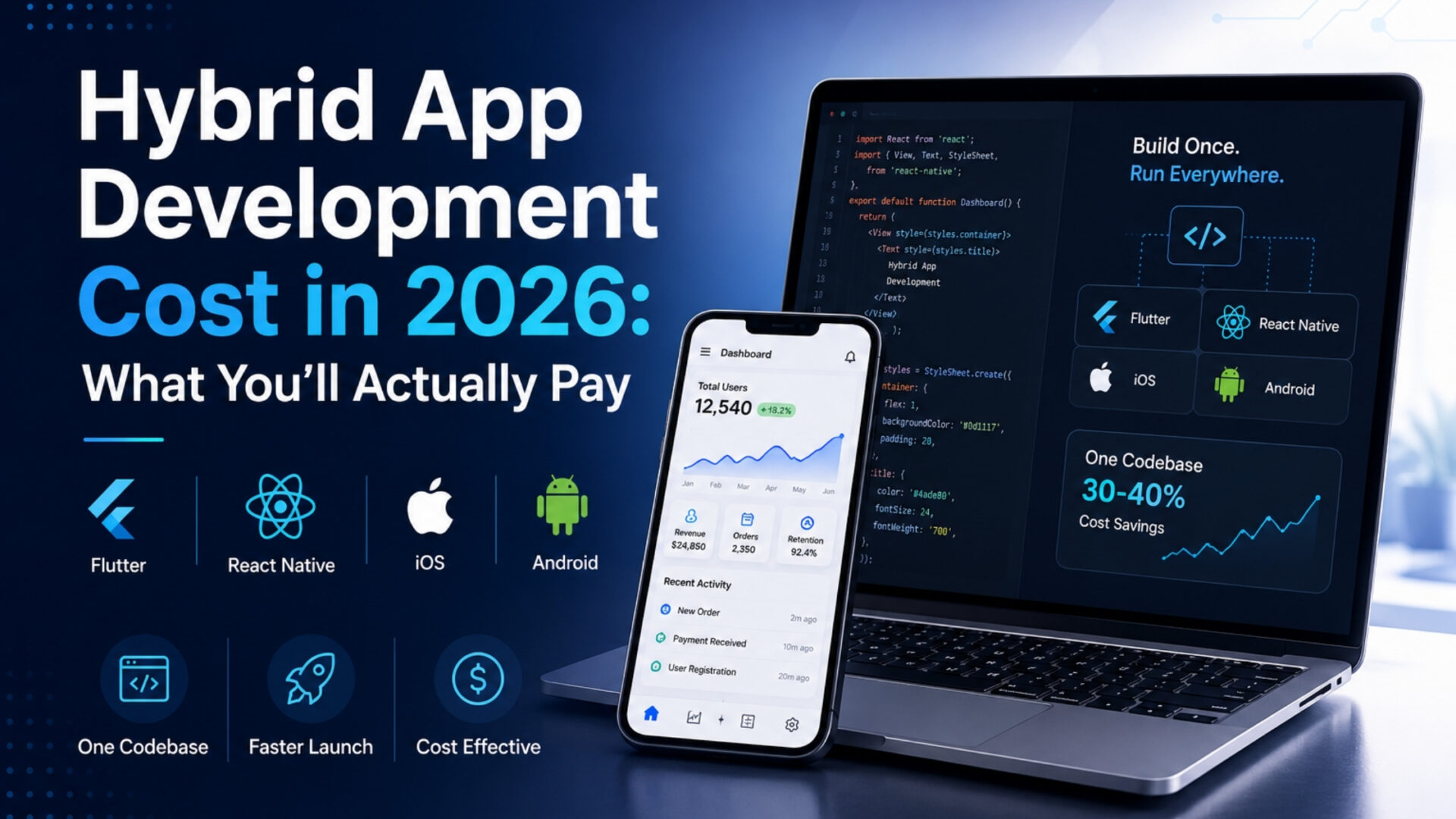
Hybrid apps generally cost 30 to 40 percent less than building two separate native apps, since you’re maintaining one codebase instead of two. That gap narrows for apps that need deep hardware access or graphics-heavy performance, where native still has an edge.
For most business apps, food delivery, booking platforms, internal tools, retail apps, hybrid is the more cost-efficient path without a real tradeoff in user experience. We’ve covered the performance, tooling, and long-term maintenance side of this comparison in far more depth in our complete native vs hybrid app development guide, worth reading if pricing isn’t your only deciding factor.
A Simple Way to Estimate Your Own Budget
Most cost calculators online are too generic to be useful. Try this instead. Score your project from 1 to 3 on each of these:
1. Number of core features (1 = one main feature, 3 = five or more)
2. Backend complexity (1 = simple database, 3 = multiple integrations or real-time sync)
3. Design custom-ness (1 = template-based, 3 = fully custom system)
4. Compliance needs (1 = none, 3 = HIPAA, PCI-DSS, or similar)
Add up your score. 4 to 6 usually lands you in the simple MVP range. 7 to 9 puts you in mid-complexity. 10 to 12 means you’re realistically looking at enterprise-level budgets. It’s not exact, but it’s a far better starting point than a single number pulled from a generic price chart.
If this is your first build, starting lean with an MVP approach keeps your initial budget closer to the low end of that range while you validate demand.
How to Reduce Cost Without Cutting Corners
Choosing the Right Development Partner
Price alone is a bad way to pick a team. Ask for case studies in your specific app category, check how they handle scope changes mid-project, and confirm who owns the code and IP after launch. If you’re evaluating multiple agencies right now, our roundup of top hybrid app development companies breaks down what separates a reliable partner from one that’ll nickel-and-dime you post-launch.
When Hybrid App Development Makes Financial Sense
Hybrid is the stronger financial choice when you’re targeting both iOS and Android from day one, when your app doesn’t depend on cutting-edge hardware features, and when speed to market matters as much as long-term cost.
If you’re building something graphics-intensive, like an AR app or a high-end mobile game, native still tends to be worth the extra spend. And if you’re weighing a lighter-weight option against both, our hybrid vs native vs PWA comparison lays out where progressive web apps fit into the budget conversation too.
For everything else, most SaaS tools, marketplaces, booking platforms, internal business apps, hybrid is where the budget-to-outcome ratio makes the most sense in 2026.
What we’ve seen hold true: across Flutter and React Native builds, from early-stage MVPs to enterprise platforms, the projects that stay on budget are the ones where scope gets locked before development starts, not the ones with the lowest hourly rate. Industry data backs this shift too, with cross-platform frameworks now dominating new commercial app builds, largely for this exact cost efficiency.
Conclusion
A single “hybrid app costs $X” number was never going to be useful. What matters is knowing which levers, complexity, features, design, location, are pushing your specific project up or down, and which hidden costs to ask about before you sign.
Get your feature list scored, get an honest quote, and build in the 15 to 20 percent maintenance budget from day one. That’s the difference between a project that stays on budget and one that doubles halfway through.
Ready to See What Your App Would Actually Cost?
Elsner has built hybrid apps across Flutter and React Native for startups and enterprise clients alike. Send us your feature list for a real, itemized estimate.
Frequently Asked Questions
How much does a hybrid app cost to build in 2026?
Most hybrid apps cost between $15,000 and $250,000, depending on complexity. Simple MVPs start around $15,000, while enterprise-grade apps with compliance and AI features can exceed $250,000.
Is hybrid app development cheaper than native?
Yes, typically 30 to 40 percent cheaper, since you’re building and maintaining one codebase instead of separate iOS and Android apps.
What’s the highest hidden cost in hybrid app development?
Post-launch maintenance. Budget 15 to 20 percent of your original development cost annually for OS updates, bug fixes, and ongoing support.
Does Flutter or React Native cost more?
Development costs are similar for most projects. The bigger factor is your team’s existing skill set, since switching frameworks adds a learning curve that shows up in your final invoice.
How long does it take to build a hybrid app?
A simple MVP takes 6 to 10 weeks. Mid-complexity apps take 3 to 5 months. Enterprise apps can take 6 months or longer.
Do I need a separate budget for App Store and Play Store fees?
Yes, though it’s small. Apple charges $99 per year for its developer program, and Google charges a one-time $25 registration fee for Play Console.
Is it cheaper to hire an offshore team for hybrid app development?
Often yes, offshore teams in India or Eastern Europe typically charge $25 to $80 per hour versus $100 to $200 for US-based teams, without a meaningful quality gap if vetted properly.