




- What White Label Local SEO Actually Means
- White Label vs In-House vs Referral: Which Model Fits
- Why Agencies Choose White Label Local SEO Services
- What Local SEO Work Gets Outsourced
- How a White Label Local SEO Engagement Works
- White Label Local SEO Pricing and Margins
- How to Vet a White Label Local SEO Provider
- AI and White Label Local SEO in 2026
- Common Mistakes Agencies Make
- How to Start a White Label Local SEO Reseller Program
- For Businesses: What a White Label Partnership Means for You
- Add Local SEO to Your Agency Without Adding Headcount
- Frequently Asked Questions
- What is white label local SEO?
- How much do white label local SEO services cost?
- Is white label local SEO worth it for small agencies?
- What is the difference between white label and reseller SEO?
- Can clients tell if you use a white label local SEO provider?
- What should agencies look for in a white label local SEO partner?
- Do white label local SEO tools include AI features in 2026?
- Is white label local SEO only for agencies?
An agency wins a local client, promises map pack rankings, then realizes nobody on the team has ever cleaned up citations or managed a Google Business Profile across multiple locations. That moment is more common than most owners admit. Demand for local search keeps climbing while in-house capacity lags behind. White label local SEO closes that gap by putting a specialist team behind your brand, doing the work while your name stays on every report.
The pull is simple. A client who hired you for web design or paid ads now expects local search, content, and answer-engine visibility too. Building all of that internally is slow and costly. Outsourcing the production lets you sell the service this week instead of next quarter. The catch is that doing it badly can damage a client relationship faster than doing nothing at all.
This guide covers what the model includes, what it costs at wholesale, how to vet a partner, and where it fits for both agencies reselling it and businesses buying from agencies that use it. The choice between building and buying mirrors the wider debate around in-house versus outsourced marketing, and local SEO is where that decision tends to bite hardest.
The short answer
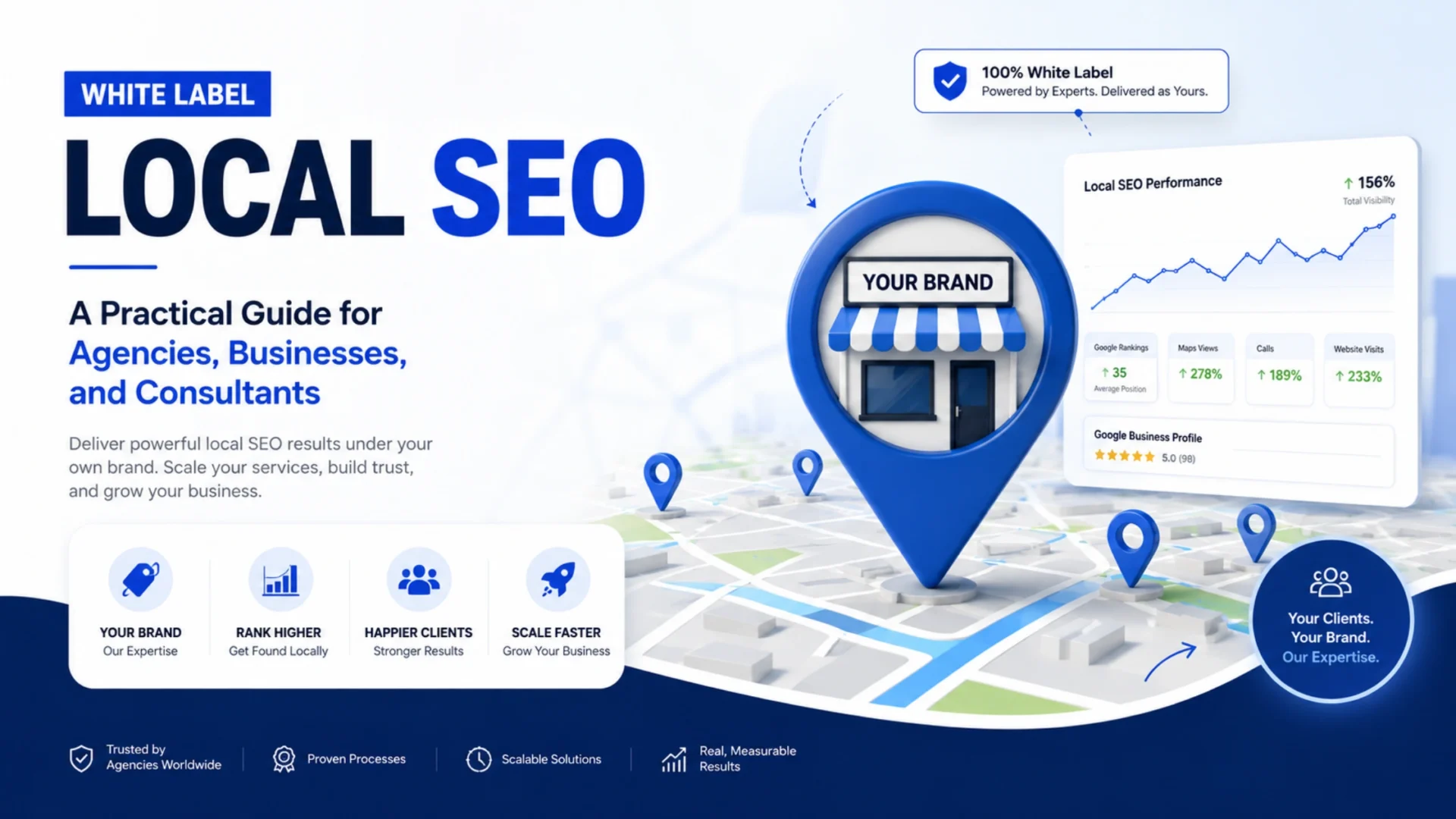
White label local SEO is local search work performed by a specialist provider and resold by an agency under its own brand. The client sees branded reports and dashboards. The provider stays invisible. Agencies pay a wholesale rate, add a markup of two to three times, and keep a gross margin that usually lands between 45% and 65%.
Sources: BrightLocal, QY Research, and industry local SEO surveys (2025 to 2026).
What White Label Local SEO Actually Means
Think of store-brand cereal. A grocery chain does not run the factory. A specialist produces the cereal, then the store puts its own label on the box. White label local SEO works the same way. You own the client relationship, the pricing, and the brand. Your partner owns the production, the tools, and the technical execution.
The work itself targets one specific outcome: helping a business show up when nearby customers search. That means the Google map pack, local organic results, and increasingly the AI-generated answers that now sit above both. A plumber wants to appear when someone types “emergency plumber near me.” A dental clinic wants the same for its neighborhood. The provider manages the business profile, citations, local pages, reviews, and authority signals that push those rankings.
Three arrangements get confused often, so it helps to separate them cleanly:
- White label. The provider works under your brand. You set retail pricing and keep the spread.
- Referral. You hand the client to another firm for a commission. Brand control goes with them.
- In-house. You hire, train, and manage the local team yourself. Full control, full overhead.
Most arrangements people call “white label local SEO services” are also reseller arrangements. You buy wholesale, you sell retail, and the client never knows a third party exists. The terms overlap so much that providers use them interchangeably in their sales decks.
White Label vs In-House vs Referral: Which Model Fits
Every model trades something away. The right pick depends on how fast you want to launch, how much margin you need to protect, and how much control you can afford to give up. Here is how the three compare on the factors that actually decide it.
My read: if local clients are already asking for help, white label wins on speed and margin. If local SEO is a one-off favor for a single account, a referral keeps things simple. Build in-house only once recurring local revenue clearly justifies the payroll. Hiring a proven local strategist takes months, and that delay is exactly the demand a partner absorbs while you keep selling.
Why Agencies Choose White Label Local SEO Services
The market tells a clear story. The global white label SEO market reached roughly $1.68 billion in 2025, with projections near $2.88 billion by 2032 at an 8.1% annual growth rate, according to QY Research. Local SEO is one of the fastest-moving slices inside that figure, partly because demand for it is so durable.
Consider how customers behave. Close to 46% of all Google searches carry local intent, and 76% of people who run a local search on a phone visit a business within 24 hours, per data compiled by BrightLocal. Local search is not a side channel for service businesses. It is the main way new customers find them.
That demand creates pressure on agencies. Client expectations have widened, and the same firm now gets asked to cover design, paid media, local search, and AI visibility. Four reasons keep surfacing when agencies make the switch to a partner model.
1. Scale without hiring
You add local SEO as a service line almost overnight, with no recruiting cycle and no new salaries on the books.
2. Predictable margins
Wholesale costs are fixed per client, so your spread is easy to model before you ever quote a retail price.
3. Faster onboarding
Production starts the week a client signs, not after a months-long hiring and ramp-up period.
4. Focus on growth
Your team spends its hours on strategy, sales, and retention instead of citation cleanup and report formatting.
This is not a fringe tactic anymore. A large share of agencies now run at least part of their delivery through outside partners, and roughly 40% of small businesses already outsource some or all of their local SEO. The model has gone mainstream because the math works.
What Local SEO Work Gets Outsourced
A solid white label local SEO scope covers the signals that actually move map pack and local organic rankings. Providers package these into tiers, but the core deliverables stay consistent across most reputable partners.
Google Business Profile optimization
Categories, services, photos, posts, and Q&A. A complete profile earns far more visits than a neglected one.
Citations and NAP consistency
Name, address, and phone data cleaned and aligned across directories so search engines trust the listing.
Review management
Generation workflows plus response drafting. Reviews influence both rankings and the decision to call.
Local landing pages
City and service pages written for geographic relevance, not thin duplicate templates.
Local link building and schema
Editorial placements, local partnerships, and structured data that helps engines read business details.
Branded reporting
Dashboards with rankings, calls, and direction requests tracked under your agency logo.
If you start with one, start with the Google Business Profile. It usually moves results faster than link building, and the gap between a complete profile and an abandoned one is wide. One newer line item deserves attention too. More than half of local terms now trigger an AI Overview, which changes how visibility gets measured and reported.
If a partner has no plan for answer engines, the scope is incomplete for 2026. Local visibility now spans classic rankings and AI citations at the same time. Understanding how GEO, AEO, and SEO differ helps you set honest client expectations before a campaign begins, rather than after the first report raises questions.
How a White Label Local SEO Engagement Works
The mechanics matter, because a smooth process is what keeps the partner invisible and the client confident. A typical engagement moves through a predictable sequence.
You sell the client and sign them under your own contract and pricing. You then place the account with your provider at the wholesale rate. The provider runs an audit, builds a plan, and starts production, while routing all reporting through a dashboard that carries your branding. Communication flows through you, so the client experiences a single agency rather than a chain of vendors.
The part that trips up new resellers is the handoff of questions. Clients ask things like why a ranking dipped or when a new location page goes live. A good partner gives you fast, plain-language answers you can pass on without exposing the relationship. A weak one leaves you guessing in front of your own client, which is where trust erodes.
The invisible partner only stays invisible if the process is tight. Reporting cadence, response times, and a clear escalation path are not paperwork. They are the difference between a partnership that scales and one that quietly burns a client every few months.
White Label Local SEO Pricing and Margins
Pricing has two layers. The provider charges you a wholesale rate per client per month. You add a markup and bill the client at retail. The gap between the two is your margin, and across the industry that margin clusters between 45% and 65% for agencies that price with discipline.
Ranges synthesized from 2026 wholesale rate cards and reseller benchmarks published by Nico Digital. Actual rates vary by vertical, link velocity, and provider location. Onshore providers typically price two and a half to four times higher than offshore for the same scope.
Most resellers apply a markup of two to three times wholesale. A package bought at $800 commonly sells in the $1,600 to $2,400 range. That spread covers your account management, sales effort, and reporting time while keeping the engagement profitable. Local SEO white label pricing rewards consistency more than aggressive discounting.
A simple illustration
Say you sell one standard local package at $2,000 a month and pay your provider $900 wholesale. Your gross margin is $1,100 a month, around 55%. Run three accounts like that and you keep roughly $3,300 a month, close to $39,600 a year, with no SEO hire on payroll. The math scales with every client you add.
One caution on the low end. Wholesale rates under $300 a month deserve suspicion. At that price, providers tend to lean on AI-generated content with no editorial review, or on low-quality link networks that can trigger penalties later. Cheap rarely stays cheap once rework and client churn enter the math. Results vary, but the pattern is consistent enough to treat as a rule.
How to Vet a White Label Local SEO Provider
A weak partner can sink a client’s rankings and your reputation in the same quarter. Vetting matters more than price. Run any candidate through this checklist before you sign a single contract.
- Reporting transparency. You get direct dashboard access, not a screenshot pasted into an email once a month.
- True white label dashboards. Reports carry your logo and domain, with no provider branding leaking through anywhere.
- Communication windows. Defined response times so you are never silent when a client asks a question.
- Link-building ethics. Editorial placements, not private blog networks. Ask exactly how every link gets sourced.
- Local market track record. Proven work on Google Business Profiles and map pack rankings for North American clients.
- Rate lock and flexibility. Wholesale pricing fixed for the term of any client engagement active at the time.
That last point saves real money. Picture signing a client at $2,200 a month against a $1,500 wholesale cost, a healthy margin. If the provider raises the wholesale rate to $1,800 in month seven while your client sits on a twelve-month contract, your margin collapses for the rest of the term. A rate lock prevents exactly that.
Red flags worth walking away from
Guaranteed number one rankings or guaranteed timelines. No access to reporting or rank tracking. Vague answers about where links come from. Any one of these is a reason to keep looking, no matter how attractive the price tag.
AI and White Label Local SEO in 2026
AI has changed production, not the fundamentals. Used well, white label local SEO tools speed up keyword clustering, draft review responses, and scale content drafts. Used carelessly, the same tools flood clients with thin pages that never rank in a real local market.
The bigger shift sits on the results page. With AI Overviews now appearing on more than half of local terms, click-through rates for some queries are sliding even when rankings hold. That means tracking impressions and overall search presence matters as much as raw clicks. A capable partner reports both and explains the difference to you in terms you can repeat to a client.
Honest framing helps here. AI assists the work. It does not replace the judgment, local relationships, and quality control that separate rankings that last from rankings that vanish after the next core update. For a closer look at adapting to answer engines, these AI search and AEO strategies map out where local visibility is heading and what to prioritize first.
Common Mistakes Agencies Make
Most white label failures trace back to a handful of avoidable errors. Knowing them upfront saves a client relationship later, and most agencies have at least two of these running at once before they notice.
- Selling a scope you did not buy. Your pitch promises link building and strategy reviews. The package you purchased covers content only. The gap surfaces in month one, and the client feels it.
- No markup discipline. Underpricing quietly kills margin. Overpricing without matching value invites churn.
- Hiding the partner too well. If you cannot answer a basic client question, the whole relationship starts to look fragile.
- Ignoring NAP consistency. Inconsistent business data drags down local rankings in a way that is easy to miss.
- Chasing the cheapest provider. The rework usually costs more than the savings ever did.
One habit prevents most of these. Map every promise in your sales pitch to a specific provider deliverable before you sign anything. If something in the pitch has no matching line in the wholesale package, either remove it from the pitch or pay for it in the package.
How to Start a White Label Local SEO Reseller Program
Launching a white label local SEO reseller program does not require a big team. It requires a process and a little discipline. Here is a sensible order of operations for agencies and consultants starting from zero.
Step 1: Pick a niche
Dentists, law firms, home services, and restaurants are proven local SEO buyers. A niche sharpens your sales pitch.
Step 2: Choose a partner
Run candidates through the vetting checklist above. Test them on a single account before scaling volume.
Step 3: Set pricing and margin
Apply a markup of two to three times wholesale and protect a gross margin of 50% or better.
Step 4: Build sales positioning
Lead with outcomes like more calls and store visits. Most owners do not care about domain ratings.
Step 5: Onboard and set cadence
Monthly branded reports keep clients confident. A predictable rhythm is what protects retention over time.
Filling the pipeline comes next, and that is its own discipline. A new service line only pays off if clients keep arriving to fill it. Pairing the offering with a deliberate lead generation strategy for digital agencies turns a capability into actual recurring revenue.
For Businesses: What a White Label Partnership Means for You
Not every reader is an agency. Plenty of business owners discover that the agency they hired uses a white label provider behind the scenes, and they wonder whether that is a problem. Usually it is not. The model is standard practice, much like a contractor using specialist subcontractors.
What matters is the quality of the work and the clarity of the reporting, not who physically performs each task. A good agency adds real value through strategy, account management, and accountability, even when production sits with a partner. The questions worth asking are simple and fair.
Transparency
Can the agency clearly explain what gets done each month and why it moves your rankings?
Reporting
Do you see calls, direction requests, and rankings, or only vanity numbers that look busy?
Ownership
Do you keep ownership of your Google Business Profile, website, and accounts if you ever switch?
If the answers are solid, a white-label-backed agency can be an efficient choice. You get specialist execution without paying for a full in-house team. The right partnership is the one that treats your local visibility as a long-term asset rather than a monthly invoice.
Add Local SEO to Your Agency Without Adding Headcount
Bring a proven local search team behind your brand, with transparent reporting and rankings your clients can see for themselves. Let’s map a partnership that fits your margins and your market.
Frequently Asked Questions
What is white label local SEO?
White label local SEO is local search work performed by a specialist provider and resold by an agency under its own brand. The agency owns the client relationship and the reporting. The provider handles production and stays invisible to the end client throughout the engagement.
How much do white label local SEO services cost?
Wholesale local SEO commonly runs $300 to $900 a month for entry scopes and $900 to $1,800 for standard scopes. Agencies resell at two to three times that rate, keeping gross margins between 45% and 65%. Rates below $300 usually signal cut corners.
Is white label local SEO worth it for small agencies?
For most small agencies, yes. It adds a profitable service line without the cost and delay of hiring. The model works best once you already have clients asking for local search help, so demand is proven before you commit to a partner.
What is the difference between white label and reseller SEO?
The terms overlap heavily. White label stresses that work appears under your brand. Reseller stresses that you buy wholesale and sell retail. In practice, almost every white label arrangement is also a reseller arrangement, so providers use the words interchangeably.
Can clients tell if you use a white label local SEO provider?
Not if the setup is done correctly. Reports, dashboards, and communication all carry your brand. The provider operates behind the scenes and never contacts your client directly. Tight internal processes are what keep the relationship smooth from the client’s view.
What should agencies look for in a white label local SEO partner?
Look for transparent reporting, true white label dashboards, ethical link building, defined communication windows, proven local market work, and a rate lock provision. Avoid any provider guaranteeing number one rankings, since no honest partner can promise that.
Do white label local SEO tools include AI features in 2026?
Many do. AI now assists with keyword clustering, content drafting, review responses, and reporting. The value depends on human oversight. AI without editorial review tends to produce thin content that fails to rank, so judgment still drives the results.
Is white label local SEO only for agencies?
No. Agencies and consultants resell it, while businesses often buy from agencies that quietly use it. For a business, the model is fine as long as reporting is clear and you retain ownership of your profile, website, and accounts.