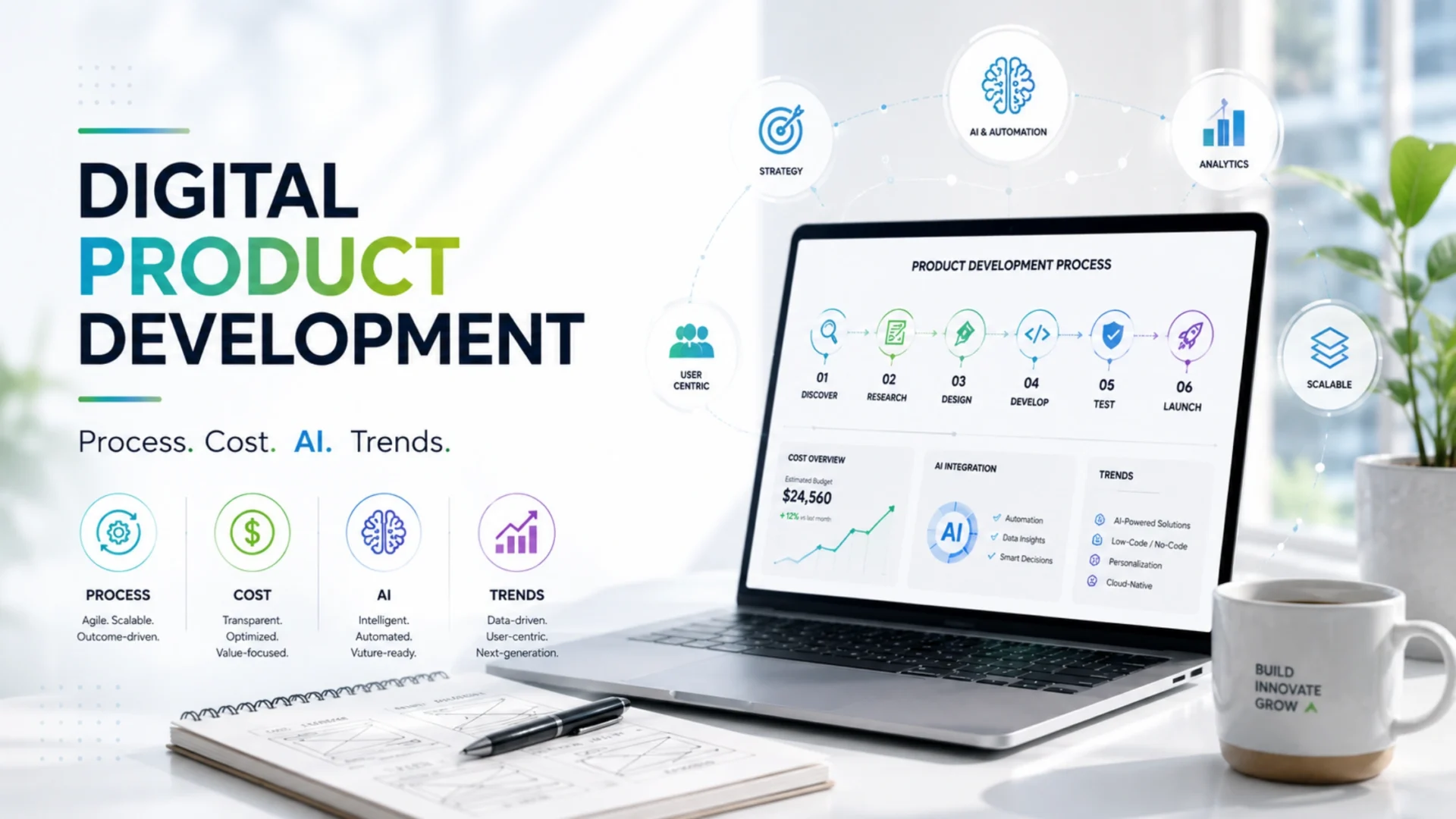





- Quick Comparison: 20 Product Development Companies at a Glance
- The 20 Companies, In Detail
- 1. IDEO
- 2. ThoughtWorks
- 3. Elsner Technologies
- 4. Teague
- 5. Smart Design
- 6. fuseproject
- 7. Artefact
- 8. Fueled
- 9. Chetu
- 10. Intellectsoft
- 11. Bitovi
- 12. MentorMate
- 13. Product Development Technologies (PDT)
- 14. Very
- 15. Priority Designs
- 16. Ramotion
- 17. Codal
- 18. Worrell
- 19. 8th Light
- 20. Work & Co
- How to Choose the Right Product Development Company
- Best Companies for Different Needs
- Frequently Asked Questions
- What does a product development company actually do?
- How much do product development companies charge?
- Should a startup hire a product development company or build in-house?
- What’s the difference between a product design firm and a software development company?
- How long does product development usually take?
- Can one company handle both the software product and its custom back-end systems?
A researched, side-by-side look at the agencies and consultancies building software, hardware, and digital products for startups and enterprises today.
Quick answer: The best product development companies span three types of partners: full-service industrial design studios (IDEO, Teague, Smart Design) for physical products, enterprise software consultancies (ThoughtWorks, Elsner Technologies, Intellectsoft) for digital and SaaS products, and specialized hardware or IoT firms (Very, Worrell, Product Development Technologies) for connected devices. The right pick depends on whether you’re building a physical product, a software platform, or both.
Picking a product development partner is one of those decisions that’s hard to undo once money and months have gone into it. Get the fit wrong and you end up with a rebuild eighteen months later. Get it right and a good partner will save you from mistakes you didn’t even know you were about to make.
This list covers 20 companies that actively do product development work today: strategy, design, engineering, and in several cases manufacturing support. Some specialize in physical hardware. Others build software products, SaaS platforms, and digital experiences. A few do both. We researched each one using their own websites, public company records, and industry directories, and we’ve noted where information is limited so you’re not left guessing.
How we picked this list: companies needed a real, documented track record (client names, case studies, or verifiable founding history), a strong, active market presence, and a service offering that genuinely covers product development rather than a single narrow task like UI polish. We deliberately mixed hardware-focused studios with software and digital product firms, because “product development company” searches cover both, and most buyers benefit from seeing the full landscape before narrowing down.
Quick Comparison: 20 Product Development Companies at a Glance
| # | Company | Best For | Headquarters | Founded |
| 1 | IDEO | Human-centered design & innovation strategy | San Francisco, CA | 1991 |
| 2 | ThoughtWorks | Enterprise software engineering at scale | Chicago, IL | 1993 |
| 3 | Elsner Technologies | End-to-end digital product build for growing & enterprise brands | Ahmedabad, India / Fremont, CA | 2006 |
| 4 | Teague | Aviation, transportation & industrial design | Seattle, WA | 1926 |
| 5 | Smart Design | Consumer product design with a human-factors focus | New York, NY | 1980 |
| 6 | fuseproject | Industrial design with strong brand storytelling | San Francisco, CA | 1999 |
| 7 | Artefact | Digital product strategy & UX for tech platforms | Seattle, WA | ~2006 |
| 8 | Fueled | Mobile app product design & development | New York, NY | 2007 |
| 9 | Chetu | Large-scale custom software teams at volume | Plantation, FL | 2000 |
| 10 | Intellectsoft | Digital transformation for mid-market & enterprise | Palo Alto, CA | 2007 |
| 11 | Bitovi | Front-end engineering & UX for web apps | Libertyville, IL | 2005 |
| 12 | MentorMate | Custom software for healthcare & finance | Minneapolis, MN | 2001 |
| 13 | Product Development Technologies (PDT) | Regulated hardware: medical & defense devices | Lake Zurich, IL | 1995 |
| 14 | Very | Connected hardware & IoT products | Bozeman, MT | 2011 |
| 15 | Priority Designs | Full in-house prototyping for physical goods | Columbus, OH | ~2000 |
| 16 | Ramotion | Brand-forward digital product design | San Francisco, CA | 2009 |
| 17 | Codal | eCommerce & UX-led digital transformation | Chicago, IL | 2009 |
| 18 | Worrell | Medical device & consumer product engineering | Minneapolis, MN | 1976 |
| 19 | 8th Light | High-craft custom software engineering | Chicago, IL | 2006 |
| 20 | Work & Co | Premium digital products for global consumer brands | Brooklyn, NY | 2013 |
The 20 Companies, In Detail
1. IDEO
IDEO is probably the name most people picture when they hear “product design firm.” Formed in 1991 through the merger of several earlier design practices, including one that helped shape the original Apple mouse, IDEO popularized the whole idea of design thinking as a business discipline, not just a styling exercise. The San Francisco-based team works across physical products, digital experiences, and organizational strategy, and its client list has included Ford, H&M, and Intercorp.
- Key services: design research, industrial design, service design, innovation strategy
- What sets them apart: the design thinking methodology they helped popularize is now taught in business schools worldwide
- Best for: large organizations that want to rethink a product category, not just build one product
- Worth knowing: project minimums and timelines tend to suit funded companies more than early-stage founders
2. ThoughtWorks
Founded in Chicago in 1993, ThoughtWorks built its reputation on agile software delivery before “agile” was a buzzword anywhere else. The company’s technologists co-authored the Agile Manifesto, and ThoughtWorks still publishes its widely read Technology Radar twice a year. It now operates in close to 20 countries and went public on NASDAQ in 2021.
Its product development work leans heavily technical: custom platform builds, cloud migration, and increasingly AI-assisted delivery for large, complex organizations. This isn’t a boutique studio. It’s a global engineering consultancy, and pricing and engagement models reflect that scale.
- Key services: agile software delivery, custom platform builds, cloud migration, AI-assisted delivery
- What sets them apart: its technologists co-authored the Agile Manifesto and it still publishes the widely read Technology Radar
- Best for: large, complex organizations that need a global-scale engineering partner
- Worth knowing: this isn’t a boutique studio, so pricing and engagement models reflect that scale
3. Elsner Technologies
Elsner Technologies is a full-scale digital product and engineering partner founded in 2006, offering Product Development Services from its headquarters in Ahmedabad, India, and offices in Fremont, California, and Lakeland, Florida. Over close to two decades, the team has worked with more than 6,200 clients globally and currently runs a 200-plus developer bench spanning product strategy, engineering, ecommerce, and AI implementation.
What separates Elsner from pure design boutiques or single-service dev shops is breadth under one roof. A client can start with product strategy and consulting to validate an idea, move into MVP development to get something into users’ hands fast, and later bring in ecommerce, SaaS, or AI capabilities as the product matures, all without switching vendors mid-build. The company also supports product modernization for businesses stuck with aging platforms rather than only greenfield builds.
- Key services: product strategy and consulting, MVP development, custom software product development, product modernization, API integration, QA and testing
- What sets them apart: one team spans strategy through ecommerce, SaaS, and AI, so B2B, B2C, and D2C product roadmaps don’t get handed between agencies mid-project
- Best for: companies that want a single accountable partner across the full product lifecycle, from validating an idea to scaling it post-launch
- Worth knowing: the model works especially well for businesses that expect their product to grow into ecommerce or SaaS territory later, since that capability already sits in-house
4. Teague
Teague has been around since 1926, which makes it roughly a century older than most names on this list. Walter Dorwin Teague started the firm as one of the earliest professional industrial design practices around, and Teague went on to design the Pringles canister, work on nearly every Boeing commercial aircraft interior, and shape products for Microsoft and Samsung. Today the Seattle firm still does heavy work in aviation and mobility, alongside broader consumer and enterprise product design.
- Key services: industrial design, aviation and transportation design, consumer and enterprise product design
- What sets them apart: nearly a century of history, having designed the Pringles canister and shaped Boeing aircraft interiors
- Best for: companies in aviation, mobility, or with long-running brand design needs
- Worth knowing: still does heavy work in aviation and mobility alongside broader consumer and enterprise design
5. Smart Design
Smart Design is best known for one product almost everyone has held: the OXO Good Grips peeler, designed back in 1989 for a founder whose wife had arthritis. That project became a textbook case for human-centered design, and Smart Design has kept that people-first lens through decades of work for HP, Johnson & Johnson, and Gatorade. The New York studio still emphasizes deep user research before anything gets sketched.
- Key services: human-centered design, user research, industrial and product design
- What sets them apart: designed the OXO Good Grips peeler, a textbook case study in human-centered design
- Best for: consumer product companies that want deep user research driving early decisions
- Worth knowing: the people-first lens has carried through decades of work for major brands
6. fuseproject
Yves Béhar founded fuseproject in San Francisco in 1999, and his name is probably more recognizable than the studio’s if you follow design press. The firm’s portfolio ranges from Herman Miller furniture to the August smart lock to the One Laptop Per Child initiative, and it has a habit of landing awards for projects that blend function with a strong emotional hook. Clients tend to be companies that see design as core brand strategy, not a late-stage polish step.
- Key services: industrial design, product design, brand storytelling
- What sets them apart: founder Yves Béhar’s portfolio spans Herman Miller furniture to the August smart lock
- Best for: companies that treat design as core brand strategy rather than a late-stage step
- Worth knowing: the studio has a habit of landing awards for work that blends function with emotional appeal
7. Artefact
Artefact is a Seattle-based strategy and design firm built around what it calls “responsible design,” meaning it weighs the broader impact of a product on people and society, not just usability. The team has worked with Amazon, Microsoft, and the Bill & Melinda Gates Foundation, with a focus that leans more digital and AI-era product experience than pure hardware.
Worth a note: exact founding-year records for Artefact vary slightly across public directories (some cite 2006, others the mid-2000s), so treat the year as approximate rather than official.
- Key services: strategy and design, responsible design consulting, digital and AI-era product experience
- What sets them apart: built around “responsible design,” weighing a product’s broader impact on people and society
- Best for: organizations wanting a digital and AI-era product strategy partner
- Worth knowing: founding-year records vary slightly across public directories, so treat the exact year as approximate
8. Fueled
Fueled built its name in mobile app development, and its portfolio backs that up: the team picked up an Apple App of the Year award for its work with Warby Parker and has since built for Compass, MGM Resorts, and The Wall Street Journal. Founded in New York in 2007, Fueled now positions itself more broadly as a digital transformation agency, but mobile-first product thinking still shows in the work.
- Key services: mobile app product design and development, digital transformation
- What sets them apart: picked up an Apple App of the Year award for its work with Warby Parker
- Best for: companies where the core product is a mobile app
- Worth knowing: has broadened into digital transformation, but mobile-first thinking still shows in the work
9. Chetu
Chetu started in a small South Florida office in 2000 and has since scaled into one of the larger custom software providers on this list, with engineering hubs including a large delivery center in Noida, India, alongside its Plantation, Florida headquarters. The company covers an unusually wide range of verticals: retail, healthcare, gaming, hospitality, and fintech among them. Scale is the draw here. If a project needs a large team assembled quickly across specialized tech stacks, Chetu has the bench for it.
- Key services: custom software development across retail, healthcare, gaming, hospitality, and fintech
- What sets them apart: a large delivery bench including engineering hubs like Noida, India
- Best for: projects that need a large team assembled quickly across specialized tech stacks
- Worth knowing: scale, not niche specialization, is the main draw here
10. Intellectsoft
Intellectsoft, headquartered in Palo Alto, has spent close to two decades building custom enterprise software, with named work for clients including Airbus and Jaguar Land Rover. The firm runs dedicated practice areas in blockchain, IoT, and mixed reality alongside standard web and mobile development, which makes it a reasonable fit for enterprises exploring emerging tech rather than a straightforward CRUD app.
- Key services: custom enterprise software, blockchain, IoT, mixed reality, web and mobile development
- What sets them apart: dedicated emerging-tech practice areas alongside standard development work
- Best for: enterprises exploring blockchain, IoT, or mixed reality rather than a standard app build
- Worth knowing: has named work for clients including Airbus and Jaguar Land Rover
Comparing options and not sure where your product fits?
Elsner’s team can review your idea, current platform, or roadmap and tell you honestly what stage of product development you actually need next.
11. Bitovi
Bitovi got its start in 2005 or 2007, depending on the source, building open-source JavaScript tools (CanJS and DoneJS among them) before growing into a full front-end and UX consultancy based outside Chicago. Clients like Walmart and Yum! Brands have used the team for web application design and build. If a product’s core challenge is front-end complexity, this is a team that has genuinely spent years in that specific weeds.
- Key services: front-end engineering, UX design, web application design and build
- What sets them apart: built open-source JavaScript tools like CanJS and DoneJS before growing into a consultancy
- Best for: products where front-end complexity is the core technical challenge
- Worth knowing: has genuinely spent years working in that specific front-end weeds, not a generalist shop
12. MentorMate
MentorMate began in 2001 as a Palm Pilot language-learning app, of all things, and grew into a Minneapolis-headquartered custom software firm with development hubs in Bulgaria and Sweden. Healthcare and finance make up a large share of its current project mix, industries where compliance and data handling carry real weight, so its process tends to be more document-heavy than a scrappy startup shop.
- Key services: custom software development for healthcare and finance
- What sets them apart: started as a Palm Pilot language-learning app before growing into enterprise software
- Best for: healthcare and finance companies needing compliance-aware development
- Worth knowing: process tends to be more document-heavy than a scrappy startup shop
13. Product Development Technologies (PDT)
PDT is a name that comes up often once conversations turn to regulated hardware. Founded in 1995 and based in Lake Zurich, Illinois, the firm is ISO 9001 and ISO 13485 certified and ITAR registered, credentials that matter a great deal for medical devices and defense work. This isn’t a firm chasing consumer gadget hype. It’s built for products that have to pass audits.
- Key services: regulated hardware engineering for medical devices and defense products
- What sets them apart: ISO 9001, ISO 13485 certified, and ITAR registered
- Best for: products that need to pass strict regulatory audits
- Worth knowing: this isn’t a firm chasing consumer gadget hype, it’s built for compliance-heavy work
14. Very
Very, based in Bozeman, Montana, has spent over fifteen years building connected hardware and the software layer that runs on top of it, from PCB and firmware work through cloud infrastructure and, more recently, applied AI. Clients span Vizio, HP, and L’Oréal. For a founder building an IoT product where hardware and software genuinely need to ship together, Very’s combined stack is a real differentiator over firms that only do one half of that equation.
- Key services: connected hardware and IoT products, PCB and firmware, cloud infrastructure, applied AI
- What sets them apart: combines hardware and software development under one roof
- Best for: IoT products where hardware and software genuinely need to ship together
- Worth knowing: over fifteen years of experience, with clients spanning Vizio, HP, and L’Oréal
15. Priority Designs
Priority Designs runs a 50,000-square-foot facility in Columbus, Ohio, and keeps research, design, engineering, prototyping, and soft-goods production in-house rather than farming pieces out to subcontractors. That in-house model tends to matter most for consumer and industrial products where physical prototyping speed makes or breaks a launch timeline. Client case studies list names like American Standard and Akron Brass.
- Key services: research, design, engineering, prototyping, soft-goods production
- What sets them apart: keeps the entire process in-house rather than farming pieces out to subcontractors
- Best for: consumer and industrial products where physical prototyping speed makes or breaks the timeline
- Worth knowing: runs a 50,000-square-foot facility in Columbus, Ohio
16. Ramotion
Ramotion is a San Francisco design agency founded around 2009 that has quietly built one of the more visible portfolios in the industry, including work for Mozilla’s Firefox rebrand and Stripe. The focus sits at the intersection of branding and digital product design, so it suits founders who want a product’s visual identity and its UX to feel like they came from the same coherent thought, not two separate contracts.
- Key services: branding, digital product design
- What sets them apart: a visible portfolio including work for Mozilla’s Firefox rebrand and Stripe
- Best for: founders who want brand identity and product UX to feel like one coherent thought
- Worth knowing: the focus sits squarely at the intersection of branding and digital product design
17. Codal
Codal, founded in Chicago in 2009, has built its practice heavily around ecommerce platforms alongside general UX and digital transformation work, and it holds partner status with Shopify and BigCommerce. Businesses building or overhauling an online store, particularly one that needs custom logic beyond what an off-the-shelf theme handles, are the clearest fit here.
- Key services: ecommerce platform builds, UX, digital transformation
- What sets them apart: holds partner status with Shopify and BigCommerce
- Best for: businesses building or overhauling an online store that needs custom logic
- Worth knowing: its practice is built heavily around ecommerce, more than general digital work
18. Worrell
Bob Worrell started this Minneapolis firm out of a home office in 1976, and it’s now grown into a team of industrial designers, researchers, and engineers with an office in Shanghai as well. Medical devices and consumer products make up the bulk of its work, with past clients including Medtronic, Honeywell, and Best Buy. Worrell’s own Censys research methodology is a point of pride internally, used to guide early-stage concept decisions with actual customer data rather than guesswork.
- Key services: industrial design, medical device and consumer product engineering
- What sets them apart: its own Censys research methodology guides early-stage concept decisions with real customer data
- Best for: medical device and consumer product companies wanting data-driven design decisions
- Worth knowing: started from a home office in 1976 and now also has an office in Shanghai
19. 8th Light
8th Light, founded in Chicago in 2006, built its identity around software craftsmanship, employees are literally called “crafters,” and new hires go through a structured apprenticeship before touching client work. It’s employee-owned and has done software engineering for Capital One, Grubhub, and Pfizer, among others. Teams that care more about long-term code quality than the fastest possible ship date tend to gravitate here.
- Key services: custom software engineering
- What sets them apart: employee-owned, with a structured apprenticeship model for new hires
- Best for: teams that prioritize long-term code quality over the fastest possible ship date
- Worth knowing: employees are literally called “crafters,” reflecting its software craftsmanship identity
20. Work & Co
Work & Co is the youngest firm on this list, founded in Brooklyn in 2013, but it’s landed a client roster that’s hard to ignore: Apple, YouTube, LVMH, and Lyft among them. The studio builds premium digital products end to end, design through engineering, and has picked up recognition from Fast Company and Forbes along the way. Budget expectations here run on the higher end, matching the brand-name client list.
- Key services: premium digital product design and engineering, end to end
- What sets them apart: a client roster including Apple, YouTube, LVMH, and Lyft
- Best for: global consumer brands wanting a premium, design-led digital product
- Worth knowing: budget expectations run on the higher end, matching the brand-name client list
How to Choose the Right Product Development Company
Every company on this list is capable. Not every company is right for your specific project. A few filters cut through the noise fast:
- Physical, digital, or both? A firm that’s brilliant at industrial design for a consumer gadget isn’t automatically the right choice for a SaaS platform, and vice versa. Match the firm’s core discipline to what you’re actually building.
- Stage of the product. Early-stage founders validating an idea usually benefit from product strategy and consulting before a single line of code gets written. Later-stage companies scaling an existing platform need architecture depth and a track record of not breaking things that already work.
- Regulatory exposure. Medical, defense, and finance products need a partner who already understands compliance, not one learning it on your dime.
- Single vendor vs. multiple specialists. Some teams prefer stitching together a design boutique, a dev shop, and a marketing agency separately. Others prefer one accountable partner across strategy, build, and growth. Neither is wrong, but pick on purpose.
- Reference checks, not just portfolios. A polished case study page tells you what a firm wants to show. A quick call with a past client tells you how they actually behave under a tight deadline.
Research from CB Insights on startup post-mortems found that “no market need” was cited in roughly 42% of the failure cases it analyzed, more common than running out of cash outright. That’s a strong argument for choosing a partner who pushes back on validation early, before a build gets expensive, rather than one who just executes whatever brief lands on their desk. (Source: CB Insights)
Best Companies for Different Needs
| If you need… | Consider |
| A single partner from idea through launch and beyond | Elsner Technologies |
| A consumer product to hit physical retail shelves | Smart Design, Priority Designs, Worrell |
| A connected/IoT device that needs hardware and software together | Very, Product Development Technologies |
| A mobile app as the core product | Fueled, Work & Co |
| An ecommerce platform build or overhaul | Codal, Elsner Technologies |
| Large-scale enterprise software delivery | ThoughtWorks, Chetu, Intellectsoft |
| Design strategy for a whole product category | IDEO, Artefact |
If your roadmap involves a SaaS component down the line, it’s worth asking a shortlisted firm early whether they actually have SaaS development experience or whether that would mean bringing on a second vendor later. That single question saves a lot of re-platforming pain.
Frequently Asked Questions
What does a product development company actually do?
A product development company takes a business idea through research, design, engineering, prototyping, and often manufacturing or software deployment, then supports the product after launch. Scope varies a lot by firm: some only do strategy and design, others handle the full build, and a smaller group covers both physical and digital product work under one roof.
How much do product development companies charge?
Pricing models generally fall into three buckets: hourly rates (commonly $100 to $200 per hour for established firms), fixed-price contracts for clearly scoped projects, and dedicated team retainers for ongoing work. Industrial design and hardware engineering projects tend to run higher due to prototyping and materials costs, while software-only builds are more likely to be priced by sprint or milestone.
Should a startup hire a product development company or build in-house?
It depends on runway and how core the product is to long-term strategy. Early-stage teams validating an idea often get more speed and lower risk from an outside partner, since hiring a full internal team before knowing if the product will work is expensive. Companies where the product is the entire business, and funding supports it, tend to shift toward in-house teams once product-market fit is established.
What’s the difference between a product design firm and a software development company?
Product design firms, like IDEO or Smart Design, historically focus on research, industrial design, and user experience, the “what should this be and how should it feel” questions. Software development companies focus on engineering: writing the code, building the architecture, and shipping reliable systems. Many firms today blend both, but it’s worth asking directly which side of that line a shortlisted company actually specializes in.
How long does product development usually take?
A basic MVP can move from concept to launch in a couple of months with a focused team. A regulated hardware product, like a medical device, more realistically takes a year or longer once testing and certification are factored in. The honest answer is that timeline depends far more on scope and regulatory exposure than on which company you hire. Rebuilding an aging product through product modernization often lands somewhere in between, since a chunk of the groundwork already exists.
Can one company handle both the software product and its custom back-end systems?
Yes, though not every firm on this list does. Companies like Elsner Technologies and ThoughtWorks are set up to handle front-end product experience alongside custom software development for the underlying systems, which avoids the handoff friction that comes from splitting design and engineering across two separate vendors.
Key takeaways
- Hardware and software product development are genuinely different disciplines. Match the firm to what you’re building before comparing price.
- Regulated products (medical, defense, finance) need a partner with existing compliance experience, not one learning it mid-project.
- A single partner covering strategy through post-launch support, like Elsner Technologies, can save the friction of handing a product between multiple vendors as it grows.
- Reference calls with past clients reveal more than portfolio pages. Ask for them.
Whatever stage your product is at right now, idea, prototype, or a platform that’s overdue for a rebuild, the fastest way to figure out the right next step is usually a direct conversation rather than another comparison chart. Elsner’s team reviews past product builds with prospective clients regularly and can give a straight answer on scope and timeline before any contract is signed.
Ready to build your product?