



- Understanding the Traditional Tile Sales Model
- Key Advantages of Traditional Sales
- Challenges of Traditional Tile Business
- What Is Ecommerce For the Tile Industry ?
- B2B ecommerce
- B2C ecommerce
- Hybrid inquiry platforms
- Benefits of Ecommerce for Tile Industry
- Expanded Global Reach
- Continuous Availability
- Enhanced Product Presentation
- Direct Customer Engagement
- Data-Driven Insights
- Start Generating Tile Inquiries from Global Buyers
- Ecommerce Vs Traditional Business – Comparative Analysis
- Tile Business Online Vs Offline: Which Model Works Better In 2026?
- Why Is Digital Transformation Tile Business Setup Necessary In 2026?
- Want to Combine Online Growth with Your Existing Sales Network?
- How to Get Started with Tile Ecommerce?
- Develop a Professional Website
- Select the Right Ecommerce Platform
- Implement SEO and Lead Generation Strategies
- Enable Advanced Product Filters and Catalog Features
- Invest in Digital Marketing Initiatives
- Common Mistakes To Avoid While Preparing Tile Sales Strategy 2026
- How Elsner Supports Tile Businesses?
- If Buyers Can’t Find You Online, They’ll Find Your Competitors
- Conclusion
- FAQs
- Is ecommerce suitable for tile manufacturers?
- Can tile businesses effectively sell products online?
- What is the cost of developing a tile ecommerce website?
- How can tile exporters generate international leads online?
- Which ecommerce platform is most suitable for tile businesses?
Walk into any tile showroom, and you’ll notice something familiar. Large slabs propped against walls, samples arranged by finish and size, a salesperson ready to walk you through the catalog. That model has worked for decades for dealers, distributors, and regional stockists. The whole chain has been the backbone of how tiles move from the factory floor to the construction site.
But something shifted. Buyers started doing their homework online before ever stepping into a showroom. Architects began sourcing from international suppliers they found through a Google search. Builders started requesting WhatsApp catalogs before scheduling visits. And tile businesses that didn’t adapt found themselves losing ground. Not necessarily to a local competitor, but to someone with a better tile ecommerce website on the other side of the world.
This article breaks down both tile business online vs offline models honestly: what works, what doesn’t, and why the smartest tile sales strategy 2026 isn’t choosing between the two.
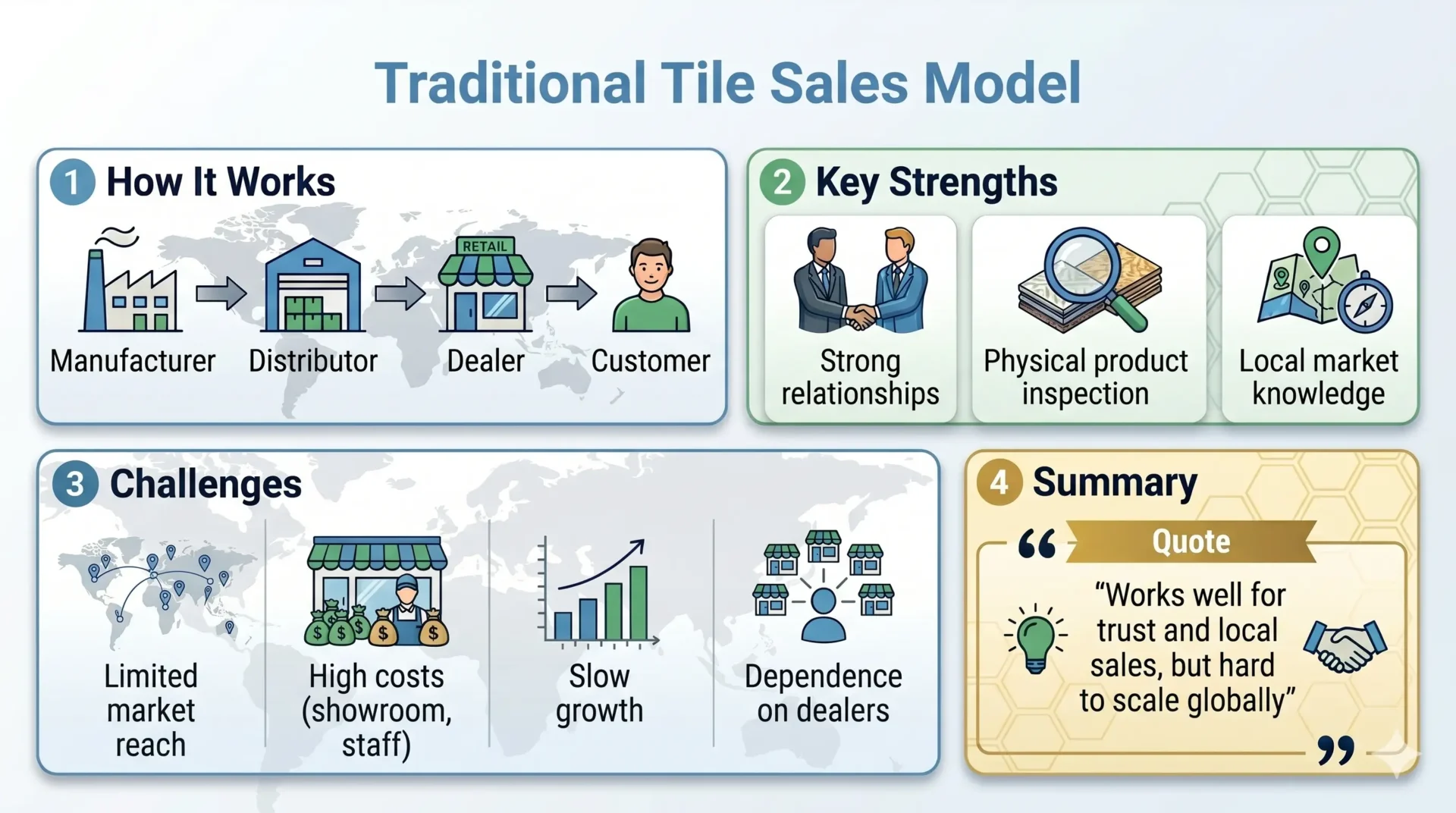
Understanding the Traditional Tile Sales Model
The traditional model is built around physical touchpoints.
- Manufacturers supply to regional distributors,
- Distributors supply to dealers,
- Dealers sell to contractors, builders, and end customers.
- Showrooms serve as the display layer: you see the product, feel the texture, check the finish under actual lighting.
This system made sense when buyers were local, relationships were long-term, and referrals drove most business.
Key Advantages of Traditional Sales
- Relationships still close deals.
In B2B tile sales strategy 2026 especially, a distributor who has worked with a contractor for fifteen years will win the deal over a newcomer almost every time. Trust built over years isn’t something a website replaces overnight.
- Physical inspection matters.
Tiles are tactile. Color renditions on screens vary. A client who wants to see how a marble-finish porcelain tile actually looks under warm lighting — they need to hold it. Showrooms solve this in a way no product photo fully can.
- Local market depth.
Traditional networks have deep roots in their geographies. Knowing the local building code cycles, the peak construction seasons, which contractors prefer which finishes — this kind of ground-level intelligence is genuinely valuable.
Challenges of Traditional Tile Business
The limitations are also real.
- Geographic reach tops the list.
A tile manufacturer in Morbi, Gujarat might produce world-class products but struggle to reach buyers in Southeast Asia, the Middle East, or Europe without a distributor network that takes years and significant margin to build.
- Operational costs are heavy.
Showroom rent, display maintenance, sample inventory, traveling sales staff — it adds up. And those costs don’t scale down when business slows.
- Dependence on intermediaries creates fragility.
If a key distributor relationship breaks down, or a dealer decides to push a competitor’s range, a business can lose an entire market segment with little warning.
- Scaling is slow.
Adding new geographies or product lines through traditional channels means building relationships from scratch. There’s no button to push.
What Is Ecommerce For the Tile Industry ?
Ecommerce for the tile industry doesn’t necessarily mean a checkout cart where someone buys 200 sq ft of floor tiles and gets them shipped to their door. In reality, it spans a range of models:
B2B ecommerce
Exporters and manufacturers showcasing product catalogs to international buyers, with inquiry forms, sample request systems, and quote-generation tools built in. B2B tile ecommerce is where most of the volume is.
B2C ecommerce
Brands selling directly to homeowners and interior designers, either for in-store pickup or delivery.
Hybrid inquiry platforms
Tile ecommerce website that present the full product range with filters (size, finish, application, shade variation) and convert visitors into qualified leads rather than direct transactions.
In practice, most tile businesses that move online start with a catalog and lead-capture model, then expand into transactional commerce as they build the logistics infrastructure to support it, a journey that purpose-built tile ecommerce services can help you navigate more efficiently.
Benefits of Ecommerce for Tile Industry
Expanded Global Reach
A well-built tile exporters online sales website works at 3 AM when you’re asleep and someone in Dubai is searching for a specific mosaic tile finish for a hotel project.
Traditional sales can’t do that. Export opportunities that would have required a trade fair, a distributor, and months of back-and-forth can now begin with a search query.
Continuous Availability
Your catalog is online. Your inquiry form is open. A buyer in a different time zone doesn’t have to wait for your office to open. This is particularly significant for B2B tile ecommerce exporters dealing with international clients across multiple time zones.
Enhanced Product Presentation
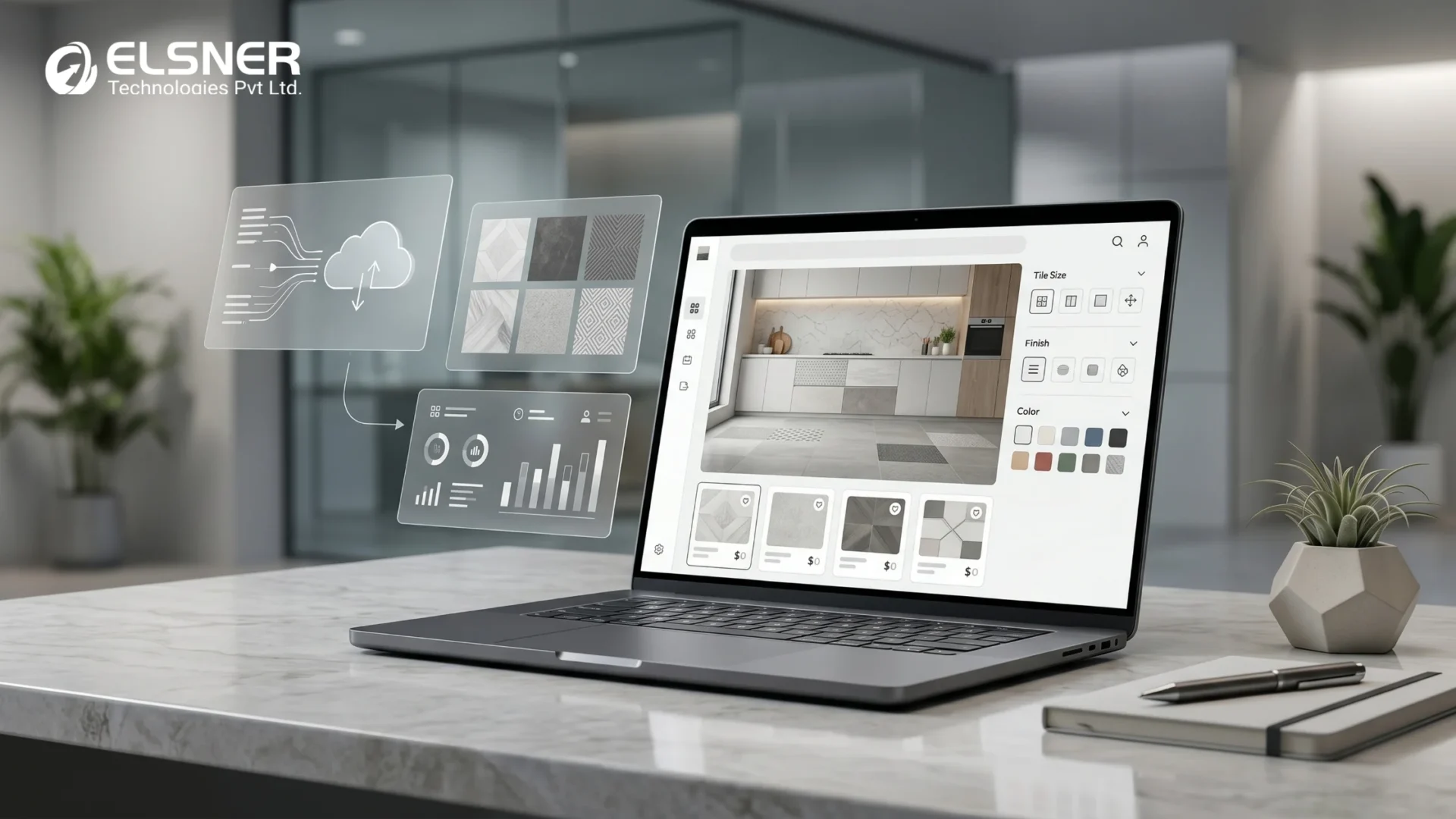
A good digital transformation tile business setup lets you showcase tiles with high-resolution imagery, multiple angle shots, room visualization examples, and detailed spec sheets — all structured and searchable.
Buyers can filter by size, finish, application, color family, or surface texture. This kind of structured presentation is genuinely hard to replicate in a physical showroom for a catalog of 500+ SKUs.
Direct Customer Engagement
Cutting out one layer of the distribution chain improves margin and communication. When a buyer can contact you directly through your website and get a response without going through a dealer who goes through a distributor, the sales cycle shortens and the relationship becomes yours to own.
Data-Driven Insights
Which products are being viewed most? Where are your website visitors coming from geographically? What search terms are bringing buyers in?
Traditional sales doesn’t give you this. Digital transformation tile business does. And it changes how you make decisions about product development, marketing spend, and geographic focus.
Start Generating Tile Inquiries from Global Buyers
Build a powerful ecommerce platform that showcases your full catalog, attracts international buyers, and works for you 24/7.
Ecommerce Vs Traditional Business – Comparative Analysis
|
Factor |
Traditional Sales |
Ecommerce |
|
Market Reach |
Local or regional |
Global |
|
Operational Cost |
High (rent, staff, logistics) |
More cost-efficient |
|
Scalability |
Limited and slow |
Highly scalable |
|
Availability |
Restricted business hours |
24/7 accessibility |
|
Customer Insights |
Limited |
Detailed analytics |
|
Relationship Depth |
Strong |
Requires active effort to build |
|
Product Experience |
Tactile, in-person |
Visual, needs strong media |
Tile Business Online Vs Offline: Which Model Works Better In 2026?
Neither, in isolation.
Ecommerce has become non-negotiable for growth and competitive positioning — particularly for manufacturers and exporters with international ambitions. The buyers are online. The architects sourcing for large projects start their research on Google and Houzz. The procurement managers for hotel chains request digital catalogs before they request samples.
At the same time, traditional sales isn’t going away. Relationship-heavy B2B markets, particularly at the contractor and large developer level, still close deals through trust built over time. A longstanding distributor relationship in a key market is genuinely hard to replicate with a website.
The businesses doing well right now are running both. They have a strong online presence that generates inbound interest globally, and they have a sales team and dealer network that converts and manages relationships locally. The ecommerce side fills the top of the funnel; the traditional side closes it.
Why Is Digital Transformation Tile Business Setup Necessary In 2026?
The reasons aren’t abstract.
Buyer behavior has already shifted. A procurement officer at a construction company doesn’t wait for a sales rep to visit. They search, they shortlist, they request samples. If you’re not showing up in that initial research phase, you’re not in the consideration set.
Competition from online-first businesses is growing. There are tile businesses — often newer entrants — that have built their entire sales motion around digital presence and are winning international clients without a single physical showroom.
International market demand is real and largely digital.
Exporters who have built SEO-optimized product catalogs are getting inquiry volume from markets they’ve never physically visited — and businesses that have gone through a tile industry digital transformation are the ones capturing that demand first. That’s a meaningful shift.
Customer expectations have changed. Even in B2B, buyers expect to find product information online, download spec sheets, and make initial contact through a website. If your digital presence doesn’t support that, it signals something unflattering about your business.
Want to Combine Online Growth with Your Existing Sales Network?
We help tile businesses create a hybrid sales system that generates leads online and converts them through your dealer and distributor network.
How to Get Started with Tile Ecommerce?
Develop a Professional Website
Not a brochure site with a contact form. A functional business tool — with a structured product catalog, high-quality imagery, application-specific sections (floor, wall, outdoor, commercial), and clear inquiry pathways.
Select the Right Ecommerce Platform
Shopify works well for businesses moving into D2C and needing speed to market. Magento or custom-built solutions are better suited for B2B operations with complex catalogs, quote-based pricing, and custom integration requirements. The right choice depends on your catalog size, business model, and technical capacity.
Implement SEO and Lead Generation Strategies
Getting the website live is step one. Getting it found is step two. A tile business targeting international buyers needs to rank for product-specific search terms not just “tiles” but “60×120 outdoor porcelain tiles” or “marble-look floor tiles for hotels.” Our detailed guide on SEO practices for tile ecommerce businesses breaks down exactly how to build that kind of search visibility. That requires structured on-page SEO, technical site health, and content that matches what buyers actually search for.
Enable Advanced Product Filters and Catalog Features
Buyers want to search by size, finish, application, color, slip resistance rating, and frost resistance. A flat product page doesn’t serve them. Structured filtering, comparison tools, and downloadable technical sheets improve both user experience and conversion.
Invest in Digital Marketing Initiatives
SEO builds long-term inbound traffic. Paid search can accelerate visibility for specific product lines or geographies. Email campaigns can nurture leads who’ve requested samples. None of this replaces the others — they work together, and marketing your tile ecommerce services effectively requires orchestrating all of them around the same goal.
Common Mistakes To Avoid While Preparing Tile Sales Strategy 2026
- Poor website design. A cluttered, outdated site communicates that your business is cluttered and outdated. First impressions in digital are fast and harsh.
- No SEO investment. A website that nobody finds doesn’t generate leads. SEO is not optional if you want organic inbound traffic.
- Slow load times. Tile product pages with multiple high-res images need to be optimized. A page that takes 8 seconds to load on mobile loses the visitor.
- Incomplete product information. No dimensions, no technical specs, no application guidance. Buyers who can’t find the information they need go somewhere else.
- Ignoring mobile. A significant share of initial product research happens on mobile devices. If your site doesn’t work well on a phone, you’re losing a portion of your audience before they’ve even started.
How Elsner Supports Tile Businesses?
Elsner works with tile manufacturers, exporters, and distributors to build ecommerce infrastructure that actually drives business not just a website that exists.
That includes custom ecommerce development for tile-specific needs, website design that handles large product catalogs cleanly, SEO strategies tailored to the tile industry, and digital marketing that generates qualified lead flow. The focus is on solutions that are built for how tile businesses actually operate, not generic templates applied to a specialized industry.
If Buyers Can’t Find You Online, They’ll Find Your Competitors
From SEO to ecommerce development, we help tile businesses build a strong digital presence that attracts, engages, and converts buyers globally.
Conclusion
The tile industry is at a practical inflection point. Traditional sales methods still work and still matter. But they’re no longer sufficient on their own for businesses that want to grow beyond their current geography or compete for buyers who start their search online.
Ecommerce isn’t a replacement. It’s an addition that changes the ceiling on what’s possible. Businesses running both models are generating leads they couldn’t reach through traditional channels while maintaining the relationship depth that closes complex deals.
The question for tile sales strategy 2026 isn’t really “ecommerce vs traditional business.” It’s “how quickly can we build the digital capability to match what we’ve already built on the ground?”
FAQs
Is ecommerce suitable for tile manufacturers?
Yes — and increasingly necessary for those targeting export markets or looking to reduce dependence on distributor networks. Benefits of ecommerce for manufacturers includes handling catalog-heavy, inquiry-driven sales rather than requiring immediate checkout.
Can tile businesses effectively sell products online?
Absolutely. Many tile businesses — particularly exporters — use online platforms not for direct transactions but for catalog presentation and lead generation. This model works well and doesn’t require complex logistics infrastructure to start.
What is the cost of developing a tile ecommerce website?
It varies significantly based on catalog size, platform choice, and features required. A basic inquiry-driven catalog site starts in a different range than a full B2B ecommerce platform with custom pricing and integration requirements. A consultation with a development partner will give you accurate scoping based on your specific needs.
How can tile exporters generate international leads online?
You can do that through a combination of an SEO-optimized product catalog (structured to rank for specific tile types and applications), targeted paid search in key export markets, and digital marketing that reaches architects, interior designers, and procurement teams in those geographies.
Which ecommerce platform is most suitable for tile businesses?
It depends on the business model. Shopify is a strong choice for businesses prioritizing speed to market and D2C sales. Magento and custom solutions offer more flexibility for large B2B catalogs, complex pricing structures, and custom integrations. WooCommerce is a cost-effective entry point for smaller operations with existing WordPress infrastructure.