




- What Is AI Search for Shopify Stores?
- What Are AI Shopping Agents?
- AI Search vs. AI Shopping Agents
- Why AI Search Matters for Shopify Merchants
- How Does AI Discover and Understand Shopify Products?
- 10 Ways to Optimize a Shopify Store for AI Search
- Not sure how AI-ready your product data actually is?
- Shopify Catalog: What Merchants Need to Know
- What is Shopify Catalog?
- How Shopify Catalog Helps AI Product Discovery
- Do Shopify Merchants Need to Create a Separate AI Product Feed?
- Does Shopify Catalog Guarantee AI Rankings?
- Shopify Agentic Storefronts and AI Shopping Channels
- Shopify Catalog API and Universal Commerce Protocol
- Shopify Catalog API
- Universal Commerce Protocol (UCP)
- Traditional Shopify SEO vs. AI Search Optimization
- Technical Shopify Optimization for AI Search
- Common Shopify AI Search Optimization Mistakes
- How to Measure Shopify AI Search Performance
- A Practical Shopify AI Search Optimization Checklist
- Future of Shopify AI Search and Agentic Commerce
- Frequently Asked Questions
- What is Shopify AI search optimization?
- How can I optimize my Shopify store for AI search?
- How do AI shopping agents find Shopify products?
- What is Shopify Catalog?
- Does Shopify Catalog help products appear in ChatGPT?
- How do I optimize Shopify product pages for AI?
- Is Shopify SEO still important for AI search?
- What is Shopify agentic commerce?
- Ready to make your catalog AI-recommendable?
A shopper had to go to Google and search for “waterproof cycling jacket” and navigate through ten blue links. Now they just ask. When you’re looking for a waterproof jacket for cycling for under $150, you can simply put a query into ChatGPT, Google’s AI Mode, or Copilot, and in seconds a few specific product picks will appear.
That change alters the focus for Shopify business owners seeking to optimize. Rather than matching a string of keywords, AI systems comprehend a request, evaluate product features with respect to a spending plan, and suggest the products that align best with it. The old “keyword-stuffing” approach to keyword optimization doesn’t work the same way anymore.
Then, the critical question is: how to make your product information accessible, trustworthy, and recommendable to an AI system?
This guide explores all the growing aspects of Shopify’s AI ecosystem that already covers ChatGPT, Google AI Mode and Gemini, Microsoft Copilot, and Meta. It explains how AI search works in the real world, how Shopify Catalog and agentic storefronts apply, and what merchants can do now to be found in these new ways of discovery.
Quick Answer
Optimizing a Shopify store for AI search means making product and brand information clear, complete, trustworthy, structured, and current, so AI systems such as ChatGPT, Google AI Mode, Gemini, and Copilot can understand, compare, and recommend your products accurately. This works through Shopify Catalog, structured data, and consistent product attributes, and it builds on top of traditional SEO rather than replacing it.
What Is AI Search for Shopify Stores?
Traditional search worked on keywords. You typed “black running shoes,” and Google matched that phrase against page titles, product tags, and metadata. It was mechanical, and it rewarded merchants who knew how to game the mechanics a little.
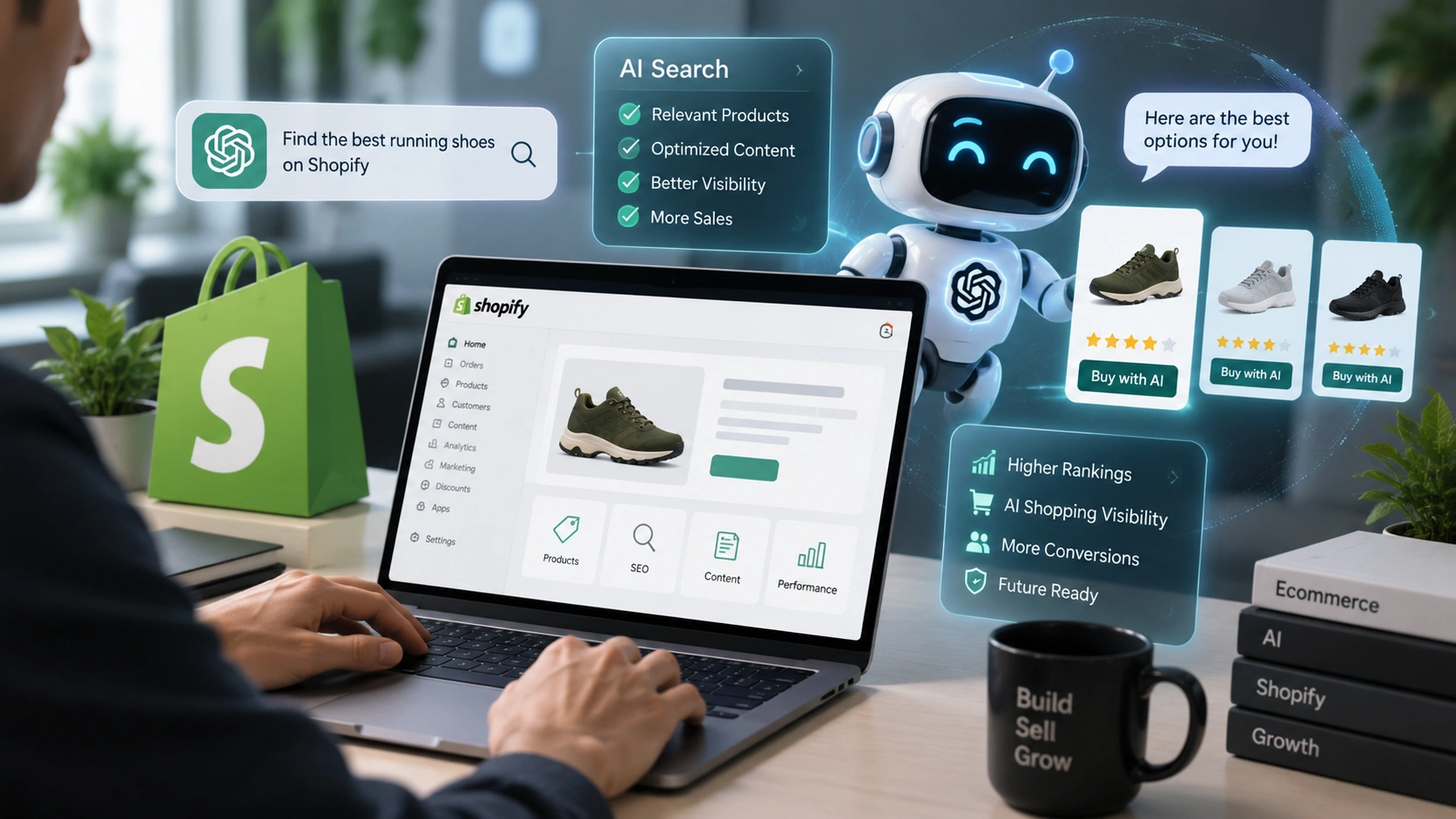
AI search is not like normal search. The shopper can type or speak a complete sentence, such as: find lightweight black running shoes for long-distance running under $120. The system must be capable of understanding a number of elements in one sentence: product category, material/weight requirement, use case, and price cap. That’s much more than a “keyword match.”
AI search includes a few related ideas:
- Conversational search: natural-language search over short phrases of keywords
- Generative AI search: involves systems such as Google’s AI Mode or ChatGPT that generate an answer, rather than providing links
- AI product suggestions: recommend products rather than merely search results
- AI shopping assistants and agentic shopping: a tool that carries a conversation forward by comparing and, in some instances, checkout
Now, here’s the difference in one line. A traditional search looks for pages with your words. AI search attempts to identify your actual purchase and then looks for products that match the search query.
That’s precisely the reason why product characteristics and structured information are more important today. No matter how well you rank in classic search, if you don’t have any details about your product’s material, weight, or use case, an AI system has very little to work with.
What Are AI Shopping Agents?
An AI shopping agent goes a step past search. It’s designed to help a shopper move through several stages of a purchase decision, not just find a starting point.
Broadly, an agent can help a shopper:
- Understand what they’re actually looking for
- Discover relevant products across one or more stores
- Compare products against each other
- Evaluate specific attributes, like size, material, or compatibility
- Recommend a shortlist or a single best option
- In some setups, assist with adding items to cart or moving toward checkout
Shopify’s agentic storefronts are built around this idea. Eligible products become discoverable through supported AI channels, but each channel, whether that’s ChatGPT or Copilot, controls how those products get ranked and presented on its own end. Shopify makes the data available. It doesn’t control the final placement.
For merchants who want to go beyond what Shopify’s built-in tools cover, custom AI agent development can extend this into store-specific automation, like agents that flag pricing errors or dead stock.
AI Search vs. AI Shopping Agents
| AI Search | AI Shopping Agents |
|---|---|
| Helps answer queries | Helps complete shopping tasks |
| Primarily discovery | Discovery plus comparison plus action |
| Can recommend products | Can potentially interact with commerce workflows |
| User remains more involved | Agent can handle more of the journey |
The distinction matters less for day-to-day optimization than you might think. Both depend on the same underlying thing: clean, complete, current product data. Get that right, and you’re positioned for either.
Why AI Search Matters for Shopify Merchants
So why this is not a passing trend to follow from the sidelines.
AI discovery represents a new source of traffic that behaves differently than organic search. AI-driven shoppers are more likely to be further into the buying process. They’ve already got a detailed idea of what they want, discussed a couple of options in the chat itself, and clicked through with genuine interest and intent, not just casual browsing.
To be clear, this is a Shopify-specific data source, not a standalone industry metric, and it’s a rapidly evolving trend, likely to change in the future as AI traffic increases.
A few reasons this pattern makes sense:
- Shorter discovery journeys: a shopper who asks an AI agent a specific question has usually skipped several rounds of comparison shopping already
- Higher-intent traffic: conversational queries tend to include budget, use case, and preferences up front, which filters out casual browsers
- Product-level recommendations: AI systems often point directly at a specific product rather than a homepage or category page
None of this replaces organic search or paid channels. It sits alongside them as a growing source of qualified visitors, and it rewards merchants whose product information is detailed enough for a machine to actually use.
How Does AI Discover and Understand Shopify Products?
It is useful to know how your product information really gets to its destination:
Shopify Store → Product Data → Shopify Catalog / Feeds / Structured Data → AI Platform → User Query → Product Matching → Recommendation
At every turn, the AI platform needs to determine if a particular product is actually the type that a customer requested. That’s totally dependent on the quality of the information it gets. If the listing is a bit too general or if there is just a little missing, it is overlooked no matter how good the product is.
The data points that carry the most weight include:
- Product title and description
- Category and product type
- Price and current availability
- Variants (size, color, material)
- Features, benefits, and use cases
- Images
- Shipping information
- Return policy details
- Reviews and other trust signals
Shopify Catalog exists specifically to organize this information into a structured format that AI platforms and shopping experiences can query. Think of it as the translation layer between your product page and whatever chat window a shopper is using.
10 Ways to Optimize a Shopify Store for AI Search
This is the part that actually moves the needle. Some of these overlap with good SEO. A few are specific to how AI systems parse product data.
1. Create Complete and Detailed Product Information
Thin descriptions were already a problem for SEO. For AI search, they’re close to a dead end. If the term “waterproof” isn’t mentioned anywhere on the page, a machine can’t determine that a jacket is waterproof. It can’t suggest a hiking product for hiking if “hiking” isn’t listed as a use case. Cover the basics thoroughly:
- Specifications and dimensions
- Materials
- Features and real-world benefits
- Compatibility with other products, systems, or sizes
- Use cases
- Size information and care instructions
This is precisely what Shopify’s own resources tell you: detailed product information, with clearly defined attributes, provides AI systems with something to work on.
2. Optimize Shopify Product Titles
A good title follows a simple pattern: Brand + Product + Key Attribute + Relevant Variant. Skip vague branding language, internal SKU codes, and repeated keywords crammed in for search engines.
Weak: “Premium Pro X”
Better: “Men’s Waterproof Lightweight Running Jacket”
The second version tells both a human and an AI system what the product actually is within three seconds. That clarity compounds across a catalog of hundreds or thousands of SKUs.
3. Write Product Descriptions for Humans and AI
Great descriptions respond to the questions your actual buyer is asking, not the ones a keyword tool has suggested. Try structuring around:
- What is it?
- Who’s it for?
- What problem does it solve?
- What are the key features?
- Where can it be used?
- What makes it different from similar products?
- What are the limitations, honestly?
The last point is more important than is realized. Descriptions containing a real-world consideration, such as “runs slightly small” or “not designed for below-freezing temperatures,” are more believable to customers and AI systems trained to detect overly promotional content.
4. Add Structured Product Data
Structured data is essentially a translation layer that tells search and AI systems exactly what’s on a page, in a format machines parse cleanly. For product pages, that typically covers:
- Product
- Offer
- Price
- Availability
- Brand
- SKU
- Review and aggregate rating
- Variant information
Google recommends placing Product structured data in the initial HTML response where possible, rather than injecting it only after JavaScript renders. It’s a small technical detail with a real impact on how reliably the data gets read.
One caveat worth stating plainly: structured data helps machines understand your content. It doesn’t guarantee AI visibility or better rankings on its own.
5. Keep Price, Inventory, and Product Availability Accurate
This one is unglamorous, and it’s also non-negotiable. An AI shopping agent that recommends an out-of-stock item, or quotes a price that changed last week, creates a bad experience that reflects on the store, not the AI platform. Keep current:
- Current and sale pricing
- Inventory counts
- Variant-level availability
- Stock status
- Shipping and delivery estimates where applicable
Shopify Catalog pulls current pricing, availability, and variant data to support AI product discovery. Stale data anywhere upstream breaks that chain.
6. Optimize Product Attributes and Metafields
Metafields are a new addition to Shopify that allow merchants to store structured data beyond the basic fields. That’s where a tremendous amount of potential lies. Material, color, size, fit, weight, compatibility, occasion, age group, product type, and use case are all helpful characteristics.
When these are consistently answered across a catalog, AI can come much closer to matching the product with a specific catalog item. For example, a gift for a 10-year-old who loves art or an office chair that can be used with a standing desk.
Don’t be tempted to add marketing copy in metafields. Keep them factual and specific.
7. Use High-Quality Product Images With Descriptive Alt Text
Images matter for more than aesthetics now. Multimodal AI systems increasingly factor in visual information alongside text, which means:
- Clear photography from multiple angles
- Product-in-use shots
- Consistent image quality across the catalog
- Descriptive, specific alt text (not “image1.jpg” or generic placeholder text)
- Variant-specific images, so a shopper sees the actual color or style they asked about
Shopify’s own guidance specifically calls out high-quality images paired with descriptive alt text as a factor worth prioritizing.
8. Build Helpful Comparison and Buying Information
AI systems need context to compare products against each other, and this is a section most Shopify stores skip entirely. Add:
- Comparison tables between similar products
- Size guides
- Material or feature comparisons
- “Best for” callouts (best for travel, best for sensitive skin, and so on)
- Compatibility notes
- Buying guides and FAQs
A quick example of what this looks like in practice:
| Feature | Product A | Product B |
|---|---|---|
| Material | Recycled polyester | Merino wool blend |
| Weight | 12 oz | 9 oz |
| Best for | Cold, wet conditions | Cool, dry layering |
| Price | $89 | $110 |
This kind of content does double duty. It gives AI systems clear comparison points, and it genuinely helps a human shopper decide faster.
9. Optimize Shopify Store FAQs and Policy Information
Shipping timelines, return windows, warranty terms, sizing charts, payment options, and customer support details all feed into how confidently an AI agent can answer a shopper’s question.
Shopify’s Knowledge Base app is built for exactly this. It lets merchants review and customize the FAQs that AI shopping agents draw on when answering questions about a store. Worth noting: Shopify has been clear that this app improves the accuracy of AI responses about a store. It doesn’t influence how often that store gets surfaced in AI platform results in the first place.
10. Build Brand Authority Beyond the Shopify Store
AI visibility isn’t purely a product-page exercise. Signals from outside the store carry weight too:
- Customer reviews (on-site and third-party)
- Editorial mentions and industry publications
- Expert content and community discussions
- Consistent brand information across the web
- Relevant backlinks from credible sources
No specific number of reviews or backlinks guarantees an AI recommendation, and any source claiming otherwise is guessing. What Shopify’s own guidance does note is that broader brand authority and external validation help AI systems treat a brand as a credible, recommendable source in the first place.
Not sure how AI-ready your product data actually is?
Elsner can run a straight audit of your Shopify catalog, structured data, and metafields, and tell you honestly where the gaps are before an AI shopping agent skips your listings.
Shopify Catalog: What Merchants Need to Know
What is Shopify Catalog?
Shopify Catalog is a structured source of product information. Eligible Shopify products get made available through it to AI platforms and other shopping experiences, without merchants having to manually build a separate export for every channel.
How Shopify Catalog Helps AI Product Discovery
Shopify Catalog plays a pivotal role in enhancing AI product discovery. Shopify Catalog is a force multiplier for AI product discovery. Core product information, such as titles, descriptions, images, prices, availability, variants, categories, and attributes, is organized into a catalog that AI platforms can query directly. That’s what allows an AI agent to extract accurate, up-to-date information rather than from a disorganized web page.
Do Shopify Merchants Need to Create a Separate AI Product Feed?
No, in most cases. Shopify stated that if a product qualifies, its data will be automatically placed in the Shopify Catalog. It means merchants will not be required to create an independent file only for Catalog inclusion.
What really needs to be done is to maintain the product data up to date, correct, and comprehensive. This work falls under content and operations responsibilities, not that of the technical export.
Does Shopify Catalog Guarantee AI Rankings?
No, and it’s worth being direct about that
Being included in Shopify Catalog doesn’t guarantee a product appears in any particular AI answer, ranking, or recommendation. Each AI channel, whether ChatGPT, Gemini, or Copilot, controls its own ranking logic and presentation rules independently. Catalog makes a product eligible to be considered. It doesn’t promise placement.
Shopify Agentic Storefronts and AI Shopping Channels
Shopify’s agentic commerce direction currently touches several major AI platforms, including ChatGPT, Google AI Mode and Gemini, Microsoft Copilot, and Meta. Agentic storefronts make eligible products discoverable through these supported channels, with the actual purchasing experience varying by platform.
That last part deserves emphasis. Not every Shopify merchant automatically shows up in every AI platform, and not every AI answer pulls from every eligible merchant. Availability depends on the channel’s own configuration, the product’s eligibility, and how well the underlying data supports a confident match.
Shopify Catalog API and Universal Commerce Protocol
This section gets a bit more technical, aimed at merchants working with developers or evaluating custom integrations.
Shopify Catalog API
The Catalog API gives developers and AI agents structured, queryable access to product information, including titles, descriptions, attributes, pricing, and availability. It’s the access point that lets an AI agent or third-party platform pull accurate product data programmatically rather than scraping a storefront.
Most merchants won’t touch this API directly. It’s typically a job for a Shopify development team, especially for stores running custom apps or a headless setup where product data needs to sync across several systems at once.
Universal Commerce Protocol (UCP)
UCP is an open standard, co-developed by Shopify and Google, designed to support commerce workflows between AI agents and merchants. It covers the full lifecycle: discovery, cart, checkout, fulfillment, and post-purchase steps.
The point of an open standard is interoperability. Instead of every AI platform building a separate integration with every ecommerce platform, UCP gives agents and merchants a shared language. It’s still an early-stage ecosystem, and how it evolves over the next year or two is worth watching rather than treating as settled.
Traditional Shopify SEO vs. AI Search Optimization
Here’s a myth worth killing early: AI optimization does not replace SEO. It builds on top of it.
Google’s current guidance states plainly that existing SEO best practices remain relevant for generative AI features in Search. Technical SEO, crawlability, page speed, internal linking, search intent alignment, structured data, mobile experience, and genuinely helpful content all still matter. AI search features are largely built on top of the same indexing and ranking systems that power classic search results.
| Traditional SEO | AI Search Optimization |
|---|---|
| Keywords | Natural language and intent |
| Rankings | Product and entity understanding |
| Search snippets | AI-generated recommendations |
| Pages | Structured product information |
| Backlinks | Broader authority signals |
| Search queries | Conversational requests |
The two strategies aren’t competing priorities. A store with strong technical SEO and thin product content will struggle in AI search the same way it struggles in classic search. A store with rich product data but a slow, poorly indexed site faces the same ceiling from a different direction. Both need attention, which is why most stores serious about this run Shopify SEO work and AI-readiness work as one connected effort instead of two separate projects.
Technical Shopify Optimization for AI Search
The technical foundation underneath AI search optimization is the same one good SEO has always needed:
- Crawlability: important pages shouldn’t be blocked or hard to discover
- Clean URLs: avoid unnecessary parameters and duplicate paths
- Correct structured data: match markup to what’s actually visible on the page
- JavaScript rendering: critical product content shouldn’t depend on heavy client-side rendering to load
- Canonical URLs: especially important for stores with variant-heavy or filtered collection pages
- Page speed and Core Web Vitals: slow pages hurt both classic rankings and AI-referred conversion
- HTML-accessible product info: content buried only inside JavaScript widgets or hidden accordions can be harder for crawlers to pick up
- Mobile-friendly UX: most shopping sessions, AI-referred or otherwise, happen on mobile
One thing not to do
Chase a special “AI sitemap.” No such requirement exists. Google’s documentation is explicit that no new markup or file format is needed beyond standard SEO fundamentals.
Stores with heavier technical debt, legacy themes, bloated apps, or a migration on the horizon usually need broader ecommerce development work before any of this technical list is worth revisiting.
Common Shopify AI Search Optimization Mistakes
A quick list of what tends to go wrong:
- Thin descriptions that leave AI systems guessing at basic attributes
- Missing attributes, especially size, material, and use case fields left blank
- Outdated inventory, leading to bad recommendations and frustrated shoppers
- Poor titles built around internal codes instead of clear language
- Duplicate content copied across similar SKUs without real differentiation
- Missing or mismatched structured data
- Information hidden inside images, like a sizing chart that exists only as a graphic
- Ignored reviews and trust signals
- Keyword stuffing dressed up as AI optimization, which misses the point since AI parses intent, not term frequency
- Assuming Catalog inclusion guarantees visibility, when it only makes a product eligible
Most of this traces back to one root issue: incomplete or inconsistent product data. Fix that, and the rest tends to resolve on its own.
How to Measure Shopify AI Search Performance
Visibility alone isn’t useful. What matters is whether AI-referred traffic converts and contributes real revenue. Worth tracking:
- AI-referred traffic volume and sources
- Product-page sessions arriving from AI channels
- Conversion rate for AI-referred sessions specifically
- Average order value from AI-referred orders
- Revenue attributed to AI channels
- Product discovery queries and customer questions surfaced through Knowledge Base
- Assisted conversions, where an AI interaction played a role earlier in the journey
Shopify provides channel and referrer attribution for orders originating from AI channels, which gives merchants a starting point for understanding where AI-driven sales are actually coming from.
Evaluate this data against business outcomes: revenue, conversion, and order value, not just raw visibility or mentions.
A Practical Shopify AI Search Optimization Checklist
Future of Shopify AI Search and Agentic Commerce
Worth being careful with predictions here. This space moves fast, and today’s infrastructure will likely look different in twelve months.
That said, a few directions seem likely to continue: more conversational shopping, deeper AI-assisted comparison, multimodal search that factors in images alongside text, and more commerce activity happening directly inside AI interfaces rather than on a merchant’s own site.
Shopify’s 2026 developer updates point toward agentic commerce infrastructure moving past the experimentation phase, with broader developer access opening through UCP and the Catalog API. That’s a signal about direction, not a guarantee about pace. Treat it as a trend worth preparing for, not a fixed roadmap.
Final Thoughts
Optimizing a Shopify store for AI search comes down to one core idea: make your product and brand information clear, complete, trustworthy, structured, and current.
This isn’t about finding a trick to hack AI rankings, because there isn’t one. It’s about making it easy for an AI system to answer a handful of basic questions about what you sell:
- What is this product, specifically?
- Who’s it actually for?
- What makes it different from the alternatives?
- How much does it cost right now?
- Is it in stock?
- Why would a shopper choose this one over something else?
Get those answers right, consistently, across a catalog, and you’ve done most of the real work. Everything else, Shopify Catalog eligibility, structured data, agentic storefront configuration, is infrastructure built to carry that information to wherever a shopper happens to be asking.
If your product data needs an audit, or you’re weighing whether a headless Hydrogen build or custom AI integration makes sense for your catalog size, Shopify development support built around AI-readiness can save months of trial and error. Elsner’s team works across Shopify SEO, ecommerce development, and AI agent development to help merchants get product data, technical SEO, and agentic commerce readiness working together instead of as separate projects.
Frequently Asked Questions
What is Shopify AI search optimization?
It’s the practice of structuring product titles, descriptions, attributes, and technical data so AI search engines and shopping agents can understand, compare, and recommend products accurately. It works alongside traditional SEO rather than replacing it.
How can I optimize my Shopify store for AI search?
Start with complete product data: clear titles, detailed descriptions, filled-in attributes and metafields, accurate pricing and inventory, and structured data that matches what’s visible on the page. Add comparison content and FAQs where relevant, then confirm your store is Shopify Catalog ready.
How do AI shopping agents find Shopify products?
They pull structured product information through Shopify Catalog and the Catalog API, then match that data against a shopper’s request based on intent, attributes, budget, and context rather than exact keyword matches.
What is Shopify Catalog?
Shopify Catalog is a structured source of product information that makes eligible products available to AI platforms and shopping experiences for discovery, comparison, and recommendation.
Does Shopify Catalog help products appear in ChatGPT?
It can make a product eligible for consideration, but it doesn’t guarantee appearance in any specific AI answer. Each AI platform, including ChatGPT, controls its own ranking and presentation independently.
How do I optimize Shopify product pages for AI?
Focus on complete specifications, clear attributes, accurate pricing and availability, quality images with descriptive alt text, structured data in the initial HTML, and honest, detailed descriptions that answer real buyer questions.
Is Shopify SEO still important for AI search?
Yes. Google’s own guidance confirms that existing SEO fundamentals remain relevant for AI-driven search features, since those features are built on the same underlying ranking and indexing systems.
What is Shopify agentic commerce?
It’s Shopify’s framework for letting AI agents help shoppers discover, compare, and in some cases purchase products through conversational interfaces, supported by infrastructure like Shopify Catalog, agentic storefronts, and the Universal Commerce Protocol.
Ready to make your catalog AI-recommendable?
Elsner works across Shopify SEO, ecommerce development, and AI agent development to help you get product data, technical SEO, and agentic commerce readiness working together.