




By Elsner SEO Editorial Team | Published May 22, 2026 | Updated June 12, 2026 | 5 min read
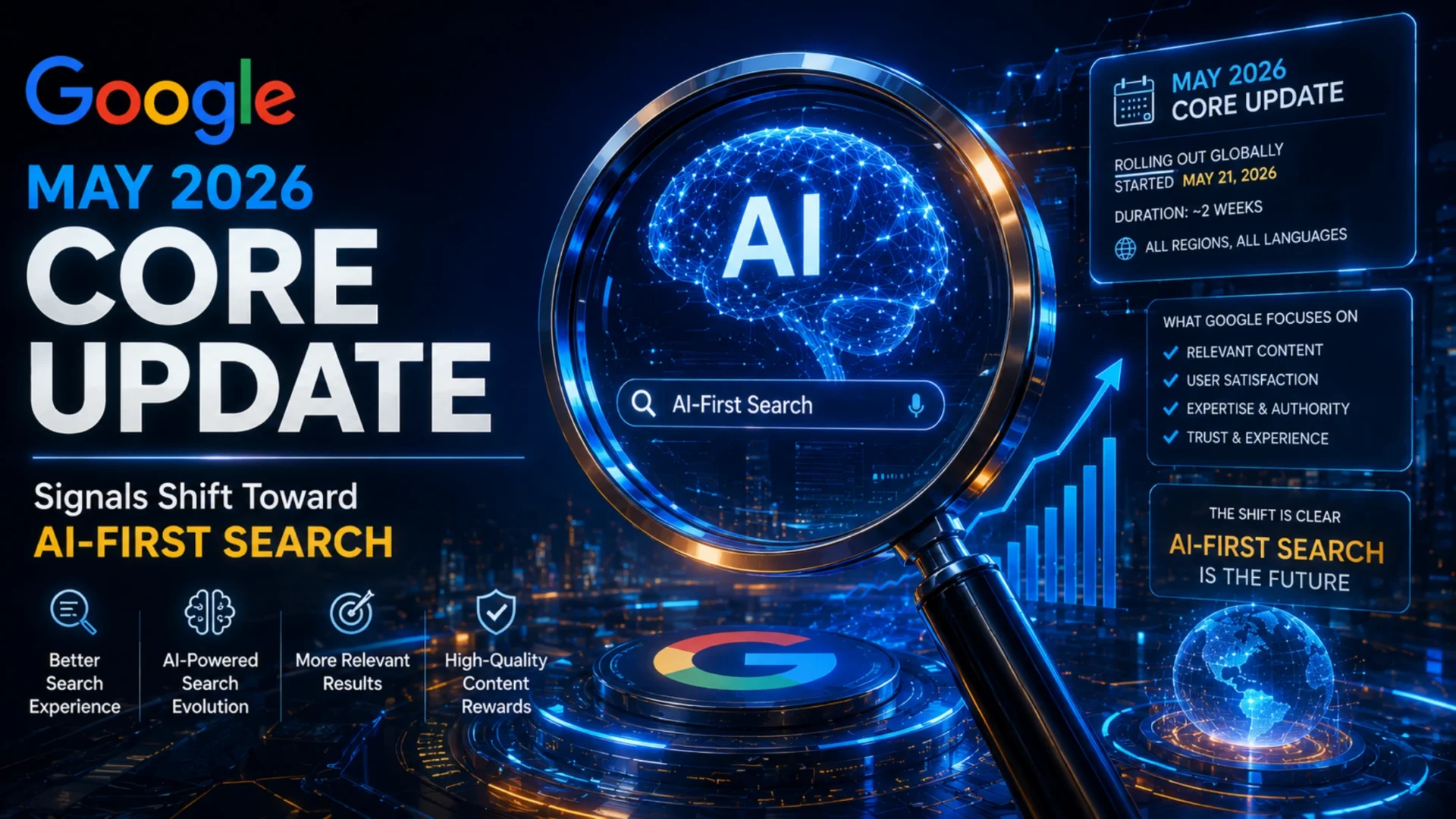
Google has officially completed the rollout of the May 2026 Core Update. The rollout began on May 21, 2026, with confirmation from Google’s Search Liaison shortly after early ranking shifts began appearing across major tracking tools. Google confirmed full completion on June 4, 2026.
This is a broad core update. That means it touches all regions, all languages, and most content categories. Volatility was reported across news, e-commerce, and informational queries throughout the rollout. Some sites moved up. Many dropped without warning. That part is typical for core updates. The timing wasn’t.
Google’s AI-first search push, accelerated by AI Overviews and deeper Gemini integration, has reshaped how content gets surfaced. The May 2026 Core Update is the clearest signal yet that the ground rules have moved.
What Google officially announced
Google confirmed the rollout on its Search Status Dashboard, describing it as a broad core update designed to better surface relevant and satisfying content. The rollout completed on June 4, 2026, with global reach across all regions and languages.
|
May 21
Official rollout start
|
June 4
Rollout completed
|
Global
All regions and languages
|
Google has reused similar wording for years. The framing isn’t new. What’s different is the moment it arrived in. This update followed closely on the heels of Google I/O 2026, where the company doubled down on AI-driven search experiences. Most search professionals don’t see that as coincidence.
Key facts confirmed after full rollout
- Rollout ran from May 21 to June 4, 2026, totaling 14 days
- Second core update of 2026 and the fourth confirmed ranking change this year
- No official blog post or specific quality signals published by Google
- Heaviest volatility observed in news, informational, and e-commerce categories
- Recovery patterns remain consistent with previous core updates: patience outperforms reactive changes
Why the SEO industry is paying close attention
Core updates happen often. So why is this one pulling more analysis than usual?
The answer is context. Search isn’t operating the way it did even twelve months ago. AI Overviews now appear on a meaningful share of informational queries across the United States, United Kingdom, India, and several European markets. Conversational search through Gemini has shifted user behavior. People ask layered questions. They expect synthesized answers, not ten blue links.
The bigger pattern behind this rollout
Google has been preparing the search ecosystem for AI-first ranking logic for at least eighteen months. Helpful Content signals folded into core ranking systems. Site reputation abuse policies tightened. Scaled content abuse got targeted. The May 2026 Core Update fits that trajectory cleanly.
Post-rollout analysis from SEO professionals on X and LinkedIn confirms a consistent pattern. Thin informational content lost visibility at scale. Sites with strong topical authority and named expert voices held or gained ground. AI-generated content without meaningful human editing took heavier hits than during previous updates. Commerce sites saw reshuffles tied to product page depth and brand signals.
One data point worth noting: position one organic click-through rates on queries where AI Overviews appear have dropped from around 27 percent to as low as 11 percent, based on SISTRIX data from March 2026. A site can hold its ranking through the core update and still see traffic decline because AI Mode is absorbing clicks above organic results. Rankings and traffic are now two separate metrics that need to be tracked independently.
There’s also a quieter trend worth flagging. Some sites that survived previous updates slipped this time. That suggests Google is refining how it weighs trust signals, not just adding new ones.
What the data shows: confirmed winners and losers
The rollout has completed and the data has stabilized. The divide between sites Google trusts and sites it doesn’t is now clear.
|
Confirmed gains
|
Confirmed losses
|
The pattern matches what enterprise SEO teams have been advising clients for over a year. Originality matters more. Depth matters more. The brand behind the content matters more.
For publishers in YMYL categories like finance, health, and legal, movement was sharper. These verticals have historically taken the biggest swings during core updates, and AI Overviews already lean heavily on authoritative sources here. E-commerce wasn’t immune either. Product pages with templated copy, weak brand presence, and thin reviews showed the most volatility.
For most sites, the honest read is this: the update rewarded what Google has been asking for. Slowly. Loudly. For years.
What businesses and publishers should do now
The rollout is complete. The time for monitoring without acting is over.
Practical steps now that the rollout has completed
- Pull a full ranking comparison: pre-update baseline (May 1 to 20) vs. current stabilized data
- Identify which content categories moved and look for thematic patterns across pages that dropped
- Audit thin or fully AI-generated pages dragging overall site quality signals
- Strengthen internal linking around topics where you have real, demonstrated expertise
- Refresh older content that ranks but reads thin against current top results
- Build genuine external signals through PR, editorial partnerships, and earned citations
- Track AI Overview citation share separately from traditional rank position. These are now two different performance metrics.
For enterprise SEO teams, this is also a useful moment to revisit content production workflows. If AI is in the mix, the human editing layer needs to be sharper than it was a year ago. Google has clearly raised the bar on what qualifies as helpful.
One structural change worth making immediately: add AI Overview performance tracking to your Google Search Console reporting. Google is rolling out a dedicated AI performance report inside Search Console. Traditional GSC metrics alone no longer tell the full story of how a page is performing in search.
A search landscape that isn’t slowing down
The May 2026 Core Update isn’t a routine refresh. It is part of a broader move toward AI-first search, and the brands willing to invest in real expertise, original thinking, and trustworthy content are the ones coming out ahead. The data from the completed rollout confirms it.
Search is harder than it was. That isn’t a bad thing for businesses serious about content. It rewards the work that should have been rewarded all along.
The next few months will show which sites built durable authority. The next few years will decide which brands stay relevant in a search experience that looks less like a list and more like a conversation.
Frequently asked questions
When did Google’s May 2026 Core Update start and finish?
Google began the rollout on May 21, 2026, with confirmation through the Search Status Dashboard. The update completed on June 4, 2026, after a 14-day rollout period.
Is this update related to AI Overviews or Gemini?
Google hasn’t tied the update directly to AI Overviews or Gemini. The timing, however, followed Google I/O 2026 and the global rollout of Gemini 3.5 Flash as the default AI Mode model. Most SEO professionals treat them as connected shifts in the same direction.
Should businesses make changes to their content now?
Yes. The rollout completed on June 4, which means ranking data has stabilized. Now is the right time to pull a pre-update vs. post-update comparison in Search Console, identify content categories that moved, and begin improving pages that lost visibility. Audit for thin content, strengthen topical authority, and add AI Overview citation tracking to your reporting setup.
Which sites were most affected by this update?
Sites built on high-volume AI-generated content, thin informational pages, and aggregator-style articles with no original input saw the heaviest drops. Commerce sites with templated product copy and weak brand signals also showed significant volatility. Sites that were already hit by the January 2026 unconfirmed update and did not recover meaningfully saw compounding losses.
My rankings held but traffic dropped. What is happening?
This is one of the most reported patterns after this update. AI Overviews and AI Mode are absorbing clicks above organic results. Position one CTR on queries where AI features appear has dropped from around 27 percent to as low as 11 percent. Ranking and traffic are now two separate signals. You need to track both independently and start monitoring AI Overview citation share as a distinct performance metric.
Sources and references
- Google Search Status Dashboard: Official May 2026 Core Update incident report
- Google Search Liaison: Official rollout confirmation on X
- SISTRIX: Position one CTR data on AI-featured queries, March 2026
- Amsive: Branded query CTR lift data under AI Overviews, 2026
- Article updated June 12, 2026 to reflect completed rollout data, confirmed site impact patterns, and post-stabilization guidance. Original publication: May 22, 2026.
Rankings shifted after the May 2026 update?
Elsner’s enterprise SEO team helps brands recover, audit AI-driven content risks, and build the topical authority Google now rewards. Talk to our specialists for a tailored update assessment.