





- What Digital Ad Intelligence Actually Means
- The Gap Most Paid Media Teams Are Working Around
- How Digital Ad Intelligence Improves Campaign Performance
- 1. Competitor Ad Monitoring That Goes Beyond Guesswork
- 2. Creative Intelligence That Cuts Testing Costs
- 3. Smarter Audience and Targeting Decisions
- 4. Budget Allocation Backed by Market Data
- 5. Real Market Benchmarks Instead of Internal Comparisons
- What a Solid Ad Intelligence Setup Actually Needs
- Where Brands See the Fastest Lift After Getting Started
- How to Build Ad Intelligence Into Your Campaign Workflow
- The Connection Between Ad Intelligence and AI-Driven Campaign Tools
- Quick Reference: What Ad Intelligence Covers Across Channels
- How Elsner Approaches Ad Intelligence for Client Campaigns
- Frequently Asked Questions
- Final Word
You’re halfway through Q2. The campaign numbers look okay on the surface. Impressions are up, CTR is holding steady, and the weekly report shows green across most columns. But conversions are flat. Return on ad spend hasn’t moved. And nobody on the team can explain exactly why.
That’s the gap digital ad intelligence is built to fix.
Most paid media teams have plenty of data. What they don’t have is context. They can see their own numbers but can’t see what’s happening in the market around them – what competitors are spending, which creative angles are resonating, where audience attention is actually shifting. Without that layer, even a well-run campaign is operating with a serious blind spot.
What Digital Ad Intelligence Actually Means
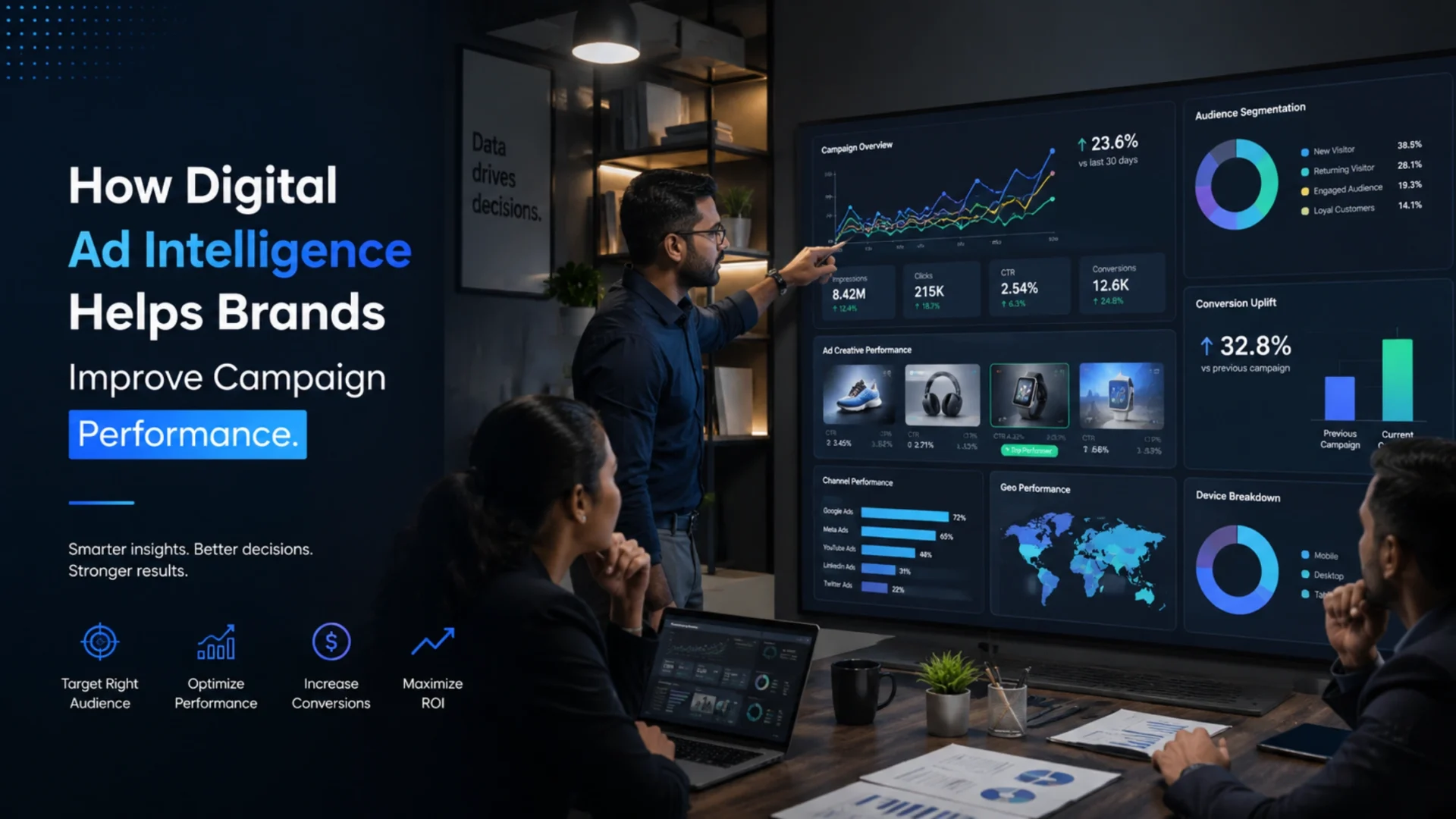
Digital ad intelligence is the practice of collecting, analyzing, and acting on advertising data – both from your own campaigns and from the broader competitive landscape. It pulls together signals from paid search, social platforms, programmatic networks, and display channels to give you a complete picture of what’s actually happening in your advertising environment.
Standard analytics tells you what happened. Ad intelligence tells you why it happened – and what’s driving performance across the market, not just inside your own account.
Think of it as a media intelligence layer that sits above your dashboards. Your Google Ads account shows you your own impression share. Ad intelligence shows you what competitors are running, how often they’re rotating creative, which platforms they’re doubling down on, and what kinds of messages are gaining traction with audiences you’re both targeting.
It’s the difference between reading your own report card and understanding the entire classroom.
The Gap Most Paid Media Teams Are Working Around
Here’s a scenario most performance marketers will recognize.
A campaign that was converting well in January starts underperforming by March. The creative hasn’t changed. The targeting is the same. The budget is steady. But results are slipping, and the internal review comes up empty because nobody thought to check what was happening externally.
What usually happened? A competitor launched a new campaign with fresher messaging. Another brand moved significant budget into a channel you relied on, inflating CPMs. Your audience segment hit saturation faster than expected because three similar brands were pounding the same demographic with the same angle.
None of that shows up in your own data. And that’s the core problem. Most teams are working with 50 percent of the relevant information – the half they generated themselves.
The common blind spots include:
- Competitor creative strategy and messaging cadence
- Platform-level spend benchmarks for your category
- Audience saturation signals across shared targeting segments
- Share of voice shifts that explain sudden performance drops
- Creative format trends gaining traction before your team identifies them
Without intelligence to fill these gaps, media buying becomes expensive guesswork. Not because the team isn’t skilled – but because they’re making decisions with incomplete information.
How Digital Ad Intelligence Improves Campaign Performance
This is where things get practical. Not theoretical benefits – real changes to how campaigns get planned, built, and optimized.
1. Competitor Ad Monitoring That Goes Beyond Guesswork
With the right intelligence setup, you can see which ad formats competitors are running, how frequently they’re rotating creative, and which platforms they’re prioritizing at any given time. You’re not guessing based on what you happen to see scrolling through Instagram – you’re looking at structured data across channels.
Say a competitor doubles their video ad frequency on YouTube two weeks before a major product launch. That’s a signal. It tells you they’re pushing hard on awareness, which means your own messaging window on that channel may narrow. You can adjust timing, shift some budget to channels they’re leaving underserved, or sharpen your own creative to cut through the noise they’re about to create.
That kind of proactive adjustment isn’t possible without intelligence. Without it, you find out a competitor made a big move after your numbers drop.
2. Creative Intelligence That Cuts Testing Costs
Internal A/B testing has real limits. You’re testing within your own campaign history, your own audience segments, your own creative biases. Market-level creative intelligence gives you a much larger sample – what hooks, formats, and visual approaches are actually resonating with audiences across your entire category, not just your own account.
Marketers using ad intelligence tools report reducing testing phases by 40 to 60 percent and cutting ad spend waste by up to 30 percent, according to industry benchmarks from 2025 and 2026. That’s not because they test less – it’s because they start from a smarter baseline.
When you brief a creative team with intelligence data – “problem-agitation hooks are outperforming social proof angles in our category right now” – you get more relevant first attempts and fewer expensive misfires. That compounds fast when you’re running campaigns across multiple channels.
3. Smarter Audience and Targeting Decisions
Audience saturation is one of the most underdiagnosed reasons campaigns plateau. If three brands in your category are targeting the same 35 to 45 year old professional segment on LinkedIn with similar messaging, response rates drop for everyone – not because the audience lost interest, but because they’re oversaturated.
Cross-channel intelligence surfaces these mismatches before they show up in your ROAS. It identifies where audience attention is shifting, which demographics competitors are ignoring, and where underserved pockets of high-intent users exist. That’s not information you can get from your own campaign data alone.
Worth noting: this is especially relevant as Performance Max adoption grows. According to Fluency’s 2026 benchmarks, PMax usage jumped from 60 to 71 percent of advertisers between 2024 and 2025. When AI handles bidding, audience intelligence becomes the primary lever teams still control.
4. Budget Allocation Backed by Market Data
Most budget decisions are still made based on historical performance and gut instinct. A channel worked last quarter, so it gets the same allocation this quarter. That logic is fine when markets are static. It breaks down fast when competitor spend patterns shift.
Intelligence tools surface which channels are over or under-indexed in your category. If competitors are moving budget away from display and toward connected TV – where programmatic CTV spending is rising significantly across brand categories – that’s a strategic signal about where attention is migrating. Acting on that early moves budget ahead of the crowd rather than behind it.
The result is fewer budget overruns and more defensible allocation decisions. “The data showed competitors pulling back on paid social in Q3” is a much stronger argument for a budget shift than “we think social is getting expensive.”
5. Real Market Benchmarks Instead of Internal Comparisons
A 3 percent CTR sounds solid until you find out competitors in your category are averaging 5.2 percent. A 2.1x ROAS looks adequate until you see that similar brands are hitting 3.4x on the same channel. Internal benchmarks create a false sense of how campaigns are performing relative to the actual market.
Share of voice, impression share, and competitive spend patterns give campaigns a real context. They answer the question every CMO actually wants answered: not “are we better than we were last month,” but “are we winning in the market?”
Those are very different questions, and only one of them matters for growth.
What a Solid Ad Intelligence Setup Actually Needs
Not a tool list – a criteria check. Because the wrong setup gives you dashboards without decisions.
Cross-channel coverage. Intelligence that only covers Google Search misses what’s happening on Meta, programmatic display, connected TV, and LinkedIn. If your competitors are running meaningful spend across three or four channels, single-channel intelligence gives you a partial picture at best.
Data freshness. Stale intelligence is often worse than no intelligence. Competitor strategies can shift in days, especially around product launches or seasonal pushes. Weekly data feeds have their place, but for fast-moving campaigns, near real-time monitoring changes what’s actionable.
Competitor coverage depth. Most tools do a reliable job tracking large, well-known brands. The gap is usually mid-tier and emerging competitors – the ones experimenting with new positioning before bigger players adopt it. Often overlooked. Usually where the most useful early signals live.
Integration with existing stacks. Intelligence that sits in a separate dashboard rarely gets used consistently. It needs to feed into wherever your team actually makes decisions – your reporting tools, your media planning workflows, your creative briefing process.
One honest caveat: most platforms cover Google and Meta well. Niche channels and newer platforms are where coverage thins out. That varies by provider, so it’s worth asking specifically about the channels that matter most for your category before committing.
Where Brands See the Fastest Lift After Getting Started
Creative refresh cycles tend to improve first. Teams that previously relied on fatigue signals from their own campaigns now have market-level context telling them when a hook or format is losing steam across the category – before it shows up in their own numbers. Fewer bad creative investments add up fast.
Budget reallocation decisions come second. Brands with zero intelligence infrastructure tend to make the biggest early gains here because they’ve been operating on the least information. Moving even 15 to 20 percent of spend based on competitive intelligence rather than habit often produces measurable ROAS improvement within the first 60 to 90 days.
Competitive response time improves across the board. The time between a competitor making a significant move and your team reacting to it shrinks from weeks to days. That’s an operational advantage that compounds over time.
Not always a dramatic overnight change. But the compounding effect of better-informed decisions at every stage – creative, targeting, budget, timing – adds up to campaigns that perform more consistently and waste less.
How to Build Ad Intelligence Into Your Campaign Workflow
Gathering intelligence is the easy part. The teams that actually see results from it connect intelligence outputs to three specific places: creative briefing, media planning, and budget approval conversations. If it doesn’t feed into decisions, it’s just another dashboard nobody checks after week two.
Build intelligence reviews into your existing campaign cadence. Weekly reviews work for most teams – bi-weekly if your campaigns run slower. What you’re looking for each review cycle:
- New competitor creative launches or format shifts
- Channel spend movement that signals emerging competition
- Audience signal changes suggesting saturation or new opportunity
- Any messaging angles gaining traction you haven’t tested yet
Assign ownership. Someone needs to be responsible for translating intelligence signals into actual recommendations – not just collecting them. A review that ends without a decision or a test queued isn’t a review. It’s a meeting.
This is also where Elsner’s performance marketing services come in. We don’t just run campaigns – we build the intelligence layer underneath them so every decision is grounded in market data, not internal history alone.
The Connection Between Ad Intelligence and AI-Driven Campaign Tools
Something worth understanding as ad platforms get smarter.
Google’s Performance Max, Meta’s Advantage+, and similar AI-driven campaign types have shifted where human strategic input actually matters. The algorithm handles bidding, placement, and delivery optimization. What it can’t do is tell you what your competitors are doing, how the market is shifting, or when your creative is losing relevance relative to what else is running.
That’s exactly where ad intelligence becomes more valuable, not less. The more you hand off execution to platform AI, the more your competitive edge depends on the quality of the signals and creative you feed into it. AI-powered strategy work only outperforms when the intelligence underneath it is sharp.
Brands that treat ad intelligence as a nice-to-have in an AI-native advertising environment are making a significant strategic mistake. The floor for execution is rising across the board. The differentiation is moving entirely upstream – to strategy, creative, and market understanding.
Quick Reference: What Ad Intelligence Covers Across Channels
| Channel | What Intelligence Surfaces | Strategic Benefit |
|---|---|---|
| Paid Search | Competitor keyword coverage, ad copy angles, impression share | Fill keyword gaps, sharpen messaging, benchmark visibility |
| Paid Social | Creative formats, hook types, offer structures, rotation frequency | Improve creative briefing, reduce testing cycles, spot saturation early |
| Programmatic Display | Publisher mix, ad network choices, banner format trends | Identify underserved placements, avoid crowded inventory |
| Connected TV | Competitor investment levels, platform distribution, share of presence | Enter high-growth channels before they get competitive and expensive |
| Video Advertising | Format choices, creative duration trends, engagement benchmarks | Align video spend with where audiences are actually watching |
How Elsner Approaches Ad Intelligence for Client Campaigns
Brands we work with don’t just get campaigns – they get an intelligence-informed strategy underneath every campaign decision. That means competitor monitoring tied to creative briefs, market benchmarking tied to budget conversations, and audience signal analysis tied to targeting strategy – not just reports that sit in a shared drive.
Our PPC management services and conversion rate optimization work are both grounded in this intelligence layer. For brands running significant paid media budgets, the difference between campaigns informed by market intelligence and campaigns built only on internal data is significant – and measurable.
If your team is running paid campaigns without a clear view of the competitive landscape, that’s the gap worth addressing first.
Frequently Asked Questions
What is digital ad intelligence?
Digital ad intelligence is the process of collecting and analyzing advertising data from your own campaigns and across the competitive landscape – covering paid search, social, display, video, and programmatic channels. It gives marketing teams the market context that standard analytics can’t provide, including what competitors are spending, what creative angles are performing, and where audience attention is shifting.
How is digital advertising intelligence different from regular campaign analytics?
Regular analytics shows you what happened inside your own campaigns. Ad intelligence adds the external layer – what competitors are doing, how the broader market is behaving, and why your performance is moving the way it is. One explains your results. The other helps you improve them by showing the competitive context those results exist within.
Which channels does digital ad intelligence typically cover?
Most platforms cover Google Search, Meta (Facebook and Instagram), programmatic display, YouTube, and LinkedIn reasonably well. Connected TV coverage is improving as programmatic CTV spending grows. Coverage of niche platforms varies significantly by tool – worth verifying before choosing a setup if those channels matter to your campaigns.
How often should brands review ad intelligence data?
Weekly reviews tied to campaign planning cycles work well for most teams. For brands in fast-moving categories or running time-sensitive campaigns around product launches or seasonal events, near real-time monitoring makes the intelligence more actionable. Quarterly reviews alone are too slow – competitive moves happen in days, not months.
Is ad intelligence only valuable for large brands with big budgets?
Not at all. Mid-market brands often see faster early returns because the competitive gaps are more visible and easier to act on. A brand spending $50,000 a month on paid media has just as much to gain from knowing what competitors are running as one spending $500,000. The difference is scale – but the strategic value of the intelligence is the same.
What should a brand do first after setting up digital ad intelligence?
Run a competitive audit against your top three to five direct competitors. Look at their creative mix – formats, hook types, offer structures. Identify which platforms they’re investing in and where they’re underinvested. Compare your own channel distribution against theirs. That audit usually surfaces one or two immediate strategic adjustments worth testing right away.
Does ad intelligence still matter when AI is managing campaign delivery?
It matters more. As AI-driven campaign types like Performance Max and Meta Advantage+ take over execution, the strategic inputs – creative quality, audience signals, competitive context – become the primary differentiator. Platform AI optimizes what you give it. Ad intelligence helps you give it better inputs than your competitors are giving theirs.
Final Word
Running paid campaigns without visibility into the competitive landscape is a bit like navigating with last year’s map. The terrain looks familiar enough to feel manageable, but the roads have shifted.
Digital ad intelligence doesn’t replace good campaign management. It makes good campaign management significantly more effective – by adding the market context that internal data can’t provide.
For brands serious about paid media performance, the question isn’t whether to build an intelligence layer into their campaigns. It’s whether to do it before or after their competitors do.
If your team is ready to build campaigns that are informed by more than just your own historical data, Elsner’s performance marketing team can show you what that looks like in practice. Reach out and we’ll walk through the gaps worth closing first.