




- What is Zero-Click Search in Ecommerce?
- The Rise of AI Ecommerce SEO
- Why Are Ecommerce Stores Losing Clicks Despite Rankings?
- How AI Ecommerce SEO is Changing Organic Marketing Strategy?
- From Keyword Targeting to Intent Optimization
- Content Depth and Authority Matter More
- Importance of Structured Data and Schema
- Brand Visibility Beyond Rankings
- Key SEO Challenges for Ecommerce Businesses
- Declining Organic Traffic
- Lower Click-Through Rates
- Difficulty in Measuring SEO Success
- 5 Strategies to Adapt to AI and Zero-Click Search
- New Metrics That Matter in Ecommerce SEO
- The Future of Ecommerce SEO
- When to Rethink Your SEO Strategy?
- Conclusion
- Struggling With Declining Organic Traffic Despite Solid Rankings?
- Frequently Asked Questions
- What is zero-click search in ecommerce?
- How does AI affect ecommerce SEO?
- Why is my ecommerce traffic dropping despite good rankings?
- How can I adapt my ecommerce SEO strategy in 2026?
- Is SEO still relevant for ecommerce?
You ranked on page one. Traffic is still down. Sound familiar?
Store owners and SEO teams are doing everything right by traditional standards — creating solid content, building good backlinks, and still watching organic traffic numbers slide. The search engine is performing. The clicks just aren’t coming.
The reason isn’t a penalty or a technical issue. It’s a structural change in how AI ecommerce SEO works. AI-generated answers and zero-click behavior are rewriting the relationship between visibility and traffic. Ecommerce businesses that don’t adapt will keep feeling that gap between rankings and results.
What is Zero-Click Search in Ecommerce?
Zero-click search happens when a user gets the answer they need directly on the search results page, without clicking through to any website.
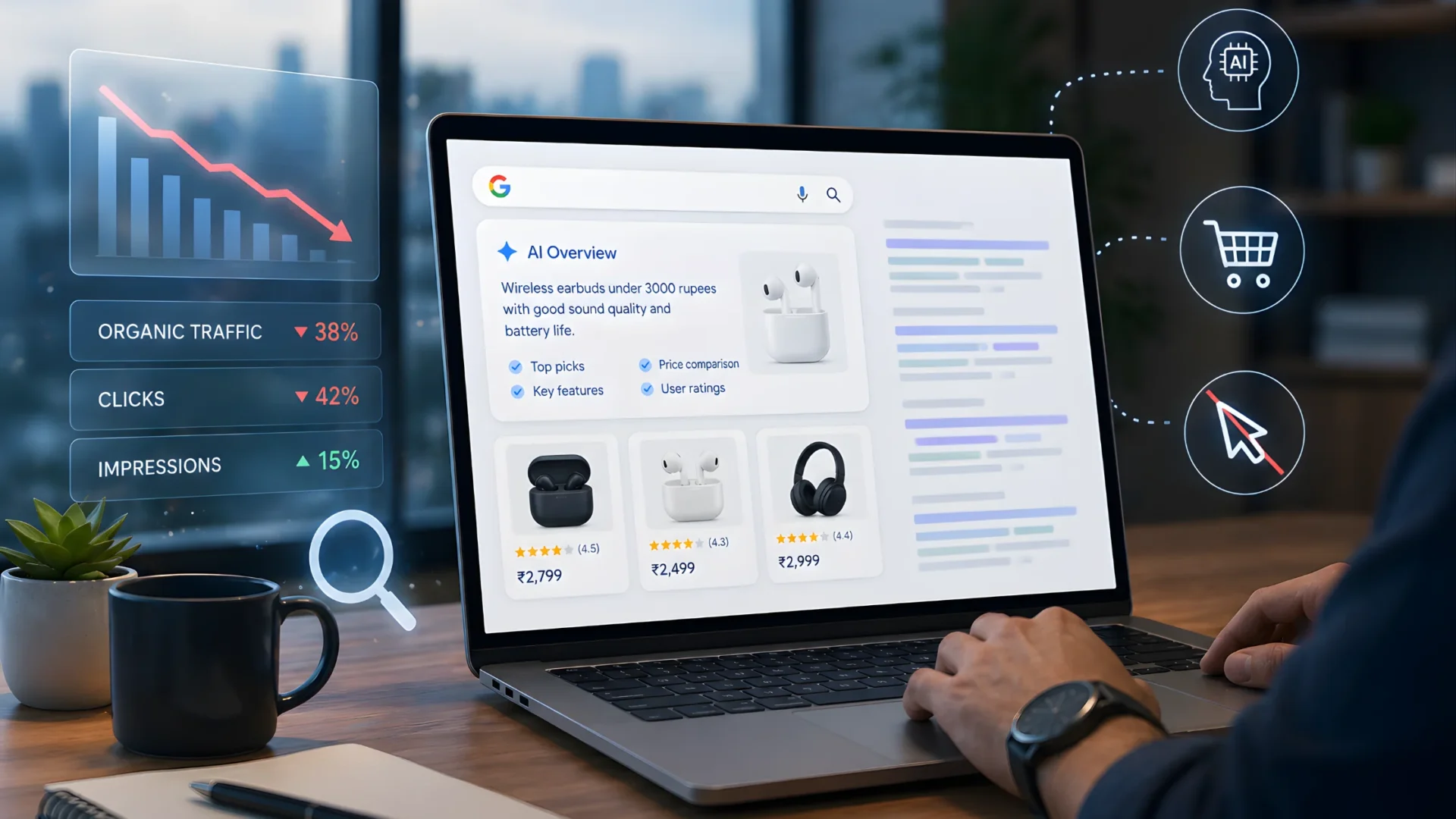
Type “what size is a medium in men’s shirts?” into Google. You’ll get a chart or sizing guide right there. Search “best wireless earbuds under 3000 rupees.” The result comes back with a list of specs, prices, and ratings pulled from multiple sources. The user got what they needed. No one got the click.
For informational queries you directly get product comparisons, sizing guides, or ingredient explanations. Google’s AI Overviews have accelerated this significantly. What used to require visiting three or four sites now gets resolved in the search results themselves.
Important: Zero-click search ecommerce is not a future concern. It’s already reshaping where traffic goes and who gets it.
The Rise of AI Ecommerce SEO
Google’s AI Overviews (formerly Search Generative Experience) pull synthesized answers from across the web and display them at the top of results pages. Bing Copilot does something similar. Both are built around the idea that search should answer questions, not just list links.
This represents a real shift in what search engines are optimized for. They used to help users find websites. Now they try to be the destination themselves. Brands need to understand how GEO, AEO, and SEO each play a different role in this new environment.
For ecommerce, this creates a two-tier problem:
The Google AI Overview ecommerce effect is real: even when your content is cited in an AI summary, the citation doesn’t always translate into a visit. Users read the answer and move on.
Why Are Ecommerce Stores Losing Clicks Despite Rankings?
Three things are driving the ecommerce organic traffic decline:
|
1
|
Search Results Pages Are More CrowdedGoogle pages now include AI summaries, featured snippets, and product carousels. The organic blue links start further down the page than they used to. Ranking #3 doesn’t mean what it meant in 2019. |
|
2
|
Users Trust On-Page AnswersGoogle now shows product comparison tables or concise answers to shopping questions. Most people don’t feel compelled to dig further. The search engine has already done the work. |
|
3
|
Informational Content Drives a Lot of SEO TrafficBlog posts about product categories, buying guides, FAQ content — these were built to capture top-of-funnel traffic. AI Overviews now do that job without sending the user anywhere. |
This doesn’t mean SEO is irrelevant. It means the old approach of ranking for everything and expecting clicks to follow no longer holds up reliably.
How AI Ecommerce SEO is Changing Organic Marketing Strategy?
From Keyword Targeting to Intent Optimization
Ranking for “blue denim jacket” is less useful if users searching that phrase are only browsing. AI in SEO ecommerce has pushed strategy toward understanding what the searcher is actually trying to do at each stage. A product page optimized for someone ready to buy looks very different from a page optimized for someone comparing options. Both deserve attention — but they need different content, different CTAs, and different structures.
Content Depth and Authority Matter More
AI systems tend to pull answers from sources that are thorough, accurate, and clearly authoritative on a topic. Thin category pages and generic product descriptions don’t get cited. Detailed, well-sourced content does. The brands showing up in AI Overviews are usually the ones with content that treats the reader like an intelligent adult.
Importance of Structured Data and Schema
Structured data is how you tell search engines and AI systems exactly what your page contains. Your website needs:
- Product schema — what you’re selling and what it costs
- Review schema — how customers have rated it
- FAQ schema — direct answers to buyer questions
- Breadcrumb schema — how it fits into your catalog
AI Overviews pull structured, parseable information when they can. If your pages aren’t marked up, you’re making it harder for AI systems to include you. Our ecommerce SEO guide covers how to implement these across product and category pages.
Brand Visibility Beyond Rankings
When someone searches your brand name directly, clicks your ads, watches your content on social media, or subscribes to your emails — that behavior tells search engines something. Ecommerce SEO trends 2026 reflect a clearer consensus: brand signals matter more than they used to. Brands with genuine recognition across multiple touchpoints are better positioned because they’re not entirely dependent on any single source of traffic. This is also where our AEO services come in — helping your content get featured directly in AI-generated answers.
Key SEO Challenges for Ecommerce Businesses
Declining Organic Traffic
Traffic from organic search has dropped for many ecommerce sites even where rankings have held steady. This is the direct result of zero-click behavior and AI-generated answers absorbing informational queries. Our ecommerce SEO services are built around exactly these current search dynamics.
Lower Click-Through Rates
Even pages that rank in positions 1–3 are seeing lower CTRs as AI Overviews and other SERP features take up visual real estate above them. The user sees the answer before they see the link.
Difficulty in Measuring SEO Success
When a user gets your brand mentioned in an AI Overview but doesn’t click, that’s a form of visibility — but it doesn’t show up in sessions or conversions. Traditional SEO metrics don’t fully capture influence in an AI-driven SERP. Attribution through AI ecommerce SEO is harder to pin down.
5 Strategies to Adapt to AI and Zero-Click Search
✅ 1. Focus on High-Intent Keywords
Transactional and commercial queries still drive real clicks. Someone searching “buy noise-cancelling headphones under ₹5000 with mic” is ready to purchase. That’s where organic SEO effort pays off most directly in 2026. The ROI from ranking for “best noise-cancelling headphones for calls” is very different from “what is noise cancellation.”
✅ 2. Optimize Product and Category Pages for Intent
Your product and category pages should answer the questions a ready-to-buy shopper has — features, specs, comparisons, real-world use cases, return policies, delivery timelines. Sparse pages with generic descriptions don’t compete when AI tools can synthesize better answers from richer sources.
✅ 3. Build Strong Brand Authority
Reviews, UGC, press mentions, and consistent publishing all contribute to brand authority that search engines recognize. A strong trust profile supports both rankings and the likelihood that AI systems will pull from your content.
✅ 4. Leverage Structured Data
Use schema markup consistently across product pages, category pages, FAQs, and breadcrumbs. Review markup is particularly useful — it feeds directly into rich results and gives AI systems clear signals about product quality.
✅ 5. Diversify Traffic Sources
If organic traffic is less reliable, the businesses that hold up best are the ones not entirely dependent on it. Email, paid social, influencer channels, and direct search all reduce exposure to algorithm changes and AI-driven click erosion.
New Metrics That Matter in Ecommerce SEO
Tracking these alongside traditional rankings gives a more accurate picture of whether your SEO effort is working in the current environment.
The Future of Ecommerce SEO
AI in search isn’t going away. Google’s investment in AI Overviews, Bing’s integration with Copilot, and the growing number of users starting product research through ChatGPT or similar tools all point in the same direction.
The search engine is steadily becoming an answer engine, and the ecommerce sites that succeed will be the ones that feed those answers rather than fight against them.
The E-E-A-T framework Google has talked about for years is now more practically important. AI systems can distinguish between thin content and genuinely useful content, and they pull from the latter. See how LLM optimization and generative search are rewriting visibility rules for 2026.
The future of ecommerce SEO also involves being present across more channels than just organic search. Customers discover products through AI chat tools, social commerce, and influencer content. A brand that shows up in those spaces doesn’t have to win every SERP fight to stay visible.
When to Rethink Your SEO Strategy?
A few specific signals suggest it’s time to reassess:
- Rankings are stable but organic traffic has been declining for two or more quarters
- Sessions are coming in but conversion rates are low, suggesting the wrong audience is finding you
- Competitor brands are appearing in AI Overviews and you’re not, even for queries where you rank organically
- You’re investing heavily in informational content but can’t connect that investment to revenue
None of these mean SEO isn’t working. They mean the strategy needs to evolve to account for how search actually behaves now. That’s exactly what our professional SEO services are designed for.
Conclusion
SEO for ecommerce is not dead. It’s genuinely harder, and the rulebook has changed in real ways. Zero-click search ecommerce behavior and AI-generated answers have broken the assumption that good rankings reliably produce clicks.
But the businesses responding well — building real authority, optimizing for actual buyer intent, using structured data correctly, and treating search as one channel among several — are still growing organic revenue. The shift asks more of SEO than it used to. That’s not a reason to pull back. It’s a reason to be sharper about where effort goes and what success actually looks like.
Struggling With Declining Organic Traffic Despite Solid Rankings?
Elsner’s ecommerce SEO team can audit your current strategy. We’ll identify exactly where AI and zero-click behavior are cutting into your traffic and what to do about it.
Frequently Asked Questions
What is zero-click search in ecommerce?
Someone searches, gets the answer on the results page, and never clicks through. Google just handles it. This hits ecommerce hardest on product comparisons, buying guides, and sizing and spec questions. All the content you built to capture top-of-funnel traffic? AI Overviews now answer those queries directly.
How does AI affect ecommerce SEO?
Zero-click search ecommerce behavior has changed two things: AI summaries sit above organic listings — your link gets seen less. And AI systems only pull from content they consider authoritative — thin pages get skipped entirely. So it’s not just fewer clicks. It’s also whether Google AI Overview ecommerce results include you at all.
Why is my ecommerce traffic dropping despite good rankings?
Your rankings are probably fine. The dynamic has just changed. Rank well → get traffic used to be automatic. Not anymore. AI answers the query before the user reaches your listing. That’s the ecommerce organic traffic decline most stores are experiencing right now — not a penalty, not a technical issue. Just a different search.
How can I adapt my ecommerce SEO strategy in 2026?
Focus on search behavior changes in your ecommerce strategy. Target transactional keywords — buyers, not browsers. Build product and category pages that answer real purchase questions. Set up structured data properly. Stop depending on a single traffic channel. AI ecommerce SEO strategy in 2026 is less about ranking for everything and more about owning the queries that convert.
Is SEO still relevant for ecommerce?
Yes. But the old playbook is outdated. The future of ecommerce SEO rewards brands that are authoritative, specific, and visible across multiple channels — not just whoever publishes the most content. Transactional queries still drive real clicks. Brand signals still influence rankings. SEO works. It just works differently now.