



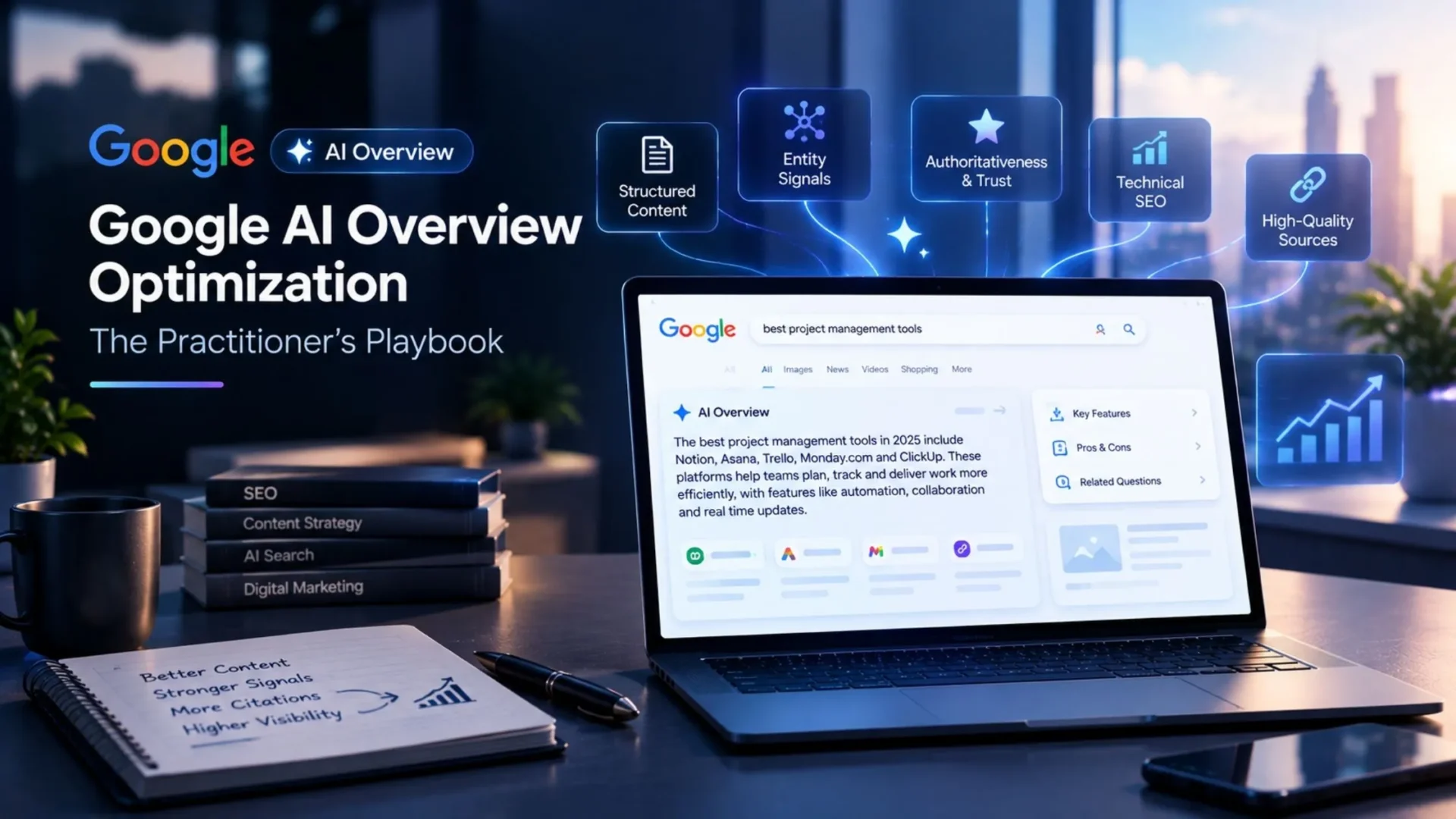
- What Google AI Overviews Are, and What They Aren’t
- The State of AI Overviews in 2026
- Coverage by Query Type
- Coverage by Vertical
- What It Does to Clicks
- How Google AI Overviews Choose Their Sources
- How to Diagnose Your Current AI Overview Visibility
- Optimizing Your Pages for AI Overview Inclusion
- Content Structure Changes
- Word-Level Changes
- Trust and Source Changes
- Content Structure and Formatting Rules
- Technical Setup for AI Overview Visibility
- Signals Beyond Your Site That Move the Needle
- Measurement: The Metrics That Actually Matter
- Sample Weekly Report (Illustrative Numbers)
- Common Mistakes That Cost AI Overview Citations
- Two Short Case Examples
- FAQs
- What is Google AI Overview?
- How do I get my website in Google AI Overview?
- What triggers Google AI Overview?
- Is AI Overview the same as Featured Snippet?
- How do I measure AI Overview visibility?
- Does AI Overview reduce organic traffic?
- Getting Started This Quarter
- Ready for a Second Opinion on Your Visibility?
Paid budget didn’t move. Organic sessions are down 20%. And on most category queries, an AI Overview now sits above all ten blue links. If that’s your Monday dashboard, you’ve already read the explainers. This isn’t another one.
Think of it as a working playbook for AI Overview optimization, written for people who know what an AI Overview is and want to earn citations inside one. You’ll get a free diagnostic you can run today, the on-page and technical changes worth your time, and a measurement setup that keeps citation share separate from traffic. Some of it is firm. Some is an observed pattern. We’ll label which is which.
What Google AI Overviews Are, and What They Aren’t
An AI Overview is Google’s AI-generated section at the top of the results page for suitable queries. It’s drawn from several sources and shows inline links to the pages it drew from. That’s the working definition, and it matters, because most optimization mistakes start with a fuzzy one.
⚠️ It’s Not a Featured Snippet
A featured snippet takes one page’s content. An AI Overview synthesizes several.
⚠️ It’s Not a ChatGPT or Perplexity Answer
Those are different models, different evidence sources, and they list things differently.
⚠️ It’s Not an Assured Result
The type of query determines whether one appears at all.
Coverage continues to expand. Featured snippets or “AI Overviews,” as BrightEdge calls them, showed on about 48% of queries it tracked in Feb 2026 (up from about 31% a year ago), and the rules for inducing them are still playing out. If you’re still wondering what the terms GEO, AEO, and SEO mean, our GEO vs AEO vs SEO comparison should help.
One framing for everything below. To earn citations, you work on three things at once: source authority, extractable content structure, and a match between your page and the query’s intent. Miss one, and the other two won’t rescue you.
The State of AI Overviews in 2026
Before you do anything, learn how much of your keyword set is even exposed. One study will show one thing; other results another. Discrepancies of 2x or more aren’t uncommon here, because panels, query mixes, and dates all differ. Interpret each number as a range from one sample, not a law.
Coverage by Query Type
Coverage by Vertical
What It Does to Clicks
Seer Interactive studied 3,119 informational queries across 42 organizations and reported that organic click-through rate on queries with an AI Overview fell from 1.76% to 0.61% (Search Engine Land coverage, September 2025). Queries without one still slid 41%. Brands cited inside the Overview earned about 35% more organic clicks than brands that weren’t.
Ahrefs estimated in December 2025 that an Overview cuts position-one CTR by about 58%, up from 34.5% in its April 2025 read. Pew Research saw a similar split in user behavior: 8% of visits with an AI summary included a click on a traditional result, against 15% without one.
One more physical fact: BrightEdge found the average Overview to be approximately 1,200 pixels, taller than a typical desktop screen. The first organic result frequently appears below the fold. Public data by lower position ranges is scarce, so we won’t make it up.
So where do you begin? You can expect Overviews on open questions, definitions, “why” and “how” searches, and long conversational searches. Navigational and transactional brand searches rarely trigger them (and that’s still classic SEO’s bag). Start where the search volume is high and your pages are already in competition.
How Google AI Overviews Choose Their Sources
Google’s own straightforward version: nothing special needs to be optimized or marked up; your page needs to be crawled and eligible to be shown with a snippet (Google Search Central). That’s the floor. Everything below it sits on top of that floor and is an observed pattern, not a binding rule.
|
1
|
Organic Ranking Helps, but It Isn’t the GateMany guides say Overviews borrow heavily from top results. BrightEdge’s data says not so much: a notable share of cited sources ranked outside the top 10, and overlap varies from 24% in health to just 11% in finance. Page one isn’t a must-have, though it still seems to carry value. |
|
2
|
Structured, Extractable ContentIn our monitoring, pages with a direct answer under a question-shaped heading get cited more often than narrative pages covering the same ground. |
|
3
|
Entity StrengthBrands mentioned consistently across authoritative sources, and sometimes backed by a Wikipedia entry, appear more often. It’s slow to build. |
|
4
|
FreshnessTopics where facts age fast (pricing, statistics, product specs, news) favor recently updated pages. Evergreen definitions care less. |
|
5
|
Schema MarkupArticle, FAQ, HowTo, and Organization markup tracks with higher citation rates in what we’ve watched. Google says it isn’t required, so call it correlation. Markup that contradicts the visible page is worth avoiding either way. |
|
6
|
Multiple Source ConsensusWhen several credible sources agree on a fact, the Overview tends to state it. Outlier claims rarely survive, even well-written ones. |
An honest note. No public ranking algorithm exists for AI Overviews, and nobody outside Google knows the weights. These patterns come from monitoring AI Overview citations across Elsner’s client portfolio, checked against the third-party studies cited here. Treat them as informed observation.
How to Diagnose Your Current AI Overview Visibility
Try this diagnostic that doesn’t require any paid tools and that anyone can do.
|
1
|
Choose 30 to 50 Priority Queries (10 minutes)Select queries that trigger an Overview and connect to leads or revenue. Vary informational and comparison searches. Avoid direct brand-related questions. |
|
2
|
Check Each One Manually (15 to 25 minutes)Open in an incognito window and record date, place, and device. Log two things: does an Overview show, and is your domain listed? Outcomes vary by session, so one attempt is a snapshot, not a conclusion. |
|
3
|
Sort the Misses (10 minutes)Three buckets: no Overview for that query, Overview shown but you’re not cited, and cited but listed late. |
|
4
|
Study the Winners (10 minutes)For each miss, note the top three cited sources and what they share. Original data? A definition up top? Sheer brand weight? Patterns show up fast. |
|
5
|
Build Your Priority List (10 minutes)Queries where you rank in the top 10, or close to it, but aren’t cited go first. They’re nearest to a win. |
When should you graduate to paid tools? Semrush’s AI Overview tracking, Ahrefs Brand Radar, and seoClarity handle this at scale, and our rundown of the best LLM SEO tools compares the field. Honestly, graduate when manual checks eat more than a couple of hours a week, when you’re tracking past roughly 100 queries, or when three or more stakeholders need recurring reports. Before that, a spreadsheet does the job.
Optimizing Your Pages for AI Overview Inclusion
Changes below are grouped by type. Each play says what to change, what impact to expect, and how to test it. Impact is directional. Nobody can promise a citation.
Content Structure Changes
Answer First
Move the direct answer into the first paragraph and put evidence after it. Expect better odds that a passage can be lifted as written, mostly on definitional and how-to pages. To test: restructure five pages, leave five similar pages untouched as controls, and rerun your diagnostic at four and eight weeks.
Question-Headed Sections
Break long content into H2 blocks that match real queries. “Pricing considerations” becomes “How much does a Shopify migration cost?” Add a one-sentence definition at the top of every conceptual section. The payoff is strongest on long-tail queries. Same test applies. Use lists for step-by-step processes and tables for comparisons.
Word-Level Changes
- Lead with the subject. “Conversion rate optimization is…” beats a windup about the digital marketing world.
- Cut hedges like “it could be argued” and “many experts believe.” They make a passage harder to lift.
- Use the exact query phrasing in H2s where it reads naturally.
Impact: small on any one sentence, noticeable across a full page. Test by rewriting a whole page, not a paragraph.
Trust and Source Changes
Cite primary sources with real links, not aggregators. Show publish and last-updated dates. Add bylines with credentials. Wherever you publish numbers, add a short methodology note. It’s the cheapest bundle of changes here, and it serves two audiences: Google’s quality systems and any editor deciding whether your numbers are safe to repeat. Isolating its effect is hard, so test by cohort: update ten stat-heavy pages and watch whether their citations hold steady over eight weeks.
Content Structure and Formatting Rules
Six rules, each with a quick before and after.
1. The Answer-First Paragraph
Open the page, or each major section, with a 40 to 60 word direct answer. Before: “Platform migrations involve many moving parts and timelines vary.” After: a plain sentence stating the typical range and the two or three factors that stretch it.
2. Question-Headed H2s
Match the actual People Also Ask phrasing where you can. Before: “Our approach to timing.” After: “How long does a platform migration take?”
3. Comparison Tables
In the pages we monitor, tables get cited more often than the paragraphs around them. Before: three paragraphs comparing plans. After: one table with plan, best fit, and main limitation.
4. Numbered Lists for Processes
Step-based content is what HowTo-style Overviews pull. Before: a chain of “first you’ll want to, then you should.” After: numbered steps, one action each.
5. Definition Lists for Concepts
The <dl>, <dt>, and <dd> elements pair a term with its meaning unambiguously. Google doesn’t require them. Clean markup just extracts cleanly.
6. Semantic HTML
One H1, a logical H2 to H6 order, valid schema, and no critical content trapped in images or late-loading JavaScript. Before: a pricing table saved as a PNG. After: a real HTML table.
Full Rewrite Example (Illustrative)
Before — a typical narrative paragraph
“When you’re thinking about moving to a new ecommerce platform, there are a lot of things to weigh. Some teams find it takes a little while, while others get it done quickly, and a lot depends on how big the catalog is, whether there’s custom functionality, and how much SEO equity is at stake.”
After — the same content built for extraction
“A mid-sized store migration usually takes several weeks, not days. Three factors move the timeline most:
- Catalog size and data cleanliness
- Custom functionality that must be rebuilt
- Redirect volume needed to protect existing rankings
Stores with all three risks should plan for the longer end.”
Same facts. The second version gives an Overview something it can quote without rewriting.
Technical Setup for AI Overview Visibility
Google says nothing technical is required beyond indexing and snippet eligibility. These items are hygiene that supports it, plus a few that matter more for other answer engines.
✅ Schema Markup Priorities
For most content types, work in this order: Article, FAQPage, HowTo, Product, Organization. One caveat: Google scaled back FAQ and HowTo rich results in 2023, so don’t expect visual SERP perks. The markup still describes your page structure to machines. On store pages, schema pairs well with solid product data, and our WooCommerce product SEO guide shows how that looks in practice. Magento teams can start with our Magento SEO services page.
✅ Crawlability and Indexability
Check robots.txt, CDN rules, and noindex tags first. Then look at Bing. Bing coverage matters more than most SEOs assume because other AI products draw on Bing-sourced results. That’s a coverage play for non-Google engines, not an AI Overview lever. Submit your sitemap in Bing Webmaster Tools and consider IndexNow.
⚠️ The LLMs.txt File
A proposed standard that points language models toward your canonical pages. Adoption is patchy, and Google has said it doesn’t use it for Search. Cheap to publish, unproven to help. Label it an experiment and keep your page work unchanged.
✅ Core Web Vitals
Fast, stable pages seem to get cited more than slow ones on the same topic, all else equal. Treat it as a tiebreaker.
✅ Structured Data Validation
Run every template through Google’s Rich Results Test and the Schema Markup Validator. Fix errors before adding new types.
✅ Image Optimization
Overviews sometimes surface images. Descriptive alt text and image markup help.
Illustrative example, not a client result: imagine a service page with strong rankings but no structured answers. The team adds a short FAQ block, matching FAQPage markup, and a refreshed intro. Within about 60 days, it moves from cited nowhere to cited in three related Overviews. Plausible, and consistent with what we see, but structure, not markup alone, likely did the work. If you want help applying this across a large site, our generative engine optimization services cover the technical layer.
Signals Beyond Your Site That Move the Needle
On-page work has an end goal, and that’s your brand strength. Go beyond the page here, because no neat markup can fix a brand that Google doesn’t know.
Wikipedia and Wikidata
A well-sourced Wikipedia page, if your brand passes the notability guidelines, is potentially the most valuable piece of content for citation. Never create your own or fake one in its absence.
High-Authority Mentions
Our rule of thumb: five placements in top-tier publications per quarter beat fifty low-tier guest posts. Quality, not volume. A single mention in a respected trade outlet that names what you do, in plain words, tends to teach the entity graph more than a dozen generic bylines.
Consistent Brand Descriptions
Your homepage, LinkedIn, Crunchbase, and directory listings should describe you the same way. Inconsistency muddies the entity graph. Calling yourself a “digital agency” in one place and an “ecommerce consultancy” in another sounds minor. It isn’t.
Reviews on Structured Platforms
G2, Capterra, TrustRadius, and Trustpilot get crawled heavily. Recent, detailed reviews carry more weight than an old star rating. Ask happy clients to name the problem you solved. Specifics get quoted; “great team” doesn’t.
Budget realistically. Work beyond your site compounds over 6 to 18 months, not weeks, and it’s the first line item executives want to cut. Hold the line.
Measurement: The Metrics That Actually Matter
Traffic alone will mislead you here. Track these instead.
- AI Overview appearance rate: the share of your priority queries that now serve an Overview. Check weekly.
- Citation share: of those Overviews, the percentage citing your domain. This is the primary KPI.
- Position in the citation list: cited first and cited third don’t earn the same clicks.
- Brand search lift: Overview referral traffic is small. The bigger signal is branded search growth 6 to 12 weeks after citation share improves.
- Sentiment and accuracy: being cited with an outdated or wrong description hurts more than not being cited. Audit monthly.
What to stop tracking? Featured snippet wins, in our view. For most commercial queries, they’re now a weaker signal than Overview citation. Don’t conflate the two.
Sample Weekly Report (Illustrative Numbers)
If you run a WooCommerce store, our WooCommerce SEO services team can wire this reporting into your existing analytics.
Common Mistakes That Cost AI Overview Citations
|
1
|
Skipping the BasicsIf a page isn’t indexed or is blocked from snippets, nothing else matters. |
|
2
|
Rewriting Everything Into Thin Q&AIt hurts overall content quality, and quality is still the thing Google rewards. |
|
3
|
Ignoring Entity Work Beyond Your SiteOn-page tweaks won’t close a large brand gap. |
|
4
|
Treating This as a One-Time ProjectOverviews change monthly. Your cycle should too. |
|
5
|
Confusing a Traffic Drop With a Visibility DropClicks fall even when you’re cited. Quitting before brand search lift appears is the costliest version of this mistake. |
|
6
|
Copying Competitor Citations BlindlyUnderstand why a source is cited before you imitate it. Sometimes it’s the data. Sometimes it’s the brand. |
Two Short Case Examples
This work sits inside our broader GEO program work, delivered in tiers that match your catalog size and team capacity.
FAQs
What is Google AI Overview?
It’s an AI-generated answer block shown at the top of Google results for eligible queries. It combines information from several sources and links to the pages it used.
How do I get my website in Google AI Overview?
There’s no guaranteed method. Google says a page must be indexed and eligible to show with a snippet. Beyond that, answer-first structure, strong entity signals, fresh data, and clear sourcing improve your odds.
What triggers Google AI Overview?
Query type is the biggest factor. “Why,” definition, how-to, and long conversational questions trigger most often, while brand and transactional searches rarely do. Coverage also varies sharply by industry.
Is AI Overview the same as Featured Snippet?
No. A Featured Snippet quotes one page. An AI Overview synthesizes several sources and can cite many pages. Winning one doesn’t mean you’ll win the other.
How do I measure AI Overview visibility?
Track a fixed set of priority queries weekly. Log whether an Overview appears, whether you’re cited, and in which position. Add brand search lift as the downstream signal.
Does AI Overview reduce organic traffic?
On average, yes. Seer, Ahrefs, and Pew all found lower click rates when an Overview appears. The size of the drop depends on query type, position, and whether you’re cited.
Getting Started This Quarter
Three moves for the next 30 days. First, run the 30-query diagnostic from the section above. Second, rewrite three high-priority pages using the structure rules covered earlier. Third, name five publications where a mention would strengthen your entity signal, and start pitching.
AI Overview optimization compounds. It isn’t a one-quarter project. The teams that treat it as a monthly cycle are the ones whose citation share keeps climbing while everyone else is still debating whether it’s real.
Ready for a Second Opinion on Your Visibility?
Our team builds and monitors AI Overview programs for ecommerce, SaaS, and services brands — citation share, entity work, and reporting wired into your analytics.