



- What Is Agentic Software Development?
- AI-Assisted vs AI-Native Development
- Why Is Software Development Becoming Agentic?
- AI Coding Agents Are Moving Beyond Autocomplete
- Coding Is Becoming Faster Than Verification
- Software Teams Need More Context, Not Just More AI
- AI Is Moving From Assistant to Collaborator
- Agentic Software Development Lifecycle: What Changes at Each Stage?
- 1. Planning and Discovery
- 2. Requirements Engineering
- 3. Architecture and System Design
- 4. Coding and Implementation
- 5. Testing and Quality Assurance
- 6. Code Review
- 7. Security and Compliance
- 8. CI/CD and Deployment
- 9. Monitoring and Maintenance
- 10. Continuous Improvement
- Traditional SDLC vs AI-Native SDLC
- What Are the Benefits of Agentic Software Development?
- Challenges and Risks of Agentic Software Development
- What Is the Role of Developers in Agentic Software Development?
- How Businesses Can Adopt an Agentic Software Development Approach
- A Three-Question Readiness Test
- How to Measure the Success of Agentic Software Development
- What Does the Future of Agentic Software Development Look Like?
- Key Takeaways
- Frequently Asked Questions
Ask an engineering manager where the week goes, and the answer has changed. Not long ago it was typing the function, the endpoint, and the tests. Now a coding agent can read a repository, edit multiple files, run the test suite, and open a pull request before standup ends. The result is a different software development question: when code generation accelerates, which parts of the lifecycle become the new bottlenecks?
Quick Answer
Agentic software development, often discussed as an AI-native software development approach or agentic SDLC, builds AI into the software development lifecycle from planning and requirements through coding, testing, deployment, and maintenance. Humans keep ownership of goals, architecture, business decisions, security, and risk. AI handles repeatable execution inside defined guardrails, while testing, review, governance, and feedback loops are redesigned to keep pace with faster software production.
The shift is bigger than adding an AI coding assistant. Traditional software development has people doing most of the work. AI-assisted development adds AI to individual tasks. AI-augmented development spreads AI across several activities while the existing process stays mostly intact. Agentic software development goes further by redesigning the workflow around human and AI collaboration. The practical objective is not to remove engineering discipline, but to make planning, specifications, validation, security, and operations capable of handling a higher volume of machine-generated work.
This guide explains what changes at each stage of the lifecycle, where AI agents create leverage, where they introduce risk, how the developer role is changing, and how businesses can adopt the model without gambling their codebase. The approach is also closely connected to AI agent development services when an organization needs custom agents that operate inside real engineering workflows.
90%
Professional developers surveyed by JetBrains reported using AI coding agents at work at least weekly between May and July 2026.
Source: JetBrains Developer Ecosystem Survey 2026
68%
Share of those surveyed developers who reported using coding agents every day.
Source: JetBrains Research
What Is Agentic Software Development?
Agentic software development is the practice of deliberately integrating AI agents into the software development lifecycle rather than treating AI as a single coding assistant. People set goals, define constraints, make consequential decisions, and remain accountable. AI performs repeatable execution inside the guardrails the engineering team establishes.
You will also hear this described as AI-native software development or the agentic SDLC. The labels point to the same broader shift: AI participates across stages, written context becomes an input to engineering work, validation becomes more important as output volume rises, governance happens during execution, and production feedback can flow back into planning.
- AI participates across stages, not just in coding.
- Humans stay accountable for decisions that require judgment.
- Specs, standards, architecture notes, and acceptance criteria become usable context for agents.
- Testing and validation increase because software output can increase faster.
- Governance is enforced during execution rather than treated as a late review.
- Production feedback can flow back into requirements and planning.
- Handoffs can be triggered by durable artifacts instead of relying only on meetings.
The word native matters. Cloud-native software was not simply a traditional data center with a few servers moved into the cloud. It was designed around the capabilities and constraints of the cloud. The same principle applies here. Dropping an agent into a workflow designed around humans typing every line may produce faster typing without removing the original bottlenecks. Redesigning the workflow can produce a different operating model, but it requires more engineering discipline than simply buying a tool.
AI-Assisted vs AI-Native Development
| Area | AI-Assisted | AI-Native / Agentic |
|---|---|---|
| Workflow | Human-led with AI helping individual tasks | Human and AI work across the lifecycle |
| AI role | Autocomplete, chat, snippets | Agents plan, edit, test, report, and iterate |
| Human role | Writes most code | Sets intent, reviews output, owns decisions |
| Handoffs | Tickets and meetings | Artifacts trigger the next step |
| Testing | Mostly hand-authored | Generated and run continuously |
| Governance | Periodic review gates | Enforced as AI acts |
| Decisions | Individual judgment | Human judgment recorded in durable artifacts |
Why Is Software Development Becoming Agentic?
Four forces are pushing software teams toward a more agentic development model.
AI Coding Agents Are Moving Beyond Autocomplete
Early AI coding tools were primarily completion systems. Current coding agents can read a repository, change several files, run commands, inspect errors, and iterate. That is a different category of capability because the tool is no longer waiting for a developer to specify every small action. It can execute a multi-step task within a defined scope.
JetBrains research also shows that adoption is moving quickly. Claude Code use among surveyed developers rose from 18 percent in January 2026 to about 39 percent by mid-year, while Codex rose from 3 percent to 16 percent. The exact percentages are survey-specific, but the direction matters: agentic coding tools are becoming part of normal engineering workflows.
Coding Is Becoming Faster Than Verification
The 2025 DORA research, based on responses from nearly 5,000 professionals, found that AI adoption correlated with higher delivery throughput while also correlating with higher delivery instability. The practical lesson is not that AI is bad for engineering. It is that additional output needs stronger validation. More code without more testing, review, and security simply increases the amount of software that can fail.
This is one of the most important ideas in agentic software development. If coding is no longer the slowest part of the process, organizations need to identify the new constraint instead of measuring success only by how quickly code appears.
Software Teams Need More Context, Not Just More AI
An agent cannot reliably follow a business rule that nobody documented. Requirements, architecture notes, coding standards, security policies, acceptance criteria, build commands, and deployment rules need to exist somewhere the agent can read them. Microsoft has described the risk of losing meaning between handoffs as translation loss. Agentic workflows reduce that loss by turning important context into durable artifacts.
This is also why documentation becomes operational infrastructure. In a traditional process, a missing architecture note may inconvenience a developer. In an agentic process, the same omission can cause an agent to generate a plausible implementation that violates a constraint nobody wrote down.
AI Is Moving From Assistant to Collaborator
Research into intent-first software engineering points toward a model where developers express goals and constraints while AI systems produce candidate implementations. Concepts such as Software Engineering 3.0 remain research directions rather than established industry standards, but they are useful for understanding where agentic development may go.
Anthropic’s AI-native SDLC work makes the operational consequence clearer: when build speed increases while planning, review, testing, and deployment stay unchanged, those surrounding stages become the bottleneck. The answer is not to slow the agent by default. It is to redesign the system around the new production rate.
Build the Right AI Development Workflow
If your team is evaluating AI coding agents or a broader agentic SDLC, start with the workflow, controls, and business outcome before choosing the tools.
Agentic Software Development Lifecycle: What Changes at Each Stage?
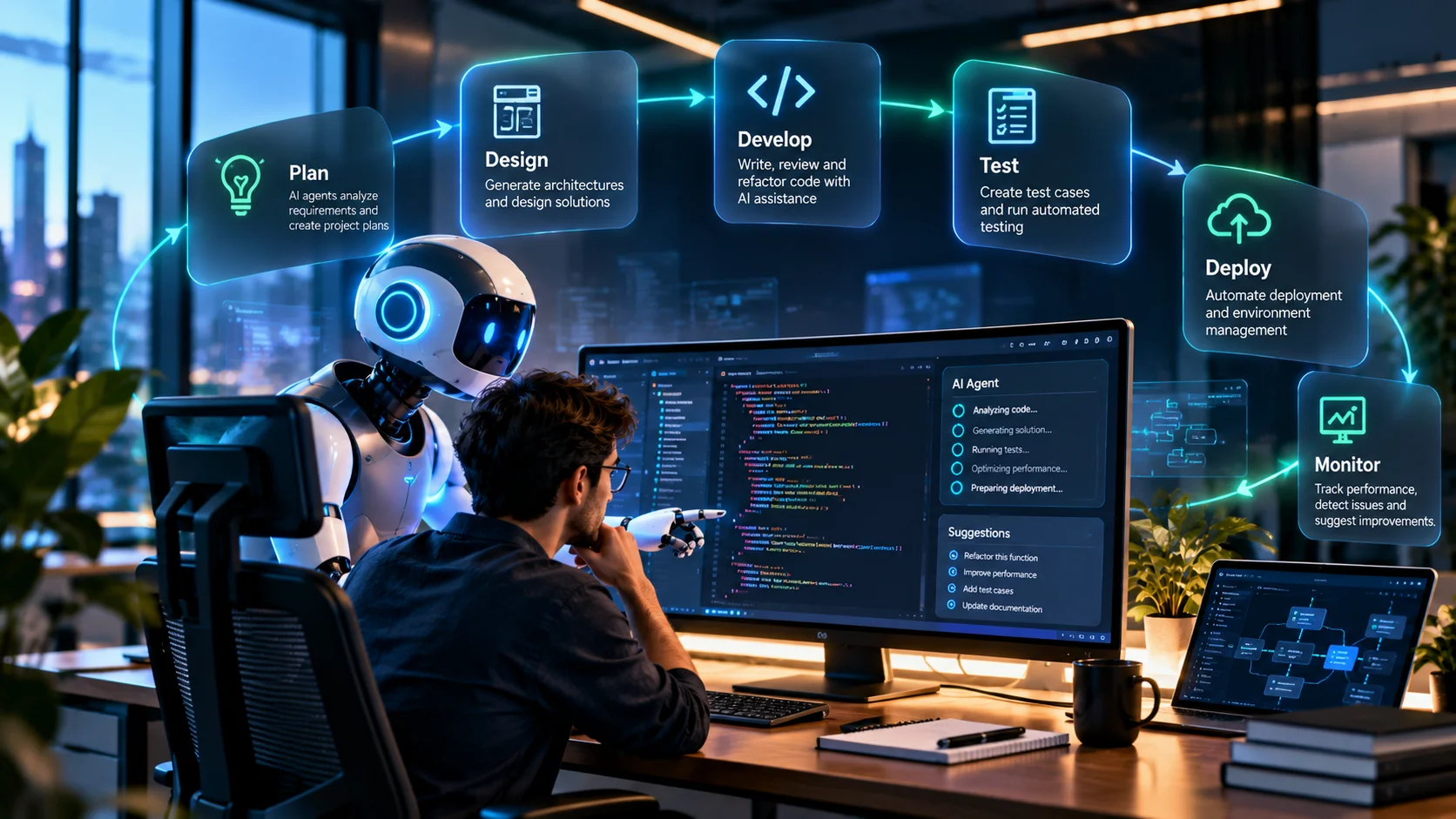
The most useful way to understand agentic software development is to follow the lifecycle from the first idea to continuous improvement. Across all ten stages, the pattern is consistent: AI can handle more volume, while a person owns the decision that carries business or technical risk.
1. Planning and Discovery
Imagine a claims operations lead who suspects that a large share of call time goes to repetitive status questions. AI can read months of support tickets, call notes, and customer feedback, cluster recurring problems, and surface edge cases that a short workshop might miss. That can make discovery faster and broader.
Prioritization still needs human ownership. Contract obligations, margin, customer impact, roadmap commitments, and organizational constraints may not exist in the source material the model analyzed. Let AI inform the ranking, but do not let it silently become the product owner.
Early uses include summarizing support tickets into ranked themes, checking a feature idea against past incidents, and turning a rough founder brief into a first draft of scope and open questions. Each output should be treated as a starting point for human review.
2. Requirements Engineering
AI can draft user stories, sharpen acceptance criteria, identify contradictions, and list edge cases. The bigger change is spec-driven development, where a structured specification becomes a shared source of truth for humans and AI before code and tests are generated.
Microsoft’s 2026 guidance on spec-driven development emphasizes the connection between specification quality and output quality. Not every change needs a heavyweight process, but important features benefit from explicit requirements, acceptance criteria, constraints, and open questions.
In practice, the person closest to the business problem can describe the requirement in plain language, the AI can turn it into a structured specification, and the product owner can correct it before implementation begins. This reduces interpretation loss between product and engineering.
3. Architecture and System Design
AI can compare API designs, database models, dependency maps, scalability options, and legacy-system structures. It can also inspect a codebase and explain undocumented relationships that would otherwise take engineers significant time to reconstruct.
Architecture remains a human accountability point. An AI can propose a monolith, microservices, event-driven design, or another pattern, but it cannot own the consequences of that choice. Large-system behavior also does not always follow the assumptions that look reasonable in a small example.
A useful practice is to ask the agent to argue against its own architecture proposal. What could this break? Which dependency is riskiest? Which alternative did it reject and why? Recording those answers creates a decision trail instead of leaving architecture as an undocumented model response.
4. Coding and Implementation
This is the stage most teams associate with AI. Agents can generate code, make multi-file changes, refactor modules, write documentation, perform migrations, and create pull requests. Examples include Claude Code, OpenAI Codex, GitHub Copilot agent features, Cursor, and Gemini Code Assist.
The tool matters less than the workflow around it. A strong pattern is plan first, code second. Have the agent inspect the relevant repository context and produce a plan naming files, dependencies, implementation order, and tests. A developer reviews the plan before code is written.
Repository instruction files can capture build commands, test commands, conventions, architecture notes, and recurring corrections. Parallel agent work can increase throughput, but only when changes are isolated enough to review properly. The limiting factor is not how many agents can run. It is how many outputs the team can genuinely verify.
5. Testing and Quality Assurance
More generated code demands more systematic validation. AI can write unit and integration tests from specifications, identify edge cases, repair brittle tests, and explain why a regression suite failed.
One rule matters: give the agent a reliable way to check its own work through a test command, build, lint process, or screenshot comparison. Also avoid letting the same agent both introduce a critical fix and redefine the test that proves the fix.
Independent verification becomes more valuable. A second agent with fresh context or a human-written acceptance test can catch an incorrect assumption shared by the first agent and its generated tests. This is where strong QA and testing practices continue to matter even when more test generation is automated.
6. Code Review
Reviewing every line by hand made sense when a colleague wrote the code. When agents generate larger diffs, AI can perform a first review by summarizing the pull request, identifying likely bugs, flagging security concerns, and checking the change against the implementation plan.
Human reviewers should focus on what machines handle less reliably: business logic, architectural fit, risk, maintainability, and whether the change should exist at all. Review becomes less about reading syntax line by line and more about evaluating intent and consequences.
A practical order is to read the plan first, then the tests, then the diff. If the tests do not prove the plan, the diff is not ready for approval. This approach keeps review focused on the requirement instead of getting lost in details the agent happened to implement correctly.
7. Security and Compliance
Security cannot remain a final-stage check when code can be produced rapidly. AI-assisted security workflows can scan changes, identify dependency risks, flag secrets, detect insecure patterns, and propose fixes for human review.
The control surface also becomes larger. Teams need to consider prompt injection, agent permissions, credential exposure, untrusted content, and auditability. Every meaningful agent action should be attributable, and compliance rules should be enforced by workflow controls where possible.
For regulated environments, the evidence layer matters. Teams may need to know which model or agent touched a change, under whose identity, and with what approval. Logged sessions, committed artifacts, branch protection, scoped permissions, and denied network access can provide stronger controls than instructions inside a prompt.
8. CI/CD and Deployment
Pipeline work involving judgment can be a useful agentic target. Agents can triage failed builds, draft release notes, inspect configuration, estimate deployment risk, and prepare rehearsed rollback actions.
Autonomy should scale by environment. Development can allow more freedom, staging can require supervision, and production can remain gated by a named approver. Fully autonomous deployment is not appropriate for every organization, especially where regulatory or financial risk is high.
A sensible starting point is read-only assistance. Let the agent triage failures and draft changelogs before allowing it to perform write actions. Use short-lived credentials, avoid standing production access, and rehearse rollback paths before relying on them.
9. Monitoring and Maintenance
Agents can watch for anomalies, read logs, investigate root causes, update stale documentation, and identify technical debt. A safer pattern is to keep detection deterministic, with scripts or monitoring systems watching thresholds, and involve the AI after a threshold has been crossed.
Once a threshold trips, the agent can correlate logs with recent deployments, summarize likely causes, and produce a structured incident report. A human decides whether to fix the issue immediately, schedule it, or dismiss it. Those decisions can then improve thresholds and reduce noise.
The same pattern works for technical debt. An agent can identify duplicated logic, aging dependencies, or recurring maintenance problems. The engineering team decides which items deserve a sprint and which can remain on the backlog.
10. Continuous Improvement
Agentic development turns the lifecycle into a loop. Production feedback becomes analysis, analysis becomes requirements, then development, testing, deployment, monitoring, and back to learning.
Every meaningful incident should produce a permanent improvement where possible. That may be a new test, a better acceptance criterion, an architecture note, a monitoring rule, or a repository instruction. The goal is to prevent the same class of failure from returning unnoticed.
The pattern behind all ten stages is durable handoff. Each stage ends by writing something down, such as an intent note, specification, plan, diff with tests, or review record. The next stage starts by reading it. Those artifacts also become an audit trail.
Traditional SDLC vs AI-Native SDLC
| Area | Traditional SDLC | AI-Native SDLC |
|---|---|---|
| Planning | Human-led workshops | Human decisions supported by AI analysis |
| Requirements | Written and interpreted manually | AI-refined specifications with human approval |
| Architecture | Human-designed | AI-explored, human-owned |
| Coding | Mostly human | Humans plus agents |
| Testing | Mostly hand-authored | Generated and continuous |
| Code review | Human-centric | AI first pass, human sign-off |
| Security | Periodic checks | Continuous scanning and controls |
| Deployment | Scripted pipelines | Pipelines with controlled AI judgment steps |
| Maintenance | Reactive | Proactive, threshold-triggered |
| Feedback | Periodic | Continuous |
This table should be read as a spectrum, not a forced migration. Most organizations will operate between the two columns for a long time. Traditional engineering practices are not obsolete. Version control, architecture, testing, security, and accountability still matter because AI changes how software gets produced, not the need to engineer it against business goals.
Regulated teams may deliberately keep human review on every change to high-risk code. That is not necessarily a failure to modernize. It can be an appropriate control decision. Agentic development should concentrate human attention where the risk is highest rather than trying to maximize autonomy everywhere.
What Are the Benefits of Agentic Software Development?
The benefits are meaningful, but broad productivity claims should be treated carefully. Research often combines self-reported productivity with delivery metrics, and results vary with architecture, codebase quality, tooling, and review maturity. The most durable benefits are practical.
- Faster development cycles: The build phase can compress when planning and review keep pace.
- More output per engineer: Engineers can steer several bounded workstreams instead of manually executing every repetitive step.
- Faster prototyping: Working prototypes can make product and MVP decisions more concrete.
- Better test coverage: Tests can be created alongside implementation instead of being postponed under deadline pressure.
- Faster documentation: Agents can update technical documentation as part of normal changes.
- More practical legacy modernization: Repetitive, well-defined migration work can be a strong fit for coding agents.
- Continuous feedback: Production signals can reach planning faster.
- Better use of engineering expertise: Senior engineers can spend more time on architecture, judgment, and difficult technical decisions.
Case-level evidence can be useful without becoming a universal benchmark. For example, Microsoft has described a brownfield engineering use case where a team reduced the onboarding time for a new asset type from roughly two to three weeks to a few days by capturing a repeatable pattern in parameterized specifications. Results will vary by task, codebase, tooling, and review maturity.
The broader lesson is that AI tends to amplify the system around it. Teams with loosely coupled architectures and fast feedback loops are better positioned to turn additional generation capacity into delivery value. If deployment takes weeks and the test suite is unreliable, an agent may simply create more changes waiting in the queue. That is why product modernization and AI adoption can belong on the same roadmap.
Challenges and Risks of Agentic Software Development
Speed has a bill attached. The faster a system can generate changes, the faster it can generate incorrect changes. The goal is not to avoid agents, but to build the controls that keep increased output useful.
Defects and Technical Debt
AI-generated code can be wrong in convincing ways. Faster generation can make technical debt accumulate faster unless testing, architecture review, and cleanup are treated as part of the same workflow.
Context Limits
Agents work from what they can see. Missing business rules, undocumented architecture, and unwritten security constraints can produce plausible but incorrect output, especially in large codebases.
Security Exposure
Generated code can introduce vulnerabilities. Agents with broad permissions or exposed credentials add new attack surface, while prompt injection becomes important when agents read untrusted content.
Over-Reliance and Skill Shifts
The risk is not only blind trust. Teams also need to preserve the ability to evaluate code critically. As agents absorb starter tasks, organizations need deliberate ways to build engineering judgment through reviews, ownership, and mentoring.
Governance and Accountability
Every meaningful agent-generated change needs a clear owner. If nobody can answer who approved a change or under what conditions an agent was allowed to act, governance becomes a weak point.
Review Bottlenecks, Tool Sprawl, and Cost
Reviewers can become overloaded when output volume rises. Teams can also accumulate overlapping tools with inconsistent policies, while usage-based pricing can create unexpected costs.
A Useful Operating Principle
Agentic development does not mean AI-autonomous development. The objective is to increase engineering leverage while keeping verification, security, and accountability strong enough to support the new rate of change.
What Is the Role of Developers in Agentic Software Development?
Will AI replace software developers? Current evidence points more strongly to redistribution of work than disappearance. Typing becomes less central while judgment becomes more important. As agents absorb mechanical work, developers spend more time on problem framing, requirements, architecture, agent orchestration, code review, testing strategy, security, product understanding, and technical decisions with business consequences.
- Problem framing, requirements, and product understanding
- Architecture and systems thinking
- Directing and orchestrating AI agents
- Reviewing output, test strategy, and security
- Technical decisions that carry business consequences
Research concepts such as intent-driven engineering describe a future where developers express goals and constraints while AI teammates produce candidate software. The timing and final form of that model remain uncertain. What is already clear is that weak fundamentals become more visible when agents accelerate execution. Developers who cannot read a diff critically or reason about system behavior will struggle more with agentic workflows, not less.
A mid-level engineer may now review several agent sessions, correct an implementation plan, and write acceptance tests for a feature while still handling the difficult code personally. The role starts to resemble technical leadership in some respects. Hiring and training therefore need to put more weight on reading code, writing specifications, understanding failure modes, and reasoning about systems.
How Businesses Can Adopt an Agentic Software Development Approach
The safest path is incremental. Start with a bounded use case, establish controls, measure outcomes, and expand only when testing and review can keep up. Businesses that need a roadmap can also use AI strategy consulting to connect experimentation with broader business and technology priorities.
1. Identify high-value use cases
Pick one painful, well-bounded workflow such as a legacy migration, repetitive refactor, test backlog, documentation task, or constrained feature implementation.
2. Audit the existing SDLC
Find where work waits. Those waiting points are where additional AI-generated output may simply queue up.
3. Define AI responsibilities
Write down what agents may do, what requires approval, and what is off limits.
4. Establish engineering standards
Document coding conventions, branching rules, review expectations, and the definition of done.
5. Create context and documentation
Give agents access to relevant architecture notes, commands, conventions, acceptance criteria, and recurring corrections.
6. Introduce AI coding agents
Start with one or two engineers and use plan-first workflows before increasing autonomy.
7. Strengthen automated testing
Agents are only as safe as the checks they run against. Build reliable tests before scaling output.
8. Add security and governance controls
Use scoped permissions, secret protection, logged actions, branch protection, and explicit approval gates.
9. Measure outcomes
Track delivery and quality outcomes rather than activity such as prompt counts or AI-generated files.
10. Scale gradually
Expand to additional teams only when review, testing, security, and operational controls are keeping pace.
A Three-Question Readiness Test
Before Giving a Task to an Agent
Ask three questions: Can we verify the result in minutes with a test, build, or screenshot? Is the required context written down where the agent can read it? Who owns the risk if the result is wrong? A no or a nobody means the workflow needs work before the agent gets the task.
Some situations justify external engineering support, including complex legacy systems, enterprise integrations, AI architecture, strict security requirements, large modernization programs, and custom AI applications. In those cases, a partner with custom software development expertise can help connect the AI workflow to the systems around it rather than treating the agent as an isolated tool.
A realistic pilot can last six to ten weeks. The first two weeks can focus on selecting the use case, preparing repository context, and establishing a baseline. The next four can run the agent against real work with plan-first workflows and mandatory human review. The final period can compare results with the baseline and decide whether to expand, adjust, or stop. Stopping is a legitimate outcome when the evidence says the use case is not ready.
How to Measure the Success of Agentic Software Development
Lines of code, prompt counts, and the number of AI-generated files measure activity. Activity is not the same as engineering value. Use outcome metrics instead.
- Deployment frequency and lead time for changes
- Change failure rate and escaped defects
- Defect rates and test coverage
- Review time per pull request
- Development cycle time
- Incident resolution time
- Developer time saved, ideally measured through a short recurring survey
- Customer outcomes such as task completion, support volume, or product reliability
Read metrics in pairs. Rising deployment frequency next to rising change failure rate is not an improvement. It is a warning that output is increasing faster than verification. Reviewer hours per merged change can also reveal verification debt. If cycle time falls while review effort climbs sharply, the organization may be borrowing from future engineering capacity.
Baseline before the pilot. Without pre-adoption numbers for cycle time, review time, and change failure rate, later claims become anecdotes. Metrics should help teams ask better questions in retrospectives rather than become simplistic targets for individuals.
What Does the Future of Agentic Software Development Look Like?
The following trends should be treated as direction rather than settled industry standards. The tooling is changing quickly, but several patterns are already visible.
- Multi-agent workflows: Separate agents can handle building, verification, testing, or security analysis, with independence used intentionally to reduce shared blind spots.
- Spec-driven development: Specifications become durable artifacts that guide both people and agents, while code becomes an output of the specification.
- AI-powered testing and security agents: Validation and security checks move closer to every change instead of waiting for periodic review.
- Intent-driven development: Research concepts point toward expressing goals and constraints at a higher level while AI produces candidate implementations.
- Human-AI engineering teams: Development environments become designed around agents from the start instead of adding agents to workflows built for manual coding.
Important questions remain open. Will specifications or code become the primary engineering artifact? How much review autonomy will regulators accept? How will organizations control costs when agent usage becomes deeply metered? Nobody knows yet. A sensible strategy is to build durable principles around accountability, verification, context, and security rather than betting the organization on one tool.
Key Takeaways
- Agentic software development goes well beyond adding a coding assistant.
- AI can participate across the SDLC, from planning and requirements to maintenance.
- Faster coding increases pressure on testing, review, security, and deployment.
- Written context and clear specifications become more valuable as agents take on more execution.
- Human oversight remains essential because accountability cannot be delegated to a model.
- Security and governance need to run inside the workflow rather than appearing only at the end.
- Developers are moving toward architecture, review, orchestration, and higher-value engineering judgment.
- Businesses should adopt agentic development gradually, measure outcomes, and scale only when verification keeps pace.
Frequently Asked Questions
What is agentic software development?
Agentic software development is an approach that integrates AI agents across the software lifecycle, from planning and requirements through coding, testing, deployment, and maintenance. Humans own goals, architecture, and risk, while AI handles repeatable execution inside defined controls.
How is agentic software development different from AI-assisted development?
AI-assisted development uses AI to accelerate individual tasks such as autocomplete, code suggestions, or snippets. Agentic development redesigns the workflow around human and AI collaboration, including specifications, testing, security, review, deployment, and feedback loops.
How does AI change the software development lifecycle?
It moves the bottleneck. Coding can become faster, so planning, review, testing, security, and deployment become more important constraints. Teams respond with better written specifications, automated validation, AI-assisted review, continuous security controls, and tighter production feedback loops.
Will AI replace software developers?
Current evidence points more toward changing responsibilities than eliminating the profession. Developers spend less time on repetitive implementation and more time on architecture, requirements, review, security, orchestration, and decisions with business consequences. Engineering judgment remains important.
What are AI coding agents?
AI coding agents are tools that can inspect a codebase, plan changes, edit multiple files, run commands and tests, interpret errors, and iterate. Unlike simple autocomplete, they can complete multi-step engineering tasks within a defined scope.
What are the biggest risks of agentic software development?
The main risks include defects and technical debt, missing context, security vulnerabilities, unclear accountability, excessive permissions, review bottlenecks, tool sprawl, and unexpected costs. Strong testing, scoped access, audit trails, and human approval reduce these risks.
How can businesses adopt agentic software development?
Start with one bounded use case, audit the current SDLC, document engineering context, define agent responsibilities, strengthen automated testing, add security and governance controls, and measure outcomes such as cycle time and change failure rate. Scale only when verification keeps pace.
Planning an Agentic Software Development Rollout?
Elsner can help review your current SDLC, identify where AI agents can create measurable value, define the right controls, and map a practical pilot around your existing systems.
Recommended Elsner Resources