



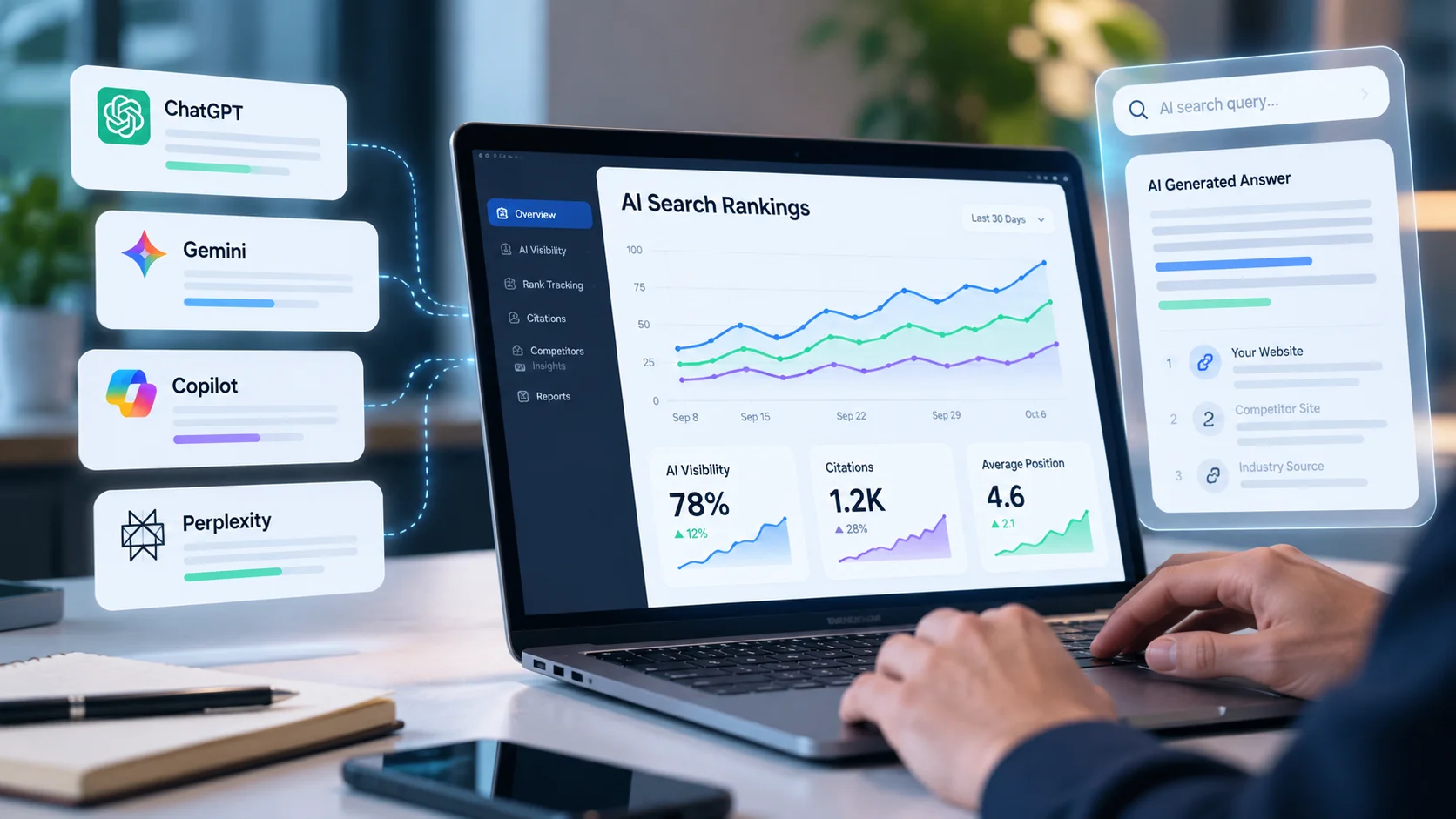
- What Is AI Rank Tracking?
- Why AI Rank Tracking Matters for Businesses
- AI Rank Tracking vs. Traditional SEO Rank Tracking
- 7 AI Search Metrics Businesses Should Track
- How to Build an AI Rank Tracking Framework
- Step 1: Start With Real Buyer Questions
- Step 2: Create a Stable Prompt Set
- Step 3: Establish a Baseline
- Step 4: Track Competitors at the Same Time
- Google Search Console and AI Search Performance
- What AI Rank Tracking Tools Can and Cannot Tell You
- Why “AI Position” Is Not Always a Real Ranking
- How to Turn AI Rank Tracking Into SEO Actions
- Need a Clearer View of Your AI Search Visibility?
- How Often Should You Track AI Rankings?
- Build an AI Search Visibility Dashboard
- AI Rank Tracking Mistakes to Avoid
- How AI Rank Tracking Supports Content Strategy
- How to Connect AI Visibility With Business Results
- A Practical 90-Day AI Rank Tracking Plan
- AI Rank Tracking Checklist
- Key Takeaways
- Frequently Asked Questions
- What is AI rank tracking?
- How is AI rank tracking different from traditional SEO rank tracking?
- What metrics should businesses track in AI search?
- Can businesses track AI rankings across ChatGPT, Gemini, and Perplexity?
- Does Google Search Console help with AI search tracking?
- Does structured data guarantee AI visibility?
- How often should AI rankings be tracked?
- Can AI rank tracking replace traditional SEO tracking?
- Want to Improve Your AI Search Visibility?
Search visibility used to be relatively easy to measure. A business could track a keyword, check where its page appeared in Google, compare the position with competitors, and monitor changes over time. Generative search is changing that model.
A potential customer may now ask ChatGPT, Google AI Mode, Gemini, or Perplexity to compare companies, recommend software, explain a technical problem, or identify the best provider for a specific requirement. Instead of receiving a simple list of links, the user may receive a synthesized answer containing several brands, sources, recommendations, and citations.
That creates a new measurement challenge. A company can rank well for traditional keywords but remain absent from important AI-generated answers. Another company may receive relatively little direct traffic from AI platforms while becoming increasingly visible during high-intent research journeys.
Quick Answer
AI rank tracking is the process of monitoring how a brand, website, product, or competitor appears across generative search experiences over time. Unlike traditional keyword rank tracking, it evaluates signals such as brand mentions, citations, prompt coverage, answer prominence, competitor visibility, and source URLs. The most reliable approach combines these observations with traditional SEO data, Google Search Console, analytics, and business outcomes rather than treating one AI visibility score as a universal ranking.
What Is AI Rank Tracking?
AI rank tracking measures how consistently a business appears when people ask relevant questions through generative search and AI-powered answer experiences.
Traditional SEO usually follows a relatively simple sequence:
Keyword → Search Engine → URL → Ranking Position
Generative search requires a broader model:
Prompt → AI Platform → Answer → Brand Mention → Citation → Competitors → Visibility
The difference is important because many AI-generated responses do not provide a fixed numerical position. A response might recommend three companies in a paragraph, cite several websites, or mention one brand without linking to it.
For that reason, businesses should think of AI visibility as the broader concept and AI rank tracking as the measurement process used to understand that visibility.
For a broader understanding of how businesses can optimize their presence across generative search experiences, see Elsner’s Generative Engine Optimization services.
Why AI Rank Tracking Matters for Businesses
Generative search is becoming another layer of the research journey. People can use AI systems to understand a category, compare providers, evaluate products, investigate solutions, and narrow down options before visiting a company’s website.
Google’s current documentation describes AI Overviews and AI Mode as experiences that can help users explore more complex questions and search journeys. Google also explains that AI features may use query fan-out to explore related subtopics and gather information from multiple sources.
That means the question for businesses is no longer limited to:
“Where does my website rank?”
It increasingly includes questions such as:
- Is my brand being mentioned for the questions my buyers ask?
- Which pages are being cited when my company is recommended?
- Which competitors appear more frequently in AI-generated answers?
- Which commercial questions do I consistently miss?
- Are AI platforms using my website as a source?
- Is AI-driven visibility translating into measurable business activity?
One Framework
The strongest approach doesn’t replace SEO rank tracking with an AI score. It combines traditional organic visibility, generative-search observations, first-party search data, analytics, competitive research, and business outcomes.
AI Rank Tracking vs. Traditional SEO Rank Tracking
AI rank tracking and traditional SEO rank tracking should not be treated as competing systems. They answer different questions and work best when used together.
| Traditional SEO | AI Rank Tracking |
|---|---|
| Tracks keywords | Tracks natural-language prompts and search scenarios |
| Measures URL positions | Measures mentions, citations, prominence, and visibility |
| Usually centered around search-result pages | Centered around generated answers and source references |
| Position is generally explicit | Ordering may be contextual rather than numerical |
| Keyword visibility is central | Prompt coverage and buyer intent are central |
A business should therefore avoid abandoning established SEO measurement. Google’s current guidance continues to emphasize core technical and content fundamentals for AI search features. There is no separate shortcut that replaces crawlability, indexability, useful content, internal linking, and other SEO foundations.
7 AI Search Metrics Businesses Should Track
A useful AI visibility report should not depend on one artificial score. Different metrics answer different questions.
1. Brand Mention Rate
Measure how frequently your brand appears across the tracked prompts. A simple calculation is: Brand Mention Rate = Responses Mentioning Your Brand ÷ Total Tracked Responses × 100.
2. Citation Rate
Track how frequently your domain or specific pages are cited. Citation rate is different from brand mention rate because an AI response can mention a company without citing its website, or cite a page without giving the brand prominent placement in the generated text.
3. Prompt Coverage
Prompt coverage tells you how many relevant buyer questions your brand participates in. Organize prompts by informational, commercial, comparison, problem-solving, branded, and category-level intent.
4. AI Share of Voice
Compare your visibility with the brands appearing in the same answers. This prevents a misleading conclusion where your mentions increase while competitors gain visibility even faster.
5. Answer Prominence
Record whether the brand is a primary recommendation, prominent mention, supporting mention, citation-only result, or absent. Do not force every AI response into a numerical position when no meaningful ordering exists.
6. Cited URL
Record which page is cited. Repeated citations can reveal which types of content are being used as evidence, such as service pages, technical guides, case studies, research, or product documentation.
7. Sentiment and Context
A brand mention is not automatically positive. Record whether the business is recommended, neutrally mentioned, presented as an alternative, or associated with a limitation. Context gives the visibility number meaning.
How to Build an AI Rank Tracking Framework
The quality of AI rank tracking depends more on the methodology than on the dashboard. A business can collect thousands of AI responses and still produce misleading reporting if the prompts, competitors, or definitions change constantly.
Step 1: Start With Real Buyer Questions
Do not begin by generating hundreds of random variations of keywords. Start with the questions your actual customers ask during research and decision-making.
Example
Keyword: Magento development company
Natural-language prompts:
- Which companies specialize in Magento development?
- What should an enterprise retailer look for in a Magento development partner?
- Who are the leading Magento development companies for complex ecommerce stores?
- What is the difference between hiring a Magento agency and an in-house team?
The goal is to measure genuine visibility, not manufacture artificial query volume.
Step 2: Create a Stable Prompt Set
Create a core benchmark of realistic prompts. For a starting program, a business could maintain 50 to 100 priority prompts and expand the set as its products, services, markets, and buyer behavior evolve.
- Topic or service
- Search intent
- Funnel stage
- Geographic relevance
- Brand vs. non-brand
- Competitor context
- Question type
Maintain a stable core set so month-over-month comparisons remain meaningful. New prompts can be added separately without replacing the original benchmark.
Step 3: Establish a Baseline
Run the benchmark across the AI platforms that matter to your audience and record the result on a fixed date. Your initial dataset should include the prompt, platform, brand presence, citation status, cited URL, competitors, answer prominence, and contextual notes.
Step 4: Track Competitors at the Same Time
A brand’s visibility should never be evaluated in isolation. If your mention rate rises from 20% to 30% but a major competitor rises from 25% to 50%, your relative competitive position may have weakened even though your own number improved.
- Primary competitors
- Category alternatives
- Major products or platforms
- Brands frequently recommended for the same use case
Google Search Console and AI Search Performance
Google Search Console should be part of an AI-search measurement strategy because Google has introduced reporting for performance from generative AI features.
This is important because it gives site owners first-party information from Google’s own search ecosystem rather than requiring every measurement to come from an external AI visibility platform.
First-Party + Third-Party
Use Google Search Console to understand Google’s search performance, then use a consistent external observation framework to monitor AI platforms that do not expose equivalent first-party visibility data.
Google also makes an important point about AI search optimization: businesses do not need a special AI-only version of SEO. Pages should remain crawlable, indexable, technically accessible, useful, and supported by strong content. Structured data can help search engines understand page information when implemented correctly, but it should accurately represent visible content.
For businesses looking to connect technical SEO with broader AI-search visibility, Elsner’s SEO services can be used as a relevant next step.
What AI Rank Tracking Tools Can and Cannot Tell You
Third-party AI visibility platforms can be useful for collecting large numbers of responses and organizing them into reports. They can help identify patterns that would be difficult to monitor manually.
However, businesses should understand the limitations.
- AI outputs can vary between runs.
- Different platforms use different retrieval and answer-generation systems.
- A third-party tool does not have access to a search engine’s private ranking system.
- A reported AI position may represent the tool’s own methodology rather than an official ranking.
- One response should not be treated as a durable visibility trend.
This is why a reliable program documents its methodology and focuses on trends across a stable prompt set rather than treating every generated response as an absolute ranking.
Why “AI Position” Is Not Always a Real Ranking
The term “AI rank” can create false precision.
“For enterprise ecommerce development, businesses often consider Brand A, Brand B, and Brand C. Brand A focuses heavily on Magento, while Brand B has stronger Shopify specialization.”
Which brand is number one?
There may not be a meaningful numerical answer. Brand A appears first, but the response may not represent a formal ranking system.
For reporting, it is often more defensible to classify the result as:
- Primary recommendation
- Prominent recommendation
- Supporting mention
- Citation only
- Not present
This approach produces a more honest representation of what the AI response actually communicates.
How to Turn AI Rank Tracking Into SEO Actions
The biggest weakness of many AI visibility reports is that they stop at measurement.
A dashboard might tell you that your brand appeared in 35% of tracked prompts. That is useful, but the next question should be: what should the marketing team do with that information?
Measure → Diagnose → Improve → Re-measure
For example, suppose your company appears frequently for informational questions but rarely appears for commercial comparison prompts.
That could indicate a commercial content gap. You may need stronger comparison pages, clearer service information, original research, case studies, implementation guidance, or more specific answers to buyer concerns.
Now consider a different situation: your brand is frequently mentioned, but your website is rarely cited.
That may indicate that AI systems recognize the brand but do not consistently find a strong first-party source to support the answer. The content team could then investigate which pages are being cited for competitors and whether the website provides equally useful, specific, and evidence-based information.
Need a Clearer View of Your AI Search Visibility?
A structured AI-search audit can identify where your brand appears, which competitors are gaining visibility, what sources are being cited, and where your content and technical foundation need improvement.
How Often Should You Track AI Rankings?
There is no universal tracking frequency that works for every business. The right cadence depends on how quickly the market, content, product catalog, and competitive landscape change.
| Cadence | Purpose |
|---|---|
| Weekly | Operational monitoring and significant visibility changes |
| Monthly | Strategic reporting and competitor analysis |
| Quarterly | Prompt-set review, methodology review, and broader content analysis |
Daily checks can create unnecessary noise because AI responses can vary. The goal is not to react to every individual answer but to identify meaningful patterns over time.
Build an AI Search Visibility Dashboard
A practical dashboard does not need dozens of metrics. It needs enough information to answer three questions: Where are we visible? Why? What should we do next?
Executive Layer
- Brand mention rate
- Citation rate
- AI Share of Voice
- Competitor visibility
- AI-referred traffic where measurable
AI Visibility Layer
- Platform
- Prompt
- Brand presence
- Answer prominence
- Cited URL
- Competitor presence
- Sentiment and context
Action Layer
- Lost prompts
- Competitor citation sources
- Content gaps
- Pages requiring updates
- New content opportunities
- Repeatedly cited pages
The action layer is particularly important. Reporting should lead to decisions rather than becoming another marketing dashboard that nobody uses.
AI Rank Tracking Mistakes to Avoid
Treating One AI Response as a Ranking
A single generated answer is an observation, not a long-term trend. Track stable prompts repeatedly before making strategic decisions.
Tracking Only Brand Mentions
A mention without citation or positive context does not necessarily indicate strong visibility. Measure the surrounding signals.
Tracking Only One AI Platform
Different AI search experiences behave differently. Select platforms according to your audience instead of assuming one platform represents the entire market.
Changing the Prompt Set Constantly
If the tracked questions change every month, historical comparisons become unreliable. Keep a stable benchmark and maintain a separate expansion set.
Ignoring Competitors
Your own visibility can improve while your competitors gain even more visibility. Always compare the same prompt set against the same competitive group.
Treating Schema as an AI Ranking Switch
Structured data can help search engines understand content, but no markup should be presented as a guaranteed AI ranking or citation mechanism.
How AI Rank Tracking Supports Content Strategy
AI visibility data can become a useful source of content intelligence when it is analyzed alongside traditional SEO data.
Suppose a competitor repeatedly appears for a group of commercial prompts and is frequently cited from detailed technical guides. That creates a research opportunity. Instead of copying the competitor’s content, examine what information the buyer needs and determine whether your website provides a more useful, original, and authoritative answer.
Similarly, if a page on your own site receives repeated citations, study why it works. It may contain original research, clear definitions, strong technical detail, first-party experience, useful examples, or information that is difficult to find elsewhere.
This is where AI rank tracking becomes more than a reporting exercise. It can help identify what information is useful enough to become part of an AI-generated answer.
For businesses building a repeatable SEO workflow, Elsner’s SEO automation resources can complement this measurement approach.
How to Connect AI Visibility With Business Results
Visibility is useful, but businesses ultimately need to understand whether it contributes to meaningful outcomes.
| Layer | Metrics |
|---|---|
| AI Visibility | Mentions, citations, prompt coverage, Share of Voice |
| Search | Impressions, clicks, rankings, search performance |
| Website | Sessions, engagement, landing pages, conversions |
| Business | Leads, opportunities, revenue, assisted conversions |
Attribution will not always be perfect. A person may discover a company through an AI-generated answer, remember the brand, and later visit the website through a direct or organic search. Analytics may not capture the original influence.
That does not mean AI visibility should be ignored. It means reports should clearly distinguish between what is directly measured and what is inferred.
A Practical 90-Day AI Rank Tracking Plan
Businesses do not need to build an enormous AI visibility program on day one. A structured 90-day rollout can create a reliable starting point.
Days 1–30: Build the Baseline
Identify priority services, products, buyer questions, competitors, and platforms. Create the core prompt set and record the initial visibility, citation, and competitor data.
Days 31–60: Diagnose the Gaps
Identify missing prompts, competitor advantages, repeatedly cited competitor pages, weak content areas, technical issues, and pages that may need stronger first-party information.
Days 61–90: Improve and Re-measure
Update priority content, strengthen internal links, improve technical accessibility where needed, publish genuinely useful supporting resources, and rerun the benchmark to identify meaningful changes.
After 90 Days: Make It Continuous
Keep a stable benchmark, add new high-value prompts when buyer behavior changes, review competitors, and connect AI visibility findings with the broader SEO and content strategy.
AI Rank Tracking Checklist
Prompt Strategy
- Use genuine buyer questions
- Cover informational and commercial intent
- Maintain a stable core prompt set
- Include relevant competitors
Visibility Metrics
- Brand mentions
- Citations
- Prompt coverage
- AI Share of Voice
- Answer prominence
- Cited URLs
- Context and sentiment
SEO Foundations
- Important pages are crawlable and indexable
- Internal links connect related content
- Important information is available in text
- Structured data accurately reflects visible content
- Technical SEO issues are monitored
Business Measurement
- AI referral traffic where available
- Conversions and assisted conversions
- Lead quality
- Revenue contribution where measurable
- Competitor visibility changes
Key Takeaways
AI rank tracking is not simply traditional SEO rank tracking with a new name. Generative search changes the unit being measured from a keyword and URL position to a broader interaction involving prompts, answers, brands, citations, sources, and competitors.
The strongest measurement framework combines traditional organic search data with AI visibility observations. Businesses should monitor brand mentions, citations, prompt coverage, competitive Share of Voice, answer prominence, cited pages, and context rather than relying on a single AI score.
Google’s continued development of generative search reporting also makes first-party search data increasingly important. At the same time, businesses should remain realistic about what third-party AI tracking tools can actually measure and avoid presenting estimated AI positions as official search rankings.
Most importantly, measurement should lead to action. If competitors dominate commercial prompts, investigate the information buyers need. If your brand is mentioned but rarely cited, examine the quality and usefulness of your source content. If your visibility improves, connect it with traffic, leads, and other business outcomes where attribution allows.
The future of search measurement will likely include more AI-generated answers, more conversational research, and more ways for users to discover brands without following a traditional results-page journey. Businesses that establish a disciplined measurement process now will be better positioned to understand that shift without abandoning the SEO fundamentals that still matter.
Frequently Asked Questions
What is AI rank tracking?
AI rank tracking is the process of monitoring how a brand, website, product, or competitor appears in generative search responses. It can include brand mentions, citations, prompt coverage, answer prominence, competitors, and cited URLs across relevant AI search platforms.
How is AI rank tracking different from traditional SEO rank tracking?
Traditional rank tracking generally measures where a URL appears for a keyword. AI rank tracking measures broader visibility within generated answers, including mentions, citations, source pages, competitors, and prompt coverage. Because AI answers do not always have fixed numerical positions, visibility should not always be represented as a conventional rank.
What metrics should businesses track in AI search?
Useful metrics include brand mention rate, citation rate, prompt coverage, AI Share of Voice, answer prominence, cited URLs, competitor visibility, and the context in which a brand is mentioned. Where available, AI referral traffic and conversions can provide additional business context.
Can businesses track AI rankings across ChatGPT, Gemini, and Perplexity?
Businesses can monitor their visibility across multiple AI platforms using a consistent prompt-based methodology and suitable third-party tools where available. However, the platforms do not operate identically, so results should be reported separately before combining them into broader visibility analysis.
Does Google Search Console help with AI search tracking?
Yes. Google has introduced reporting for performance from its generative AI search experiences. Search Console should be combined with broader AI visibility observations because it does not replace monitoring of other AI platforms.
Does structured data guarantee AI visibility?
No. Structured data can help search engines understand eligible information, but it should not be treated as a guaranteed AI ranking or citation mechanism. Businesses should focus on accurate, useful content, crawlability, indexability, internal linking, and correctly implemented structured data.
How often should AI rankings be tracked?
Weekly monitoring can work well for operational tracking, while monthly analysis is useful for strategic reporting. A quarterly review can be used to reassess prompts, competitors, methodology, and content opportunities. The most important factor is keeping the core measurement framework consistent.
Can AI rank tracking replace traditional SEO tracking?
No. Traditional SEO remains important because search engines still rely on established technical and content foundations. AI visibility tracking should complement traditional SEO measurement rather than replace it.
Want to Improve Your AI Search Visibility?
Build a measurable AI search strategy with the right combination of technical SEO, content optimization, generative search visibility, and ongoing performance analysis.