



- A Quick Primer: What GEO Tools Actually Do
- How to Evaluate a GEO Tool
- Tools by Category
- AI Visibility and Mention Tracking
- Content Optimization for AI Answers
- Citation and Source Monitoring
- All-in-One GEO Platforms
- Free and Low-Cost Options
- Building a GEO Tool Stack
- The Honest Limits of Today’s GEO Tools
- FAQs
- What are GEO tools?
- What is the best GEO tool?
- Can I track my brand in ChatGPT answers?
- Are there free GEO tools?
- Do GEO tools replace SEO tools?
- Wrapping Up
- Not Sure Which GEO Tools Are Actually Worth the Spend?
GEO is still young, and honestly, its tool kit is even younger. A year ago, most of what got called a “GEO tool” was really a rebranded rank tracker with a new logo. That’s changed fast. There’s now a real category of software built specifically to track, shape, and monitor how brands appear inside AI answers. But the category is crowded, uneven, and moving month to month.
This guide organizes the best generative engine optimization tools for 2026 by the job they actually do, not as a flat list of logos. That matters more than it sounds. Most teams don’t need one tool. They need a stack, and picking the right pieces starts with understanding what each category is actually for.
A Quick Primer: What GEO Tools Actually Do
Before naming anything, it helps to separate the jobs. Generative engine optimization software generally does one or more of three things.
|
1
|
Track Brand Visibility Inside AI AnswersThese tools run prompts against ChatGPT, Gemini, Perplexity, Claude, Copilot, and Google’s AI Overviews, then report whether and how your brand gets mentioned. |
|
2
|
Optimize Content So AI Engines Can Actually Use ItThis is closer to traditional content optimization, but tuned for extraction and citation rather than just ranking. |
|
3
|
Monitor Which Sources AI CitesKnowing that your brand got mentioned is one thing. Knowing which page, competitor, or third-party review drove that mention is a different and arguably more useful signal. |
For the fuller picture of how this fits alongside traditional search, our GEO vs AEO vs SEO comparison guide breaks down where each discipline starts and stops.
How to Evaluate a GEO Tool
Skip the feature list for a second. Before you name a single platform, it’s worth having real criteria.
Most buyers don’t, and they end up with a dashboard that looks impressive and tells them almost nothing they can act on.
Coverage is the number one thing people misunderstand. A tool that focuses only on ChatGPT can reveal at most one-third of the story. Gemini, Perplexity, and AI Overviews have distinctions that are so significant that monitoring based solely on one platform will not only understate your visibility but provide a distorted picture of what is going on.
Tools by Category
The usual caveat: this space changes almost monthly. New entrants launch, pricing shifts, and features that were premium last quarter sometimes become standard overnight. Treat the names below as a strong starting point, not final, and verify current pricing and feature sets directly before you commit.
AI Visibility and Mention Tracking
This is the category most people mean when they say “GEO tool.” These platforms run structured prompts across multiple AI engines and report whether, how, and how favorably your brand shows up.
- Profound and Scrunch AI sit toward the enterprise end, with multi-LLM monitoring, sentiment analysis, and competitor benchmarking built for teams that need board-level reporting.
- Peec AI and AthenaHQ occupy a lighter, more accessible tier, useful for agencies or mid-sized teams that want visibility tracking without an enterprise contract.
- Otterly.AI has built a name for itself as an affordable entry point, with weekly visibility alerts that work well for startups and smaller marketing teams.
What to look for here: prompt-level segmentation, not just a single visibility score. A dashboard that shows overall brand mentions without breaking them down by query is a lot less useful than it looks.
Content Optimization for AI Answers
A separate category focuses less on measurement and more on shaping content to be extraction-friendly in the first place.
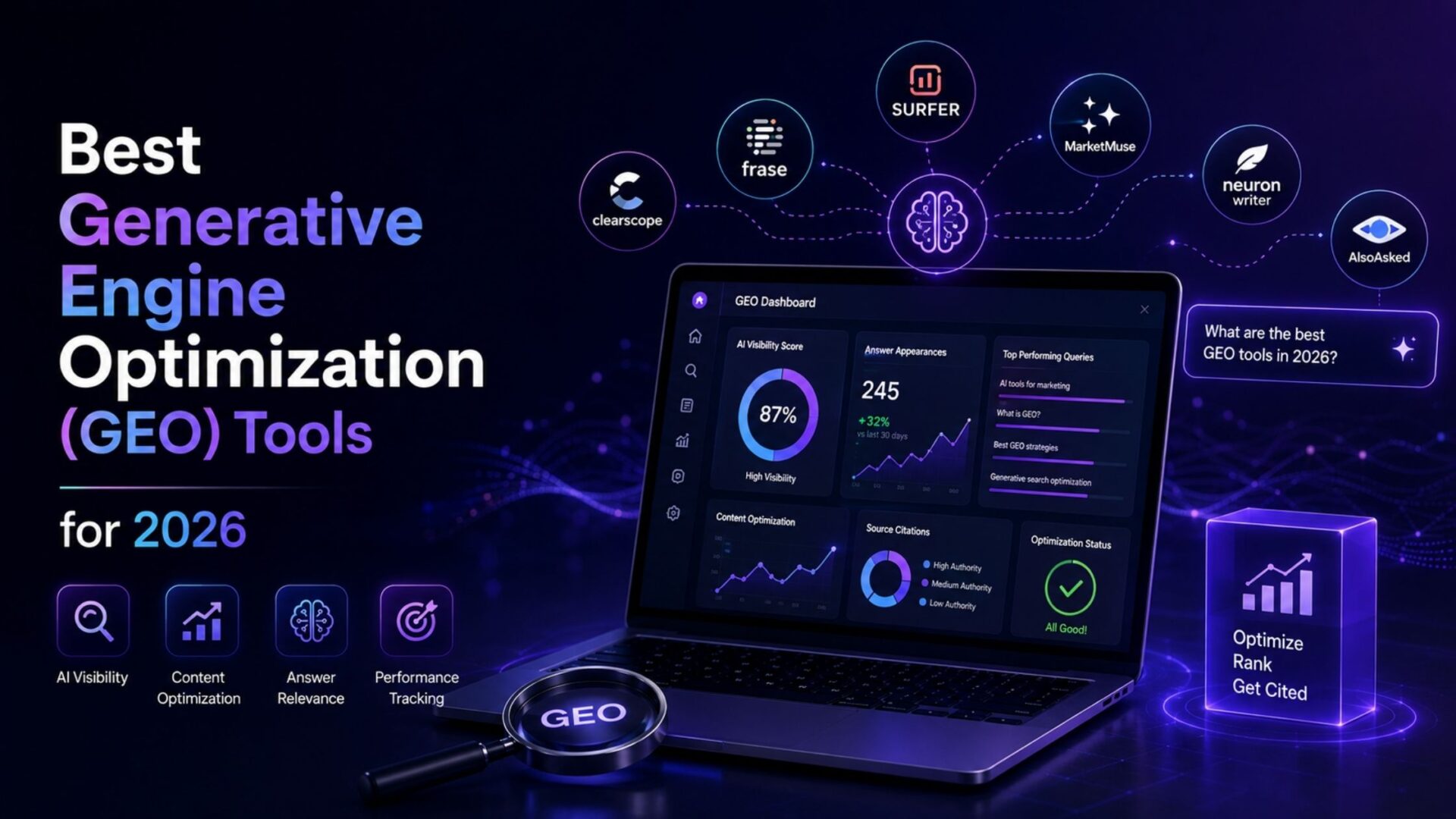
- Frase has leaned hardest into this, adding explicit GEO features alongside its existing SEO brief and content generation tools.
- Surfer SEO and Clearscope remain built primarily around traditional on-page optimization and NLP term coverage, though both have started layering in answer-style structuring.
- Writesonic takes a production-first approach, combining AI-assisted writing with structured, answer-ready formatting aimed at increasing citation odds.
None of these guarantee inclusion in an AI answer. What they do is improve the odds by making content easier for a model to parse, quote, and attribute cleanly, which is really the whole game.
Citation and Source Monitoring
This is the category that tells you not just that you got mentioned, but where the AI pulled that information from.
Platforms like Profound and Scrunch extend into this territory as part of broader suites, showing which URLs, reviews, or third-party pages are actually feeding AI answers about your brand or your competitors. That insight is genuinely useful for something practical: if a competitor’s comparison page keeps getting cited and yours doesn’t, you now know exactly where to focus.
All-in-One GEO Platforms
For teams that would rather run one subscription than five, all-in-one suites combine tracking, optimization guidance, and citation monitoring under a single roof. Goodie AI and Scrunch AI both position themselves this way, alongside newer entrants like Semrush’s AI Visibility Toolkit, which folds GEO reporting into an existing SEO platform many teams already pay for.
Neither approach is wrong. It depends on team size and how much tool sprawl you’re willing to tolerate.
For teams building this into a broader strategy rather than buying tools in isolation, it’s worth pairing tool selection with the tactics covered in our guide to AI search and AEO strategies.
Free and Low-Cost Options
Not every team needs a $500-a-month platform on day one. There’s a reasonable amount you can do for free.
Manual prompt checks cost nothing. Open ChatGPT, Gemini, and Perplexity, run the same handful of buyer intent questions your customers might ask, and note whether your brand shows up. It’s tedious at scale but genuinely useful early on.
- HubSpot’s AEO Grader offers a free visibility snapshot with basic sentiment and competitor benchmarking, a reasonable starting point for teams not ready to commit to a paid tool.
- Mangools’ AI Search Grader covers similar ground.
- Several of the paid platforms above, including Otterly.AI, also offer limited free tiers or trials worth testing before you buy.
Free tools stop being enough once you need historical tracking, multi-platform coverage, or reporting you can hand to leadership. At that point, manual checks become a time sink rather than a strategy, and it’s usually worth graduating to a paid tool.
Building a GEO Tool Stack
Mature teams, who are not very particular about a single tool that covers everything, usually end up with a combination of two or even three different tools, where each one is responsible for a unique area. A practical solution would be to first track the changes, then optimize the content, and finally monitor for issues, done in that order.
|
1
|
Start With a Visibility TrackerEstablish a baseline first, so you know where your brand actually stands across AI answers before you change anything. |
|
2
|
Add a Content Optimization ToolBring this in once you know which queries and topics you’re missing, so you’re optimizing against real gaps rather than guesses. |
|
3
|
Layer In Citation MonitoringAdd this once you have enough tracking data to know which sources are worth influencing. |
Match the stack to the team size. A solo marketer or small agency probably doesn’t need Profound and Scrunch running in parallel. One lighter tracking tool plus manual prompt checks is often plenty. Larger teams with dedicated content and SEO functions can justify a fuller stack, particularly once GEO reporting needs to sit alongside traditional SEO metrics for leadership.
One caution worth repeating: tool overload is real. Adding a fourth or fifth platform rarely adds proportional insight, and it usually just adds another dashboard nobody checks after month two.
If you’re weighing this against your existing marketing stack, our roundup of the best AI marketing tools covers where GEO software fits alongside the tools you’re probably already using.
The Honest Limits of Today’s GEO Tools
Here’s the part most vendor pages skip. GEO tooling in 2026 is genuinely useful, but it’s also young, and it’s worth knowing where it falls short before you build a strategy entirely around a dashboard.
⚠️ Coverage Gaps Are Common
Even the strongest platforms don’t track every AI surface equally well, and newer entrants like DeepSeek or regional AI search products are often thin or missing entirely.
⚠️ Accuracy and Attribution Are Still Shaky
AI answers are non-deterministic, meaning the same prompt run twice can return different results. That makes single-point measurements noisy, and it’s part of why prompt volume and testing consistency matter more than any single tool’s dashboard number.
⚠️ Judgment Still Beats Any Dashboard
A visibility score tells you where you stand today. It doesn’t tell you why a competitor is winning a specific answer, or what content change would actually move the needle. That interpretation still takes a person who understands the topic, not just the software.
None of this is a reason to skip GEO tooling. It’s a reason to treat the output as directional, not as gospel.
FAQs
What are GEO tools?
GEO tools are software platforms built to track, optimize, or monitor how a brand appears inside AI-generated answers from tools like ChatGPT, Gemini, and Perplexity. They generally fall into visibility tracking, content optimization, or citation monitoring.
What is the best GEO tool?
There isn’t a single best answer here. It depends on budget and goal. Enterprise teams often lean toward platforms like Profound or Scrunch AI for full multi-LLM monitoring. Smaller teams frequently start with Otterly.AI or Peec AI for affordable tracking, or with free tools like HubSpot’s AEO Grader.
Can I track my brand in ChatGPT answers?
Yes. Most GEO visibility tools run structured prompts against ChatGPT specifically, alongside other AI platforms. You can also do this manually by running a set of buyer intent questions directly in ChatGPT and noting the results, which works reasonably well at a small scale.
Are there free GEO tools?
Yes, though they’re limited. Manual prompt testing costs nothing, and tools like HubSpot’s AEO Grader and Mangools’ AI Search Grader offer free visibility snapshots. Free tiers tend to run out once you need historical data or multi-platform coverage.
Do GEO tools replace SEO tools?
No. They cover a different, related problem. Traditional SEO tools track keyword rankings and technical site health. GEO tools track how AI engines summarize, cite, and recommend your brand. Most teams need both, and the two increasingly overlap as platforms like Semrush fold GEO reporting into existing SEO suites.
Wrapping Up
Tools help. They don’t replace a strategy, and picking the right stack without a plan behind it usually just means paying for dashboards nobody acts on. The right combination depends on your goals, your team size, and how your brand actually shows up in AI answers today. It is worth finding out before you buy anything.
If you want a second opinion on where your brand stands and which tools are actually worth the spend, Elsner’s generative engine optimization services team can help you figure that out and build a plan around it rather than a shelf of unused software.
Not Sure Which GEO Tools Are Actually Worth the Spend?
Elsner’s GEO team can assess where your brand stands in AI answers today and build a right-sized tool stack and strategy around it — not a shelf of unused software.