



- What Makes B2B CRO Different
- Rethinking What “Conversion” Even Means
- Optimizing the Funnel, Stage by Stage
- Top of Funnel
- Middle of Funnel
- Bottom of Funnel
- The RFQ and Quote Flow
- The Pricing Visibility Debate
- Trust and Risk Reduction for Committees
- B2B Checkout and Account Features
- Measuring B2B CRO the Right Way
- Aligning CRO With Sales
- Common B2B CRO Mistakes
- Bringing It Together
- Not Sure Where Your B2B Funnel Is Leaking Pipeline?
- Frequently Asked Questions
- How is B2B CRO different from B2C?
- What’s a good B2B conversion rate?
- Should B2B sites show pricing?
- How do I optimize a quote or RFQ flow?
- How do I measure B2B CRO with long sales cycles?
If you’ve ever taken a CRO checklist built for an ecommerce store and tried to run it on a B2B site, you already know the problem. Half the advice doesn’t apply. Add urgency banners, shorten the form, throw in a countdown timer, and nothing moves. Sometimes things get worse.
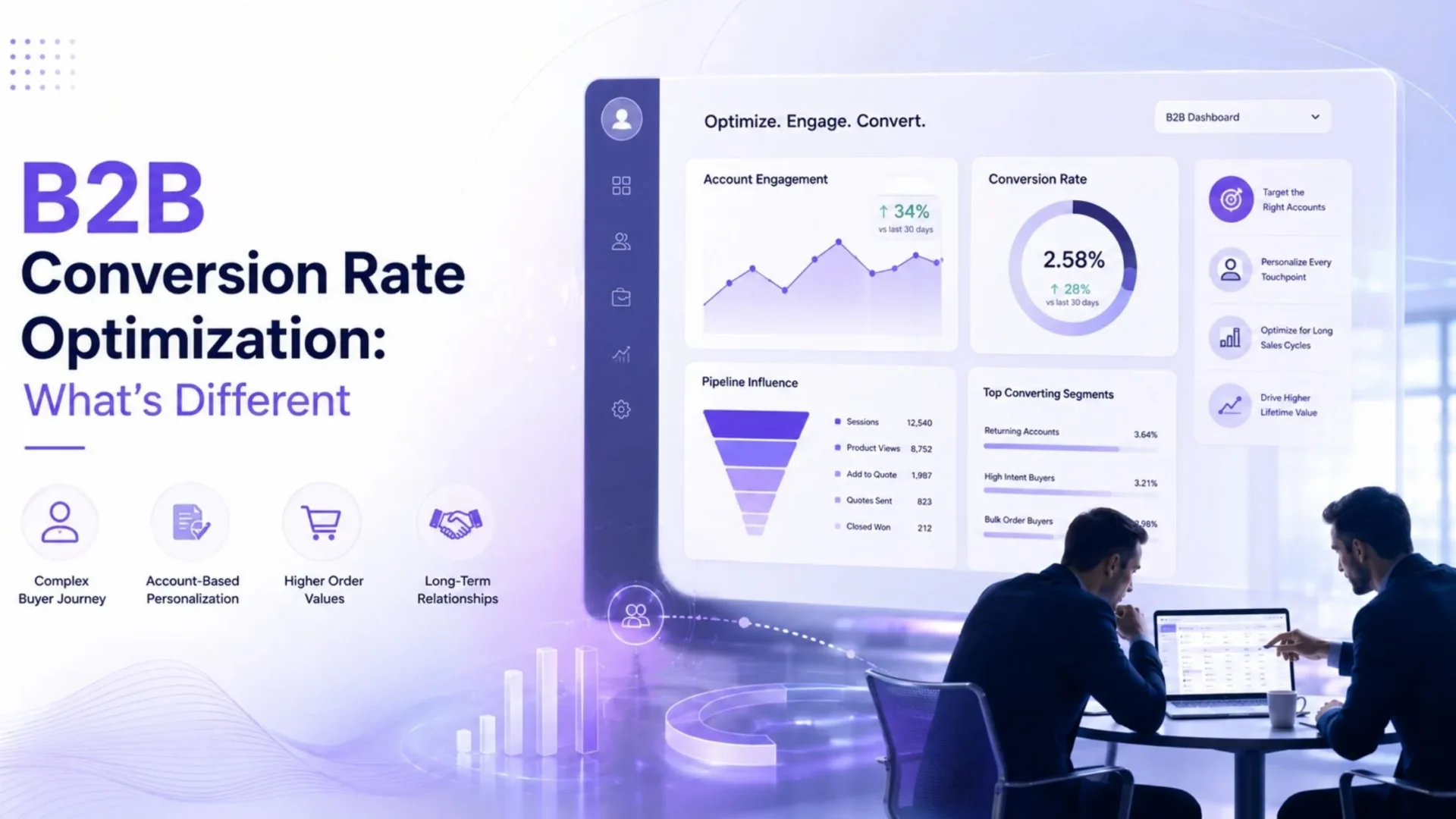
That’s because B2B conversion rate optimization isn’t a smaller version of B2C CRO. It’s a different game with different rules, a different buyer, and a very different idea of what “converting” even means.
If you’ve already read up on general CRO trends for 2026, this blog picks up where that leaves off, focused specifically on what changes when you’re optimizing for a buying committee instead of a single shopper.
What Makes B2B CRO Different
Most teams assume the B2B funnel is just a longer version of B2C. It’s not. Here’s a quick side by side comparison to show why.
Look at that last row for a second. In B2C, you’re playing a volume game. One extra conversion barely moves the needle, so you optimize for scale. In B2B, one qualified lead that turns into a real deal can be worth more than a hundred form fills that go nowhere.
That single fact should reshape almost everything about how you approach conversion rate optimization services for a B2B site.
Rethinking What “Conversion” Even Means
In B2C, the conversion is usually obvious. Someone buys the thing. In B2B, the actual purchase might be months away, and there’s rarely one direct moment you can point to and say “that’s when they converted.”
So you end up working with two layers:
If you only track the macro conversion, you’ll miss most of the story. A lot happens in those smaller steps, long before anyone fills out a form.
This is also where lead quality beats lead count. Forty leads a month sounds better than fifteen, until you realize thirty five of them were students, competitors, or people who will never buy. So before you touch a single button or headline, map out what the journey actually looks like for your buyers, who’s involved and what they need to see. B2B segmentation helps here too, since different buyers move through that journey differently.
Optimizing the Funnel, Stage by Stage
Top of Funnel
This is where most B2B sites make their first mistake: chasing form fills instead of qualified interest. A shorter form isn’t automatically better if it can’t tell a serious buyer from someone doing idle research.
A few things that tend to help here:
- Ask one or two qualifying questions instead of stripping the form down to just an email
- Offer gated content that’s genuinely useful, not a thin excuse to collect an email address
- Ensure your top-of-funnel content actually filters for relevance and not just for driving traffic
- Watch out for the small UX mistakes that kill conversions at this stage, since they’re often the reason genuinely interested buyers bounce before they ever reach a form.
Middle of Funnel
This is where committees start to form, and where a lot of B2B deals quietly stall. Someone champions your product internally, but they need something solid to bring to the rest of the group.
Case studies, comparison pages, and demo paths matter enormously here, not because they close the deal. But because they help your champion with what they need to convince the people who haven’t talked to you yet.
Bottom of Funnel
This is the part almost everyone under-invests in, and it’s arguably where the real CRO gains are hiding.
By this stage, the buyer has usually done the research. What’s left is mechanical, getting a quote, moving through checkout, or clearing internal sign-off. This is exactly where a lot of B2B sites lose deals they’d already basically won.
Quote and RFQ flows matter most, and we’ll dig into that next. But checkout counts too, purchase orders, net terms, and bulk ordering can be the difference between a completed order and someone emailing your sales team instead.
Approval friction is worth a mention on its own. The person filling out your form rarely has the final say, so a flow that lets them save progress or share a quote internally saves everyone time.
The RFQ and Quote Flow
For many B2B sites, the Request For Quotation or RFQ flow is the single highest-leverage surface on the entire website. Not the homepage. Not the blog. The quote form.
Think about it. Someone has already decided they’re interested enough to ask for pricing. That’s a hot lead, arguably the hottest one you’ll get, and yet this is the exact place where a lot of sites throw in the clunkiest, slowest, most confusing form on the whole site.
Multi-step approvals with no save option, no confirmation email, a three day wait before anyone follows up. All of that friction lands right at the moment the buyer was most ready to move.
A few fixes that make a real difference:
✅ Let People Save and Return
Let people save a cart or quote and come back later, since B2B decisions rarely happen in one sitting.
✅ Build for Internal Approval
Build for the reality that someone else in the buyer’s org, procurement, or a manager, needs to approve this before it moves forward.
✅ Reply Fast
A quote request that sits for three days can lose momentum that took weeks to build.
✅ Ask Only for What You Need
Keep the form asking only for what you actually need to send a real quote.
Get this one flow right, and it can outperform months of top-of-funnel tweaks.
The Pricing Visibility Debate
There’s no single right answer here. Anyone who tells you otherwise is oversimplifying.
So which one’s right for you? It really comes down to your model. If your pricing is fairly standard, showing at least a starting number usually builds more trust than it costs you. If every deal is custom, gating makes more sense, just make sure there’s a clear next step so it doesn’t feel like a dead end.
Trust and Risk Reduction for Committees
When multiple people have to agree before anyone signs anything, risk aversion goes way up. Nobody wants to be the person who recommended the vendor that fell apart six months in.
This is where proof matters more than persuasion. Case studies tied to specific roles, since a CFO and a VP of Ops care about very different things. Security and compliance signals if you’re in a space where that’s relevant. And ROI evidence your internal champion can actually take into a meeting and use to sell the idea upward, because that’s often what’s really happening behind the scenes.
B2B Checkout and Account Features
For B2B ecommerce specifically, checkout friction shows up in ways a standard store never deals with.
- Net terms and purchase order support, since a lot of B2B buyers can’t just pay with a credit card
- Bulk ordering and CSV upload for repeat, high-volume purchases
- Fast reorder flows for buyers who order the same items on a schedule
- Multiple user roles per account, so a purchasing team can actually work together inside one account
If you’re running an ecommerce store on a platform like Magento or Shopify, a lot of this comes down to how well you’ve configured Magento B2B ecommerce features or Shopify B2B capabilities. Getting these right removes friction that a standard ecommerce CRO checklist wouldn’t even think to look for.
Measuring B2B CRO the Right Way
Here’s an uncomfortable truth. A lot of B2B CRO “wins” reported in case studies are measuring the wrong thing entirely.
A form conversion rate going up means very little on its own. What actually matters:
- Pipeline and revenue influence, not raw lead count
- Assisted conversions across the whole journey, since the first touch rarely gets credit for the close
- Lead to close rate, because 200 leads that convert at 2% aren’t better than 80 leads converting at 8%
- Giving tests enough time to actually reach significance, since B2B traffic is thinner and cycles are longer, calling a test after a week of data is basically a guess
If your traffic is light, you may need to run a test for months, not days, before trusting the result. That’s frustrating, but it’s the reality of working with smaller, slower audiences.
Aligning CRO With Sales
A lot of B2B CRO efforts quietly fail because marketing and sales are optimizing for two different things without realizing it.
Marketing wants more leads. Sales wants leads that actually close. If those two goals aren’t aligned, marketing can hit every internal target while sales quietly drowns in unqualified leads and starts ignoring the marketing funnel altogether.
Get a shared, specific definition of what a qualified lead actually looks like. Build a real feedback loop where sales tells you which leads turned into real conversations and which ones went nowhere. Then optimize toward that, not toward the vanity number that looks good in a monthly report.
Common B2B CRO Mistakes
A quick list of things that tend to backfire in B2B specifically:
|
1
|
Borrowing B2C Urgency TacticsFake countdown timers, “only 2 left” messaging that just erode trust with a professional buyer. |
|
2
|
Chasing Lead Count Over QualityChasing a bigger lead count while quality quietly drops. |
|
3
|
Optimizing Around One PersonaOptimizing the whole funnel around one persona and ignoring everyone else on the buying committee. |
|
4
|
Ending A/B Tests EarlyEnding A/B tests early because traffic is thin and the data looked promising after four days. |
Bringing It Together
B2B conversion rate optimization isn’t about squeezing out more form fills. It’s about getting the right conversions in front of the right buyers, across a journey that involves more people and more time than a typical B2C funnel ever has to deal with.
Get the quote flow right. Align marketing and sales around what a qualified lead actually looks like. Measure pipeline impact instead of vanity metrics. Do those three things well and you’ll likely see more movement than any generic CRO checklist could offer.
If you’re looking at your own funnel and not sure where the real friction is hiding, that’s usually a sign it’s worth a second set of eyes. Our team works with B2B and ecommerce businesses on exactly this kind of optimization, from quote flows to platform-specific fixes across ecommerce development. Happy to take a look at where your funnel might be quietly leaking pipeline.
Not Sure Where Your B2B Funnel Is Leaking Pipeline?
Elsner’s team works with B2B and ecommerce businesses on quote flows, checkout friction, and platform-specific fixes. Let us take a look at where your conversions are quietly slipping away.
Frequently Asked Questions
How is B2B CRO different from B2C?
B2B and B2C CRO differ based on the audience behaviour. B2B involves longer cycles, multiple decision makers, and conversions that are often leads or quotes rather than direct purchases. Optimizing for lead quality matters more than optimizing for volume.
What’s a good B2B conversion rate?
It varies a lot by industry, deal size, and traffic quality, so treat any single benchmark number with some skepticism. Focus more on your own trend over time and your lead-to-close rate than a generic industry average.
Should B2B sites show pricing?
It depends on your pricing model. Standardized pricing usually benefits from transparency. Highly custom or negotiated pricing often makes more sense gated, paired with a clear next step.
How do I optimize a quote or RFQ flow?
Cut unnecessary fields, let buyers save progress, build in the reality of internal approvals, and follow up fast once a request comes in. This flow deserves as much attention as your homepage, arguably more.
How do I measure B2B CRO with long sales cycles?
Track pipeline influence and lead-to-close rate rather than raw conversion numbers, and give tests enough time to reach real significance before acting on the results.